
Last Updated: May 19, 2026
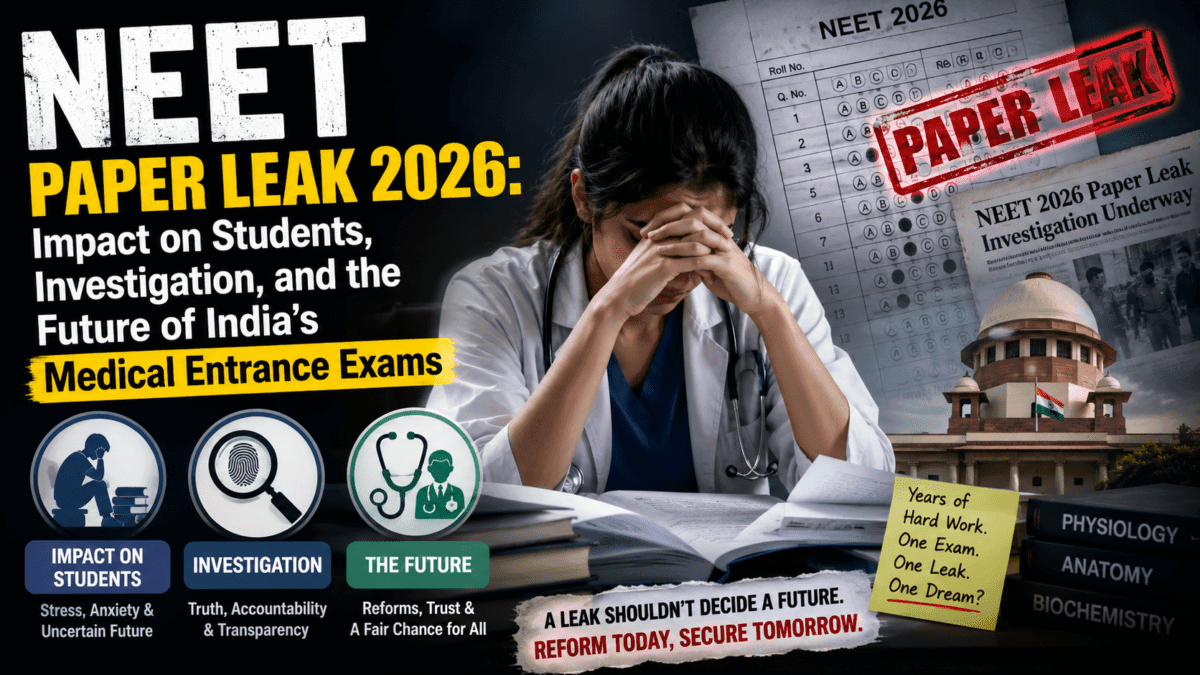
For over 22 lakh students across India, NEET UG 2026 was supposed to be the turning point of their lives.
Years of preparation.
Sleepless nights.
Hundreds of mock tests.
And for many middle-class families, coaching fees that stretched their finances to the limit.
Everything depended on one exam.
Then the controversy exploded.
Allegations of a NEET paper leak began circulating online after reports claimed that a “guess paper” shared on WhatsApp showed major similarities with the actual exam. Within days, the issue became national news. Social media flooded with anger, student protests intensified, and questions were raised about transparency in exams and the growing problem of competitive exam fraud in India.
Soon after, the National Testing Agency (NTA) cancelled NEET-UG 2026, affecting millions of aspirants nationwide.
The NEET exam controversy is no longer just an education headline. It has become a story about broken trust, exam malpractice in India, emotional pressure on students, and growing concerns about the future of the education system in India.
What is the NEET Exam?
NEET (National Eligibility cum Entrance Test) is India’s centralized medical entrance exam conducted by the National Testing Agency (NTA).
The NTA NEET exam serves as the gateway for admission into:
- MBBS,
- BDS,
- AYUSH,
- veterinary,
- and nursing programs across India.
Introduced to create a standardized and merit-based medical admission process, NEET replaced multiple state-level entrance exams and became one of the largest competitive exams in the country.
Every year, more than 20 lakh students appear for NEET, competing for a limited number of government medical seats. This intense competition has made NEET one of India’s most stressful and high-pressure entrance exams.
For many students, especially from middle- and lower-income families, NEET is more than an exam — it is the only path toward a medical career and financial stability.
Why is NEET Conducted?
The primary purpose of NEET is to create a fair and transparent medical admission process across India.
Before NEET, students had to appear for multiple state-level and private medical entrance exams, creating confusion, inconsistent standards, and allegations of unfair admissions.
The centralized NEET system was designed to:
- ensure merit-based selection,
- create equal opportunities,
- reduce admission irregularities,
- and maintain educational standards nationwide.
However, the recent NEET exam leak case has raised serious concerns about whether centralized exams alone can guarantee fairness and transparency.
What Happened in the NEET Paper Leak 2026 Case?
NEET-UG 2026 was conducted on 3 May 2026 under strict security measures that reportedly included:
- biometric verification,
- GPS-tracked question paper transport,
- AI-assisted CCTV monitoring,
- and signal jammers at exam centres.
Despite these measures, allegations soon emerged that leaked question papers had circulated before the examination through WhatsApp and coaching networks.
According to early CBI probe reports, a handwritten copy of the paper was allegedly accessed in Rajasthan, scanned into a PDF, and shared through coaching groups in Sikar. Reports also suggest that some students allegedly paid lakhs of rupees for access to the leaked material.
As outrage grew, NTA officially cancelled NEET-UG 2026 on 12 May 2026, while the CBI launched a nationwide investigation into the NEET paper leak case.
The NEET re-exam controversy has since triggered Supreme Court petitions, public protests, and growing pressure for examination reforms in India.
How Do Paper Leaks Happen in Competitive Exams?
The NEET exam controversy has once again exposed how vulnerable high-stakes exams can become despite advanced security systems.
Experts believe paper leaks often happen due to:
- insider involvement,
- weak security chains,
- corruption networks,
- coaching mafia operations,
- poor exam centre management,
- and digital vulnerabilities.
Messaging platforms like Telegram and WhatsApp allow leaked material to spread rapidly within minutes, making modern exam fraud far more difficult to control.
Role of Technology in Exam Frauds
Technology now plays a double role.
While AI monitoring and digital surveillance are being used to improve exam security systems, scammers are also using encrypted communication, scanned PDFs, and organized online groups to bypass traditional safeguards.
This growing technological battle is becoming one of the biggest challenges for India’s examination authorities.
Impact of NEET Paper Leak on Students
The biggest victims of the NEET paper leak are honest students.
Many aspirants described feeling:
- heartbroken,
- mentally exhausted,
- anxious,
- and demotivated after the cancellation announcement.
Students living in coaching hubs like Kota and Sikar now face:
- extended accommodation costs,
- repeat preparation pressure,
- uncertainty about rankings,
- and growing stress among NEET students.
The controversy has also damaged confidence in the fairness of competitive exams.
Many genuine aspirants fear that years of hard work can be undermined by organized exam malpractice.
Student Mental Health During Exams
Mental health experts have highlighted rising:
- anxiety,
- sleep disruption,
- emotional burnout,
- and depression among NEET aspirants.
For “droppers” who already sacrificed one or more years preparing for the exam, the emotional pressure has become even more intense.
Impact on Parents and Society
The NEET exam controversy has created a major trust crisis in the education system in India.
Parents who invested significant savings in coaching fees, travel, and accommodation are demanding accountability and stronger exam security systems.
Across social media, many people questioned whether unfair competitive exams are becoming increasingly normalized in India.
The issue has also intensified discussions around:
- coaching mafia influence,
- lack of transparency in exams,
- and the need for stricter action against organized paper leak networks.
Government and NTA Response
Initially, NTA maintained that NEET-UG 2026 was conducted under strict security protocols.
However, following mounting evidence and public outrage, the exam was cancelled and the investigation handed over to the Central Bureau of Investigation (CBI).
The government has promised strict action against those involved and emphasized dismantling organized “paper leak mafia” networks.
Steps Taken to Prevent Future Paper Leaks
Authorities are now discussing:
- AI-based monitoring,
- stronger cybersecurity systems,
- encrypted question paper delivery,
- biometric verification,
- and stricter digital surveillance.
The controversy has also renewed debates around examination reforms in India and whether major entrance exams should shift toward online systems.
Should NEET Be Conducted Online?
The NEET paper leak controversy has reignited discussions about online entrance exam systems.
Possible Advantages
- Better digital security
- Less physical paper handling
- Faster evaluation
- AI-assisted monitoring
- Reduced transportation risks
Major Challenges
- Internet accessibility issues
- Rural digital divide
- Technical glitches
- Cybersecurity threats
- Infrastructure limitations
While online systems may reduce physical paper leaks, they also introduce new risks that India’s education infrastructure may not yet be fully prepared to handle.
How Students Can Stay Motivated During Such Controversies
For students, the emotional impact of the NEET exam leak case can feel overwhelming.
Experts recommend:
- following only official updates,
- avoiding social media rumours,
- maintaining a study routine,
- focusing on revision instead of panic,
- and seeking emotional support when needed.
Students should remember that one disrupted examination cycle does not define their future or abilities.
Future of NEET and Competitive Exams in India
The NEET 2026 news has become a turning point in the discussion around India’s examination system.
Students, parents, and experts are now demanding:
- stronger transparency,
- better accountability,
- independent security audits,
- and modernized digital protection systems.
The future of competitive exams in India may increasingly involve:
- AI-based monitoring,
- encrypted systems,
- stricter cybersecurity,
- and more transparent governance models.
The real challenge is rebuilding trust.
Because without trust, even the most advanced examination systems can fail.
Conclusion
The NEET paper leak 2026 controversy is more than just another exam scandal.
It is a reminder of what happens when trust in a high-stakes examination system breaks down.
Millions of students prepared honestly.
Families invested years of sacrifice.
And they deserve a system that protects fairness with complete seriousness.
The investigation, re-exam, and legal proceedings are important. But what matters most is whether India uses this moment to create meaningful reforms that make future paper leaks harder to execute.
Because a fair examination system is not just important for students — it is essential for the future of healthcare and the integrity of India’s education system itself.