
What Is Artificial Intelligence (AI)? The Complete Beginner’s Guide (2026)
Last updated: August 2026
Artificial Intelligence (AI) is one of the most transformative technologies of the 21st century, powering everything from search engines and virtual assistants to healthcare, finance, education, and business. Yet many people still wonder: What is Artificial Intelligence, and why does it matter?
In this complete beginner’s guide, you’ll learn what AI is, how Machine Learning and Data Science relate to it, where AI is used, the best AI courses, trusted AI PDF resources, and the latest AI news. Written in simple language with practical examples, this guide is designed to help beginners understand AI with confidence.
What is Artificial Intelligence?
In Short: Artificial intelligence (AI) is technology that enables computers and machines to simulate human learning, comprehension, problem-solving, decision-making, creativity, and autonomy. It is the broad field of computer science dedicated to building systems that can perform tasks normally requiring human intelligence.
That’s how IBM — one of the pioneers of modern computing — defines it, and it’s a good working definition to keep in your back pocket.
In simple: AI is what happens when we teach a machine to do things that normally require human intelligence — recognizing a face in a photo, translating a sentence, recommending a movie, driving a car, or writing a paragraph like this one.
A simple way to think about it: your smartphone calculator can do arithmetic, but nobody calls it “intelligent” — it just follows fixed instructions. An AI system is different because it can handle situations it wasn’t explicitly programmed for, by learning patterns from data or experience.
It’s worth being precise here, because the term “artificial intelligence” gets used loosely. Not every AI system is a chatbot, and not every algorithm is “true” intelligence in the human sense. Even the field’s founders debated this. Computer scientist John McCarthy — who coined the term in 1956 — defined AI simply as “the science and engineering of making intelligent machines.”
AI is a spectrum, not a single thing
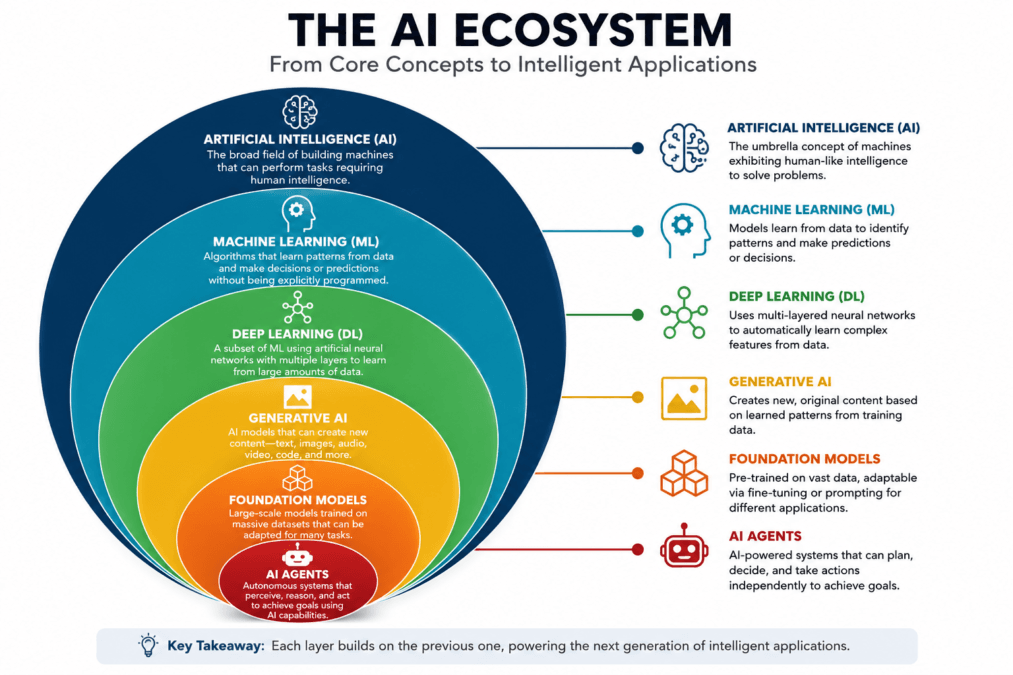
One of the most common misconceptions beginners have is imagining AI as one unified technology. In reality, “artificial intelligence” is an umbrella term that covers many overlapping fields, including:
- Machine learning (ML) — algorithms that learn patterns from data
- Deep learning — a subset of ML using layered neural networks
- Natural language processing (NLP) — enabling machines to understand and generate human language
- Computer vision — enabling machines to interpret images and video
- Robotics — combining AI with physical machines
- Generative AI — foundation models that create new text, images, audio, or video
- AI agents — systems that can plan and take multi-step actions toward a goal with limited human supervision
Did you know? Netflix has estimated that its AI-driven recommendation and personalization system saves the company over $1 billion a year by reducing subscriber cancellations — a single, concrete example of how “invisible” AI already shapes everyday digital life.
Key takeaway: AI is not one technology — it’s a broad field of computer science focused on building systems that can perform tasks that typically require human intelligence. Machine learning is the engine that powers most modern AI, and generative AI is the most visible recent application of that engine.
Common Mistake: People often think “AI = ChatGPT.” In reality, ChatGPT (built by OpenAI) is just one application of AI — specifically, a conversational interface built on top of a large language model (LLM). AI itself is a much broader field that also includes computer vision, robotics, recommendation systems, and traditional rule-based systems that have nothing to do with chatbots.
History and Evolution of Artificial Intelligence
In Short: AI research formally began in 1956 at the Dartmouth Workshop, where John McCarthy coined the term “artificial intelligence.” The field has passed through cycles of breakthrough and disappointment — including two “AI winters” — before the 2012 deep learning revolution and the 2020s generative AI boom brought it to mainstream attention.
Understanding where AI came from makes it much easier to understand where it’s going. The story isn’t a straight line — it’s full of breakthroughs, setbacks, and long “winters” where funding and enthusiasm dried up before the next wave of progress arrived.
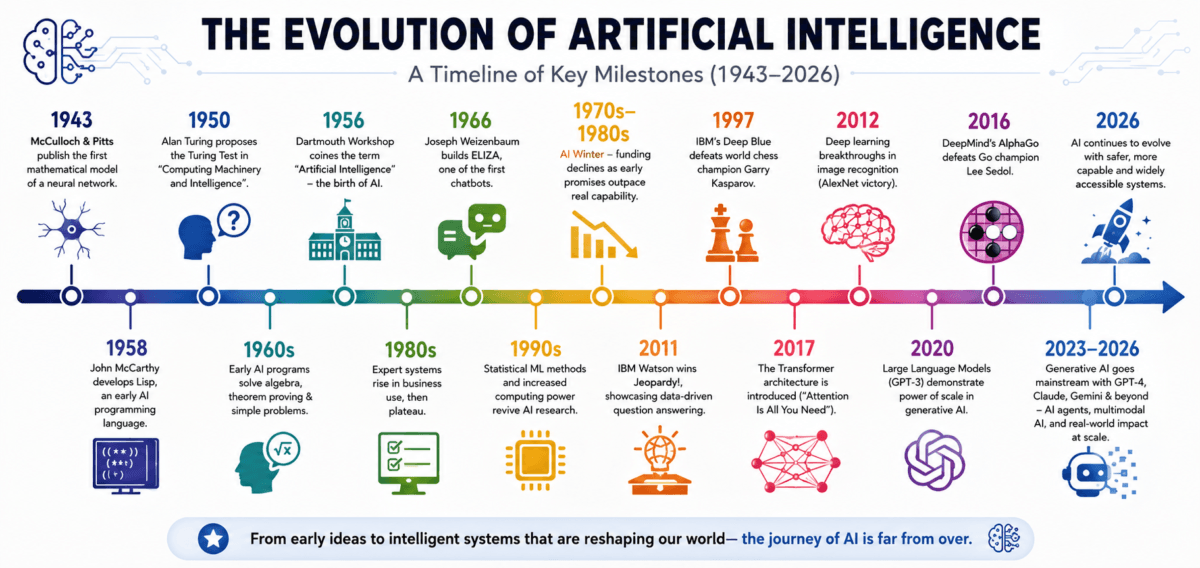
The theoretical foundation was laid in 1943, when Warren McCulloch and Walter Pitts proposed the first mathematical model of a neural network. Seven years later, in 1950, British mathematician Alan Turing published Computing Machinery and Intelligence, introducing what’s now known as the Turing Test — a way of asking whether a machine’s behavior could be indistinguishable from a human’s.
The field got its name and its official starting point in the summer of 1956, at a workshop held at Dartmouth College in New Hampshire. The workshop was organized by John McCarthy, Marvin Minsky, Nathaniel Rochester, and Claude Shannon, and its founding proposal argued that “every aspect of learning or any other feature of intelligence can in principle be so precisely described that a machine can be made to simulate it.” That gathering — often called the birthplace of AI as a field — is where the phrase “artificial intelligence” was formally coined.
Timeline: Key Moments in AI History
| Year | Milestone |
|---|---|
| 1943 | McCulloch & Pitts publish the first mathematical model of a neural network |
| 1950 | Alan Turing proposes the Turing Test |
| 1956 | Dartmouth Workshop coins the term “Artificial Intelligence” |
| 1958 | John McCarthy develops Lisp, an early AI programming language |
| 1966 | Joseph Weizenbaum builds ELIZA, an early natural-language chatbot |
| 1970s–1980s | “AI winter” — funding declines as early promises outpace real capability |
| 1980s | Expert systems rise in business use, then plateau |
| 1997 | IBM’s Deep Blue defeats world chess champion Garry Kasparov |
| 2011 | IBM Watson wins Jeopardy!, showcasing data-driven question answering |
| 2012 | Deep learning breakthroughs in image recognition mark a major turning point |
| 2016 | DeepMind’s AlphaGo defeats Go champion Lee Sedol |
| 2017 | The Transformer architecture is introduced, laying the foundation for modern large language models (LLMs) |
| 2020s | Foundation models like GPT, Gemini, and Claude go mainstream; generative AI reaches hundreds of millions of users |
| 2025–2026 | Agentic and reasoning-focused AI, embodied robotics, and global AI governance frameworks move from research to real-world deployment |
Two “AI winters” — one in the 1970s and another in the late 1980s — are important to understand, because they’re a reminder that hype cycles in AI are not new. Both times, funding and interest dropped sharply after early systems failed to live up to grand promises. What changed everything after 2012 was the combination of three ingredients: massive datasets, much more powerful computing hardware (especially GPUs), and refined neural network techniques — a combination often called “deep learning.”
Did you know? At the original 1956 Dartmouth Workshop, researchers predicted that machines as intelligent as humans would exist within about 25 years. Seventy years later, artificial general intelligence still doesn’t exist — a good reminder to treat bold AI timeline predictions with healthy skepticism.
Key takeaway: AI research is nearly 70 years old. Today’s generative AI boom isn’t a sudden invention — it’s the result of decades of incremental research finally meeting enough data and computing power to work at scale.
“The Full History of AI: From Turing to Transformers” →
How Artificial Intelligence Works
In Short: Most AI systems learn through a repeated process of training on data — adjusting internal parameters (weights) until their predictions get closer to correct — rather than being programmed with fixed rules for every possible scenario.
Here’s where a lot of beginner explanations get either too simplistic (“it’s just math!”) or too technical (“it’s a stochastic gradient descent optimization over a loss function”). Let’s find the middle ground.
Most modern AI systems work through a process with three basic ingredients:
- Data (the dataset) — examples the system learns from (text, images, numbers, sounds)
- A model — a mathematical structure (often a neural network) that identifies patterns in that data
- Training — a repeated process of adjusting the model so its predictions get closer to being correct, followed by inference — using the trained model to make predictions on new, real-world data
Think of training a model the way you might train a new employee. At first, they make mistakes. You correct them. Over time, with enough feedback, they get better at the task — not because you gave them a rulebook for every possible situation, but because they learned the underlying pattern.
A simple analogy
Imagine teaching a child to recognize dogs. You don’t hand them a legal-style definition (“an animal with four legs, fur, and a tail that barks”). Instead, you point at dozens of dogs — big ones, small ones, different colors — and say “dog” each time. Eventually, the child generalizes the pattern and can recognize a dog they’ve never seen before.
That’s essentially what machine learning does, except the “child” is a neural network, and the “pointing” is a mathematical process that adjusts millions (sometimes billions) of internal parameters based on training data.
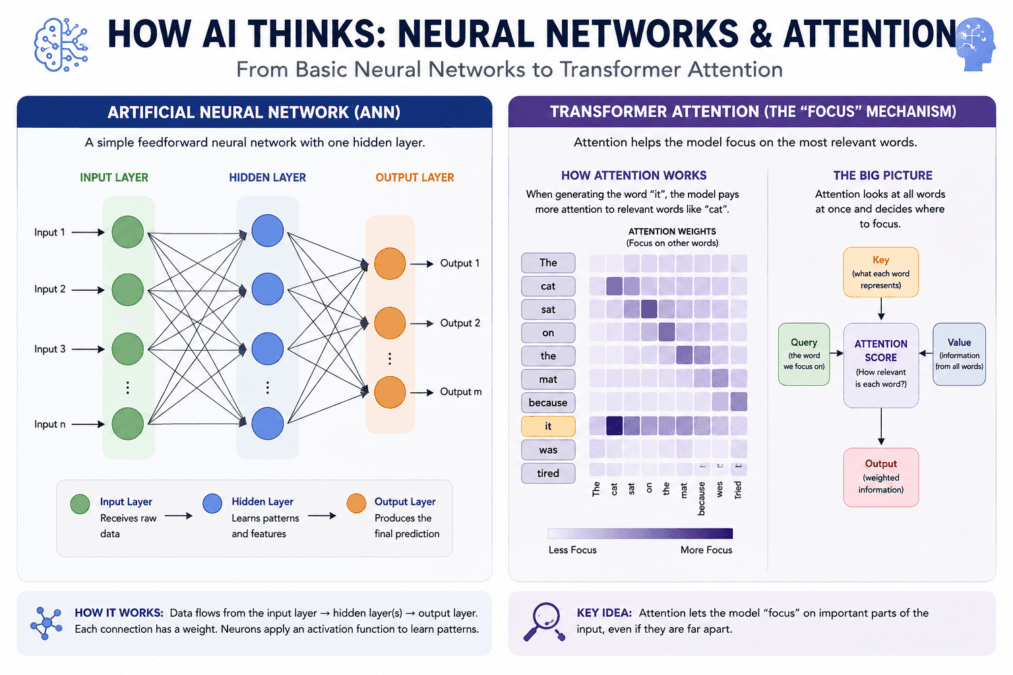
The building blocks of a neural network
- Neurons (nodes): simple units that process a piece of information
- Layers: neurons are stacked in layers — an input layer, one or more “hidden” layers, and an output layer
- Weights: numerical values that determine how much influence one neuron has on the next
- Activation functions: rules that decide whether a neuron “fires” and passes information forward
- Training/backpropagation: the process of comparing the model’s output to the correct answer and adjusting weights to reduce errors
- GPU (Graphics Processing Unit): specialized computer hardware, originally built for video games, that turned out to be extremely efficient at the parallel math neural networks require — a major reason deep learning became practical after 2012
- Tensor: the basic mathematical data structure (a multi-dimensional array of numbers) that frameworks like PyTorch and TensorFlow use to represent and process data flowing through a neural network
Deep learning — the technique behind most of today’s headline-making AI — simply means using neural networks with many hidden layers, allowing the system to learn increasingly abstract patterns (edges → shapes → objects, for example, in image recognition).
From Neural Networks to Transformers and LLMs
Most of today’s most visible AI systems — including ChatGPT, Gemini, and Claude — are built on an architecture called the Transformer, introduced by Google researchers in 2017. Transformers are especially good at handling sequences of data (like sentences) and paying “attention” to which words or tokens matter most to each other. Scaling this architecture up, with enormous datasets and compute budgets, is what produced today’s large language models (LLMs) and, more broadly, foundation models — large, general-purpose models that can be adapted to many different downstream tasks.
Key takeaway: AI systems learn from data through repeated trial-and-error adjustment, not by being explicitly told every rule. The more relevant, high-quality data and computing power available, the better the model typically performs — though data quality and ethical sourcing matter just as much as quantity.
Types of Artificial Intelligence
In Short: AI is classified two ways — by capability (Narrow AI, General AI, Superintelligence) and by functionality (reactive, limited memory, theory of mind, self-aware). Only Narrow AI exists today; the rest remain theoretical.
AI can be classified in two different ways: by capability (how smart it is relative to humans) and by functionality (how it behaves in the moment). Understanding both helps you cut through a lot of confusing media coverage.
Classification by Capability
| Type | Description | Real-World Status |
|---|---|---|
| Artificial Narrow Intelligence (ANI / “Weak AI”) | Designed to perform a specific task well (e.g., spam filtering, facial recognition, chess) | This is the only type of AI that exists today |
| Artificial General Intelligence (AGI / “Strong AI”) | A hypothetical system that could match human cognitive ability across any task | Still theoretical — no consensus exists on how, or even whether, it will be achieved |
| Artificial Superintelligence (ASI) | A hypothetical system surpassing human intelligence across all domains | Purely speculative at this stage |
It’s important to be precise here, because headlines often blur the line between narrow AI achieving something impressive in one domain (say, solving advanced math problems or generating realistic video) and “true” general intelligence. As of 2026, even the most capable systems from labs like OpenAI, Google DeepMind, and Anthropic remain examples of highly capable narrow AI — extraordinary within their domains, but not the flexible, cross-domain reasoning that defines AGI.
Classification by Functionality
| Type | Description | Example |
|---|---|---|
| Reactive Machines | Respond to current input only, with no memory of past experience | IBM’s Deep Blue chess computer |
| Limited Memory | Uses recent past data to inform decisions | Self-driving cars, recommendation engines |
| Theory of Mind | Would understand emotions, beliefs, and intentions (still largely research-stage) | Experimental social robotics |
| Self-Aware AI | Hypothetical AI with consciousness | Does not exist; purely theoretical |
Common Mistake: Assuming that because a model like GPT or Gemini can hold a fluent conversation, it must be “close to” AGI. Fluency in language is not the same as general reasoning across arbitrary domains — a distinction AI researchers are careful to maintain even when a system’s outputs feel remarkably humanlike.
Key takeaway: Every AI system in use today — including large language models like ChatGPT, Gemini, and Claude — is a form of narrow AI. They can be extraordinarily capable within their training and design, but they are not “thinking” in the human sense, and general intelligence remains an open research question.
Machine Learning Explained
In Short: Machine learning (ML) is the subset of AI where systems learn patterns from data instead of following manually written rules, using three main approaches — supervised, unsupervised, and reinforcement learning.
Machine learning (ML) is the subset of AI focused on algorithms that learn the patterns of training data and use that pattern recognition to make predictions or decisions on new, unseen data — without being explicitly programmed with hard-coded rules for every scenario.
Machine learning has come to dominate the field of AI. It’s the backbone of everything from spam filters and fraud detection systems to autonomous vehicles and today’s large language models.
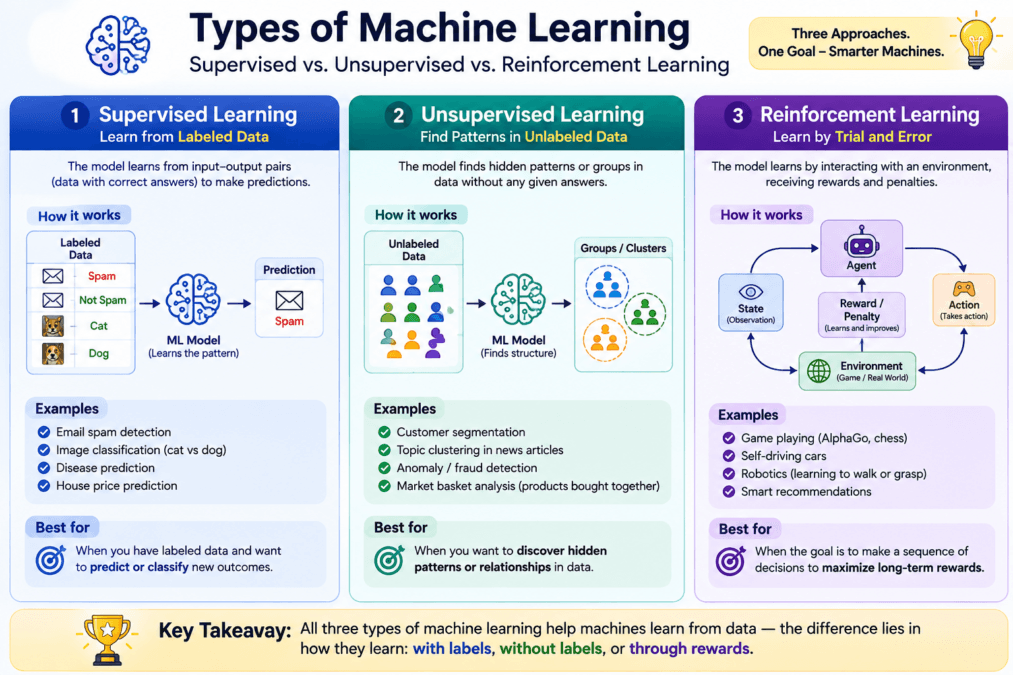
The Three Main Types of Machine Learning
1. Supervised Learning The model learns from labeled examples — data that already includes the “correct answer.” For instance, thousands of emails labeled “spam” or “not spam” teach the model to classify new emails.
2. Unsupervised Learning The model is given unlabeled data and must find patterns or groupings on its own — for example, clustering customers into segments based on purchasing behavior, without being told what those segments should be in advance.
3. Reinforcement Learning The model learns by trial and error, receiving rewards or penalties for its actions — the same technique DeepMind used to train AlphaGo to master the game of Go through millions of self-played games.
Common Machine Learning Techniques
- Linear and logistic regression — predicting numeric values or classifying data into categories
- Decision trees and random forests — rule-based branching models often used in business analytics
- Neural networks — layered systems inspired loosely by the human brain, used for complex pattern recognition
- Support vector machines — used for classification tasks with clearly defined boundaries
- Clustering algorithms (e.g., k-means) — used to group similar data points together
Key takeaway: Machine learning is how most modern AI systems actually “learn.” Instead of programming explicit rules, engineers train a model on data and let it discover the patterns — which is why the quality, diversity, and fairness of the training data matters enormously.
Artificial Intelligence vs Machine Learning
In Short: All machine learning is AI, but not all AI is machine learning. AI is the broad goal (building intelligent-behaving machines); machine learning is one specific method for reaching that goal, based on learning from data.
This is one of the most searched — and most misunderstood — questions in the entire field.
Artificial intelligence is the broader goal — building machines that can perform tasks requiring human-like intelligence. Machine learning is one specific method for achieving that goal, based on learning from data rather than following fixed, manually written rules.
To make this concrete: a very basic chess program built from a huge list of “if-then” rules written by a programmer would technically qualify as AI, even though it involves no learning at all. A modern chess engine that improves its play by analyzing millions of games is both AI and machine learning.
Artificial Intelligence vs Machine Learning: Side-by-Side Comparison
| Aspect | Artificial Intelligence (AI) | Machine Learning (ML) |
|---|---|---|
| Definition | The broad field of building machines that simulate human intelligence | A subset of AI focused specifically on learning from data |
| Goal | Simulate reasoning, perception, language, decision-making, and more | Improve prediction accuracy by learning patterns in data |
| Approach | Can include rule-based systems, search algorithms, robotics, ML, and more | Relies on statistical models trained on data |
| Examples | Rule-based chatbots, expert systems, robotics, computer vision, ML systems | Spam filters, recommendation engines, fraud detection, image classifiers |
| Relationship | The umbrella category | One (very important) technique inside that category |
Deep learning, in turn, is a subset of machine learning — one that uses neural networks with many layers. And generative AI is a further subset of deep learning, focused specifically on models that create new content rather than just classify or predict.
Key takeaway: If AI is the destination (machines that behave intelligently), machine learning is one of the main vehicles getting us there. Not every AI system uses machine learning, but nearly every headline-making AI system today does.
Artificial Intelligence and Data Science
In Short: Data science is the broader discipline of extracting insight from data using statistics, programming, and domain expertise — often using machine learning as one of its core tools. AI, ML, and data science overlap heavily but are distinct fields.
If AI and machine learning are about building systems that learn and predict, data science is the broader discipline concerned with extracting knowledge and insight from data — using statistics, programming, domain expertise, and often machine learning itself.
Think of it this way: a data scientist might use machine learning as one tool among many (alongside statistical analysis, data visualization, and business analytics) to help a company understand customer churn, forecast sales, or detect fraud.
How AI, Machine Learning, and Data Science Fit Together
| Field | Primary Focus | Typical Tools |
|---|---|---|
| Data Science | Extracting insights and value from data | Python, R, SQL, statistics, data visualization, ML |
| Artificial Intelligence | Building systems that simulate intelligent behavior | Rule-based systems, ML, robotics, NLP, computer vision |
| Machine Learning | Enabling systems to learn patterns from data | Regression, neural networks, decision trees |
In practice, these fields overlap heavily. A data scientist working on a fraud-detection project is doing data science (cleaning and analyzing transaction data), applying machine learning (building a predictive model), and contributing to a broader AI system (the fraud-detection product a bank actually deploys).
Why This Matters for Beginners
If you’re deciding what to study, this distinction can help you choose a path:
- Interested in statistics, business insight, and storytelling with data? → Data science may be your entry point
- Interested in building the algorithms and systems that learn? → Machine learning engineering is a strong fit
- Interested in the big-picture systems, ethics, and applications of intelligent machines? → Broader AI research or AI product roles may suit you
Key takeaway: Data science, AI, and machine learning are closely related but distinct disciplines. Nearly every serious career path into AI runs through a strong foundation in data science fundamentals — statistics, programming, and data handling.
Applications of Artificial Intelligence
In Short: AI is used across healthcare, finance, retail, transportation, education, manufacturing, customer service, creative industries, and law — mostly by automating repetitive pattern-recognition tasks and augmenting human judgment.
AI has moved well beyond research labs and into daily life. Here’s where you’re most likely to encounter it — often without realizing it.
Healthcare AI assists in medical image analysis (detecting tumors in scans), drug discovery, predictive diagnostics, and administrative automation in hospitals.
Finance Banks use AI for fraud detection, algorithmic trading, credit scoring, and personalized financial advice through robo-advisors.
Retail and E-commerce Recommendation engines (the “customers who bought this also bought…” feature), dynamic pricing, and inventory forecasting all rely heavily on machine learning.
Transportation Self-driving and driver-assist technologies use computer vision and reinforcement learning to interpret roads, obstacles, and traffic in real time.
Education Adaptive learning platforms personalize content to a student’s pace, and AI tools assist teachers with grading, content creation, and administrative tasks.
Manufacturing and Robotics Predictive maintenance, quality inspection via computer vision, and increasingly capable robots handling logistics and warehouse tasks (an area of rapid growth in 2026 as vision-language-action models move into physical hardware).
Customer Service Chatbots and virtual assistants handle routine queries, freeing human agents for complex cases.
Creative Industries Generative AI tools now assist with writing, image generation, music composition, and video editing — while raising ongoing questions about copyright and originality.
Law and Legal Research AI-powered research tools help legal professionals search case law, summarize contracts, and flag risk clauses — though human review remains essential for accuracy and accountability.
Key takeaway: AI is not confined to any single industry. Its biggest impact tends to come from automating repetitive pattern-recognition tasks and augmenting — rather than fully replacing — human judgment.
Artificial Intelligence for Different Users
In Short: AI’s practical value looks different depending on who’s using it — here’s a quick-reference breakdown by profession.
One reason AI can feel abstract is that most explanations treat “the user” as a generic developer. In reality, AI shows up very differently depending on your role:
| User Type | How AI Typically Helps |
|---|---|
| Students | Personalized tutoring, concept explanations, study planning, and language learning support |
| Teachers | Automated grading assistance, lesson planning, differentiated content for mixed-ability classrooms |
| Doctors & Healthcare Workers | Diagnostic imaging support, clinical documentation assistance, drug interaction checks |
| Lawyers & Legal Professionals | Case law research, contract review and clause extraction, legal document drafting support |
| Business Owners | Customer service automation, sales forecasting, marketing personalization, competitive analysis |
| Researchers | Literature review assistance, hypothesis generation, data analysis, and simulation |
| Developers | Code generation and review, debugging assistance, automated testing, documentation |
| Parents | Educational tools for children, screen-time and content moderation tools, household scheduling assistants |
Key takeaway: AI isn’t a one-size-fits-all tool. The most effective way to learn AI is to start from your own profession or use case, rather than trying to learn “all of AI” in the abstract.
Benefits and Challenges of AI
In Short: AI offers major efficiency, personalization, and research gains — but raises real concerns around bias, transparency, job displacement, privacy, misinformation, and accountability, which is why global governance frameworks now exist.
No honest introduction to AI would be complete without an equally honest look at both sides of the coin.
Benefits of AI
- Efficiency at scale — automating repetitive tasks frees up human time for higher-value work
- Pattern detection beyond human capacity — spotting subtle patterns in massive datasets (e.g., early disease indicators)
- 24/7 availability — AI systems don’t get tired, enabling round-the-clock customer support or monitoring
- Personalization — tailoring recommendations, learning content, and services to individual needs
- Accelerated research — from drug discovery to materials science, AI is helping researchers explore possibilities faster than manual methods allow
Challenges and Risks of AI
- Bias and fairness — models trained on biased data can reproduce or amplify that bias in decisions affecting real people
- Transparency (“black box” problem) — complex models can be difficult to interpret, making it hard to explain why a decision was made
- Job displacement — automation of certain tasks raises legitimate concerns about workforce transitions, even as new roles emerge
- Data privacy — AI systems often require large amounts of personal data, raising security and consent concerns
- Misinformation and deepfakes — generative AI can be misused to create convincing fake content
- Accountability and governance — determining who is responsible when an AI system causes harm remains a live legal and ethical question
- AI safety and alignment — as AI systems become more capable and autonomous (AI agents), researchers increasingly focus on “alignment”: ensuring systems reliably pursue goals that match human intent, and don’t behave in unpredictable or harmful ways
How the World Is Responding: AI Governance Frameworks
Recognizing both the promise and the risk, governments and standards bodies have developed frameworks to guide responsible, trustworthy AI development — often referred to collectively as “responsible AI” or “AI regulation”:
How to Classify Your AI System Under the EU AI Act (Guide)
| Framework | Issued By | Focus |
|---|---|---|
| OECD AI Principles | Organisation for Economic Co-operation and Development | International principles for trustworthy AI, adopted by dozens of countries and referenced by the G20 |
| NIST AI Risk Management Framework (AI RMF) | U.S. National Institute of Standards and Technology | A voluntary framework built around four functions: Govern, Map, Measure, and Manage |
| UNESCO Recommendation on the Ethics of AI | UNESCO | The first global standard-setting instrument on AI ethics, adopted by UNESCO member states |
| EU AI Act | European Commission | A binding, risk-based legal framework classifying AI systems by risk level |
| ISO/IEC 42001 | International Organization for Standardization | The first international certifiable AI management system standard |
The NIST framework, for example, is structured around four core functions — Govern (establishing a culture of accountability), Map (understanding context and risk), Measure (analyzing and evaluating risk), and Manage (responding to and monitoring risk) — and is explicitly designed to be voluntary, technology-neutral, and adaptable across industries and organization sizes.
Key takeaway: Responsible AI adoption isn’t just a technical challenge — it’s a governance challenge. Understanding frameworks like the OECD AI Principles and NIST AI RMF is increasingly essential for anyone working with AI in a professional or business context, not just researchers.
The EU AI Act Explained (2026):→ Am I Regulated Under the EU AI Act? →Do I Really Need an AI Policy?→Is Your AI System High-Risk
- Does the EU AI Act Apply to Indian Companies? →
- Does the EU AI Act Apply to My Company
- EU AI Act Compliance for Indian SaaS Startups
- My SaaS Uses ChatGPT — Am I Regulated Under the EU AI Act?
- How to Classify Your AI System Under the EU AI Act (Guide)
AI Statistics You Should Know (2026)
In Short: AI adoption, investment, and hiring have accelerated sharply — here are the numbers that matter for understanding the field’s current scale.
- The U.S. Bureau of Labor Statistics projects data scientist employment to grow 34% from 2024 to 2034, making it one of the fastest-growing occupations tracked, with roughly 23,400 openings projected each year.
- Computer and information research scientist roles — which capture much advanced AI work — are projected to grow 20% over the same period, far above the average for all occupations.
- The World Economic Forum, citing LinkedIn data, reports that AI has already helped create 1.3 million new roles globally, including ML engineers, forward-deployed engineers, and data annotators.
- AI/ML engineering job postings grew significantly through 2025–2026, with multiple industry salary surveys describing demand for AI talent as outstripping supply by roughly a 3:1 ratio in the U.S. market.
- India’s AI market was estimated at roughly $6 billion in 2026, with projections to reach approximately $17 billion by 2027.
Key takeaway: These figures shift quickly — treat any single statistic as a snapshot rather than a permanent fact, and always check the publication date of the source before citing it.
Internal link: “AI Job Market Report: Updated Quarterly” →
AI Careers, Skills, and Salaries
In Short: AI careers span research, engineering, product, and governance roles. Core skills include programming (especially Python), statistics, and increasingly, responsible-AI literacy. Compensation varies widely by role, seniority, and employer tier.
Common AI Career Paths
| Role | What They Do |
|---|---|
| Machine Learning Engineer | Builds and deploys ML models into production systems |
| Data Scientist | Analyzes data and builds models to answer business questions |
| AI Research Scientist | Develops new algorithms and architectures, often in academic or industry labs |
| AI Engineer / Applied AI Engineer | Integrates foundation models and AI agents into real products |
| Prompt Engineer / AI Interaction Designer | Designs and refines how humans interact with generative AI systems |
| AI Ethics / Governance Specialist | Assesses and manages the risk, fairness, and compliance of AI systems |
| MLOps Engineer | Manages the infrastructure, deployment pipelines, and monitoring of ML systems |
| Data Annotator / Labeling Specialist | Prepares and labels the training data models learn from |
Core AI Skills Roadmap
Foundational (Month 1–3):
- Basic Python programming
- Statistics and probability fundamentals
- Linear algebra basics (vectors, matrices)
- Data handling with libraries like pandas and NumPy
Intermediate (Month 4–8):
- Core machine learning algorithms (regression, classification, clustering)
- Model evaluation and validation techniques
- Introduction to neural networks and deep learning frameworks (PyTorch, TensorFlow)
- SQL and data pipeline basics
Advanced (Month 9+):
- Deep learning specialization (computer vision or NLP)
- Working with LLMs and prompt engineering
- Deploying models to production (MLOps)
- Responsible AI, fairness testing, and governance frameworks
AI Salary Snapshot (2026, U.S. Market)
| Role / Level | Typical Base Salary Range (USD) |
|---|---|
| Entry-level AI/ML roles | $120,000 – $170,000 |
| Mid-level Machine Learning Engineer | $120,000 – $240,000 |
| Senior Machine Learning Engineer | $160,000 – $310,000+ |
| AI Engineer (frontier labs, total comp) | Can exceed $500,000+ with equity and bonuses at top-tier organizations |
Figures vary significantly by region, company tier, and specialization — LLM fine-tuning and AI safety/alignment expertise, for example, tend to command noticeable pay premiums over generalist roles. These numbers are U.S.-centric snapshots pulled from multiple 2026 industry salary surveys and should be treated as directional, not exact.
Key takeaway: You don’t need to become a research scientist to build a career touching AI. Roles range from highly technical (ML engineer, research scientist) to hybrid (AI product manager, prompt engineer) to governance-focused (AI ethics specialist) — pick a lane based on your existing strengths.
Internal link: “How to Become a Machine Learning Engineer: Step-by-Step” → Internal link: “AI Career Roadmap for Non-Technical Professionals” →
AI Certifications Worth Considering
- Microsoft Certified: Azure AI Fundamentals (AI-900) — a widely recognized entry-level credential
- Google Cloud Generative AI Leader / ML Engineer certifications — official Google Cloud credentials
- AWS Certified Machine Learning – Specialty — for cloud-based ML infrastructure roles
- DeepLearning.AI course certificates (Machine Learning Specialization, Deep Learning Specialization) — widely recognized in industry, though not accredited degrees
- IBM AI Engineering Professional Certificate — a structured, applied credential from IBM via Coursera
A quick note on certifications: in AI hiring, a strong project portfolio (models you’ve actually built and deployed) often carries as much or more weight than certificates alone — treat certifications as a structured way to learn, not a substitute for hands-on practice.
Internal link: “Best AI Certifications Compared (2026)” →
Leading AI Companies and Research Labs
Understanding the AI landscape means recognizing the organizations shaping it. Here are some of the most influential names beginners will encounter:
| Organization | Known For |
|---|---|
| OpenAI | Creator of the GPT model family and ChatGPT |
| Google DeepMind | Creator of AlphaGo, Gemini, and foundational deep learning research |
| Anthropic | Creator of the Claude model family, with a research focus on AI safety |
| Microsoft | Major AI infrastructure provider and OpenAI partner; Azure AI services |
| Meta AI | Developer of the open-weight Llama model family |
| NVIDIA | Leading provider of GPU hardware powering most AI training and inference |
| IBM | Long-running AI research pioneer (Deep Blue, Watson) and enterprise AI (watsonx) |
| Amazon (AWS) | Major cloud AI infrastructure and model provider |
In India specifically, homegrown efforts include Sarvam AI and Krutrim, which are developing large language models tailored to Indian languages, alongside government-backed initiatives covered in the next section.
Key takeaway: The AI landscape includes both a small number of “frontier labs” building the largest foundation models, and a much larger ecosystem of companies applying AI to specific industries — both are valid, valuable places to build a career.
Internal link: “Foundation Models Compared: GPT vs Gemini vs Claude vs Llama” →
Artificial Intelligence in India
In Short: India has launched the government-backed IndiaAI Mission to build national AI compute, datasets, skilling programs, and multilingual AI infrastructure, positioning the country as a major hub for AI adoption and talent.
Given how large and fast-growing India’s tech and student population is, AI policy and infrastructure developments here deserve their own section.
IndiaAI Mission
Approved by the Union Cabinet in March 2026 with a total outlay of approximately ₹10,371.92 crore, the IndiaAI Mission is India’s flagship national AI programme, administered by the Ministry of Electronics and Information Technology (MeitY). It is organized around pillars covering:
- Compute infrastructure (targeting 10,000+ publicly accessible GPUs)
- Datasets and data platforms
- Application development
- Skilling and capacity building
- Startup and innovation support
- Responsible/safe AI
- Research at institutions like the IITs and IISc
Bhashini: India’s National Language AI Platform
Bhashini, the Digital India national language translation mission, supports real-time translation, speech-to-text, and text-to-speech across all 22 scheduled Indian languages, making it one of the largest government-built multilingual AI platforms in the world by language diversity. It’s already integrated into large-scale government platforms used by hundreds of millions of citizens.
India AI Impact Summit 2026
India hosted the India-AI Impact Summit 2026 in New Delhi in February 2026, a major global gathering under the IndiaAI Mission and MeitY, focused on inclusive AI innovation, safe and responsible AI, and AI’s role in areas like agriculture and public services.
Other Key Institutions
- NITI Aayog — India’s policy think tank, which has published national AI strategy papers
- Digital India — the broader digital infrastructure initiative Bhashini and IndiaAI build upon
- IITs and IISc — leading research institutions receiving AI research funding under the mission
Key takeaway: India is pursuing a distinctive AI strategy centered on public compute access, multilingual infrastructure, and large-scale skilling — rather than trying to compete directly with frontier labs on model scale alone.
Internal link: “AI Jobs and Skilling Programs in India: Complete Guide” → Internal link: “IndiaAI Mission Explained: What It Means for Students and Startups” →
Best AI Tools to Know (2026)
Beginners often want a practical starting point beyond theory. Here are widely used categories of AI tools, grouped by use case (always verify current pricing and terms directly on each provider’s official site, as offerings change frequently):
| Category | Example Tools |
|---|---|
| Conversational AI / Assistants | ChatGPT (OpenAI), Gemini (Google), Claude (Anthropic), Copilot (Microsoft) |
| Code Generation | GitHub Copilot, Claude Code, Cursor |
| Image Generation | Midjourney, DALL·E, Google’s Imagen |
| Video Generation | Runway, Sora (OpenAI), Google’s Veo |
| AI Writing & Productivity | Notion AI, Grammarly, Claude, ChatGPT |
| Data Science / ML Development | Jupyter Notebooks, scikit-learn, PyTorch, TensorFlow |
| Enterprise AI Platforms | Microsoft Azure AI, Google Cloud Vertex AI, AWS Bedrock, IBM watsonx |
A note on staying current: this list will change quickly as new tools launch and others are deprecated. Treat it as a category map rather than a permanent ranking, and check each provider’s official site for current capabilities.
Internal link: “Best Free AI Tools for Students in 2026” → Internal link: “AI Tools for Small Business: A Practical Comparison” →
Latest Artificial Intelligence News
In Short: As of August 2026, major AI trends include a shift toward agentic and reasoning-focused models, AI tackling frontier research problems, the rise of embodied/robotic AI, and expanding global AI governance activity.
AI is one of the fastest-moving fields in technology, so any “latest news” section will age quickly — but here’s a snapshot of the trends shaping the field as of August 2026, along with where to follow ongoing developments.
Key Trends in 2026
- Agentic and reasoning-focused models. Leading labs have shifted focus from simply scaling model size toward improving step-by-step reasoning — models that “pause” to work through complex problems rather than responding instantly.
- AI tackling frontier research problems. In early August 2026, OpenAI reported that an internal research model had produced solutions to several previously unsolved problems in mathematics and theoretical computer science, publishing formal proofs for outside verification. Researchers were careful to note that success in a well-defined, verifiable domain like mathematics is not the same as general, human-level intelligence across all tasks.
- The rise of “embodied AI.” Vision-language-action models are increasingly being integrated into physical robots, accelerating deployment of humanoid and warehouse robotics in logistics settings.
- Continued debate over AI and consciousness. Researchers and philosophers continue to publicly debate what it would even mean to determine whether an AI system is “conscious” — a reminder that many foundational questions about AI remain unresolved even as capabilities advance.
- Expanding AI governance activity. Regulatory frameworks such as the EU AI Act continue to move through implementation phases, while organizations increasingly adopt voluntary frameworks like the NIST AI RMF and ISO/IEC 42001 to prepare for compliance.
Where to Follow Reliable AI News
For readers who want to stay current, prioritize primary sources and established technology journalism over aggregator sites and unverified social media claims:
- Official research blogs: OpenAI, Google AI, Anthropic, Microsoft, NVIDIA, IBM Research
- Academic sources: arXiv preprints (for early-stage research), ACM and IEEE publications
- Policy sources: OECD.AI, NIST, the European Commission’s AI policy pages, UNESCO, MeitY/IndiaAI
- Established technology and science journalism outlets
Key takeaway: Because the field moves so quickly, always check the publication date and original source of any AI news claim — especially anything describing a “breakthrough.” Treat bold claims about AGI or superintelligence with particular skepticism until verified by independent researchers.
Internal link: “AI News Hub: Updated Weekly” →
Best Artificial Intelligence Courses
If this guide has sparked your interest, here’s a curated list of reputable, well-established courses — prioritizing official platforms from universities and recognized AI organizations rather than unverified providers.
| Course | Provider | Best For | Level |
|---|---|---|---|
| Machine Learning Specialization | DeepLearning.AI & Stanford Online (via Coursera), taught by Andrew Ng | Absolute beginners wanting a rigorous but accessible foundation | Beginner |
| Deep Learning Specialization | DeepLearning.AI (via Coursera) | Learners ready to go deeper into neural networks | Intermediate |
| AI For Everyone | DeepLearning.AI (via Coursera) | Non-technical professionals and business leaders | Beginner (non-technical) |
| CS50’s Introduction to Artificial Intelligence with Python | Harvard University (via edX) | Learners who want a strong computer-science foundation | Intermediate |
| Elements of AI | University of Helsinki / MinnaLearn | Complete beginners who want a free, gentle introduction | Beginner |
| Machine Learning Crash Course | Google AI | Developers who want Google’s official hands-on ML introduction | Beginner–Intermediate |
| Microsoft AI Fundamentals (AI-900) | Microsoft Learn | Professionals pursuing a recognized certification | Beginner |
| MIT OpenCourseWare — Introduction to Machine Learning | MIT | Learners who want free access to real MIT course material | Intermediate–Advanced |
A quick note on the most famous of these: the Machine Learning Specialization is a three-course program built by DeepLearning.AI in collaboration with Stanford Online, taught by Andrew Ng — a founding lead of the Google Brain team, former Chief Scientist at Baidu, and co-founder of Coursera. It’s a rebuilt, expanded version of Ng’s original 2012 Machine Learning course, which has been taken by millions of learners and remains one of the most highly rated introductions to the field.
How to Choose the Right Course
- New to programming and math? Start with a conceptual, non-technical course like AI For Everyone or Elements of AI before jumping into code-heavy content.
- Comfortable with basic Python? The Machine Learning Specialization is widely considered the gold-standard starting point.
- Want a university credential or certificate? Look at Harvard’s CS50 AI course or Microsoft’s official certification tracks.
- Want to go deep into research-level material for free? MIT OpenCourseWare offers full lecture materials at no cost.
Key takeaway: You don’t need a computer science degree to start learning AI. The best beginner path usually starts with a conceptual overview, followed by a structured, project-based course like Andrew Ng’s Machine Learning Specialization.
Internal link: “Best Free AI Courses Ranked (2026)” → Internal link: “AI Learning Roadmap: 0 to Job-Ready in 12 Months” →
Free Artificial Intelligence PDF Resources
For readers who prefer downloadable, offline study material, here are categories of reputable free resources worth seeking out directly from official sources (always download PDFs from the original institution’s website to ensure accuracy and avoid outdated or unofficial copies):
- Stanford CS229: Machine Learning Course Notes — lecture notes covering supervised learning, unsupervised learning, and reinforcement learning fundamentals, available through Stanford’s course pages
- MIT OpenCourseWare AI and ML lecture notes and problem sets — free downloadable materials from MIT’s official OCW site
- NIST AI Risk Management Framework (AI RMF 1.0) — the full official PDF is published on NIST’s government website
- OECD AI Principles overview documents — available through OECD.AI’s official portal
- UNESCO Recommendation on the Ethics of Artificial Intelligence — the full text is published on UNESCO’s official site
- IEEE and ACM introductory white papers on AI ethics and standards — available through their respective digital libraries
A quick caution: be wary of “Artificial Intelligence PDF” downloads circulating on random file-sharing sites — they’re frequently outdated, unofficial, or riddled with errors. Always source PDFs directly from the university, standards body, or organization that published them.
Internal link: “Download the Free AI Beginner’s Guide (PDF)” →
AI Terminology Glossary (A–Z)
A quick-reference glossary of terms you’ll encounter throughout this guide and elsewhere in AI coverage:
- AI Agent — a system that can autonomously plan and execute multi-step actions toward a goal, often using tools or other software
- AI Alignment — the research area focused on ensuring AI systems reliably pursue goals consistent with human intent
- AI Safety — the broader field concerned with preventing unintended or harmful AI behavior
- Dataset — the collection of examples (text, images, etc.) used to train or evaluate a model
- Deep Learning — machine learning using neural networks with many layers
- Foundation Model — a large, general-purpose model (like GPT, Gemini, or Claude) trained on broad data and adaptable to many tasks
- Generative AI — AI that creates new content (text, images, audio, video) rather than just classifying or predicting
- GPU (Graphics Processing Unit) — specialized hardware well-suited to the parallel computation neural networks require
- Inference — the process of using a trained model to make a prediction on new data
- LLM (Large Language Model) — a foundation model trained primarily on text, capable of understanding and generating human language
- Machine Learning (ML) — the subset of AI where systems learn patterns from data
- Neural Network — a layered mathematical structure loosely inspired by the brain, used to recognize patterns
- Prompt Engineering — the practice of crafting inputs to get better outputs from a generative AI model
- PyTorch / TensorFlow — the two most widely used open-source frameworks for building and training neural networks
- Responsible AI — practices and principles ensuring AI is developed and deployed fairly, safely, and transparently
- Training — the process of adjusting a model’s internal parameters using data so it improves at a task
- Transformer — the neural network architecture (introduced in 2017) underlying most modern LLMs
Internal link: “The Complete AI Glossary: 100+ Terms Explained” →
Future of Artificial Intelligence
Predicting the future of any fast-moving technology is a humbling exercise — AI’s own history is full of overconfident predictions (recall that Dartmouth Conference attendees in 1956 believed human-level machine intelligence was roughly 25 years away). With that humility in mind, here are the directions most researchers and institutions agree are worth watching:
More capable reasoning, not just more parameters. The trend across major labs in 2026 has shifted from simply building larger models toward improving how models reason step-by-step through complex problems.
Agentic AI. Systems that can plan and carry out multi-step tasks with less human supervision — booking, researching, coding, and coordinating with other tools — are an active area of development, alongside growing attention to how to keep such systems safe and controllable.
Embodied AI and robotics. The integration of AI “brains” (vision-language-action models) into physical robots is accelerating, particularly in logistics and manufacturing settings.
Stronger governance and regulation. Expect continued rollout of frameworks like the EU AI Act, alongside growing global alignment around principles like those from the OECD and NIST — as governments try to keep pace with rapidly advancing capability.
AI in scientific discovery. From protein folding to materials science to mathematics, AI is increasingly being used as a genuine research tool rather than just a productivity aid, though results in narrow, verifiable domains shouldn’t be mistaken for general intelligence.
Ongoing debate about AGI timelines. There remains no scientific consensus on when — or whether — artificial general intelligence will be achieved. Readers should treat confident AGI predictions, in either direction, with healthy skepticism.
Key takeaway: The future of AI will likely be shaped as much by governance, trust, and responsible deployment as by raw technical capability. The organizations and individuals who understand both the technology and its risks will be best positioned to use it well.
Frequently Asked Questions
What is Artificial Intelligence in simple words?
Artificial intelligence is technology that allows computers to perform tasks that normally require human intelligence — such as understanding language, recognizing images, or making decisions — by learning from data or following designed rules.
What is the difference between AI and Machine Learning?
AI is the broad goal of building machines that behave intelligently. Machine learning is one specific method for achieving that goal, where systems learn patterns from data instead of following manually written rules. All machine learning is AI, but not all AI is machine learning.
Is Artificial Intelligence the same as Data Science?
No. Data science is the broader discipline of extracting insight from data using statistics, programming, and often machine learning. AI is focused specifically on building systems that simulate intelligent behavior. The two fields overlap heavily but aren’t identical.
What are the main types of Artificial Intelligence?
By capability: Artificial Narrow Intelligence (the only type that exists today), Artificial General Intelligence (still theoretical), and Artificial Superintelligence (purely speculative). By functionality: reactive machines, limited memory systems, theory-of-mind AI, and self-aware AI.
Can I learn Artificial Intelligence without a computer science background?
Yes. Courses like AI For Everyone (DeepLearning.AI) and Elements of AI (University of Helsinki) are designed specifically for non-technical learners. From there, structured courses like the Machine Learning Specialization can build technical skill step by step.
What is Generative AI?
Generative AI is a subset of deep learning focused on creating new content — text, images, audio, video, or code — rather than simply classifying or predicting outcomes from existing data. Tools like large language models are the most well-known examples.
Is Artificial Intelligence dangerous?
AI carries real risks — including bias, misinformation, privacy concerns, and job displacement — which is why governments and standards bodies (such as NIST, the OECD, and the European Commission) have developed governance frameworks to guide its responsible development and use. Most researchers view these as manageable challenges requiring active governance, rather than reasons to avoid the technology altogether.
How much do AI and machine learning jobs pay?
2026 industry salary surveys put U.S. machine learning engineer base pay roughly between $120,000 and $310,000+ depending on seniority, with total compensation at top frontier labs reaching significantly higher figures — though these numbers vary widely by region, company, and specialization.
Where can I find reliable Artificial Intelligence news?
Prioritize official research blogs (OpenAI, Google AI, Anthropic, Microsoft, NVIDIA), academic sources like arXiv, and established technology journalism — and always check publication dates, since the field changes quickly.
Is a career in Artificial Intelligence a good choice?
Given how deeply AI is being integrated into healthcare, finance, education, manufacturing, and virtually every other industry, demand for AI, machine learning, and data science skills has grown substantially — the U.S. Bureau of Labor Statistics, for instance, projects 34% growth in data scientist employment from 2024 to 2034. As with any fast-moving field, it’s worth building a strong foundation in fundamentals (math, statistics, and programming) rather than chasing trends alone.
Conclusion
Artificial intelligence isn’t magic, and it isn’t science fiction — it’s a field of computer science, nearly seven decades in the making, built on a fairly simple idea: that machines can learn patterns from data and use those patterns to perform tasks that normally require human intelligence.
Understanding the distinctions covered in this guide — AI versus machine learning, narrow versus general intelligence, the promise versus the real risks, and where careers, courses, and governance fit into the picture — will put you ahead of most casual observers of this technology. From here, the best next step is simple: pick one beginner course from the list above, and start building real, hands-on understanding rather than just following headlines.
Whether you’re a student mapping out a career, a business owner trying to separate genuine opportunity from hype, a lawyer navigating AI’s growing footprint in legal work, or simply someone who wants to understand the technology shaping the world around them, the fundamentals in this guide will serve as a solid foundation for whatever comes next in AI.
Related Guides
- Artificial Intelligence vs Machine Learning: Full Comparison
- Best AI Courses for Beginners (2026 Ranked List)
- Best Free AI Tools for Students and Professionals
- Generative AI Explained: How LLMs Actually Work
- Prompt Engineering for Beginners: A Practical Guide
- AI Ethics and Governance Explained
- AI in Law: A Guide for Legal Professionals
- IndiaAI Mission and India’s National AI Strategy
- Latest Artificial Intelligence News (Updated Weekly)
- Free AI and Machine Learning Resources and PDFs
- AI Career Roadmap: From Beginner to Job-Ready
- The Complete AI Glossary (A–Z)
About This Guide
Written and fact-checked using official documentation from: IBM, Stanford Online, MIT OpenCourseWare, DeepLearning.AI, NIST, OECD.AI, UNESCO, the European Commission, and government sources including MeitY and the IndiaAI Mission. This guide is reviewed periodically to reflect current developments in AI research, governance, and education. If you notice outdated information, please use the feedback option on this page — the AI field moves quickly, and we aim to keep this resource current.
Secondary Keywords: AI, AI Artificial Intelligence, What is Artificial Intelligence, Machine Learning, Artificial Intelligence Machine Learning, Artificial Intelligence and Machine Learning, Artificial Intelligence Course, Artificial Intelligence and Data Science, Artificial Intelligence News, Artificial Intelligence PDF
Semantic Entities / NLP Keywords (used naturally throughout): OpenAI, Anthropic, Google DeepMind, Gemini, Claude, GPT, LLM, Transformer, Neural Network, Prompt Engineering, AI Agent, Computer Vision, Speech Recognition, Generative AI, Responsible AI, Foundation Models, Inference, Training, Dataset, GPU, Tensor, PyTorch, TensorFlow, AI Regulation, AI Safety, AI Alignment
SEO Tags (30): Artificial Intelligence, AI for beginners, What is AI, Machine Learning explained, AI vs Machine Learning, Deep Learning, Generative AI, AI courses online, Free AI courses, AI certification, Data Science, AI and Data Science, AI applications, AI in healthcare, AI in business, Types of AI, History of AI, Future of AI, AI news, AI governance, NIST AI framework, OECD AI principles, AI ethics, Neural networks, Natural language processing, Computer vision, AI PDF guide, Andrew Ng machine learning course, AI careers, AI in India
Internal Linking Suggestions (20+)
External Official References
- IBM
- Stanford Online / DeepLearning.AI — Machine Learning Specialization
- NIST
- OECD.AI
- UNESCO
- European Commission — EU AI Act overview
- MIT OpenCourseWare — Introduction to Machine Learning
- Harvard University — CS50’s Introduction to Artificial Intelligence with Python (edX)
- U.S. Bureau of Labor Statistics — Occupational Outlook Handbook (data scientists, computer and information research scientists)
- World Economic Forum — AI and the labor market reporting (citing LinkedIn data)
- Ministry of Electronics and Information Technology (MeitY), Government of India — IndiaAI Mission
This article is intended as an evergreen educational and pillar resource. AI news, tools, salaries, and course details evolve quickly — review and refresh statistics, sections, and news periodically to maintain accuracy .