
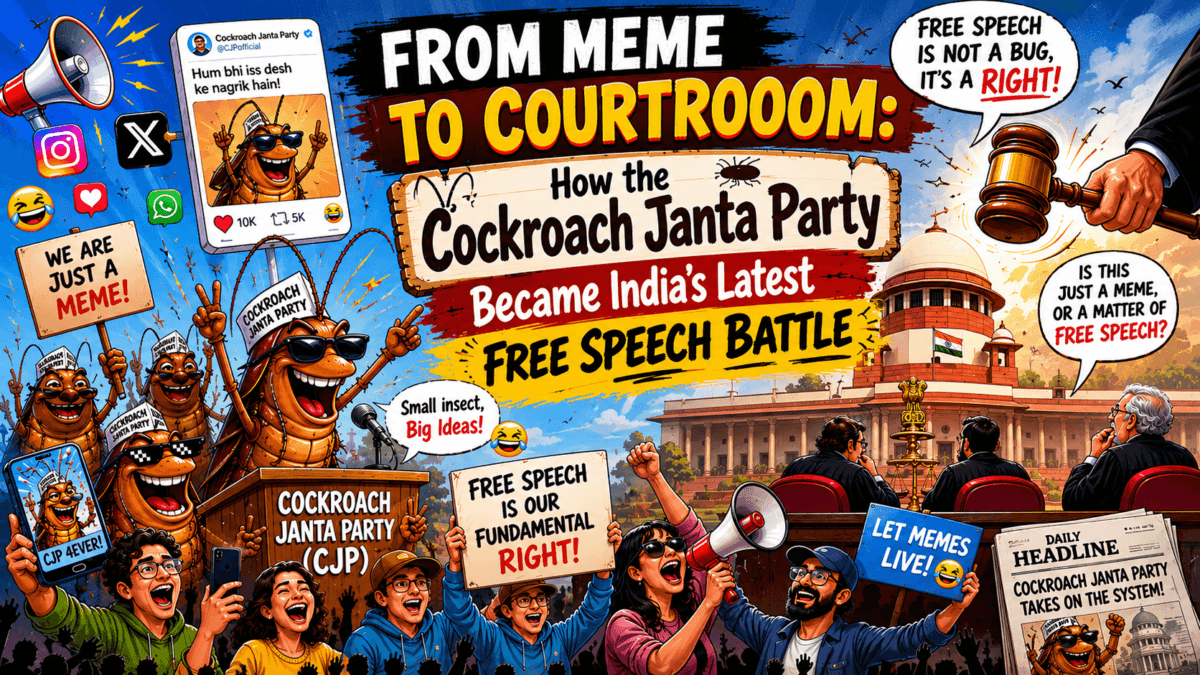
Last Updated: July 25, 2026
Why This Story Is Trending
Imagine building something millions of people love — overnight.
Now imagine waking up the next morning and finding it completely gone. No warning. No explanation. Just silence.
That is exactly what Abhijeet Dipke, founder of Cockroach Janta Party, says happened to him.
His satirical political movement grew to millions of followers in just days. Then the X account went dark. And instead of staying quiet, Dipke walked into the Delhi High Court and turned a viral internet joke into one of the most talked-about free speech cases in India right now.
“The internet turned an insult into a political identity — and the government apparently did not like what it saw.”
What makes this story so unusual is the mix of ingredients. A Supreme Court remark. A satirical fake party. A government blocking order. A national security claim. And now, a High Court battle.
The story is drawing attention well beyond political circles because it touches something fundamental — who can speak online in India, who can be silenced, and how far the state can go when it invokes national security.
This is not just about one blocked account. This is about power, protest, and the future of political speech in digital India.
Who Is Abhijeet Dipke?
He is not the kind of person you would expect to start a political movement.
No party office. No election ticket. No press conferences with party flags behind him.
Abhijeet Dipke is identified in current reporting as the founder of Cockroach Janta Party, a satirical online political outfit that gained fast traction on social media. Reports also describe him as being based in Boston, and as someone using political satire to comment on unemployment, institutional accountability, and media freedom.
That detail — Boston — is worth thinking about for a moment.
Here is a man living thousands of miles away from India, watching events unfold on his screen, and somehow building one of the fastest growing political movements the Indian internet has ever seen. That alone tells you something powerful about how social media has completely changed who gets to participate in politics, and from where.
Public coverage so far focuses more on his role as a digital activist and political communicator than on a long conventional party career. In other words, he appears to be less of a mainstream politician and more of a creator-activist who turned online frustration into an organized satirical brand.
He used humor as both a weapon and a shield. The joke was the point. But underneath the joke was something much sharper — real anger, real frustration, and a very serious question about how institutions treat ordinary citizens.
That combination of laughter and fury is exactly what made Cockroach Janta Party travel so fast across the internet.
What Is Cockroach Janta Party?
“Think of it less like a political party and more like a movement wearing a party’s costume.”
The name sounds like a joke. That is entirely the point.
Cockroach Janta Party emerged this month as a satirical online movement that spread rapidly across platforms, especially among younger users.
But where did the name come from?
The group’s name traces back to Supreme Court remarks on May 15, when the Bench headed by CJI Surya Kant used the word “cockroaches” in a discussion about unemployed youngsters moving into social media and RTI activism. The Chief Justice later clarified that the remark was aimed at people using forged qualifications and fake degrees.
But by the time that clarification came, the damage — or depending on how you look at it, the spark — had already happened.
Young Indians, many of them unemployed, many of them deeply frustrated with slow institutional change, saw themselves in that word. And instead of being hurt by it, they owned it. They wore it like a badge.
This is a very old and very powerful move in political history. Taking an insult and turning it into a symbol of pride. The Cockroach Janta Party did exactly that — and they did it with the speed that only internet culture makes possible.
The party uses satire to comment on unemployment, institutional accountability, and media freedom. That makes it closer to political performance art than a conventional party in the electoral sense, although its online reach has been large enough to attract serious attention from both users and authorities.
Why Was the Party Created?
To understand why millions of people joined a party named after a pest, you need to understand the mood that created it.
India has one of the youngest populations in the world. It also has one of the most competitive job markets. When young people cannot find work, they turn to the tools available to them — social media, RTI filings, online campaigns. These are not dangerous tools. These are the tools of engaged citizens trying to participate in democracy.
The clearest explanation in reporting is that the movement grew out of frustration and irony. It reflects dissatisfaction with mainstream politics and public anger over unemployment, online activism being dismissed, and the feeling that institutions often speak harshly about young people trying to participate in public life.
When the Supreme Court bench appeared to dismiss those very tools as the hobby of people with fake degrees, it felt to many young Indians like confirmation of something they already suspected — that the establishment does not take them seriously.
Cockroach Janta Party was the response. Not a petition. Not a protest march. A satirical movement that held up a mirror and said — look at what you are doing.
The satirical framing matters because it changes how people interpret the movement. For supporters, it is a clever protest against social and political exclusion. For critics, it may look like trolling, provocation, or intentional escalation.
Both of those things can be true at the same time. That ambiguity is part of what makes satire so powerful — and so legally complicated.
“What started as satire quickly became a censorship debate.”
Then the Movement Suddenly Disappeared
One day the account was there, growing faster than almost anything seen on Indian social media in recent years. Then it was gone.
According to the reporting, the government ordered the blocking of the CJP’s X account, citing national security concerns, and MeitY reportedly asked X to withhold the account under Section 69A of the IT Act. One report also says the block followed inputs from the Intelligence Bureau.
Section 69A is not a small provision. It is one of the most powerful tools the Indian government has for controlling what people can see and say online. It allows the government to order platforms to block content for reasons including national security and public order. And crucially, these orders are often issued with no public explanation — meaning the person being silenced may not even officially know why.
This opacity is exactly what free speech advocates have long criticized about Section 69A. A satirical political party can be blocked, and the public may never know the real reason.
There is also a second layer to the controversy: Dipke claimed the party’s social media accounts were hacked before the suspension, and later said the party had lost access to its platforms. As of the latest reporting, neither X nor the government had publicly commented in detail on those allegations.
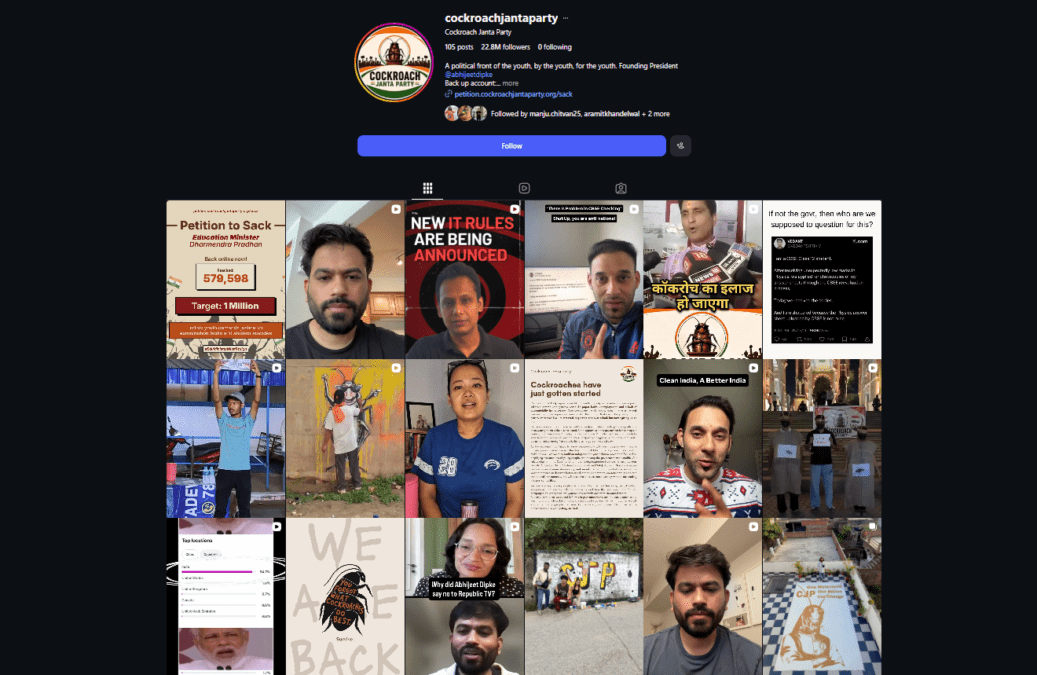
The numbers make the block even more striking. The account allegedly gained hundreds of thousands of followers on X and over 22 million on Instagram, as reported by Bar and Bench.
A movement that large does not go unnoticed. And apparently, it did not.
Delhi High Court Case
Faced with a blocked account, alleged hacking, and no public explanation from anyone, Dipke did something very simple — he went to court.
Dipke has now moved the Delhi High Court challenging the blocking order and seeking relief against the suspension of the X account. The petition was filed through Advocate Nakul Gandhi of NG Law Chambers and was expected to be heard this week, according to the report.
The legal question at the heart of this case is not complicated to understand, even if the law around it is.
India’s Constitution protects freedom of speech and expression under Article 19. That right is not absolute — it can be restricted on grounds like national security. But those restrictions must be reasonable, proportionate, and open to judicial challenge. The question the Delhi High Court now has to answer is whether blocking a satirical political account — one whose main activities appear to be humor and political commentary — meets that standard.
The legal conflict is straightforward on the surface but important underneath: if the state blocks a satirical political account on national security grounds, what level of transparency, justification, and judicial review should apply?
Legal experts watching this case will compare it to the landmark 2015 Shreya Singhal judgment, where the Supreme Court struck down Section 66A of the IT Act for violating free speech. Section 69A survived that judgment — but only because of procedural safeguards that were supposed to protect citizens. Whether those safeguards are actually being used properly in cases like this is exactly what the Delhi High Court is now being asked to examine.
Timeline of Events
| Date | What Happened |
| May 15 | Supreme Court remarks using the word “cockroaches” trigger online anger and satire |
| Early–Mid May | Cockroach Janta Party gains millions of followers across platforms |
| May 22 | Dipke alleges account takedowns, website removal, and hacking |
| May 24–25 | Reports confirm Dipke has moved Delhi High Court against the X account block |
Social Media Reactions and Internet Buzz
While lawyers prepared their arguments, the internet had already delivered its own verdict — loudly, creatively, and repeatedly.
The story has spread quickly because it is easy to understand and easy to meme. Social media users have treated Cockroach Janta Party as both a joke and a symbol, which is exactly the kind of dual identity that makes political satire travel fast online.
Memes flooded timelines. New solidarity accounts appeared within hours of the blocking. Users changed profile pictures. Hashtags trended. The attempt to silence the movement had the opposite effect — it made it louder.
This is the Streisand Effect in its purest form. The more you try to suppress something, the more attention it gets. By blocking the account, authorities may have given Cockroach Janta Party the most powerful thing a satirical movement can receive — the credibility of being taken seriously enough to be seen as a threat.
There is a clear split in reaction. Supporters see the block as heavy-handed and say satire should not be treated like a security threat, while critics argue that the movement’s rapid virality and provocative tone may have invited scrutiny.
Both camps are passionately engaged. And that engagement is itself part of the story. When a satirical political account generates genuine public debate about free speech, judicial oversight, and platform power, it has clearly stopped being just a joke.
Bigger Questions This Controversy Raises
Step back from the specific facts and you can see much larger questions forming.
India in 2025 is a country where political battles are fought online as much as in Parliament. The ability to reach millions of people with a message — funny or serious, satirical or sincere — is a real form of political power. And power that cannot be controlled through traditional means will always attract attention from those who want to control it.
This is not only about one account. It is about how India handles political speech in digital spaces, especially when that speech comes dressed as satire. Cases like this test the boundary between platform moderation, state censorship, and constitutional free speech.
There is also a platform accountability angle worth examining. X, like all major social media companies in India, must comply with Indian law including Section 69A orders. But platforms also have a responsibility to their users. The degree to which they push back on such orders, seek judicial review, or transparently inform users varies hugely — and it matters hugely for the quality of public discourse.
Online satire can spread faster than official messaging, but it can also be more vulnerable to sudden takedowns, hacked accounts, and opaque enforcement. If courts treat such cases seriously, they could shape how future political creators, meme pages, and activist collectives operate online.
The tools of digital activism — speed, humor, virality, reach — come with serious vulnerabilities. An account built over weeks can vanish in hours. A community of millions can be scattered with a single government order. How to build resilient, legally protected digital political movements in this environment is a question that activists, lawyers, and courts are still working out — in India and around the world.
What Happens Next?
The Delhi High Court hearing is the immediate next step. The court will examine the blocking challenge and the legal basis for the government’s order.
The range of outcomes is wide.
If the court asks for greater disclosure or narrows the basis for blocking, that could strengthen the legal position of satire and activist accounts online. If the government’s blocking order is upheld, it may encourage stricter moderation of politically provocative digital campaigns.
Either way, the Indian legal system is being asked to answer questions that courts around the world are grappling with. How do you protect free political speech in a digital age? How do you tell the difference between satire and sedition? How much transparency does the state owe citizens when it silences their voices online?
There are no easy answers. But the fact that these questions are now being asked in a High Court — because of a satirical party named after a pest — shows just how much the landscape of Indian politics and public speech has changed.
FAQs
Who founded Cockroach Janta Party?
Abhijeet Dipke is reported as the founder of Cockroach Janta Party.
Why was the X account blocked?
Reporting says the government blocked it citing national security concerns, and MeitY reportedly asked X to withhold the account under Section 69A of the IT Act.
Is Cockroach Janta Party a real political party?
It appears to function mainly as a satirical online movement rather than a conventional electoral party, based on available reporting.
What is the Delhi High Court case about?
Dipke has challenged the blocking of the party’s X account and is seeking relief against the suspension.
Why is this important for free speech in India?
Because it sits at the intersection of satire, free speech, online censorship, and state power in India.
What is Section 69A of the IT Act?
It is a law that allows the Indian government to direct platforms like X to block content on grounds including national security and public order — often without any public explanation.
Conclusion
The Cockroach Janta Party controversy is a reminder that politics in India now lives as much on social platforms as in Parliament or courtrooms. What began as a viral satirical movement has now become a test case for digital free speech, platform accountability, and how far the state can go in responding to provocative online political expression.
What started with a Supreme Court judge’s poorly received choice of words has cascaded into a legal battle that could shape the rules of political speech in digital India for years to come. That is an extraordinary journey for a movement that is barely a few weeks old.
If the Delhi High Court case moves forward, it could become one of the more closely watched online speech disputes of the year.
The question it leaves hanging — the one that no court ruling will fully answer — is this: in a democracy that takes pride in its freedoms, should a satirical political movement with tens of millions of followers need a High Court petition just to exist online?
That is not really a legal question. It is a political one. And in a democracy, citizens are the ones who ultimately get to answer it.
“And perhaps that is the real reason this story refuses to disappear — because in digital India, even a joke can become a political movement, and even a political movement can be silenced with a single order.”
Sources
- Bar and Bench — Delhi High Court challenge and background of the movement
- LiveLaw — Satirical origin and court filing details
- The Economic Times — Account block and hacking allegations
- Deccan Herald — Government crackdown allegations
- Times of India — Delhi High Court petition filing report