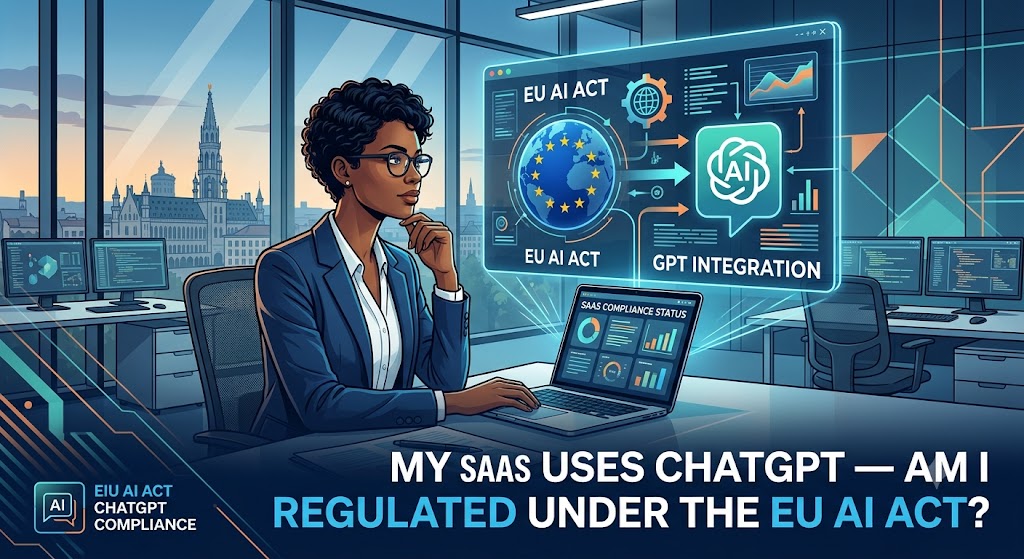
EIU AI Act ChatGPT Integration Compliance
Rohan built a customer-support SaaS tool in Pune. Under the hood, it calls the OpenAI API to draft replies, summarize tickets, and detect customer sentiment. He never trained a model himself — he just wired an API key into his product. So when a European reseller asked him for an “AI Act compliance statement,” his first reaction was: surely this is OpenAI’s problem, not mine?
My SaaS Product Uses ChatGPT — Am I Now Regulated Under the EU AI Act?
Quick Answer
It isn’t only OpenAI’s problem. The moment you wrap a general-purpose AI (GPAI) model like ChatGPT, Claude, or Gemini into a product you sell under your own name, you typically become a provider of the resulting AI system under the EU AI Act — with your own, separate obligations, layered on top of whatever obligations the underlying model provider carries (European Union, 2024, Art. 3(3)). This article explains exactly where your responsibility starts, where it ends, and what a lean SaaS team should actually do about it.
EU AI Act Compliance at a Glance
- Using an LLM API does not exempt you from the Regulation — you can still be a “provider” of your own product.
- The underlying model provider (e.g., OpenAI) and you as the integrator can both have separate, overlapping obligations.
- Your main near-term duties are usually transparency (Art. 50) and correct risk classification of your specific feature.
- If you substantially modify or repurpose the model into a high-risk use, heavier obligations can attach to you specifically (Art. 25).
- Open-source model exceptions generally do not apply to closed, proprietary APIs like the standard ChatGPT API.
- Review your vendor’s own AI Act commitments — good vendors publish these; if not, ask.
Why This Problem Matters
Most SaaS products today are not built from scratch — they are built on top of general-purpose AI models accessed via API. The EU AI Act anticipated this. It creates specific rules for the AI value chain, recognizing that multiple parties — the model developer, the SaaS company that integrates it, and sometimes distributors or resellers — can each carry distinct obligations toward the same underlying technology (European Union, 2024, Recital 73; Art. 25).
Getting this wrong has real consequences. Article 99 sets fines of up to €15 million or 3% of global annual turnover for most non-compliance with the Regulation’s substantive obligations (European Union, 2024, Art. 99). And practically, EU enterprise buyers are increasingly asking not just “which AI vendor do you use?” but “what is your regulatory status given that vendor?” — a question Rohan’s reseller was really asking.
If you haven’t yet confirmed whether the EU AI Act reaches your company at all, start with our guide, Does the EU AI Act Apply to My Company If I’m Not Based in Europe?
Who Is Affected
This article is for you if:
- Your product calls a third-party LLM or GPAI API (OpenAI, Anthropic, Google, Mistral, etc.) to power a feature.
- You fine-tune, wrap, or rebrand a foundation model rather than training your own.
- You are unsure whether the model provider’s compliance covers you, or whether you have separate obligations.
- You sell your AI-powered product to customers with any EU exposure.
What Happens If You Ignore It
- You may misrepresent your compliance status to customers, which creates contractual and reputational risk beyond the Regulation itself.
- You may miss transparency obligations that attach to your product specifically, such as disclosing AI-generated content or chatbot interactions (European Union, 2024, Art. 50).
- You may unknowingly become a “provider” of a high-risk system if you repurpose or substantially modify the underlying model for a high-risk use case, inheriting the full provider obligation set (European Union, 2024, Art. 25(1)(c)).
Step 1: Understand That Two Layers of Obligation Can Exist at Once
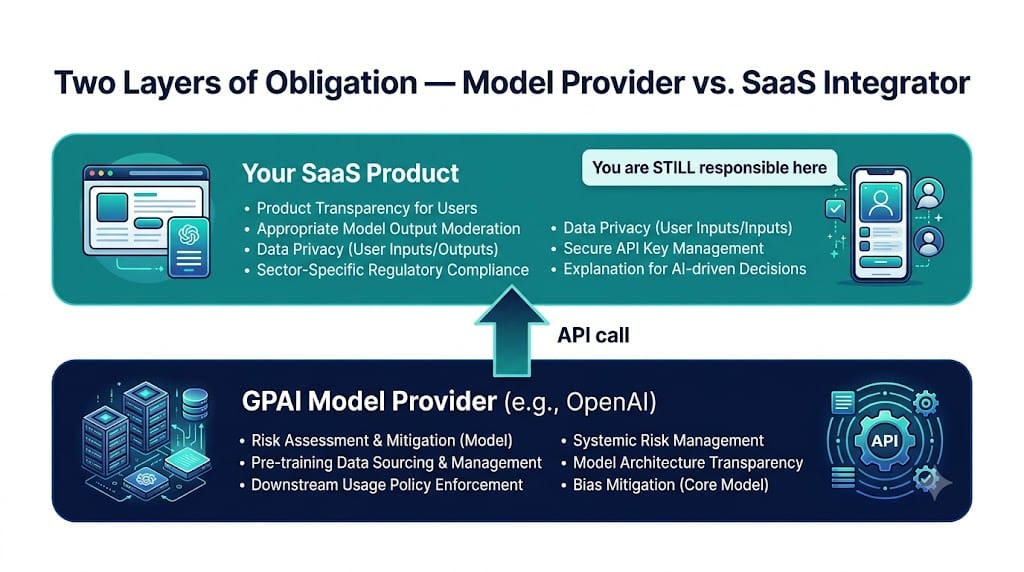
There are two separate roles in play, and it helps to think of them as stacked layers:
GPAI model provider vs SaaS integrator obligations
Layer 1 — The GPAI model provider (e.g., OpenAI, Anthropic, Google). Providers of general-purpose AI models carry their own obligations: maintaining technical documentation, providing information to downstream providers who integrate the model, having a policy to respect EU copyright law, and publishing a summary of training content (European Union, 2024, Art. 53(1)). If the model is classified as carrying systemic risk, additional obligations apply, including model evaluation, adversarial testing, and serious incident reporting (European Union, 2024, Arts. 55, 51–52).
Layer 2 — You, the SaaS company integrating the model. You are typically a provider of your own AI system — the product you built on top of the API — with obligations that depend on how you use the model and what risk tier your specific feature falls into (European Union, 2024, Art. 3(3)).
Official Resource: Regulation (EU) 2024/1689, Articles 53–56 (GPAI provider obligations) — EUR-Lex
Neither layer replaces the other. OpenAI meeting its Article 53 obligations does not automatically make your customer-support tool compliant — it only means the foundation you built on is properly documented.
Step 2: Classify What Your Feature Actually Does
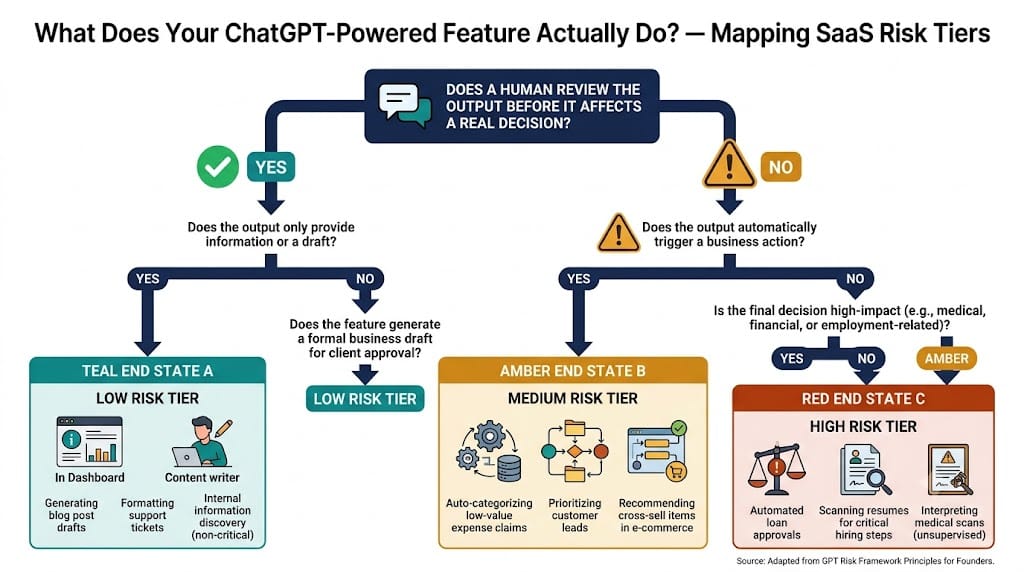
The question isn’t “do I use ChatGPT?” — it’s “what does my feature do with it?” Apply the same risk-tier logic used for any AI system (European Union, 2024, Art. 6; Annex III):
| Your Feature | Likely Risk Tier | Why |
| Drafting suggested email replies for agents to review | Minimal / limited risk | Human reviews before sending; narrow procedural task (Art. 6(3)(a)) |
| Fully automated chatbot replying to customers directly | Limited risk | Requires disclosure that it’s an AI system (Art. 50) |
| Scoring or ranking job applicants using LLM-generated summaries | High-risk | Falls within Annex III recruitment category if it materially influences hiring decisions |
| Automated credit or eligibility decisions using LLM output | High-risk | Falls within Annex III financial/eligibility categories |
| Internal summarization tool with no customer-facing decision impact | Minimal risk | No significant risk of harm; unlikely to trigger Annex III |
The API you call does not determine your risk tier — what your feature decides or influences does.
Official Resource: European Commission — AI Act FAQs — digital-strategy.ec.europa.eu/en/faqs/navigating-ai-act
Mini Case Study: A Support-Desk SaaS Tool Draws the Line Correctly
Consider a scenario representative of many AspirixWriters readers: a customer-support SaaS company using the OpenAI API to draft suggested replies that a human agent must approve before sending. Because a human reviews and can override every output before it affects the customer, the feature falls under the Article 6(3)(b) exemption — it improves the result of a previously completed human activity rather than replacing human judgment. The company documented this reasoning, added a simple in-product disclosure that “replies may be AI-assisted,” and moved on with a one-page internal record.
Contrast this with a hypothetical competitor that lets the same model auto-send replies without review — that design choice alone could shift the feature toward limited-risk transparency duties, or higher, depending on what the replies are used for. This is illustrative of how the same underlying model can sit in different risk tiers purely based on product design; your own classification should be documented and verified against the official Regulation text.
Step 3: Meet Your Obligations as the Integrator
If your feature is minimal-risk: document your reasoning (why no significant risk of harm exists) and keep it on file — this alone satisfies most of your practical burden (European Union, 2024, Art. 6(3)–(4)).
If your feature is limited-risk (most chatbots and AI-drafted content): disclose to users that they are interacting with, or reading content generated by, an AI system, unless this is obvious from context (European Union, 2024, Art. 50).
If your feature is high-risk: you inherit the full provider obligation set — risk management (Art. 9), data governance (Art. 10), technical documentation (Art. 11), human oversight (Art. 14), and conformity assessment (Art. 43) — regardless of the fact that you didn’t train the underlying model yourself.
A special trigger to watch for — Article 25: if you take a general-purpose AI model that was not classified as high-risk and modify its intended purpose so that the resulting system becomes high-risk, you become the provider of that high-risk system, with full obligations, even though you never trained the model (European Union, 2024, Art. 25(1)(c)). This is the scenario most SaaS founders overlook: repurposing a general chat model into, say, an automated hiring-decision tool changes your legal position entirely.
Official Resource: Regulation (EU) 2024/1689, Article 25 (responsibilities along the AI value chain) — EUR-Lex
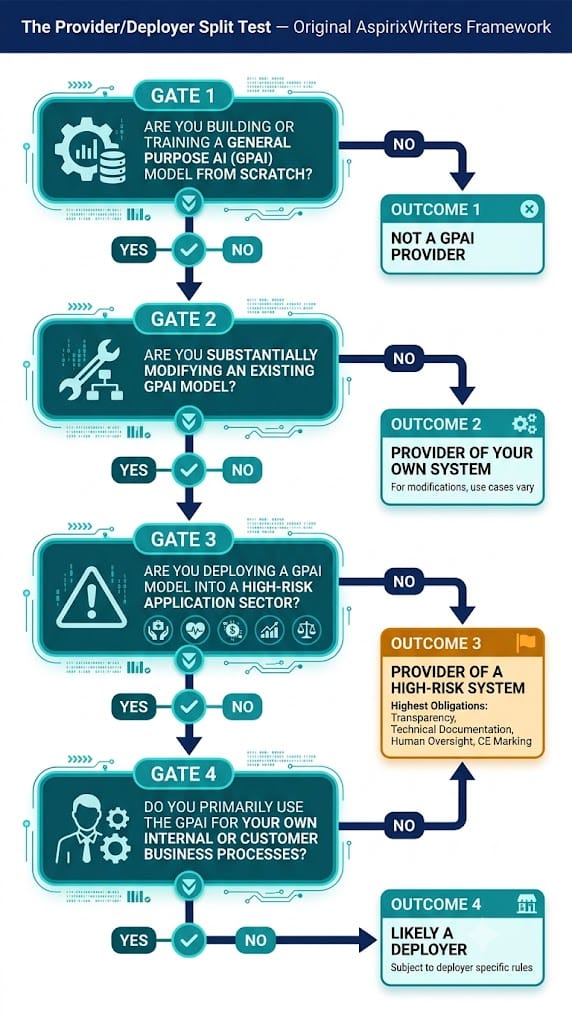
AspirixWriters Framework: The Provider/Deployer Split Test
We built the Provider/Deployer Split Test to help SaaS teams quickly determine their layered status when using third-party GPAI models:
- Did you build the underlying model? No → you are not the GPAI model provider.
- Did you rebrand, fine-tune, or wrap the model into your own named product? Yes → you are a provider of your own AI system (Art. 3(3)).
- Did you change what the model is used for, in a way that creates a high-risk use? Yes → you become the provider of a high-risk AI system under Article 25(1)(c), regardless of who trained the model.
- Do you only use someone else’s branded AI tool internally, without reselling it? Yes → you are likely a deployer, not a provider.
This is AspirixWriters analysis and original methodology, not an official EU AI Act requirement — it is a practical operating model for applying Articles 3 and 25 to real integration decisions.
Startup Integrator vs. Enterprise Integrator: How the Approach Differs
| Small Startup Using an LLM API | Enterprise Using an LLM API |
| One documented risk classification per feature, reviewed on release | Formal AI system inventory audited across many products |
| Simple in-product AI disclosure text | Legal-reviewed disclosure language across jurisdictions |
| Relies on vendor’s published GPAI documentation | Runs its own vendor due-diligence and contractual review process |
| Quarterly re-check of vendor’s compliance status | Continuous vendor risk monitoring |
| Uses Art. 6(3) narrow-task exemptions where genuinely applicable | Often builds systems complex enough to fall outside simple exemptions |
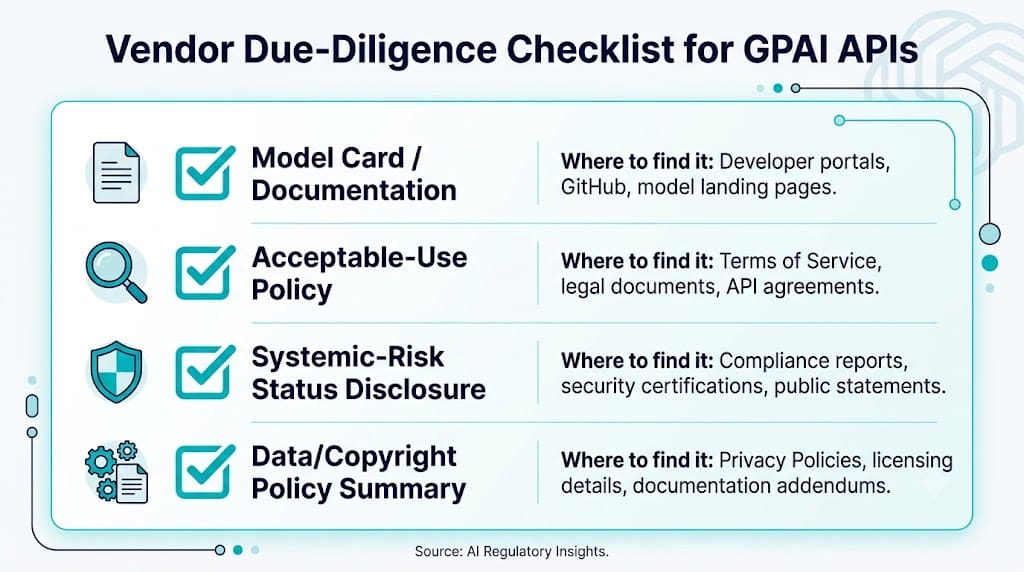
Step 4: Check What Your Vendor Has Already Published
Reputable GPAI providers publish documentation intended to help downstream integrators comply — model cards, acceptable-use policies, and sometimes AI Act-specific statements. Reviewing this is not optional diligence; it directly affects what you can rely on as a downstream provider (European Union, 2024, Recital 73 — value-chain parties should provide the necessary information to enable the downstream provider to comply).
Important nuance: the exceptions available to free and open-source GPAI models under Articles 53(2) and 54(6) generally do not apply to standard commercial, closed-weight APIs like the default ChatGPT API — so don’t assume “it’s just an API call” reduces your documentation burden.
Official Resource: European AI Office — GPAI Code of Practice — digital-strategy.ec.europa.eu/en/policies/ai-code-practice
Common Mistakes SaaS Founders Make
- Assuming the model vendor’s compliance covers you. It covers the model. It does not cover your product’s specific use of it.
- Treating “we just call an API” as a reason to skip documentation. Article 6(4) still requires a documented risk assessment even for exempt features.
- Missing the Article 25 repurposing trap. Changing what a general model is used for can turn you into a high-risk provider overnight.
- Forgetting transparency duties for AI-generated content or chat interfaces. Article 50 applies to you as the integrator, not just the model developer.
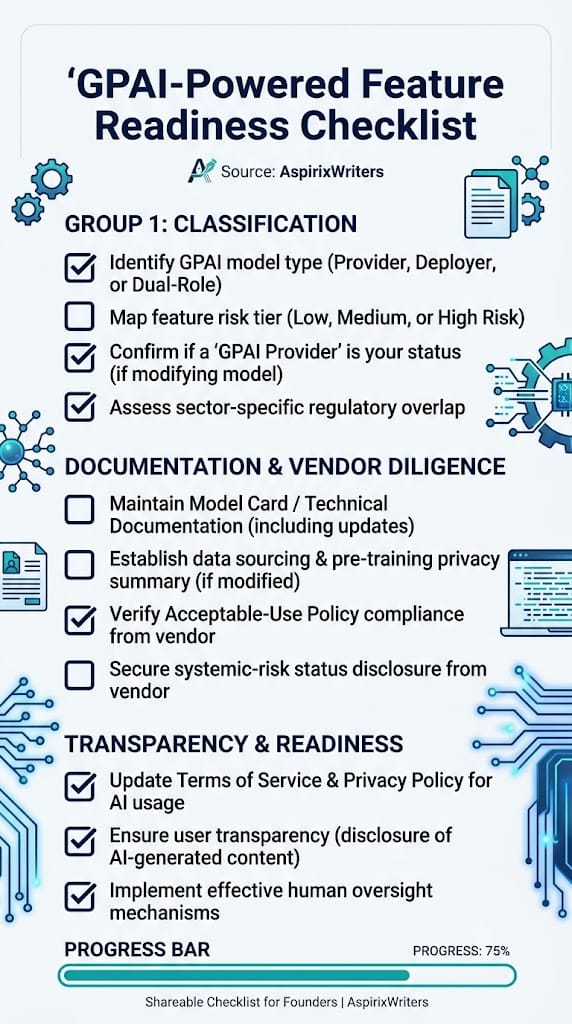
Checklist: Is My GPAI-Powered Feature Ready for Scrutiny?
Classification
- [ ] I know which specific feature(s) call a third-party GPAI model.
- [ ] I have classified each feature’s risk tier based on what it decides, not which vendor powers it.
- [ ] I have completed an AI inventory listing every GPAI-powered feature in my product.
Documentation & Vendor Diligence
- [ ] I have reviewed my model vendor’s published documentation or model card.
- [ ] I have a documented risk assessment for any feature I believe is exempt under Article 6(3).
- [ ] I maintain a vendor register recording which GPAI models power which features.
- [ ] I have checked whether my vendor’s model is classified as carrying systemic risk.
Transparency & Readiness
- [ ] Users are told when they’re interacting with an AI system or reading AI-generated content, where required.
- [ ] I have reviewed whether any feature repurposes the model into a high-risk use (Article 25 trigger).
- [ ] I have named one internal owner for tracking GPAI-related obligations.
- [ ] I check EUR-Lex or the European Commission’s AI Act page quarterly for updates.
FAQs
If OpenAI is compliant, am I automatically compliant too?
No. The model provider’s compliance covers the model itself. As the integrator, you carry separate obligations tied to your specific product and use case (European Union, 2024, Art. 3(3)).
Does using an API instead of hosting my own model reduce my obligations?
It can reduce some technical burden (you’re not training the model), but your obligations as a provider of your own AI system, and your transparency duties, remain (European Union, 2024, Art. 50).
What if I fine-tune the model on my own data?
Fine-tuning increases the case for you being treated as a provider of the resulting system, and may trigger additional documentation expectations depending on how the fine-tuned system is used.
Can changing what I use the model for really change my legal status?
Yes — under Article 25(1)(c), modifying the intended purpose of a general-purpose AI system in a way that makes it high-risk makes you the provider of that high-risk system.
Do open-source model exceptions help me if I use the ChatGPT API?
Generally no. The open-source exceptions under Articles 53(2) and 54(6) are designed for freely available, openly licensed models with published weights — not standard closed commercial APIs.
Key Takeaways
- Using a GPAI API does not exempt your SaaS product from the EU AI Act — you can still be a provider of your own system (Art. 3(3)).
- Two layers of obligation exist simultaneously: the model provider’s and yours as the integrator.
- Your risk tier depends on what your feature decides or influences, not which model powers it.
- Repurposing a general model into a high-risk use can make you the provider of a high-risk system under Article 25.
- Standard closed-weight APIs (like the default ChatGPT API) generally don’t qualify for open-source exceptions.
Conclusion
Rohan’s instinct — “surely this is OpenAI’s problem” — is the single most common misconception among SaaS founders building on top of large language models. It is understandable, but it isn’t how the Regulation is structured. The EU AI Act was deliberately designed to follow AI systems along their value chain, assigning responsibility to whoever shapes how the technology is actually used. For most lean SaaS teams, the fix is not complicated: classify what your feature really does, document that judgment, add the right disclosures, and watch for the moment a “helpful assistant” feature quietly becomes a “high-risk decision” feature.
Next Step
Download our free EU AI Act Risk Classification Checklist or read our companion guide, How Can an Indian SaaS Startup Comply with the EU AI Act Without Hiring a Full-Time Compliance Team?, to build a lean, ownable compliance workflow around your AI-powered features.
This article is for general informational purposes and does not constitute legal advice. Founders should consult their qualified legal counsel for advice specific to their AI system and market exposure.
About the Author
Dr. Rekha Khandelwal is the Founder of AspirixWriters and a legal researcher and writer specializing in AI Governance, AI Regulation, AI Compliance, AI Ethics, and Responsible AI. Her work focuses on translating complex legal and technical frameworks — including the EU AI Act — into practical guidance for businesses, professionals, researchers, and students navigating the global AI governance landscape.
Explore more AspirixWriters resources on EU AI Act compliance, including our complete guide and free risk classification checklist, to continue building your organization’s AI governance foundation.
- How to Check Is Your AI System High-Risk Under the EU AI Act (2026)
- Does the EU AI Act Apply to Indian Companies? A Complete Compliance Guide (2026)
- My Startup Uses ChatGPT. Do I Really Need an AI Policy? (2026 Guide)
- EU AI Act Compliance for Indian SaaS Startups (No Team Needed)