
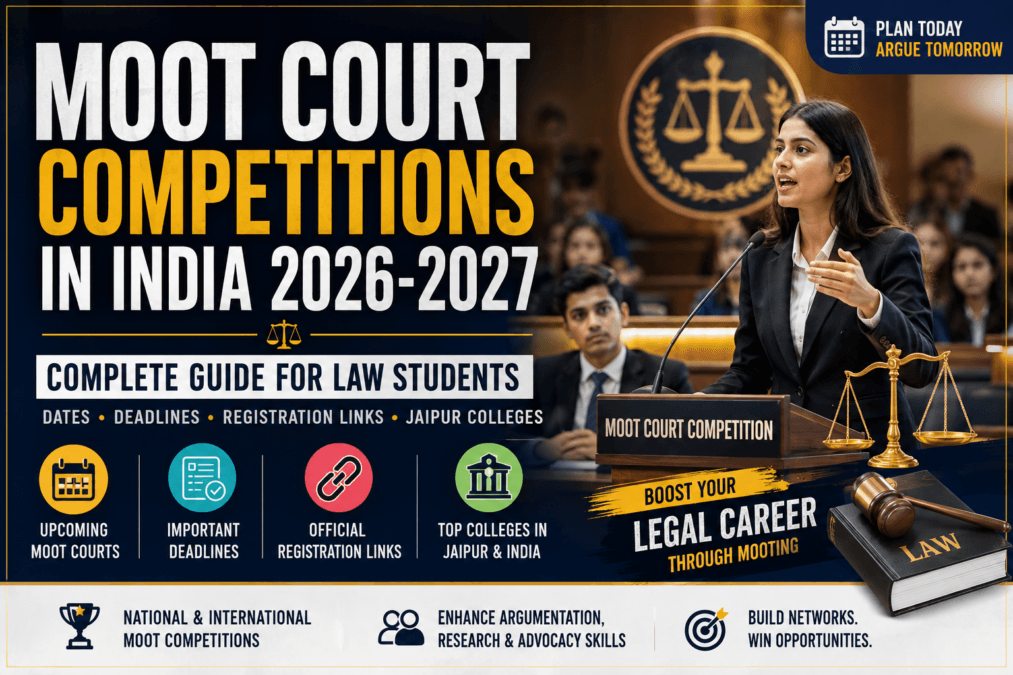
Moot Court Competitions in India 2026–2027
Don’t Miss New Law Opportunities!
Join our WhatsApp community for verified updates on Law Jobs, Internships, Competitions, Scholarships, LLB Notes & more.
This page brings together selected current and upcoming moot court competitions, along with practical guidance on eligibility, team formation, memorial writing, legal research, oral arguments and moot-court preparation.
Last updated: 8 September 2026
Competition dates, registration deadlines, eligibility, fees and rules can change. Always check the official organiser’s website/rulebook before registering.
Upcoming Moot Court Competitions 2026–2027
The following opportunities have been checked against official institutional or competition sources.
| Competition | Area | Date | Current Status |
|---|---|---|---|
| 67th Philip C. Jessup International Law Moot Court Competition 2027 | Public International Law | National/Friendly Rounds: Jan–Mar 2027 | 🟢 Registration Open |
| 34th Willem C. Vis Moot 2026–27 | International Commercial Arbitration & Sales Law | 19–25 March 2027 | 🟢 Registration period open |
| 25th Henry Dunant Memorial Moot Court Competition 2026 | International Humanitarian Law | 20–22 November 2026 | 🟢 Registration information available |
| 3rd NEHU National Moot Court Competition 2026 | Legal Advocacy | 29–30 September 2026 | 🟢 Upcoming |
| ALC International Moot Court Competition 2026 | Legal Research & Advocacy | 26–27 September 2026 | 🟢 Registration deadline: 10 September 2026 |
1. Jessup 2027 — Philip C. Jessup International Law Moot Court Competition
Area: Public International Law
Organiser: International Law Students Association (ILSA)
Edition: 67th Jessup International Law Moot Court Competition
Team registration opened on 3 August 2026. The official deadline for registration, payment and submission of the team roster is 20 November 2026. Memorials are due on 12 January 2027, followed by national and friendly rounds from January to March 2027.
Official information:
Jessup 2027 – ILSA
2. 34th Willem C. Vis International Commercial Arbitration Moot
Area: International Commercial Arbitration & International Sales Law
Location: Vienna, Austria
Moot dates: 19–25 March 2027
The 34th Vis Moot registration begins in September 2026. The official registration-form deadline is 12 November 2026, while the registration fee is due 11 December 2026. The problem is scheduled for distribution on 2 October 2026.
The competition is open to law students from different countries and focuses on international commercial sales law and arbitration.
Official information:
34th Vis Moot – Official Website
3. 25th Henry Dunant Memorial Moot Court Competition 2026
Area: International Humanitarian Law
Organisers: Indian Society of International Law (ISIL) and International Committee of the Red Cross (ICRC)
Location: New Delhi
Mode: Physical
Dates: 20–22 November 2026
The official ISIL website currently lists the competition and provides the registration form, rules and moot problem. Its listing states that no registration fee is required. Students should nevertheless check the official rules for the complete eligibility and submission requirements.
Official information:
Indian Society of International Law – Henry Dunant Moot
4. 3rd NEHU National Moot Court Competition 2026
Organiser: North-Eastern Hill University (NEHU)
Location: Shillong
Date: 29–30 September 2026
NEHU’s official website currently lists the 3rd NEHU National Moot Court Competition 2026 as an upcoming event beginning on 29 September 2026. Students should check the university’s current notice/rulebook for registration deadline, eligibility, team composition and fees before applying.
Official information:
NEHU – Official Website
5. ALC International Moot Court Competition 2026
Organiser: Asian Law College, Noida
Dates: 26–27 September 2026
Registration deadline: 10 September 2026
The competition information currently available through participating law-school moot committees states that registration closes on 10 September 2026, with the competition scheduled for 26–27 September 2026.
Asian Law College’s official website confirms its active Moot Court Committee and its 2026 moot-court activities.
Official institution:
Asian Law College – Moot Court
Important: Because the current deadline is very close, students should confirm the registration status and rulebook directly with the organiser before applying.
Competitions No Longer Open
Some competitions previously shown on this page should not remain under “Open for Registration.”
For example, Samvidhan Pe Charcha 4.0 at Parul University was scheduled for 25–27 September 2026, but its official registration deadline was 25 August 2026. It should therefore be removed from the live opportunities table or moved to a Past/Closed Competitions section.
This is important for maintaining the credibility of the page.
What Is a Moot Court Competition?
A moot court competition is a simulated legal proceeding in which students argue a hypothetical legal dispute before judges or adjudicators.
Unlike a traditional trial advocacy exercise, a moot generally emphasises:
- Legal research
- Case-law analysis
- Statutory interpretation
- Written memorials
- Oral advocacy
- Judicial questioning
- Rebuttal and sur-rebuttal, where applicable
A typical moot requires students to identify legal issues, research authorities, develop arguments for both sides, prepare written submissions and present oral arguments.
Why Should Law Students Participate in Moot Courts?
Mooting can help students develop:
Legal Research Skills
Learn how to locate statutes, judgments, regulations, treaties and other legal authorities.
Memorial Drafting
Develop structured written arguments supported by appropriate authorities.
Oral Advocacy
Learn how to present arguments clearly and persuasively.
Analytical Thinking
Moot problems often require students to analyse competing interpretations of law.
Courtroom Confidence
Regular oral practice helps students become more comfortable answering questions from a bench.
Teamwork
Most competitions require students to work together as speakers and researchers.
The practical orientation of moot courts is consistent with the clinical and practical components recognised within India’s legal-education framework.
Who Can Participate?
There is no single eligibility rule for all moot court competitions.
Depending on the competition, eligibility may depend on:
- 3-year LL.B. or 5-year integrated LL.B.
- Year/semester of study
- LL.M. eligibility
- Institution-specific requirements
- Team size
- Speaker/researcher requirements
- Whether cross-institution teams are permitted
- Previous participation
- National or international eligibility
Always read the current competition rulebook before registering.
How to Choose the Right Moot Court Competition
If you are participating for the first time, do not select a competition only because of its prize money.
Consider:
1. Subject Area
Choose an area that you can research effectively.
Common moot subjects include:
- Constitutional Law
- Criminal Law
- Commercial Law
- Arbitration
- International Law
- Human Rights
- International Humanitarian Law
- Intellectual Property
- Environmental Law
- Technology Law
- Space Law
- Insolvency Law
2. Eligibility
Before forming your team, check:
- Course/year requirements
- Institution requirements
- Team size
- Speaker and researcher requirements
- Registration requirements
3. Total Cost
Consider more than the registration fee:
- Travel
- Accommodation
- Food
- Printing
- Memorial preparation
- Institutional expenses
- Visa expenses for international competitions
4. Competition Credibility
Look for:
- Identifiable organiser
- Official rulebook
- Official registration page
- Published proposition
- Clear deadlines
- Official contact details
- Previous editions
How to Prepare for a Moot Court Competition
Step 1: Read the Proposition Carefully
Read the proposition several times.
Identify:
- Parties
- Facts
- Procedural history
- Jurisdiction
- Relief sought
- Legal issues
- Relevant legislation
- Constitutional provisions
- Treaties
- Important cases
Create a separate list of all legal issues before beginning detailed research.
Step 2: Read the Official Rules
Before preparing the memorial, read the current rulebook carefully.
Pay attention to:
- Memorial format
- Page/word limits
- Citation requirements
- Anonymity
- Font and spacing
- Submission deadlines
- Oral-round duration
- Speaker requirements
- Scoring criteria
- Rebuttal rules
- Permitted/prohibited assistance
Never rely on a generic memorial format when the competition has its own rules.
Moot Court Legal Research
A strong moot requires strong legal research.
Start With Primary Authorities
Prefer:
- Constitution
- Statutes
- Reported judgments
- Regulations
- Treaties
- Official government documents
- Judgments of relevant international courts and tribunals
Find Leading Cases
For every issue, identify:
- Leading authorities
- Recent decisions
- Authorities supporting your argument
- Adverse authorities
- Cases distinguishing the opposing position
Check Whether the Law Has Changed
Always check whether an older authority has subsequently been:
- Followed
- Distinguished
- Overruled
- Modified
- Superseded by legislation
Verify Every Citation
Before submitting a memorial, verify:
- Case name
- Citation
- Court
- Year
- Relevant paragraph/page
- Legal proposition for which the case is cited
Never rely on an AI-generated case citation without checking the primary source.
Useful Legal Research Resources
Students can use:
Indian Legal Sources
- Supreme Court of India — eSCR
- India Code
- Official High Court websites
- Government legal databases
International Sources
- International Court of Justice
- United Nations Treaty Collection
- ICRC resources
- WTO legal resources
- WIPO resources
- Official arbitral institution websites
Secondary Research Tools
- Google Scholar
- Indian Kanoon
- SSRN
- Institutional library databases
- SCC Online
- Manupatra
- Westlaw
- LexisNexis
Use secondary databases for discovery, but verify important authorities against primary or authoritative sources.
Moot Court Memorial Format
There is no universal memorial format. The competition’s official rulebook always takes priority.
A typical memorial may contain:
- Cover Page
- Table of Contents
- List of Abbreviations
- Index of Authorities
- Statement of Jurisdiction
- Statement of Facts
- Issues Raised
- Summary of Arguments
- Arguments Advanced
- Prayer
- Annexures, where permitted
Always follow the specific competition’s rules.
How to Improve Oral Advocacy
Before the oral rounds:
- Understand every authority cited in your memorial.
- Prepare likely questions from the bench.
- Practise answering without reading continuously from notes.
- Prepare both your strongest and weakest arguments.
- Prepare rebuttal and sur-rebuttal where applicable.
- Practise within the prescribed time.
- Conduct mock hearings with classmates or faculty.
- Maintain professional courtroom etiquette.
Good mooting is not simply about speaking confidently. It is about combining research, legal reasoning, written advocacy and oral presentation.
Responsible Use of AI in Moot Courts
AI tools can assist with:
- Brainstorming research questions
- Organising research
- Creating preliminary outlines
- Improving language
- Identifying issues for further research
However, students should not treat AI-generated cases, statutes, quotations or legal propositions as verified authorities.
Every important authority should be checked against the original judgment, legislation, treaty or official source.
This is particularly important for memorials, where an incorrect citation can undermine an otherwise strong argument.
Moot Court Preparation Checklist
Before submitting your memorial, check:
☐ Read the complete proposition
☐ Identified all issues
☐ Read the official rulebook
☐ Checked eligibility
☐ Verified team composition
☐ Researched primary authorities
☐ Checked recent judgments
☐ Researched opposing arguments
☐ Verified every citation
☐ Checked memorial formatting
☐ Checked page/word limit
☐ Removed identifying information where required
☐ Proofread the memorial
☐ Practised oral arguments
☐ Prepared for judicial questions
☐ Checked registration/submission deadline
Frequently Asked Questions
What is a moot court competition?
It is a simulated legal proceeding where students argue a hypothetical legal dispute before judges or adjudicators.
Is moot court useful for law students?
Yes. It provides practical experience in legal research, written advocacy and oral argument.
Can 3-year LL.B. students participate?
Many competitions allow them, but eligibility varies. Always check the particular competition’s rules.
Can 5-year BA LL.B./BBA LL.B./BCom LL.B. students participate?
Many competitions accept students from integrated law programmes, but eligibility is competition-specific.
Can LL.M. students participate?
Some competitions permit LL.M. students while others restrict participation to undergraduate law students. Check the rulebook.
Can two different colleges form one team?
Only if the competition rules permit cross-institution teams.
What is a memorial?
A memorial is the written submission prepared by the participating team setting out its legal arguments and supporting authorities.
Can AI be used for memorial writing?
Only to the extent permitted by the particular competition. Students should always follow the competition’s rules and independently verify legal authorities.
How AspirixWriters Selects Moot Court Opportunities
AspirixWriters aims to keep this page useful rather than simply collecting every competition announcement available online.
Before featuring a competition, we try to check:
- Official organiser
- Current competition edition
- Official registration route
- Competition dates
- Registration deadline
- Eligibility
- Team requirements
- Fees, where available
- Official rules/proposition
An aggregator listing alone is not treated as sufficient confirmation.
Because competition information can change quickly, students should always verify the final details on the official organiser’s website before registering.
Stay Updated
Bookmark this page for moot court competitions in India and international moot opportunities.
We will update this page when new competitions are announced and move completed or expired opportunities out of the active section.
For other law-student opportunities, explore:
- Related Career Resources
- Call for Papers, Conferences, Webinars & Workshops
- Jobs
- Freelancing
- Internships
- Scholarships & Fellowships
- Judiciary
- Moot Courts & Competitions
- Explore
- ✔ Law Study Material
- ✔ Practical Legal Guides
- ✔ Legal writing
- ✔ Artificial Intelligence
- ✔ Best Tools & Resources
- ✔ Career Opportunities
- ✔ Best Books
- ✔ Professional Writing Services
Classmate Pulse Spiral Notebook ✏️ Need a Spiral Notebook for Everyday Writing? A spiral notebook…

Latest Scholarships & Fellowships 2026–27: Open Opportunities for Upcoming call
Latest Scholarships & Research Fellowships 2026–27 Last Verified: 30 September 2026 Students, researchers, PhD scholars…
Writing & Research Resources: Useful Books, Tools & Essentials for Writers and Researchers
Whether you are an author, content writer, law student, academic researcher, PhD scholar, teacher, or…
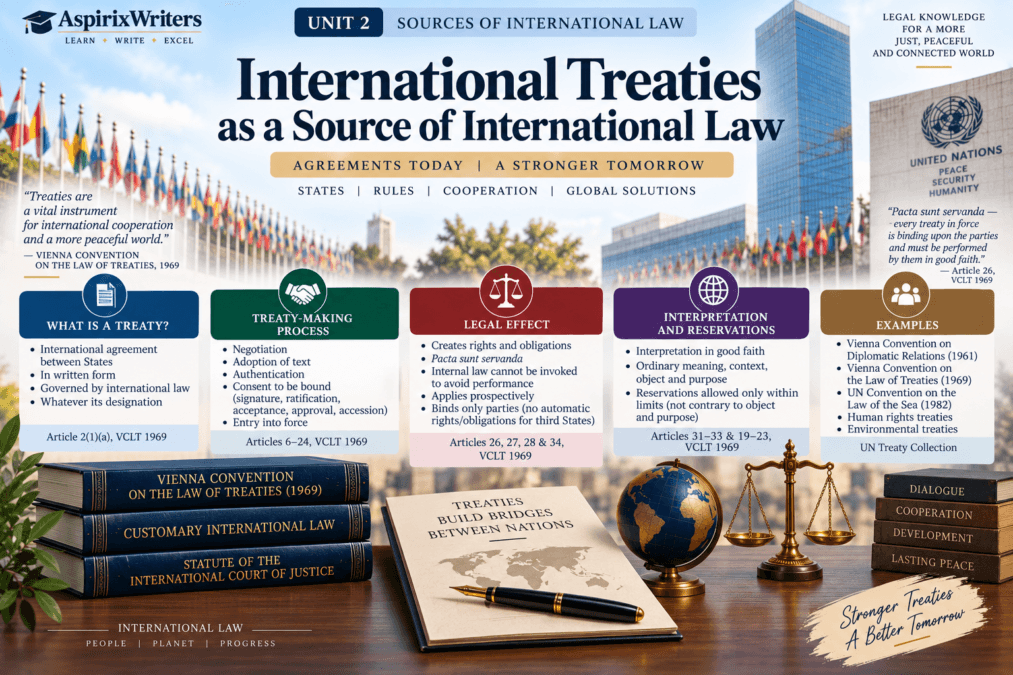
International Treaties as a Source of International Law | LL.B. Notes
International Treaties as a Source of International Law Introduction International treaties are one of the…
The Ultimate Guide to Organizing LLB Notes for Exam Success
LLB Notes for Exam Success Studying law is not simply about reading hundreds of pages….
What Is the Best AI Tool for Legal Research in 2026? A Practical Guide for Lawyers, Law Students and Researchers
What Is the Best AI Tool for Legal Research in 2026? Last updated: September 2026…