How Can an Indian SaaS Startup Comply with the EU AI Act Without Hiring a Full-Time Compliance Team?
EU AI Act Compliance for Indian SaaS Startups
Priya runs a 14-person SaaS company out of Bengaluru. Her product helps European recruitment agencies screen job applicants using a machine-learning model that ranks CVs. Last month, a prospective customer in Germany sent her a vendor questionnaire she had never seen before: “Please confirm your AI system’s risk classification under Regulation (EU) 2024/1689 and provide your EU declaration of conformity.”
Priya didn’t know what to say. Her company has no lawyer in Brussels, no compliance officer, and a total legal budget of zero. She is not alone. Thousands of Indian SaaS founders are discovering that the EU AI Act applies to them the moment a single European customer uses their product — regardless of where the company is incorporated (European Union, 2024, Art. 2(1)(c)).
This article answers the question founders actually ask: can a small SaaS company comply with one of the world’s most complex AI laws without hiring a dedicated compliance team? The honest answer is yes — but only if you work smart, not hard. Here is exactly how.
EU AI Act Compliance at a Glance
- The Regulation can apply to your company even without an EU office, based on where your AI system’s output is used.
- Start by determining whether you are a Provider or a Deployer — this decides which obligations apply.
- Classify your AI system’s risk tier: unacceptable, high-risk, limited-risk, or minimal-risk.
- Build documentation early — don’t wait for a vendor questionnaire to force the issue.
- SMEs and start-ups have statutory rights to regulatory sandboxes and reduced conformity assessment fees.
- Review official EU sources regularly — the implementation timeline is still evolving.
Why This Problem Matters
The EU AI Act is not a “Europe-only” law. It reaches any provider that places an AI system on the EU market or whose AI system’s output is used in the EU, even if the company has no office, subsidiary, or employee in Europe (European Union, 2024, Art. 2(1)(c)). For an Indian SaaS company selling to even one European client, this is not a hypothetical risk. It is an active legal obligation.
Ignoring it is expensive. Article 99 of the Regulation sets administrative fines of up to €35 million or 7% of global annual turnover for the most serious violations (use of prohibited AI practices), and up to €15 million or 3% of global turnover for other breaches of the Regulation, including failures related to high-risk AI obligations (European Union, 2024, Art. 99). For a startup preparing for a Series A round, a compliance gap discovered during due diligence can be just as damaging as the fine itself — investors and enterprise customers now routinely ask for AI Act readiness evidence before signing.
If you’re unsure whether the Act even reaches your business in the first place, our companion article, Does the EU AI Act Apply to My Company If I’m Not Based in Europe?, walks through the extraterritorial scope question in detail.
Who Is Affected
If your SaaS product does any of the following, this article is written for you:
- You sell to, or have users in, the European Union — even indirectly, through a reseller or platform.
- Your AI system’s output is used by people located in the EU, even if you never signed a contract with an EU entity.
- You use a third-party general-purpose AI (GPAI) model, such as an LLM API, inside your product.
- You are unsure whether you are a “provider” or a “deployer” under the Regulation.
What Happens If You Ignore It
Three things typically happen to under-prepared startups:
- Sales stall. Enterprise and mid-market EU buyers increasingly require an AI Act compliance statement or risk classification before procurement. No answer means no deal.
- Fundraising friction. Investors doing diligence on EU-exposed AI companies are asking about AI Act readiness as routinely as they ask about GDPR.
- Regulatory exposure accumulates. Obligations under the Regulation are already in force in stages (European Union, 2024, Art. 113), and non-compliance discovered later is harder and costlier to fix retroactively than to build in from the start.
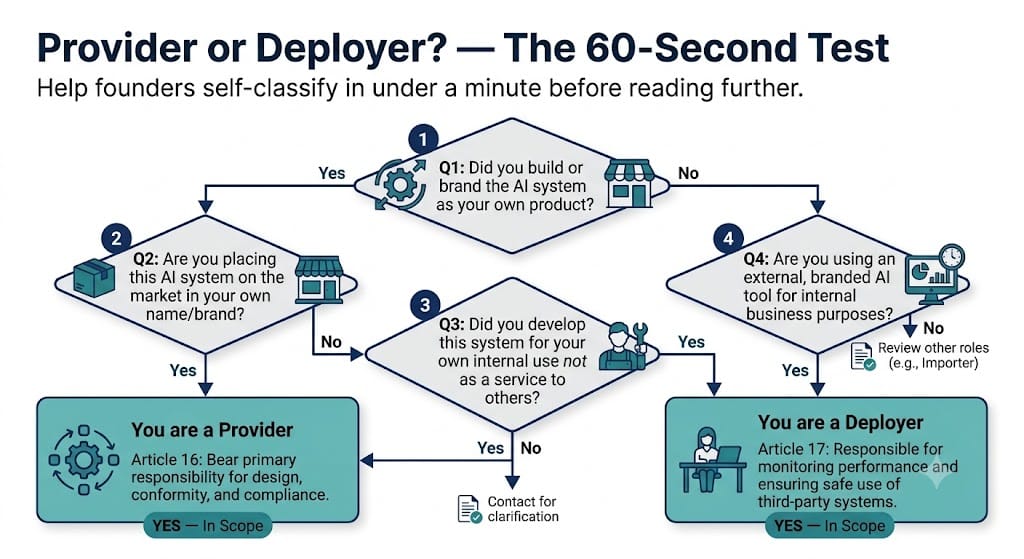
Step 1: Find Out If You’re a “Provider” or a “Deployer”
The single most important decision in your entire compliance journey is this classification, because it determines which obligations apply to you.
- A provider develops an AI system (or has one developed) and places it on the market or puts it into service under its own name or trademark (European Union, 2024, Art. 3(3)). Most SaaS companies that build their own models or fine-tune and productize a third-party model are providers of that system.
- A deployer uses an AI system under its own authority in the course of a professional activity, without being the one who built or branded it (European Union, 2024, Art. 3(4)). A company that simply plugs an off-the-shelf AI feature into an internal HR process, without reselling it, is typically a deployer.
Most SaaS companies selling AI-powered software to other businesses are providers — the heavier of the two obligation sets — because they are placing the system on the market under their own product name.
Official Resource: Regulation (EU) 2024/1689, Article 3(3)–(4) (definitions) — EUR-Lex
Step 2: Classify Your AI System’s Risk Tier
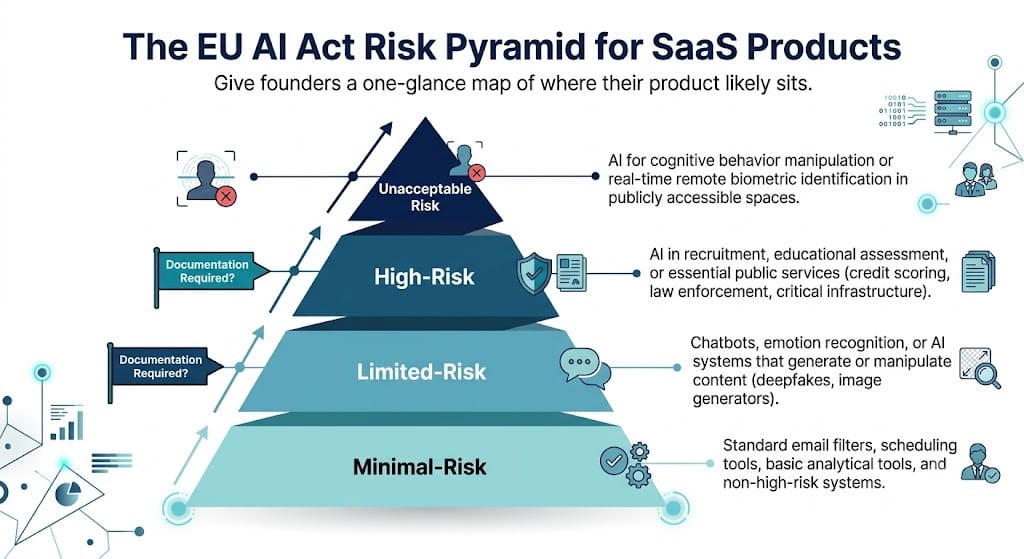
The EU AI Act uses a tiered, risk-based structure (European Union, 2024, Art. 6; Annex III):
| Risk Tier | What It Means | Example for SaaS |
| Unacceptable risk | Banned outright | Social scoring, certain manipulative or emotion-inference systems (Art. 5) |
| High-risk | Heaviest obligations — conformity assessment, technical documentation, human oversight | CV-screening tools, credit-scoring features, certain biometric or educational-assessment tools (Annex III) |
| Limited risk | Transparency obligations only | Chatbots, AI-generated content that must be disclosed as such (Art. 50) |
| Minimal risk | No specific AI Act obligations | Most internal analytics, spam filters, basic recommendation engines |
Two nuances matter for founders. First, even if your use case appears on the Annex III high-risk list, Article 6(3) allows you to determine — and document — that your specific system does not pose a significant risk, for example because it performs only a narrow procedural task or improves a previously completed human activity (European Union, 2024, Art. 6(3)). This documented self-assessment is not optional if you want to rely on the exemption. Second, if your AI system performs profiling of natural persons, it is automatically treated as high-risk regardless of the narrow-task exemptions (European Union, 2024, Art. 6(3), final subparagraph).
If your product uses a third-party GPAI model (an LLM API, for example), you also inherit transparency-related obligations toward that model, and — separately — the GPAI provider itself carries obligations under Articles 53–56, including additional duties if the model is classified as carrying “systemic risk” (European Union, 2024, Arts. 51–56).
Official Resource: European Commission — AI Act FAQs (risk classification guidance) — digital-strategy.ec.europa.eu/en/faqs/navigating-ai-act
Mini Case Study: An HR-Tech SaaS Startup Gets Procurement-Ready
Consider a scenario representative of many AspirixWriters readers: a small HR-tech SaaS company selling an AI-powered CV-screening tool to European recruitment agencies. Because the tool ranks job applicants, it falls within the Annex III category covering AI systems used in recruitment and selection. Rather than treating this as an unmanageable burden, the company’s two-person product team:
- Classified the feature under Annex III and documented why the narrow-task exemptions in Article 6(3) did not apply, since the system materially influences hiring decisions.
- Prepared lightweight technical documentation covering the model’s data sources, testing results, and human-review step before the ranking result reaches a recruiter.
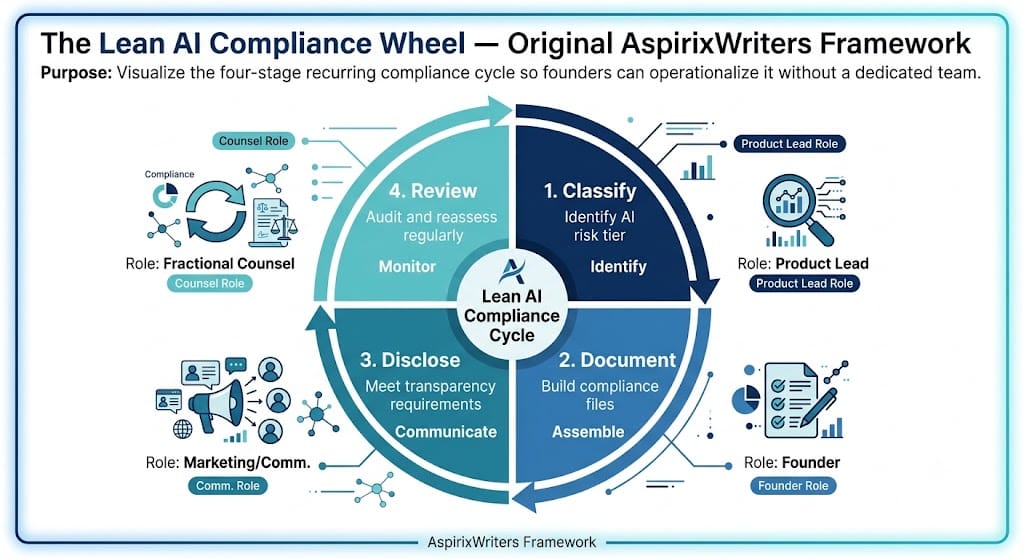
- Assigned its existing product manager as the part-time compliance owner, using the Lean AI Compliance Wheel described below.
When a German customer’s due-diligence questionnaire arrived, the company had a documented answer within a day — instead of scrambling for weeks. This is illustrative of the practical outcome the steps in this article are designed to produce; your own documentation and classification will depend on your specific system and should be verified against the official Regulation text.
Step 3: Build Compliance Into What You Already Do
This is where lean startups win. You do not need a compliance department — you need to fold four disciplines into your existing product and engineering workflow.
If you are high-risk, you need:
- A risk management system that runs across the AI system’s lifecycle (European Union, 2024, Art. 9).
- Data governance practices for your training, validation, and testing data, including examining the data for bias (European Union, 2024, Art. 10).
- Technical documentation demonstrating compliance, prepared before the system is placed on the market (European Union, 2024, Art. 11).
- Human oversight measures that allow a person to understand, monitor, and if necessary override the system (European Union, 2024, Art. 14).
- A conformity assessment before market entry — for most Annex III use cases (points 2–8), this can be done through internal control, without a notified body, which is significantly lighter for startups than third-party certification (European Union, 2024, Art. 43(2)).
If you are limited-risk (e.g., a chatbot): your main duty is transparency — telling users clearly that they are interacting with an AI system, unless this is obvious from the context (European Union, 2024, Art. 50).
Regardless of tier, appoint one internal owner — even part-time — who is responsible for tracking obligations. This does not need to be a hire; it can be your existing CTO, product lead, or a fractional/outsourced legal advisor reviewed quarterly.
Original AspirixWriters Framework: The Lean AI Compliance Wheel
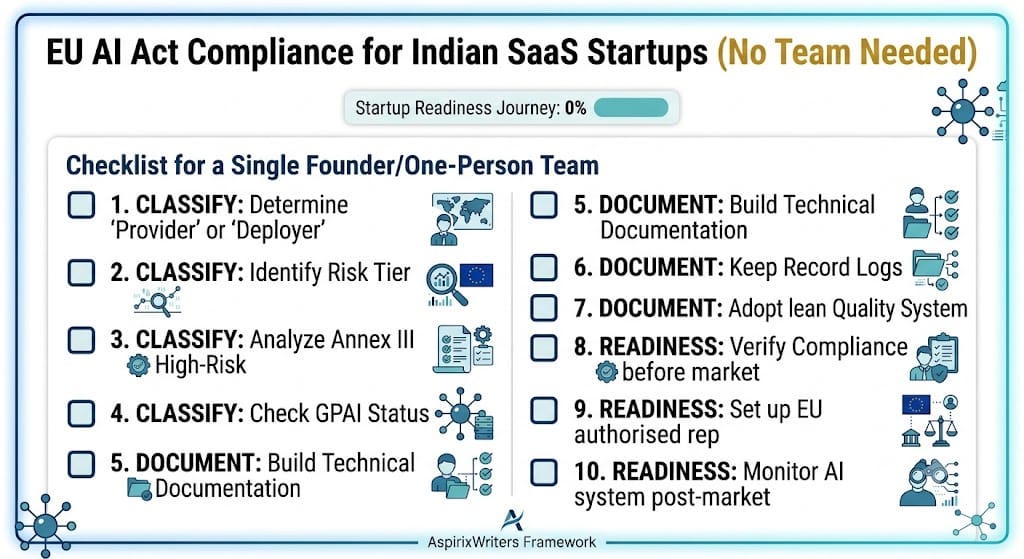
We built the Lean AI Compliance Wheel specifically for resource-constrained startups that cannot support a dedicated compliance function. It compresses the Regulation’s obligations into four recurring, ownable workstreams:
- Classify — Re-run your risk classification every time you ship a new AI feature.
- Document — Maintain a living technical file (system description, data sources, testing results, human oversight design).
- Disclose — Keep your transparency notices, vendor questionnaires, and customer-facing AI disclosures current.
- Review — Quarterly check against regulatory updates (the AI Act has staged implementation dates and is subject to ongoing amendment).
This is AspirixWriters analysis and original methodology, not an official EU AI Act requirement — it is a practical operating model for applying the legal requirements above with minimal headcount.
How a Lean Startup’s Approach Differs From an Enterprise’s
You are not expected to replicate a multinational’s compliance function. The obligations are the same in substance, but the operating model should scale to your size:
| Small Startup | Enterprise |
| One part-time compliance owner (e.g., product lead or founder) | Dedicated compliance team or governance department |
| Lightweight, living documentation updated per release | Formal governance program with audit trails |
| Quarterly regulatory review | Continuous monitoring and legal counsel on retainer |
| Internal-control conformity assessment where eligible (Art. 43(2)) | Often subject to third-party notified body assessment |
| Uses SME sandbox access and reduced fees (Art. 62) | Typically not eligible for SME provisions |
Step 4: Use the Regulatory Sandboxes and SME Support Built Into the Law
Founders often assume the EU AI Act treats every company the same way. It does not. The Regulation explicitly requires Member States to give SMEs and start-ups priority access to AI regulatory sandboxes — supervised testing environments — provided eligibility conditions are met (European Union, 2024, Art. 62(1)(a)). It also requires that conformity assessment fees be reduced proportionately for SME providers, based on their size and market presence (European Union, 2024, Art. 62(2)). Microenterprises are additionally permitted to comply with certain quality management system elements in a simplified manner (European Union, 2024, Art. 63(1)).
These provisions exist precisely because lawmakers anticipated that companies like Priya’s would need a lighter path. Use them.
Official Resource: European AI Office — SME and start-up support — digital-strategy.ec.europa.eu/en/policies/ai-office
Step 5: Know Your Realistic Timeline
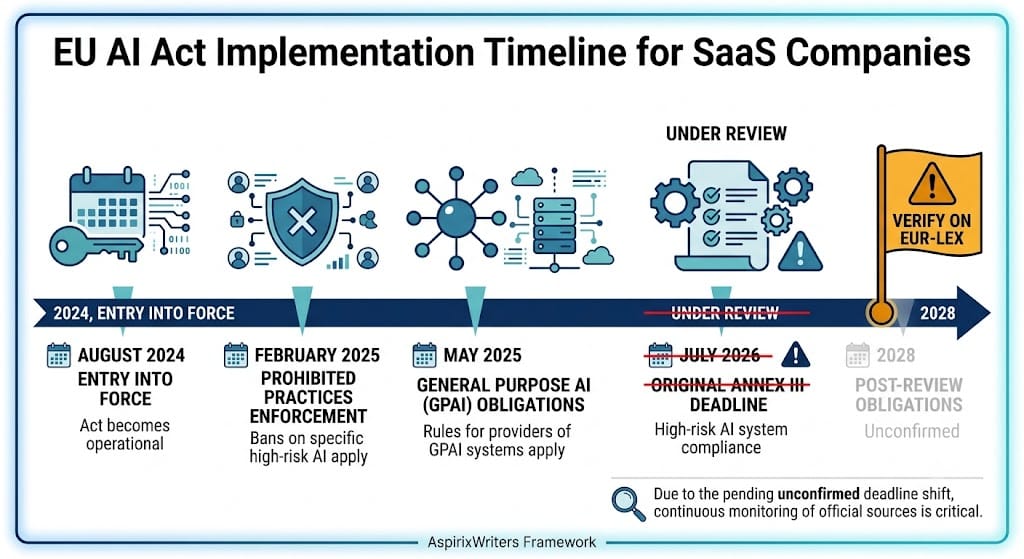
A regulatory note on timing: The EU AI Act entered into force in stages, with prohibited practices (Art. 5) and AI literacy obligations applying first, GPAI model obligations following, and the main body of high-risk obligations under Annex III originally scheduled for August 2026 (European Union, 2024, Art. 113). In May 2026, EU institutions reached a political agreement — reported as the “Digital Omnibus on AI” — that would push the main Annex III high-risk deadline to December 2027 and the Annex I deadline to August 2028.
Before you rely on any specific deadline for a compliance decision, confirm the current status directly on EUR-Lex (https://eur-lex.europa.eu/eli/reg/2024/1689/oj) or the European Commission’s AI Act page (https://digital-strategy.ec.europa.eu/en/policies/regulatory-framework-ai), since a political agreement is not the same as a binding, published amendment.
Official Resource: Official Journal of the European Union — eur-lex.europa.eu/oj/direct-access.html (check for published amending regulations before relying on any deadline)
Common Mistakes Indian SaaS Startups Make
- Assuming “we’re not in the EU” means the law doesn’t apply. It applies based on where the output is used, not where the company is based (European Union, 2024, Art. 2(1)(c)).
- Treating GPAI API use as someone else’s problem. Using an LLM API doesn’t remove your own obligations as a provider of the product built on top of it.
- Skipping documentation because “we assessed it’s not high-risk.” Article 6(4) requires that assessment to be documented — an undocumented judgment call offers no legal protection.
- Waiting for the compliance deadline to get close. Enterprise sales cycles and investor diligence already expect answers now.
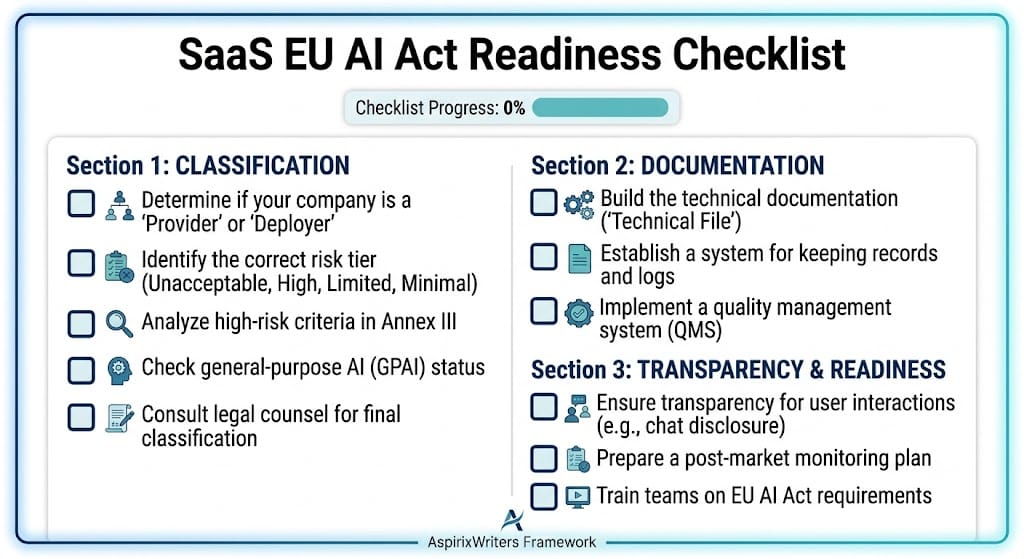
Checklist: Am I Ready for an EU AI Act Vendor Questionnaire?
Classification
- [ ] I know whether I am a provider or a deployer for each AI feature I sell.
- [ ] I have classified each AI feature against Article 5 (prohibited), Annex III (high-risk), Article 50 (limited-risk/transparency), or minimal-risk.
- [ ] I have completed an AI inventory listing every AI feature across my product.
Documentation
- [ ] I have a documented risk assessment for any Annex III-adjacent feature I believe is exempt.
- [ ] I have basic technical documentation for any high-risk feature, kept up to date.
- [ ] I maintain a vendor register listing every third-party AI model or API I use.
- [ ] Human oversight measures are clearly defined and documented for high-risk features.
Transparency & Readiness
- [ ] I have a transparency notice for any chatbot or AI-generated content feature.
- [ ] Relevant staff have completed basic AI literacy training.
- [ ] I have named one internal owner for AI Act compliance tracking.
- [ ] I check EUR-Lex or the European Commission’s AI Act page quarterly for updates.
FAQs
Does the EU AI Act apply if I have no office in the EU?
Yes, if your AI system’s output is used by people in the EU, the Regulation can apply regardless of where your company is incorporated (European Union, 2024, Art. 2(1)(c)). See our full breakdown in Does the EU AI Act Apply to My Company If I’m Not Based in Europe?
Do I need a notified body to certify my product?
Not necessarily. For most Annex III high-risk use cases (points 2–8), providers can follow a conformity assessment based on internal control, without third-party involvement (European Union, 2024, Art. 43(2)).
What if I only use someone else’s AI model through an API?
You may still be a provider of the resulting product you sell, with your own obligations, separate from the underlying model provider’s obligations under Articles 53–56.
Is there really a deadline extension to 2027?
A political agreement reported in May 2026 (the “Digital Omnibus on AI”) is understood to propose this, but it should be verified against EUR-Lex or the European Commission before being treated as binding law.
Can a five-person startup realistically comply without a lawyer?
Yes, for most limited- and minimal-risk products. High-risk products benefit from at least periodic input from external counsel or a fractional compliance advisor, even without a full-time hire.
Key Takeaways
- The EU AI Act can apply to your Indian SaaS company even without an EU office, based on where your AI system’s output is used (Art. 2(1)(c)).
- Your obligations depend heavily on whether you are a provider or a deployer, and which risk tier your product falls into.
- Most Annex III high-risk conformity assessments can be done through internal control — no notified body required for most use cases.
- SMEs and start-ups have statutory rights to sandbox access and reduced conformity assessment fees.
- The Regulation’s implementation timeline may be shifting under the 2026 Digital Omnibus discussions — verify current deadlines before making compliance decisions.
Conclusion
Priya’s story isn’t a cautionary tale about a startup that failed — it’s the story of thousands of founders realizing, mid-deal, that a European law now shapes their product roadmap. The good news is that the EU AI Act was written with proportionality in mind: lighter conformity paths, sandbox access, and reduced fees exist specifically for companies like hers. A small SaaS team can absolutely comply — not by hiring a compliance department, but by building classification, documentation, and disclosure into the workflow they already have.
Next Step
Download our free EU AI Act Risk Classification Checklist or explore our The EU AI Act Explained (2026): A Complete Guide for Businesses, Startups & AI Professionals to start building an AI governance program today — no compliance department required.
This article is for general informational purposes and does not constitute legal advice. Founders should consult legal counsel for advice specific to their AI system and market exposure.
About the Author
Dr. Rekha Khandelwal is the Founder of AspirixWriters and a legal researcher and writer specializing in AI Governance, AI Regulation, AI Compliance, AI Ethics, and Responsible AI. Her work focuses on translating complex legal and technical frameworks — including the EU AI Act — into practical guidance for businesses, professionals, researchers, and students navigating the global AI governance landscape.
Explore more AspirixWriters resources on EU AI Act compliance, including our complete guide and free risk classification checklist, to continue building your organization’s AI governance foundation.
Official Sources: EUR-Lex — Regulation (EU) 2024/1689,
European Commission — Regulatory Framework for AI,