
Startup Chatgpt AI Policy
Arjun runs a 12-person fintech startup in Mumbai. His team uses ChatGPT every day — for writing emails, summarising contracts, drafting pitch decks, even reviewing terms and conditions. Nobody asked for permission. It just happened. And Arjun is fine with it because productivity is up and nobody is complaining.
Then one day, his developer pastes an entire client database into ChatGPT to “clean up the formatting.” A team member uses a personal free-tier account to summarise a confidential investor memo. And a sales executive sends a customer’s financial details into a prompt asking for help writing a proposal.
Arjun had no idea any of this was happening. He had no policy.
This is not a hypothetical. It is the most common AI governance failure in startups today — and it is completely preventable.
1. Quick Answer
Yes, your startup needs an AI policy — even if you have only five employees. An AI policy tells your team which tools are approved, what data they cannot share with AI systems, who reviews AI outputs before they are used, and what happens if something goes wrong. Without one, your team will keep using ChatGPT unsupervised, and the risks — data leaks, compliance violations, legal liability — grow silently every day.
Decision Flow — Does My Startup Need an AI Policy?
Using ChatGPT at work?
↓
Personal tasks only (no client or company data)?
↓ Yes → Lower risk, but a basic policy still helps
Using client data, source code, or internal documents?
↓ Yes
→ You need an AI policy
↓
→ Move your team to ChatGPT Business plan
↓
→ Add human review for sensitive outputs
↓
→ You are now compliant and protected
At a Glance
- 80% of knowledge workers already use ChatGPT or similar tools regularly — most without IT approval (aona.ai, ChatGPT enterprise security guide 2026).
- On the free tier, OpenAI may use your conversations to improve its models. Client data, source code, and financial details do not belong there.
- ChatGPT Business ($25/user/month) excludes your data from model training by default — a critical distinction most founders miss.
- The EU AI Act adds legal obligations for startups using AI in high-risk decisions like hiring or credit scoring, effective 2026 (beltsys.com, ChatGPT for business guide 2026).
- An AI policy does not have to be long or complex. A well-written one-page document already puts you ahead of most startups.
2. Does This Apply to You?
| Reader | Should you keep reading? |
| Startup founder (any sector) | Yes — this is a governance gap in almost every early-stage company |
| Developer or CTO | Yes — free-tier vs paid-tier data handling is a technical decision with legal consequences |
| Operations or HR lead | Yes — AI policy lives in your team handbook, not just your legal files |
| In-house lawyer or compliance officer | Yes — the EU AI Act and GDPR add specific obligations that an informal “just use it” approach cannot satisfy |
| SaaS founder selling to EU customers | Yes, urgently — your customers will start asking for your AI policy before signing contracts |
| Student or early-stage entrepreneur | Yes — building good AI habits from day one is far cheaper than fixing them later |
3. Why This Matters
Your team is already using AI. The question is whether it’s governed.
ChatGPT crossed 300 million weekly active users in early 2026, making it the fastest-adopted technology tool in corporate history (startbrain.ai, ChatGPT for business enterprise guide 2026). The majority of those users are in workplaces. Many are in startups. Most are using personal accounts with no organisational oversight at all.
This matters for five reasons:
Data privacy. When an employee pastes a client’s personal data or your company’s source code into a free ChatGPT account, that data may be used to train future AI models under OpenAI’s current free-tier terms — though OpenAI’s policies can and do change, so always verify the latest terms directly at openai.com/policies. Most employees never read those terms at all. A policy does that reading for them and sets a rule they can actually follow.
Legal liability. If a client’s confidential information leaks through an AI tool your employee used without authorisation, you are the one explaining it to a regulator — not OpenAI. GDPR, India’s DPDP Act, and sector-specific regulations in finance and healthcare all create liability for data controllers, which means you.
Output quality. Without a review process, AI-generated content goes straight into emails, proposals, legal documents, and customer-facing communications. ChatGPT is confident even when it is wrong. A human review requirement catches errors before they reach a client.
EU AI Act exposure. If you use AI in decisions that affect people — hiring, credit assessment, performance management — the EU AI Act creates specific obligations including transparency, human oversight, and impact assessments (Regulation (EU) 2024/1689, Art. 6 and Annex III). “We didn’t know ChatGPT was involved in that decision” is not a defence.
Investor and customer trust. Enterprise buyers and investors in 2026 are beginning to ask about AI governance as part of due diligence. Not having a policy is a red flag — it signals you haven’t thought through your operational risks.
Practical Insight: An AI policy is not bureaucracy. It is the document that answers the question “what do we do when something goes wrong?” — before something goes wrong.
4. Understanding the Problem: What Is Shadow AI?
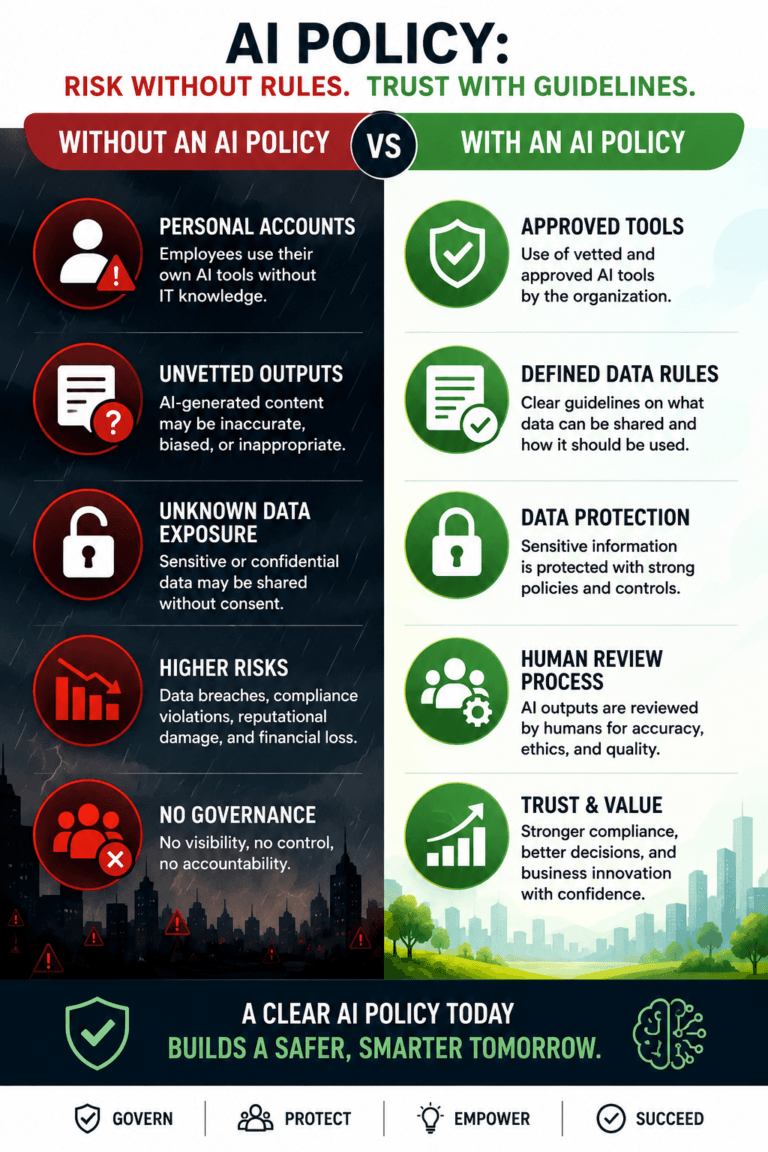
Shadow AI is what happens when employees use AI tools without their employer’s knowledge or approval. It is the AI equivalent of shadow IT — and it is happening in almost every startup right now.
The problem is not that employees are using ChatGPT. The problem is that they are using it:
- On personal free-tier accounts where data may be used for model training
- Without knowing which data is safe to share
- Without any human review of outputs before they are acted on
- Without any record of what was shared or generated
One industry survey found that a significant share of organisations report employees using AI tools without IT approval, creating unmanaged data privacy exposure.
This is not a technology problem. It is a communication and governance problem. Employees are not being reckless — they are filling a gap where guidance should exist. An AI policy fills that gap.
5. What an AI Policy Actually Covers
A good AI policy is not a long legal document. It is a clear, practical set of rules your team can actually read and follow. It covers five things:
1. Which tools are approved. Name the specific AI tools your team is allowed to use for work. If ChatGPT is approved, specify which plan — free, Business, or Enterprise. If other tools like Claude, Gemini, or Copilot are also in use, include them. Tools not on the list are not approved for work use (optro.ai, employee AI usage policy guide 2026).
2. What data can and cannot be shared. Create three simple buckets:
- Green — public information, general research, anonymised examples. Fine to share with any approved AI tool.
- Amber — internal documents, meeting notes, product roadmaps. Only on approved paid plans with data training turned off.
- Red — client personal data, source code, financial records, legal advice, anything under NDA. Never into an external AI tool without a specific contractual data-processing agreement in place.
3. Who reviews AI outputs before they are used. Not every output needs review. A brainstormed list of blog topics is low stakes. A contract clause, a financial summary, or a compliance document is not. The policy should specify which categories of output require human review before they reach a client, a regulator, or an internal decision.
4. What is prohibited. Be explicit. Examples of prohibited uses: impersonating a real person, generating false information and presenting it as verified, using AI to make final hiring or credit decisions without human review, using personal accounts for any work involving client data (trainual.com, ChatGPT policy template).
5. What to do if something goes wrong. Incident reporting. If an employee accidentally shares data they shouldn’t have, the policy needs to tell them: stop, report it to [name or role], within [timeframe]. This is not just good practice — under GDPR and India’s DPDP Act, data incidents may require formal notification within set timelines.
Practical Insight: Write the policy for your least experienced team member, not your most senior one. If your newest hire can read it and know exactly what to do, it’s working.
6. The ChatGPT Plan Problem Every Startup Ignores
This is the most important practical decision in your AI governance setup — and most founders get it wrong by default.
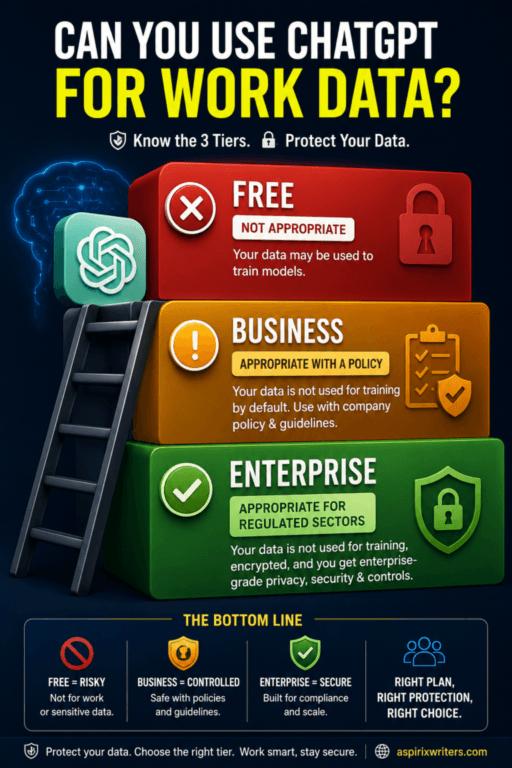
ChatGPT offers four tiers for business: Free, Plus, Team (now Business), and Enterprise — each with different data handling guarantees.
Here is what that actually means for your startup:
| Plan | Price | Data used for training? | Best for |
| Free | $0 | May be used for training by default* | Personal use only. Never for client or company data |
| Plus | $20/month | Not used for training (verify current settings) | Individual professionals, light business use |
| Business | $25/user/month | Excluded by default, DPA provided* | Startups — this is usually the right entry point |
| Enterprise | ~$60/user/month | Excluded with contractual guarantees + audit logs | Regulated sectors, large teams, EU compliance |
*OpenAI’s plan terms, pricing, and data-handling defaults change regularly. Always verify the latest position directly at openai.com/policies and help.openai.com before making compliance decisions based on this table.
OpenAI has reached approximately 5 million paying business users combining Business and Enterprise plans, suggesting strong adoption among organisations that have understood the data-handling distinction.
The practical rule: if your team is doing anything involving clients, contracts, finances, or internal strategy — they should be on ChatGPT Business at minimum, not free personal accounts. The cost difference is trivial compared to the cost of a data breach or a GDPR enforcement notice.
7. What the Law Says
GDPR (if you have EU users or customers) Under GDPR, you are a data controller if you process personal data of EU residents. Using ChatGPT to process that data — even just summarising a client email — makes OpenAI a data processor. That relationship needs a Data Processing Agreement (DPA). OpenAI provides a DPA for Business and Enterprise customers. It does not exist for free or Plus accounts used informally (aona.ai, ChatGPT enterprise security guide 2026).
India’s DPDP Act, 2023 India’s Digital Personal Data Protection Act applies to anyone processing personal data of Indian residents. The obligations include purpose limitation, data minimisation, and security safeguards. Pasting a customer’s KYC data into ChatGPT without a defined purpose and safeguard likely violates the spirit — and possibly the letter — of the Act once its rules are fully notified (DPDP Act, 2023, Sections 8–11).
EU AI Act (if your product uses AI in decisions) If your startup uses AI — including ChatGPT — to make or assist decisions in areas like hiring, credit scoring, or performance management, the EU AI Act may classify those uses as high-risk (Regulation (EU) 2024/1689, Art. 6 and Annex III). High-risk AI uses require transparency, human oversight, and documentation. Using a free ChatGPT account informally for these decisions satisfies none of those requirements.
Practical Insight: You don’t need to be a large company for these laws to apply. GDPR enforcement actions have hit organisations of all sizes. The DPDP Rules, once notified, will follow the same pattern in India.
8. Real-World Examples
The developer who shared source code. A well-known example — now widely cited in enterprise security guides — involves developers pasting proprietary code into ChatGPT to get help debugging. The code is then potentially used in model training. For a startup whose IP is its codebase, this is an existential risk dressed up as a productivity habit (aona.ai, ChatGPT enterprise security guide 2026). The fix is simple: approved paid plan plus a rule that source code is Red-category data.
The sales team that over-shared. A startup sales team uses ChatGPT to help draft proposals. One team member copies a prospect’s entire financial profile — shared under NDA — into a prompt asking for help tailoring the pitch. No policy existed to stop this. No one knew it happened until an audit six months later. The data was gone. The NDA was potentially breached. The deal was lost.
Case study: HR-tech startup builds a policy in three days. A 20-person HR-tech startup in Hyderabad was using ChatGPT to draft job descriptions, screen application summaries, and generate interview questions. When a large enterprise client asked during contract negotiations whether the startup had an AI governance policy, the founder realised they had nothing to show.
Over three days, the co-founder and one legal advisor did the following: audited which team members were using ChatGPT and on which accounts (Day 1); classified all their use cases into Green, Amber, and Red categories (Day 2); drafted a one-page policy and migrated the team to ChatGPT Business (Day 3). The client signed the contract. The policy, once in place, also helped the team recognise that their AI-assisted candidate-screening feature likely fell under Annex III of the EU AI Act — something they had not considered before.
The lesson: an AI policy is not just a risk document. It is a business enablement document that can open doors, not just close vulnerabilities.
Did You Know? An effective ChatGPT policy balances security with usability — overly restrictive policies drive usage underground, while permissive policies leave the organisation exposed. The goal is not to ban AI. It is to channel it.
9. Common Mistakes
- Assuming the free tier is fine for work use — it’s not. Data privacy defaults differ dramatically from paid plans.
- Writing a policy but never sharing it — a document nobody has read does not protect you.
- Banning AI entirely — this drives shadow AI underground. Your team will still use it; you just won’t know.
- Forgetting contractors and freelancers — they use AI too. Your policy needs to cover them.
- No incident reporting process — if a data leak happens, you need a clear response path, not improvisation.
- Not updating the policy — AI tools change fast. A policy written in January 2025 may not cover the tools your team is using in June 2026.
10. Myth vs Fact
| Myth | Fact |
| “We’re too small to need an AI policy.” | Data protection laws apply regardless of company size. GDPR and DPDP Act don’t have startup exemptions. |
| “ChatGPT keeps everything confidential.” | On free and Plus plans, data may be used for training. Only Business and Enterprise plans offer clear contractual data protections (OpenAI help centre, Enterprise and Business plan terms). |
| “Our team is sensible — they wouldn’t share anything sensitive.” | Employees share data accidentally, not maliciously. Without a clear policy, they don’t know where the line is. |
| “An AI policy will slow us down.” | A one-page policy takes two hours to write. A data breach investigation takes months and costs multiples of that. |
| “The EU AI Act only affects EU companies.” | It applies to any company whose AI output is used by EU residents — including Indian startups with EU customers. |
11. Your AI Policy Starter Checklist
Use this to build your first AI policy document — or audit the one you already have:
- [ ] List every AI tool currently used by your team (including unapproved personal accounts).
- [ ] Define three data categories: Green (shareable), Amber (paid plans only), Red (never share externally).
- [ ] Specify which ChatGPT plan is approved — and confirm all team members are on it.
- [ ] Name which types of AI outputs require human review before use.
- [ ] List explicitly prohibited uses — client personal data, source code, NDA-covered documents.
- [ ] Write a simple incident reporting process: who to tell, within what timeframe.
- [ ] Check whether you need a Data Processing Agreement with OpenAI (required for EU personal data).
- [ ] Share the policy with every team member, including freelancers and contractors.
- [ ] Set a review date — at minimum every 6 months given how fast AI tools change.
Your 5-day implementation timeline:
| Day | Action |
| Day 1 | Identify every AI tool your team is currently using — including personal accounts |
| Day 2 | Classify your data into Green / Amber / Red buckets |
| Day 3 | Draft the policy (one page is enough to start) |
| Day 4 | Share with the team, answer questions, confirm everyone has read it |
| Day 5 | Upgrade accounts to ChatGPT Business if not already done |
| Every 6 months | Review and update — tool terms and regulations change fast |
Free Download: A one-page AI Policy Template for Startups (PDF) is available from the AspirixWriters resource library.
12. Frequently Asked Questions
1. Does a startup really need a formal AI policy?
Yes. Even a one-page document that defines approved tools, prohibited data types, and a review process is infinitely better than nothing. Regulators and enterprise clients increasingly expect to see one.
2. What is the difference between ChatGPT free and ChatGPT Business for data privacy?
On the free tier, conversations may be used to improve OpenAI’s models by default. On the Business plan ($25/user/month), data is excluded from model training by default and OpenAI provides a Data Processing Agreement — both critical for business use (OpenAI Business plan terms).
3. Does GDPR apply to my startup if I’m based in India?
Yes, if you process personal data of EU residents — including EU customers, users, or employees. Processing that data through ChatGPT without a Data Processing Agreement likely creates a GDPR compliance gap.
4. What is shadow AI and why does it matter?
Shadow AI is the use of AI tools by employees without organisational knowledge or approval. It matters because data shared through unapproved personal accounts is outside your control — and outside your data protection obligations (optro.ai, employee AI usage policy).
5. Does the EU AI Act affect Indian startups?
Yes, if your product uses AI in ways that touch EU users — especially in high-risk areas like hiring, credit, or healthcare (Regulation (EU) 2024/1689, Art. 2). The Act’s scope is based on where AI is used, not where the company is incorporated.
6. Can I use ChatGPT to write the policy itself?
Yes — that is perfectly reasonable. Use it to draft, then have a legal professional review the final version, especially the data handling and liability sections.
7. How long should the policy be?
For most startups, one to two pages is enough. The goal is a document your team will read and remember — not a 40-page legal manual nobody opens.
8. How often should the policy be updated?
At minimum every six months. AI tools, plan terms, and regulations are changing fast enough that an annual review is not sufficient.
13. Key Takeaways
- Your team is already using ChatGPT. An AI policy governs how — it does not stop them.
- Free-tier ChatGPT has different data-handling defaults than Business or Enterprise plans. Most startups are on the wrong tier for the work they’re doing.
- An AI policy covers five things: approved tools, data categories, output review rules, prohibited uses, and incident reporting.
- GDPR, India’s DPDP Act, and the EU AI Act all create legal obligations that informal ChatGPT use can violate.
- A one-page policy written this week already puts you ahead of most startups of your size.
14. What Should You Do Next?
Founder / CEO: Spend two hours this week writing a one-page AI policy using the checklist above. Share it at your next all-hands. Upgrade your team to ChatGPT Business if they aren’t already.
Developer or CTO: Audit your current AI tool usage — who is using what, on which accounts, for what tasks. Flag anything involving source code or internal systems as Red-category immediately.
Operations or HR lead: Add the AI policy to your employee handbook and onboarding pack. Make sure contractors and freelancers sign the same agreement as full-time employees.
Lawyer or compliance officer: Review whether your OpenAI relationship requires a formal Data Processing Agreement under GDPR or DPDP Act obligations. Check whether any current uses touch EU AI Act high-risk categories.
SaaS founder selling to EU enterprise: Your next B2B contract review may include a question about your AI governance policy. Build one now, before the sales process creates the pressure to have it ready yesterday.
15. Conclusion
The question is not really “do I need an AI policy?” The question is: “do I want to find out what happens when I don’t have one?”
Your team is already using ChatGPT. Some of them are probably sharing things they shouldn’t. Not because they’re careless — because nobody told them where the line is. An AI policy is simply the document that draws that line clearly, protects your clients, protects your company, and tells your team that you’re running AI governance seriously.
It doesn’t have to be long. It doesn’t have to be complex. It just has to exist.
Call to Action
Need help creating an AI policy tailored to your startup? AspirixWriters provides AI governance content, compliance guidance, and practical resources for founders building responsibly. Whether you need a one-page internal policy, a full AI governance framework, or simple-english explainers on the EU AI Act and DPDP Act for your team — start with the resources below or reach out directly.
If this article was useful, the next reads in the AspirixWriters AI Regulatory Framework hub are:
Related Reading
- Does the EU AI Act Apply to Indian Companies?
- Is Your AI System High-Risk? Here’s How to Check
- EU AI Act: Complete Guide for Startups
- India’s DPDP Act, 2023: What It Covers
- NIST AI RMF Explained
Written by
Dr. Rekha Khandelwal Legal Researcher | AI Governance Writer | Author | Assistant Professor (Law) Founder – AspirixWriters
About the Author
Dr. Rekha Khandelwal is a legal researcher, financial educator, and AI governance writer specialising in AI regulation, digital law, and emerging technology governance. Through AspirixWriters, she publishes practical, research-backed guides that help startups, businesses, and professionals navigate complex legal and regulatory frameworks in simple English.
Author’s Note
This article is for educational and informational purposes only and does not constitute legal advice. AI tool terms, pricing, and regulatory obligations change frequently — verify current plan terms directly with OpenAI and consult your legal professional for advice specific to your jurisdiction and business circumstances.
Review Information
Last Reviewed: June 2026 Next Review: Within 6 months or upon any major change to ChatGPT plan terms, GDPR enforcement guidance, or DPDP Act rules.
Official References
- Regulation (EU) 2024/1689 — EU AI Act, Articles 2, 6, and Annex III. Official Journal of the European Union. https://eur-lex.europa.eu/eli/reg/2024/1689/oj/eng
- OpenAI — ChatGPT Business Plan Terms and Release Notes. https://help.openai.com/en/articles/11391654-chatgpt-business-release-notes
- OpenAI — ChatGPT Enterprise: Models, Limits, and Workspace Settings. https://help.openai.com/en/articles/11165333-chatgpt-enterprise-and-edu-models-limits
- OpenAI — Usage Policies. https://openai.com/policies/usage-policies/
- European Commission — GDPR: Rules for Businesses and Organisations. https://commission.europa.eu/law/law-topic/data-protection_en
- Ministry of Electronics and Information Technology — Digital Personal Data Protection Act, 2023. https://www.meity.gov.in/data-protection-framework
- AI Act Service Desk — Article 6: Classification Rules for High-Risk AI Systems. https://ai-act-service-desk.ec.europa.eu/en/ai-act/article-6
- SHRM — Generative AI Usage Policy Template. https://www.shrm.org/topics-tools/tools/policies/chatgpt-generative-ai-usage
- Aona AI — ChatGPT Enterprise Security Guide 2026. https://aona.ai/blog/chatgpt-enterprise-security-guide/
- Optro AI — AI Usage Policy: Defining Acceptable AI Use by Employees. https://optro.ai/blog/employee-ai-usage-policy
- Academic Writing
- AI Governance
- AI in Business & Marketing
- AI in Content Creation
- AI in Research & Education
- AI In SEO
- AI Tools & Review
- Creative Writing & Storytelling
- General
- Income Tax
- Indian Laws
- Legal Drafting & Pleading
- Mutual Funds
- Trending
How to Classify Your AI System Under the EU AI Act (Guide)
EU AI Act Risk Classification Step-by-Step How Do I Classify My AI System Under the…
My SaaS Uses ChatGPT — Am I Regulated Under the EU AI Act? AI Act ChatGPT Integration Compliance
EIU AI Act ChatGPT Integration Compliance Rohan built a customer-support SaaS tool in Pune. Under…
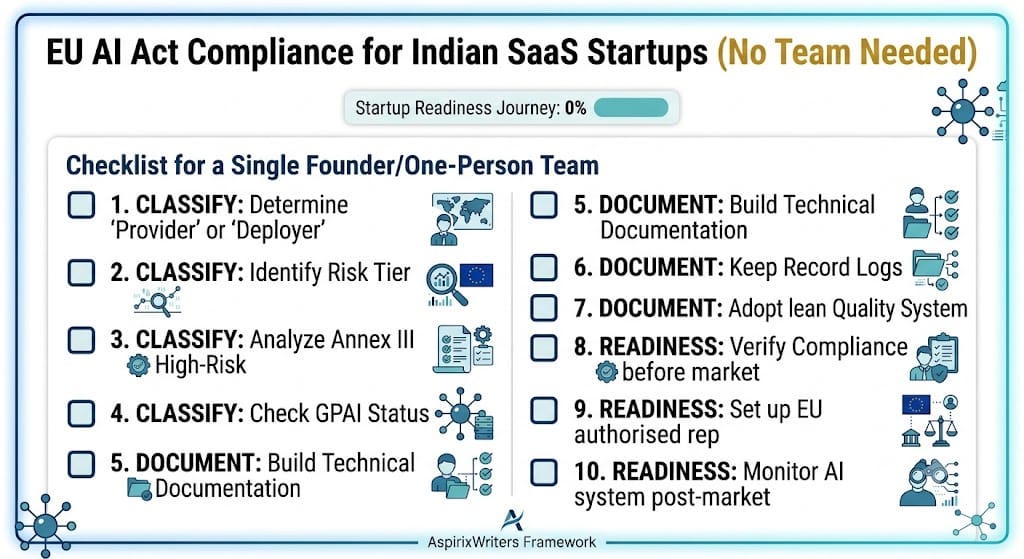
EU AI Act Compliance for Indian SaaS Startups (No Team Needed)
How Can an Indian SaaS Startup Comply with the EU AI Act Without Hiring a…
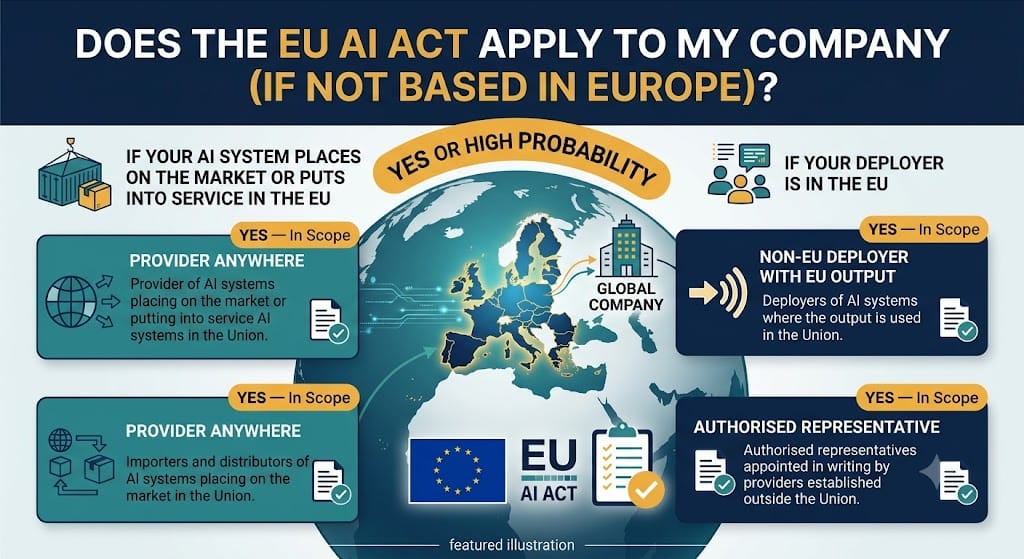
Does the EU AI Act Apply to My Company If I’m Not Based in Europe?
Does the EU AI Act apply to Non-EU Companies Quick Answer Yes — in most…
The EU AI Act Explained (2026): A Complete Guide for Businesses, Startups & AI Professionals
The EU AI Act Explained Reviewed Against: Regulation (EU) 2024/1689 and official European Commission guidance….

How to Check Is Your AI System High-Risk Under the EU AI Act (2026)
Is Your AI System High-Risk Under the EU AI Act (2026)? Rohan is a product…