
Great Content Still Needs On-Page SEO
You can write the most informative blog in your niche — but without proper on-page SEO, it may never rank.
On-page SEO helps search engines understand your content and helps readers consume it easily. In 2026, Google prioritizes clarity, usefulness, and experience, not keyword stuffing.
This on-page SEO checklist for blog posts will help you optimize every article before hitting publish.
What Is On-Page SEO?
On-page SEO refers to all optimizations done inside a blog post, including:
- Content structure
- Keywords
- Headings
- Internal links
- Images
- Page experience
Unlike technical SEO, this is fully under your control as a writer or blogger.
Complete On-Page SEO Checklist for Blog Posts
1. Target One Primary Keyword Only
Each blog should focus on one main keyword.
Best practices:
- Use it in the title
- Use it naturally in the introduction
- Add it in headings where relevant
- Avoid forced repetition
Keyword clarity improves rankings.
2. SEO-Optimized Title (H1)
Your blog title should be:
- Clear
- Helpful
- User-focused
Good example:
On-Page SEO Checklist for Blog Posts (2026 Guide)
Avoid clickbait or misleading titles.
3. Write a Helpful Introduction
Your introduction should:
- Address the reader’s problem
- Explain what they will learn
- Encourage them to continue reading
Google evaluates whether users find value early.
4. Proper Heading Structure (H2, H3)
Use headings to organize content.
| Element | Best Practice |
|---|---|
| H1 | One per page |
| H2 | Main sections |
| H3 | Sub-points |
| Headings | Clear & descriptive |
This improves readability and crawlability.
5. Content Readability & Formatting
Readable content performs better.
- Short paragraphs
- Bullet points
- Tables where helpful
- Simple language
Write for humans first — SEO follows.
6. Internal Linking (Very Important)
Link to:
- Related blogs
- Pillar pages
- Supporting content
Benefits:
- Improves site structure
- Reduces bounce rate
- Helps Google understand relationships
7. Image Optimization Checklist
For every image:
- Use compressed images
- Add descriptive alt text
- Avoid keyword stuffing in alt text
Images improve engagement and accessibility.
8. Meta Title & Meta Description
These appear in search results.
Meta title tips:
- Include primary keyword
- Stay within length limit
Meta description tips:
- Summarize value
- Encourage clicks
9. URL Structure
Keep URLs:
- Short
- Clean
- Keyword-focused
Right –/on-page-seo-checklist-blog-posts
Wrong – /p=123?ref=abc
10. Content Accuracy & Trust Signals
Google values:
- Accurate information
- Clear explanations
- Reliable references
Always update content when needed.
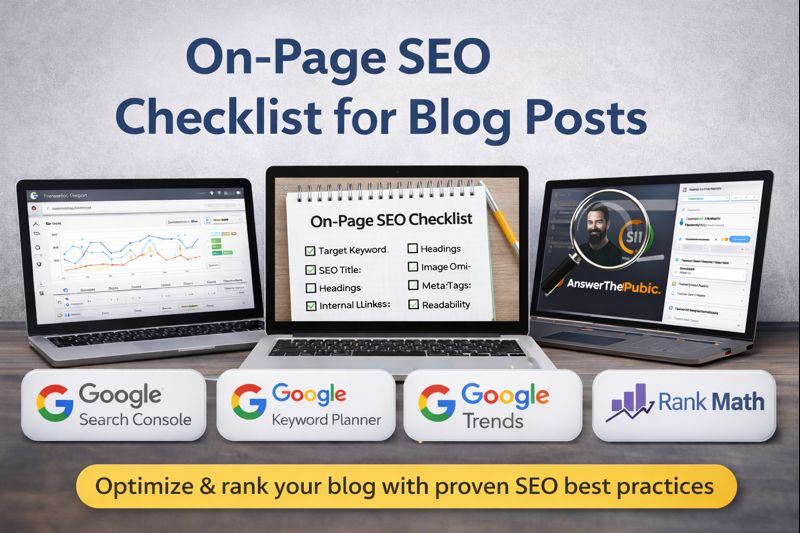
On-Page SEO Checklist (Quick Table)
| Area | Done? |
|---|---|
| Primary keyword defined | ☐ |
| SEO-friendly title | ☐ |
| Clear introduction | ☐ |
| Headings structured | ☐ |
| Internal links added | ☐ |
| Images optimized | ☐ |
| Meta title & description | ☐ |
| Readability checked | ☐ |
Use this before publishing every blog.
Common On-Page SEO Mistakes to Avoid
- Keyword stuffing
- Long unformatted paragraphs
- Ignoring internal links
- Missing alt text
- Writing only for search engines
FAQs
1. What is On-Page SEO in blogging?
On-Page SEO is the process of optimizing individual blog posts to improve their ranking on search engines like Google. It includes optimizing the title, headings, keywords, content quality, internal links, images, and meta tags to make the post more useful for readers and easier for search engines to understand.
2. Why is On-Page SEO important for blog posts?
On-Page SEO helps your blog rank higher, attract more organic traffic, and improve user experience. Without proper optimization, even high-quality content may not appear in search results.
3. What is the most important On-Page SEO factor?
The most important factor is high-quality, helpful content that satisfies search intent. Google prioritizes content that solves problems, answers questions, and provides real value.
4. How many keywords should I use in a blog post?
Use one primary keyword and 3–5 related keywords naturally. Avoid keyword stuffing. Focus on readability and usefulness.
5. How do headings help in On-Page SEO?
Headings (H1, H2, H3) improve readability and help search engines understand your content structure. They also increase your chances of ranking in featured snippets.
6. Should I add images for On-Page SEO?
Yes. Images improve user experience and engagement. Always add ALT text with keywords so search engines can understand the image.
7. What is internal linking in SEO?
Internal linking means linking to other relevant posts on your website. It helps search engines crawl your site and increases the time users spend on your website.
8. What is a meta title and meta description?
Meta title and description are short summaries that appear in Google search results. They help users decide whether to click your blog post.
9. How can I optimize my blog post for Google ranking?
You can optimize by:
Using the main keyword in the title
Writing helpful and original content
Using headings properly
Adding internal and external links
Optimizing images
Writing an SEO-friendly meta description
Conclusion:
On-Page SEO Turns Content Into Results
On-page SEO Checklist is not about tricks — it’s about clarity, structure, and usefulness.
When you follow this checklist consistently, your blogs:
- Rank better
- Read better
- Perform better
Use On-page SEO Checklist as your pre-publish standard.
Step-by-Step Guide To Writing SEO-Optimised Blog That Rank On Google (2026)
References
Google Search Central – SEO Starter Guide
https://developers.google.com/search/docs/fundamentals/seo-starter-guide
Google Search Essentials
https://developers.google.com/search/docs/essentials
Google – Creating Helpful, Reliable, People-First Content
https://developers.google.com/search/docs/fundamentals/creating-helpful-content
Google Page Experience & Core Web Vitals
https://developers.google.com/search/docs/appearance/page-experience
- Academic Writing
- Editing & Proofreading
- SME Writing Services
- SEO Blogwriting Services
- Creative & Ghostwriting
- Academic Writing
- AI Ethics & Future
- AI in Academic Research
- AI in Business & Marketing
- AI in Content Creation
- AI in Design & Development
- AI in Education/Teaching
- AI in Research
- AI Tools & Review
- Indian Laws
- Motivation
- SEO & Digital Marketing
- Writing & Content Creation

Best Free SEO Tools for Blog Writers in 2026 (Trusted & Beginner-Friendly)
Free SEO Tools for blog writers – Good Writing Needs the Right SEO Tools Writing…

How to Create an SEO Content Strategy for Your Website (That Actually Works)
Introduction: Random Content Doesn’t Rank Anymore Many websites publish blogs regularly but still struggle with…
How to Do Keyword Research for Blog Writing in 2026 (Even if You’re a Beginner)
Step by step guide – Keyword Research for Blog Writing Imagine this: You spend 6…
On-Page SEO Checklist for Blog Posts (2026 Complete Guide)
Great Content Still Needs On-Page SEO You can write the most informative blog in your…
Step-by-Step Guide to Writing SEO-Optimised Blog That Rank on Google (2026)
Introduction You may be writing amazing blogs… but if Google can’t “understand” them properly, no…
Why Businesses Need SEO Blog Writing Services (Not Just Blogs)
Introduction: Blogging Isn’t the Problem — Unoptimized Blogging Is Many businesses publish blogs regularly, yet…