Last Updated: April 19, 2026
(Module 3) – Complete Guide Research Methodologies
From Concept to Submission: A Complete Guide to Research Paper and Thesis Writing
Academic Writing Mastery: The Complete 2026 Guide To Research Papers, Thesis & Dissertation Writing
(Module 1) Complete Guide – The Complete Guide To Research Paper Structure: IMRAD Format, Thesis Organization & Academic Writing (2026)
(Module 2) Complete Guide – The Academic Writing Process: Complete Guide from First Draft to Submission (2026)
Why Methodology Determines Research Quality
Here’s what thesis examiners focus on first: your methodology section (Research Methodologies). Not your findings, not your discussion—your methods. Why? Because flawed methodology invalidates everything else.
Think about it: if you study the wrong people, ask the wrong questions, or analyze data incorrectly, your conclusions are worthless. Brilliant analysis of bad data is still bad research.
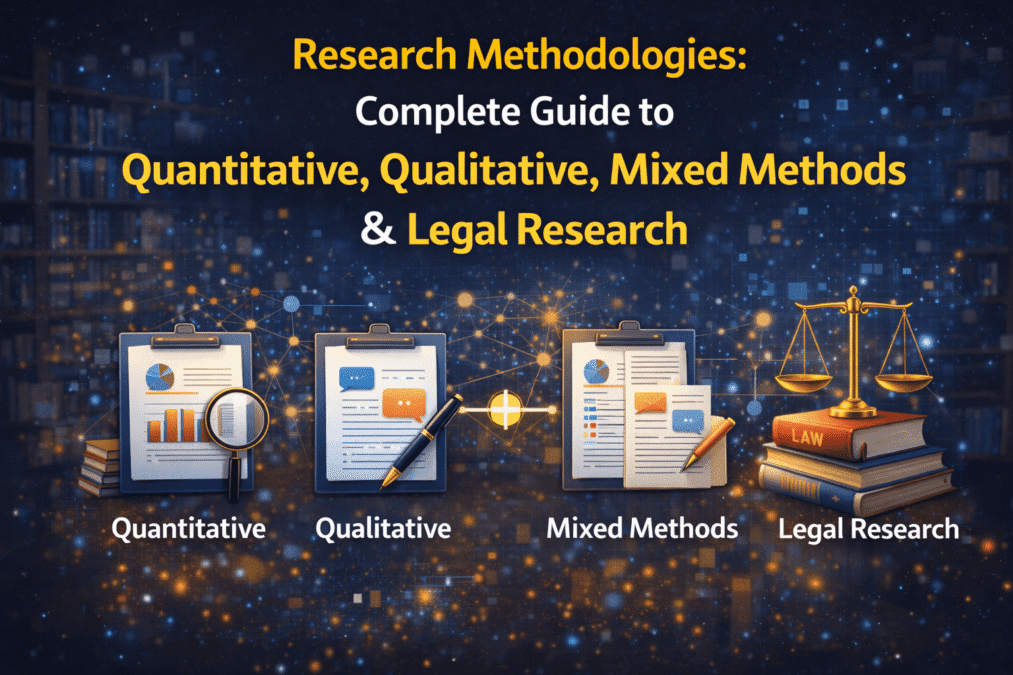
This comprehensive guide teaches you how to choose and justify appropriate research methods:
- Quantitative research (experiments, surveys, statistical analysis)
- Qualitative research (interviews, observations, thematic analysis)
- Mixed methods (combining approaches strategically)
- Sampling strategies for all research types
- Doctrinal legal research (for law students)
- How to justify your methodological choices
Whether you’re in sciences, social sciences, humanities, or law, understanding methodology is essential for conducting valid, credible research.
Understanding Research Paradigms
Before choosing methods, understand the philosophical foundation of research.
Positivist Research
Core assumption: Objective reality exists and can be measured.
Typical approach: Quantitative methods, statistical analysis, hypothesis testing
Example: Testing whether a new teaching method improves test scores
When appropriate: Sciences, psychology, education research with measurable outcomes
Interpretivist Research
Core assumption: Reality is socially constructed; meaning depends on context and interpretation.
Typical approach: Qualitative methods, interviews, observations, textual analysis
Example: Understanding how teachers experience and make sense of curriculum changes
When appropriate: Humanities, sociology, anthropology, understanding subjective experiences
Pragmatic Research
Core assumption: Use whatever methods answer your research question best.
Typical approach: Mixed methods—combining quantitative and qualitative
Example: Measuring program outcomes (quantitative) while understanding participant experiences (qualitative)
When appropriate: Applied research, evaluation studies, complex social phenomena
Quantitative Research Methods
Quantitative research measures variables numerically and analyzes relationships statistically.
When to Use Quantitative Methods
Use quantitative when you want to:
- Test relationships between variables
- Measure prevalence or frequency
- Compare groups statistically
- Establish causation through experiments
- Generalize findings to larger populations
Types of Quantitative Research
1. Experimental Research
Manipulate independent variable, measure effect on dependent variable.
Example:
Research question: Does peer mentoring improve student retention?
Design: Randomly assign students to mentoring (treatment) or no mentoring (control). Measure retention rates after one year.
Requirements:
- Random assignment to conditions
- Control group for comparison
- Manipulation of independent variable
- Control of confounding variables
2. Quasi-Experimental Research
Similar to experiments but without random assignment.
Example:
Compare retention at colleges with peer mentoring programs vs. colleges without. Can’t randomly assign colleges to conditions, so it’s quasi-experimental.
3. Survey Research
Collect data through questionnaires or structured interviews.
Example:
Survey 500 students about study habits, measure relationship with academic performance.
4. Correlational Research
Examine relationships between variables without manipulation.
Example:
Do students with higher self-efficacy have better grades? Measure both variables, calculate correlation.
Quantitative Sampling Strategies
Probability Sampling (Generalizable):
1. Simple Random Sampling
- Every member has equal chance of selection
- Use random number generator
- Best for generalizability but requires complete sampling frame
2. Stratified Random Sampling
- Divide population into strata (categories)
- Random sample from each stratum
- Ensures representation of subgroups
Example:
To survey university students, stratify by year (1st, 2nd, 3rd, 4th), then randomly select 50 from each year.
3. Cluster Sampling
- Divide population into clusters
- Randomly select clusters
- Survey all or sample within selected clusters
Example:
To study government college students statewide, randomly select 10 colleges (clusters), then survey all first-year students in those colleges.
Non-Probability Sampling (Less Generalizable):
4. Convenience Sampling
- Sample whoever is easily accessible
- Least rigorous but practical
5. Purposive Sampling
- Deliberately select participants with specific characteristics
- Used when you need specific expertise or experience
Sample Size Considerations
Minimum recommendations:
- Surveys: 100-300 for descriptive statistics, 300+ for inferential statistics
- Experiments: 30 per group minimum, 50+ preferred
- Correlational: 50 minimum, 100+ preferred
Reality check: Larger samples increase statistical power but require more resources. Balance ideal with feasible.
Qualitative Research Methods
Qualitative research explores meanings, experiences, and social processes in depth.
When to Use Qualitative Methods
Use qualitative when you want to:
- Understand lived experiences
- Explore processes or meanings
- Generate theory from data
- Study phenomena that can’t be quantified
- Gain deep insight rather than breadth
Types of Qualitative Research
1. Phenomenology
Study lived experiences of a phenomenon.
Example:
Research question: What is the experience of being a first-generation college student?
Method: In-depth interviews with 15-20 first-generation students about their experiences.
2. Grounded Theory
Generate theory from systematic data analysis.
Example:
Research question: How do PhD students develop as researchers?
Method: Interview 30 students at different stages, code data iteratively to develop theory of research identity development.
3. Ethnography
Study cultures or social groups through immersion and observation.
Example:
Research question: How do PhD cohorts function as learning communities?
Method: Participate in and observe one cohort for a full academic year, conduct interviews, analyze artifacts.
4. Case Study
In-depth examination of specific case(s).
Example:
Research question: How did one university successfully implement peer mentoring?
Method: Study one program intensively—documents, interviews, observations—to understand success factors.
Qualitative Data Collection
In-Depth Interviews:
- Semi-structured (guided but flexible)
- 45-90 minutes typical
- Record and transcribe
- 15-30 interviews typical for PhD research
Focus Groups:
- 6-10 participants discuss topic together
- Group interaction generates rich data
- 4-8 groups typically needed
Observations:
- Participant observation (researcher participates)
- Non-participant observation (researcher observes)
- Field notes documenting what you see/hear
Document Analysis:
- Analyze existing texts (policies, reports, social media, historical documents)
Qualitative Sampling
Purposive Sampling:
- Select information-rich cases
- Deliberate selection based on study needs
Snowball Sampling:
- Participants recommend others
- Useful for hard-to-reach populations
Theoretical Sampling:
- Used in grounded theory
- Sample based on emerging theory
- Continue until theoretical saturation (no new insights)
Sample sizes:
- Interviews: 15-30 typical
- Focus groups: 4-8 groups
- Ethnography: Extended engagement with one site
Mixed Methods Research
Combining quantitative and qualitative approaches strategically.
Why Use Mixed Methods
Strengths:
- Quantitative provides breadth and generalizability
- Qualitative provides depth and understanding
- Together, they answer more complex questions
Example:
Question: Why do some government colleges retain students better than others?
Quantitative: Survey 1,000 students across 20 colleges, identify factors correlated with retention
Qualitative: Interview 30 students and 10 administrators to understand how and why these factors operate
Mixed Methods Designs
1. Convergent Design
- Collect quantitative and qualitative data simultaneously
- Analyze separately
- Compare/integrate findings
2. Explanatory Sequential Design
- Quantitative first (what’s happening?)
- Then qualitative (why is it happening?)
Example:
Survey shows peer mentoring correlates with retention (quantitative).
Then interview students to understand why mentoring helps (qualitative).
3. Exploratory Sequential Design
- Qualitative first (explore phenomenon)
- Then quantitative (test patterns identified qualitatively)
Example:
Interview students to identify retention factors (qualitative).
Then create survey based on themes, test with larger sample (quantitative).
Data Collection Instruments
Surveys and Questionnaires
Question types:
Closed-ended: Fixed response options
- Likert scales (1=Strongly Disagree to 5=Strongly Agree)
- Multiple choice
- Yes/No
Open-ended: Participants write responses
- Good for exploration
- Harder to analyze
Survey design tips:
- Pilot test with 10-20 people
- Clear, unambiguous questions
- Avoid leading questions
- Logical order
- Not too long (fatigue reduces quality)
Interview Protocols
Semi-structured interviews:
Opening questions: Build rapport
- “Tell me about your experience as a PhD student”
Main questions: Core topics
- “How did you experience the peer mentoring program?”
Probes: Follow-up for depth
- “Can you give me an example?”
- “What did that mean to you?”
Closing: Anything to add?
- “Is there anything else you think I should know?”
Ethical Considerations
IRB/Ethics Committee Approval
Required for:
- Human subjects research
- Surveys, interviews, observations of identified individuals
- Access to sensitive data
Not required for:
- Analysis of publicly available data
- Some document analysis
- Quality improvement projects (sometimes)
When in doubt, check with your IRB.
Informed Consent
Participants must understand:
- What the study involves
- Potential risks/benefits
- Their participation is voluntary
- They can withdraw anytime
- How confidentiality will be protected
Confidentiality
Protect participant identity:
- Use pseudonyms
- Remove identifying details
- Store data securely
- Don’t share raw data containing identifiers
Justifying Your Methodology
Examiners and reviewers want to know: Why did you choose these methods?
Strong Methodological Justification
1. Align with research questions
Weak: “I used interviews because I like talking to people”
Strong: “Interviews allow exploration of complex retention decisions that surveys cannot capture. To understand why students stay or leave requires understanding their subjective experiences, which interviews provide”
2. Acknowledge alternatives
“While surveys could measure retention predictors quantitatively, interviews were chosen to understand the processes through which peer support influences retention decisions—a how and why question requiring qualitative depth”
3. Address limitations
“The small sample (n=30) limits generalizability but provides the depth needed to understand retention mechanisms. Findings will generate hypotheses testable in future large-scale quantitative research”
Common Methodological Mistakes
Mistake 1: Methods Don’t Match Questions
Wrong: Quantitative question with qualitative method (or vice versa)
Wrong: “What percentage of students experience imposter syndrome?” → Interview 15 students
Right: Survey large sample OR qualitatively explore the experience of imposter syndrome
Mistake 2: Insufficient Sample
Wrong: Survey 25 people, claim generalizable findings
Wrong: Interview 5 people for phenomenology (need 15-20)
Mistake 3: No Justification
Wrong: “I used surveys” (Why? Why not interviews? Why this sample size?)
Right: Explain your choices and acknowledge limitations
Mistake 4: Ignoring Validity/Reliability
Quantitative: Use validated instruments when available. If creating your own, pilot test.
Qualitative: Use member checking, triangulation, thick description for trustworthiness.
Quick Reference: Choosing Methods
If you want to:
- Test hypotheses → Quantitative (experimental or survey)
- Measure prevalence → Quantitative (survey with probability sampling)
- Understand experiences → Qualitative (interviews or phenomenology)
- Explore processes → Qualitative (ethnography or case study)
- Both breadth and depth → Mixed methods
- Generate theory → Qualitative (grounded theory)
If studying:
- Large populations → Quantitative
- Complex phenomena → Qualitative or mixed
- Specific cases in depth → Qualitative
- Measurable outcomes → Quantitative
Legal Research and Writing: Complete Guide for Law Students and Legal Researchers
Conclusion
Research methodology is your foundation. Choose methods that match your research questions, justify choices clearly, and execute carefully.
- For sciences and social sciences: Quantitative, qualitative, or mixed methods depending on your questions.
- For law students: Doctrinal methodology for analyzing legal texts; socio-legal methods for studying law in practice.
- For everyone: Strong methodology = credible research. Weak methodology = invalid conclusions, regardless of how brilliant your analysis.
Master methodology. Everything else depends on this foundation.
Academic Writing Mastery: The Complete 2026 Guide To Research Papers, Thesis & Dissertation Writing
FAQs
Q: What is research methodology and why does it matter?
Research methodology is the philosophical and strategic framework guiding how you design your study, collect data, and analyse findings. It explains why your chosen methods are appropriate for your research question, not just what you did. A strong methodology justifies your approach — examiners and reviewers assess whether your design could actually answer your question. Describing methods without methodology is like reporting what you cooked without explaining why the recipe works.
Q: What are the main types of research methodology?
Research methodology falls into three main types: quantitative (measuring variables numerically, testing hypotheses, generalising findings statistically); qualitative (understanding meaning, experience, and context through non-numerical data like interviews and observation); and mixed methods (combining both in one study). Each type suits different research questions. The choice is not a preference — it is determined by what your question requires. Legal research adds a fourth tradition: doctrinal methodology, analysing primary legal sources through legal reasoning.
Q: What is the difference between research methodology and research methods?
Research methodology is the overarching framework — the philosophical assumptions, paradigm, and strategic logic of your study. Research methods are the specific tools: surveys, interviews, experiments, statistical tests. Methodology answers ‘why this approach?’ Methods answer ‘what exactly was done?’ A thesis methodology chapter addresses both. A journal article methods section primarily addresses methods with brief methodological justification. Confusing the two produces methodology chapters that describe procedures without philosophical grounding.
Q: How do you choose between qualitative and quantitative research?
Choose based on your research question, not preference or familiarity. If your question asks ‘how many,’ ‘how much,’ or ‘is there a relationship between’ — use quantitative. If your question asks ‘why,’ ‘how does it work,’ or ‘what does it mean to participants’ — use qualitative. If you need both numerical patterns and contextual understanding, use mixed methods. The methodology must follow the question. A quantitative design cannot answer a ‘why’ question; a qualitative design cannot establish prevalence.
Q: What is a research paradigm and do I need one?
A research paradigm is the set of philosophical assumptions underlying your research: what counts as knowledge (epistemology), what reality is (ontology), and how values affect research (axiology). The main paradigms are positivism, interpretivism, critical realism, and constructivism. You always have a paradigm whether or not you name it — making it explicit in your methodology chapter demonstrates intellectual self-awareness. Thesis examiners assess paradigm alignment: does your design match your stated philosophical stance?
Author
Dr. Rekha Khandelwal, a legal scholar and academic writing expert, is the founder of AspirixWriters. She has extensive experience in guiding students and researchers in writing research papers, theses, and dissertations with clarity and originality. Her work focuses on ethical AI-assisted writing, structured research, and making academic writing simple and effective for learners worldwide.
Author Profile Dr. Rekha Khandelwal | Academic Writer, Legal Technical Writer, AI Expert & Author | AspirixWriters
References
- Patton, M. Q. (2021). Qualitative Research & Evaluation Methods (5th ed.). Sage Publications.
- Bryman, A. (2016). Social Research Methods (5th ed.). Oxford University Press.
- Denzin, N. K., & Lincoln, Y. S. (2018). The Sage Handbook of Qualitative Research (5th ed.). Sage Publications.
Part of: Complete Research Writing Guide Series Academic Writing Mastery: The Complete 2026 Guide To Research Papers, Thesis & Dissertation Writing
- Research Paradigms: Why Your Philosophical Stance Shapes Everything
- Quantitative Research Design: From Hypothesis to Valid Results
- Qualitative Research Design: Choosing the Right Approach
- Qualitative Data Collection and Analysis: Interviews, Coding, and Trustworthiness
- Mixed Methods Research: When and How to Combine Approaches
- Sampling Strategies
- Research Ethics in Practice: What Ethics Forms Don’t Tell You
Next in Series:
- Complete Guide: Data Analysis and Results Presentation: Complete Guide for Quantitative, Qualitative & Legal Research (2026) (Module 4)
- Complete Guide: Organization and Academic Tone: Complete Guide to Professional Scholarly Writing (2026) (Module 5)
- Complete Guide: Peer Review and Publication: Complete Guide from Submission to Acceptance (2026) (Module 6)
- Complete Guide: AI Tools in Academic Research: Opportunities, Ethics, and Best Practices (2026) (Module 7)
- Complete Guide: Grant Writing and Research Funding: Complete Guide to Finding Money for Your Research (2026) (Module 8)
- Complete Guide: Academic Career Development: Complete Guide to Building Your Professional Life in Research (2026) (Module 9)
- Complete Guide: Research Ethics and the IRB Process: Complete Guide to Doing Research Responsibly (2026) (Module 10)
No post found!