Last Updated: April 20, 2026
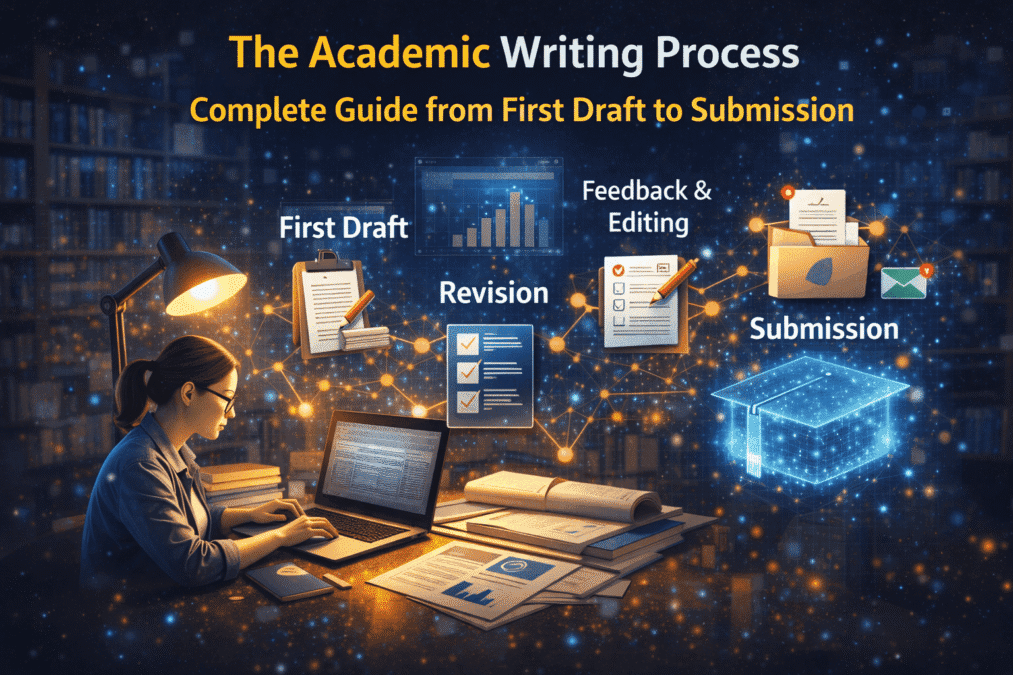
Module 2, Complete Guide: The Academic Writing Process – from First Draft to Submission
From Concept to Submission: A Complete Guide to Research Paper and Thesis Writing
Academic Writing Mastery: The Complete 2026 Guide To Research Papers, Thesis & Dissertation Writing
Module 1 Complete Guide:- The Complete Guide To Research Paper Structure: IMRAD Format, Thesis Organization & Academic Writing (2026)
The Academic Writing Process :
Why Most PhD Students Struggle with Writing (And How to Fix It)
Here’s the secret successful academics won’t admit: nobody finds academic writing easy. Even professors with hundreds of publications struggle. The difference? They’ve developed a systematic process.
If you’re stuck staring at a blank page, procrastinating on your thesis, or rewriting the same paragraph endlessly, you’re experiencing what every researcher faces. But you don’t have to suffer blindly.
This guide reveals the proven writing process that transforms scattered ideas into published research:
- The 12-week research paper writing plan
- Overcoming writer’s block and procrastination
- Effective drafting strategies (write first, edit later)
- Systematic revision techniques
- Time management for busy researchers
- Legal writing process specifics (for law students)
Whether writing your first journal article or finishing your PhD dissertation, this roadmap takes you from concept to submission.
The Biggest Myth About Academic Writing
Myth: Good writers sit down and produce perfect prose immediately.
Reality: Good writers follow a messy, iterative process—they’ve just learned to embrace the mess.
The academics you admire don’t write perfect first drafts. They write terrible first drafts, then revise repeatedly. The difference between published researchers and struggling students isn’t talent—it’s process.
What Research Shows
Studies on academic productivity reveal:
- Professional writers produce 4-5 drafts before submission (Belcher, 2019)
- Successful PhD students write regularly (30-60 minutes daily beats marathon weekend sessions) (Silvia, 2019)
- Revision separates strong from weak papers (Sword, 2012)
- Structured schedules increase productivity by 300% (Murray, 2017)
The message: process beats inspiration every time.
The 12-Week Research Paper Writing Plan
This proven timeline takes you from idea to submission. Adjust timelines to your project, but keep the sequence.
Week 1-2: Planning and Outlining
Don’t start writing yet. Invest in planning.
Week 1 Tasks:
- Define research question precisely
- Identify target journal or thesis chapter
- Read 10-15 key papers in your area
- Create detailed outline (every section, key points)
Week 2 Tasks:
- Refine outline based on journal guidelines
- Gather all data, tables, figures, notes
- Draft methods section (easiest starting point)
- Write working title and abstract
Why start with methods and abstract? These sections are factual and straightforward—no interpretation needed. Building early momentum matters more than perfect sequencing.
Week 3-5: First Draft
Goal: Get words on paper. Don’t edit yet.
Week 3: Introduction and literature review
- Write 500-1000 words daily
- Don’t stop to perfect sentences
- Use placeholders: [FIND CITATION], [EXPAND THIS]
Week 4: Results section
- Create all tables and figures first
- Write text explaining each visual
- Report findings without interpretation
Week 5: Discussion and conclusion
- Interpret findings
- Connect to literature
- Address limitations honestly
- Explain implications
Reality check: Your first draft will be rough. That’s normal. Aim for completeness, not perfection.
Week 6: Cooling Period
Step away for one full week.
This isn’t procrastination—it’s strategic. When you return, you’ll see problems you were blind to before.
Use this week to:
- Read recent papers in your field
- Work on other projects
- Let your subconscious process
Week 7-9: Structural Revision
Focus on big-picture issues:
Week 7: Structure and flow
- Does each section do its job?
- Do paragraphs follow logical order?
- Are transitions smooth?
- Does your argument build coherently?
Week 8: Content and argument
- Are claims supported with evidence?
- Have you addressed counterarguments?
- Is significance clear?
- Are limitations acknowledged?
Week 9: Literature integration
- Are citations current (last 5 years)?
- Have you cited key papers?
- Is your contribution clear relative to prior work?
- Are all claims properly attributed?
Week 10-11: Line-Level Editing
Now focus on sentences and words:
Week 10: Clarity
- Eliminate jargon where possible
- Break up long sentences (<25 words)
- Use active voice (“we analyzed” not “data were analyzed”)
- Remove redundancy
Week 11: Style
- Strengthen weak verbs
- Vary sentence structure
- Tighten prose (cut 10-15%)
- Check consistent terminology
Week 12: Final Polish and Submission
Final week checklist:
- Format per journal/university guidelines
- Check all references (every citation in list)
- Proofread carefully (read aloud)
- Verify tables/figures properly labeled
- Write cover letter (for journals)
- Get colleague review
- Submit confidently
Overcoming Writer’s Block and Procrastination
Why You’re Really Stuck
Writer’s block usually isn’t about writing—it’s about:
Fear of judgment: “What if reviewers think this is stupid?”
Perfectionism: “This sentence isn’t good enough”
Unclear thinking: “I don’t know what I want to say”
Overwhelm: “This project is too big”
Each needs a different solution.
Solutions That Actually Work
For Fear: The Shitty First Draft
Give yourself permission to write badly.
Anne Lamott’s advice: “Write a shitty first draft.” Nobody sees your first draft. Let it be terrible. You can’t edit a blank page, but you can edit bad writing.
Exercise: Set timer for 15 minutes. Write without stopping, editing, or worrying. Just words on paper. This breaks perfectionism.
For Perfectionism: Separate Drafting from Editing
Drafting mode: Create content. Don’t judge.
Editing mode: Improve content. Be critical.
Never do both simultaneously. It’s like driving with one foot on gas, one on brake.
Practical tip: Some writers disable the delete key during drafting. Others write on paper where crossing out feels less permanent.
For Unclear Thinking: Reverse Outlining
If you don’t know what to write, you probably don’t know what you think yet.
Reverse outlining:
- Write one-sentence summaries of main points
- Arrange sentences in logical order
- Identify gaps or weak connections
- Add supporting points under each main point
- Now you have a detailed outline—start drafting
For Overwhelm: Break Into Tiny Pieces
Don’t write “a dissertation.” Write “500 words on sampling strategy.”
Chunk your project:
- Today: Methods section introduction (200 words)
- Tomorrow: Describe participants (300 words)
- Next day: Explain data collection (400 words)
Small wins build momentum. Momentum beats motivation.
Writing Schedules That Work
The Daily Writing Habit (Most Effective)
Research shows: Writing 30 minutes daily produces more than 8 hours on weekends.
Why? Consistency beats intensity. Your brain stays engaged with your project, making each session easier to start.
How to build the habit:
- Set specific time: Same time daily (morning works best)
- Set specific duration: Start with 15-30 minutes (not hours)
- Set specific place: Same location signals “writing time”
- Track it: Mark calendar daily (“don’t break the chain”)
Example:
- 7:00-7:30 AM: Writing session
- Before email, before anything else
- No exceptions for 30 days (builds automatic habit)
The Binge Writing Approach
Some can’t write daily (teaching schedules, lab work, field research). If that’s you, use strategic binges.
Make them effective:
Before binge: Outline what you’ll write
During binge: Minimize distractions (airplane mode)
After binge: Schedule next binge immediately
Example: 8 hours every Saturday for 12 weeks. Detailed outlines on Fridays. Review and plan Sundays.
For Indian Academic Schedules
Teaching schedules often allow:
- 3-4 hours daily during non-teaching semesters
- 1-2 hours daily during teaching semesters
- Full days during semester breaks
Optimize your calendar:
- Heavy writing during winter/summer breaks
- Teaching semesters for data collection and reading
- Protect writing time like teaching time
The Art of Revision
Most writers spend 20% drafting and 80% revising. If you’re spending more time drafting, you’re doing it wrong.
Three-Pass Revision Strategy
Pass 1: Structural Revision
Read through once without making changes. Note:
- Does argument flow logically?
- Are sections in right order?
- Is anything missing?
- What should be cut?
Then make structural changes: move sections, add missing pieces, delete tangents.
Pass 2: Paragraph-Level Revision
Look at each paragraph:
- Does it have one main idea?
- Does first sentence introduce that idea?
- Do subsequent sentences develop it?
- Does it connect to adjacent paragraphs?
Pass 3: Sentence-Level Revision
Polish individual sentences:
- Eliminate unnecessary words
- Strengthen weak verbs
- Vary sentence structure
- Fix grammar and punctuation
The Reverse Outline for Revision
After drafting, create a reverse outline:
- Read your draft
- Write one-sentence summary of each paragraph
- Look at your sentence list
Do they form a logical argument? Identify:
- Paragraphs that don’t support thesis (delete)
- Ideas that repeat (combine)
- Logical gaps (add paragraphs)
- Better sequencing (rearrange)
This reveals structural problems normal reading misses.
Getting Feedback Effectively
When to Seek Feedback
Timing: After structural revision (Pass 1) but before line editing. Not too early (need complete draft) or too late (time for major changes).
Who to ask:
- Your advisor (always)
- Colleagues in your field (understand content)
- Colleagues outside your field (test clarity)
- Writing center consultants (structure and style)
How to Ask
Be specific: “Does my Discussion section argument make sense?” not “What do you think?”
How to Use Feedback
You decide what changes to make. Not all feedback is good feedback. Look for patterns—if three people point out the same issue, fix it.
Writing Tools and Resources
Essential Tools
Reference Managers:
- Zotero (free, open-source)
- Mendeley (free, Elsevier integrated)
- EndNote (powerful, expensive)
Writing Software:
- Microsoft Word (standard)
- LaTeX (mathematics, physics, CS)
- Scrivener (long-form projects)
- Google Docs (collaboration)
Grammar and Style:
- Grammarly (error catching)
- Hemingway Editor (complex sentences)
- ProWritingAid (style analysis)
Focus Tools:
- Freedom / Cold Turkey (block websites)
- Forest (gamified focus)
- Pomodoro apps (25-minute intervals)
For Non-Native English Writers
If English isn’t your first language, you face extra challenges.
Build Academic English Skills
Read strategically: Notice how authors structure arguments, introduce evidence, express disagreement.
Keep phrase bank: Collect useful phrases:
- “While previous research has shown…”
- “These findings suggest that…”
- “However, this interpretation overlooks…”
Use Tools Wisely
Do use:
- Grammar checkers
- Native English speakers for final proofread
Don’t:
- Rely on Google Translate for complex sentences
- Use overly complex words to sound “academic”
- Feel inferior (some best writing comes from non-native speakers)
Language Support Options in India
- Professional editors (₹1-3 per word)
- Writing groups with native speakers
- University language support
- Exchange proofreading with English students
Remember: Ideas matter more than perfect grammar. Editors fix language; they can’t fix unclear thinking.
Managing the Emotional Side
Dealing with Imposter Syndrome
Imposter syndrome: Feeling you’re not smart enough, that you’ll be “found out.”
Reality: Almost every PhD student experiences this. Including confident ones.
How to cope:
- Keep evidence of competence (positive feedback, acceptances)
- Remember: you were admitted because you’re qualified
- Talk to others (everyone feels this way)
- Focus on progress, not perfection
Building Resilience
Academic writing involves rejection: papers rejected, harsh reviews, critical feedback.
Build resilience:
Separate feedback from self-worth: Rejected paper ≠ you’re not smart. It means this paper wasn’t right for this journal at this time.
Reframe rejection as information: Reviews tell you how to improve.
Celebrate small wins: Finished section? Celebrate. Progress deserves recognition.
Build community: Connect with other writers. Shared struggles feel less isolating.
Quick Reference Checklist
Pre-Writing
- Research question clearly defined
- Target audience identified
- Literature reviewed thoroughly
- Detailed outline created
- All data/materials gathered
Drafting
- Write in focused sessions (30-90 min)
- Turn off internal editor
- Complete sections out of order if needed
- Use placeholders for details
- Aim for completeness, not perfection
Revising
- Pass 1: Structure and argument
- Pass 2: Paragraph organization
- Pass 3: Sentence-level clarity
- Check citations and references
- Verify formatting compliance
Final Polish
- Proofread (read aloud)
- Run grammar/spell check
- Format per guidelines
- Write cover letter (if journal)
- Submit
Legal Research and Writing: Complete Guide for Law Students and Legal Researchers
Conclusion
Academic writing success comes from process, not inspiration. Whether you’re writing an empirical research paper or a legal doctrinal article, systematic approaches produce results.
For most disciplines: Follow the 12-week plan, write daily, revise systematically.
The writing process feels overwhelming at first. But thousands of PhD students complete theses every year. Not because they’re brilliant writers, but because they follow proven processes.
Start today. Write for 15 minutes. Tomorrow, 15 more. In 12 weeks, you’ll have a draft.
The process works. Trust it.
FAQs
Q.1: What is the academic writing process step by step?
The academic writing process has six stages: planning (defining the research question and argument); drafting (writing without editing, getting ideas on paper); revising (restructuring for logic and argument coherence); editing (sentence-level clarity and precision); proofreading (grammar, spelling, citation format); and submission preparation (formatting, word count, cover letter). Most writers underestimate how much time revision takes — a first draft is not a submission-ready draft.
Q.2: How do you overcome writer’s block in academic writing?
Writer’s block in academic writing usually signals a thinking problem, not a writing problem — you are not sure what you want to say. The most effective fix is to write badly on purpose: set a timer for 20 minutes and write without stopping or editing. Separate drafting from revision completely. Start with the section you understand best, not the introduction. Having a detailed outline before drafting eliminates most writer’s block because each section has a specific job.
Q.3: How long does it take to write a research paper?
A 7,000-word journal article typically takes 8–16 weeks for an experienced researcher and longer for early-career researchers. This includes literature review, drafting, revision, and formatting. A PhD thesis chapter takes 4–8 weeks per chapter. The most time-consuming stages are revision and citation checking, which most writers underestimate. Writing daily in short sessions (60–90 minutes) is more productive than infrequent long sessions.
Q.4: What is the difference between revising and editing a research paper?
Revising addresses structure and argument — reorganising sections, strengthening the gap statement, ensuring the discussion connects to the research question. Editing addresses prose — improving sentence clarity, eliminating jargon, reducing passive voice. Revising comes first; editing a draft that still has structural problems wastes time. Most writers edit too early and revise too little. A paper can be beautifully written and still be rejected because the argument structure is unclear.
Q.5: How do you maintain academic writing productivity during a PhD?
Write every day, even for 30 minutes — daily writing produces more output than waiting for long uninterrupted blocks. Set weekly word count targets, not just daily ones. Separate writing time from reading and research time. Track your progress visibly. Use a writing group or writing partner for accountability. The researchers who complete theses on time are not those who write better — they are those who write more consistently.
Author
Dr. Rekha Khandelwal, a legal scholar and academic writing expert, is the founder of AspirixWriters. She has extensive experience in guiding students and researchers in writing research papers, theses, and dissertations with clarity and originality. Her work focuses on ethical AI-assisted writing, structured research, and making academic writing simple and effective for learners worldwide.
Author Profile Dr. Rekha Khandelwal | Academic Writer, Legal Technical Writer, AI Expert & Author | AspirixWriters
References
- Belcher, W. L. (2019). Writing Your Journal Article in Twelve Weeks (2nd ed.). University of Chicago Press.Writing Your Journal Article in Twelve Weeks, Second Edition: A Guide to Academic Publishing Success, Belcher
- Silvia, P. J. (2019). How to Write a Lot (2nd ed.). American Psychological Association.
- Sword, H. (2012). Stylish Academic Writing. Harvard University Press.
- Murray, R. (2017). How to Write a Thesis (4th ed.). Open University Press.
(Module 2) Complete Guide: The Academic Writing Process: Complete Guide from First Draft to Submission (2026)
- How to Start Writing and Keep Going
- How to Write Clear Engaging Academic Prose
- The Revision Process: How to Turn a Draft Into a Submission
- Citation Styles Explained: APA, MLA, Chicago, IEEE, and Bluebook
- Reference Management: Zotero and Mendeley from Setup to Submission
- Preparing A Submission Ready Document: The Complete Pre-Submission Checklist
- Legal Writing Process And Citation: A Complete Guide For Law Students And Legal Researchers
Next in Series:
- Complete Guide: Research Methodologies: Complete Guide to Quantitative, Qualitative, Mixed Methods & Legal Research (2026) (Module 3)
- Complete Guide:Data Analysis and Results Presentation: Complete Guide for Quantitative, Qualitative & Legal Research (2026) (Module 4)
- Complete Guide:Organization and Academic Tone: Complete Guide to Professional Scholarly Writing (2026) (Module 5)
- Complete Guide:Peer Review and Publication: Complete Guide from Submission to Acceptance (2026) (Module 6)
- Complete Guide:AI Tools in Academic Research: Opportunities, Ethics, and Best Practices (2026) (Module 7)
- Complete Guide:Grant Writing and Research Funding: Complete Guide to Finding Money for Your Research (2026) (Module 8)
- Complete Guide:Academic Career Development: Complete Guide to Building Your Professional Life in Research (2026) (Module 9)
- Complete Guide:Research Ethics and the IRB Process: Complete Guide to Doing Research Responsibly (2026) (Module 10)
No post found!