Last Updated: April 20, 2026
The IMRAD Framework
Understanding the Structure of Research Papers and Theses – Module 1:
From Concept to Submission Series | 2026
← Back to Pillar Post: The Complete Guide to Research Paper Structure
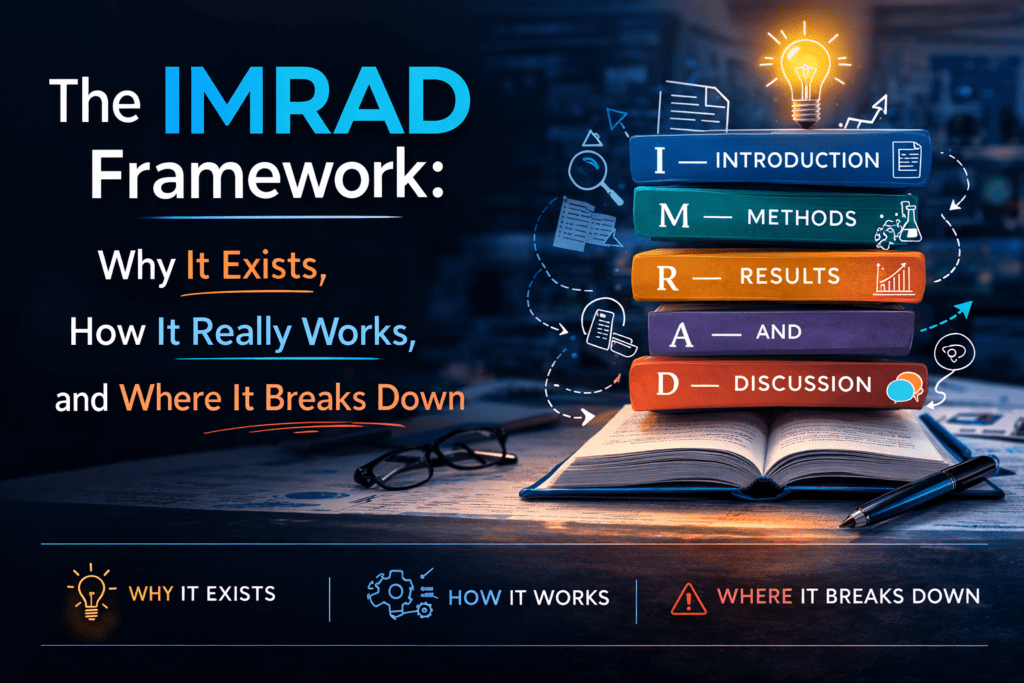
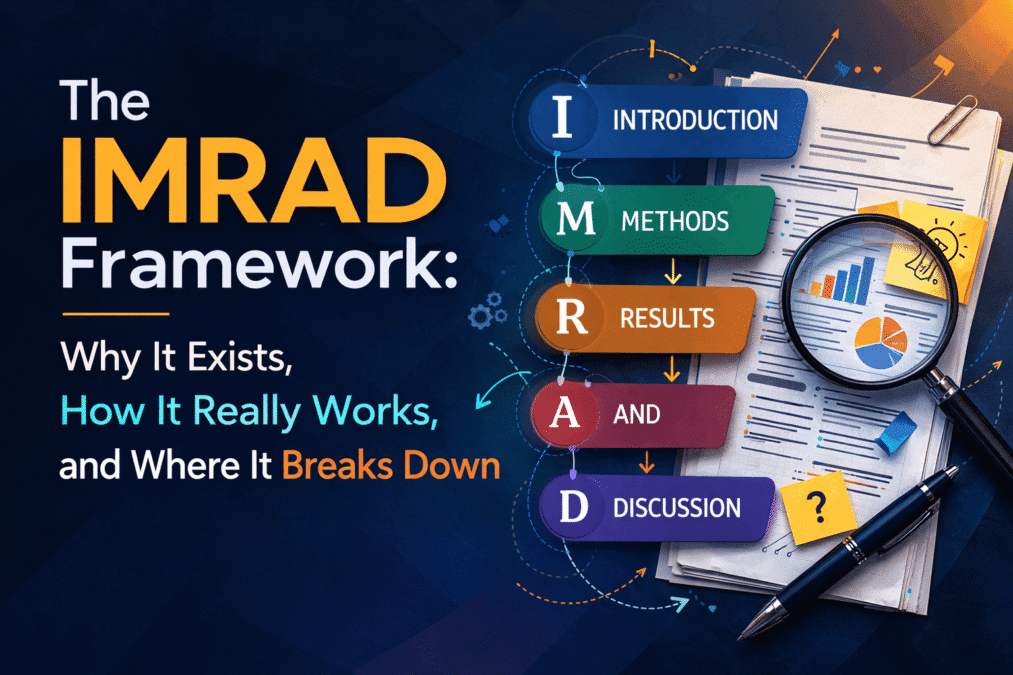
Your main post gave you the overview — IMRAD stands for Introduction, Methods, Results, and Discussion, and it dominates empirical publishing across science and the social sciences. This post goes one level deeper: why this format exists, what each section is intellectually doing (not just containing), and the specific failure modes that produce weak papers even when researchers think they are following the structure correctly.
Why The IMRAD Framework Exists
IMRAD was not invented by a committee. It evolved over roughly a century of scientific publishing, driven by a simple problem: as research output grew, readers needed to find information fast without reading every paper in full.
Before IMRAD, scientific papers were written as narratives — a chronological account of what the researcher thought, tried, found, and concluded. Readable, but inefficient. A researcher scanning twenty papers a week needed to know immediately whether a study was methodologically sound and whether the finding was relevant, without committing to a full read.
IMRAD solved this by giving every paper a predictable architecture. Once you know the format, you can jump straight to Methods to evaluate the study design, skip to Results to check the finding, and then decide whether the Discussion is worth your time. The format is essentially a service to the reader.
This is the most important thing to understand about IMRAD: it is a communication tool, not a bureaucratic requirement. Every structural decision you make inside it should be guided by one question — what does my reader need to know at this point, and in what order?
What Each Section Is Actually Doing
Most guides tell you what goes in each IMRAD section. This section tells you what each one is intellectually doing — which is what allows you to write them well rather than just filling them in.
Introduction: Building the case
The Introduction is not background-setting. It is argument-building. You are making a case that a specific gap exists in current knowledge, that this gap matters, and that your study is the right way to address it.
By the time a reader reaches your research question, they should feel that it was almost inevitable — that given everything you have shown them, of course this is what needed to be studied. If they think “well, that is one possible thing to study,” the Introduction has not done its job.
The funnel shape — broad context narrowing to specific question — is the structural expression of this logic. You start wide to show the general area matters, narrow to show what is specifically unknown, and arrive at your research question as the natural resolution.
Methods: Writing for the sceptical reader
The Methods section has one primary reader: someone who doubts your findings and wants to know whether your study design can support the claims you are making. This is not paranoid — this is exactly who peer reviewers are.
Your job is not simply to describe what you did. It is to give a sceptical expert enough information to evaluate whether what you did was appropriate. The replication test — could another researcher repeat your study from your description — is a proxy for this. Replicability requires precision, and precision is what allows your work to be evaluated.
Results: The discipline of pure description
The Results section demands something that does not come naturally: presenting findings without saying what they mean. Just the facts.
The reason this matters is epistemological. Science works by separating observation from interpretation — reporting findings in a form that other researchers can evaluate independently before any particular interpretation is applied. When you mix results with interpretation, you make it harder for readers to assess whether your conclusions are warranted.
Discussion: Where scholarly thinking becomes visible
The Discussion is where you demonstrate what kind of thinker you are. It is not a summary of Results in different words. It asks why the findings came out as they did, connects them to the broader theoretical landscape, engages seriously with unexpected results, and draws implications that go beyond this specific study.
The move from Results to Discussion is the move from data to knowledge — from “82% of students were retained” to “what this tells us about peer support as a mechanism in Indian government colleges.” That move requires both intellectual courage and intellectual honesty.
When to Use IMRAD — and When Not To
IMRAD fits research that involves systematic data collection and analysis. If you have a defined procedure for gathering evidence that can be described precisely and evaluated by others, IMRAD gives you the right frame.
It does not fit theoretical papers, historical research, humanities dissertations, or legal doctrinal research. Applying IMRAD to these produces a distorted account of what you actually did — a Methods section that misdescribes an archival search as a laboratory procedure, or a Results section that presents legal analysis as though it were statistical data.
| Use IMRAD | Use an alternative structure |
| Experiments and quasi-experiments | Theoretical or philosophical papers |
| Survey-based quantitative research | Humanities research (history, literature) |
| Qualitative studies — interviews, ethnography | Legal doctrinal research |
| Mixed methods research | Standalone literature reviews |
The simplest test: do you have a Methods section you can genuinely write — not a description of a literature search, but a real account of how you gathered and analysed original evidence? If not, IMRAD is not your structure.
The Four IMRAD Failure Modes
Every section of IMRAD has a characteristic failure mode — a pattern of weak writing common enough that experienced editors recognise it on sight. Knowing these by name lets you catch them in your own drafts.
1. The literature dump (Introduction)
A long summary of previous work that tells the reader what has been studied, but makes no argument about what those studies collectively show or fail to show. You end up listing Smith said X, Jones said Y, therefore more research is needed. That is not an argument.
The fix: identify what the literature shows collectively, where it is genuinely incomplete or contested, and why that gap matters. Sources become evidence for your argument rather than the argument itself.
2. The procedure list (Methods)
A chronological account of what you did without any justification for those choices. “I selected 50 participants. I used a questionnaire. I analysed the data using SPSS.” Technically accurate, but answering the wrong question. Readers are not asking what you did — they are asking why they should trust that what you did was the right approach.
Every significant methodological choice needs a rationale. Why semi-structured interviews rather than a survey? Why purposive sampling? One or two sentences per choice is enough — but their absence leaves reviewers with nothing to evaluate except whether you followed convention.
3. The interpretation that crept in (Results)
Interpretive language that slips in among descriptions of findings. Often it is a single word — “surprisingly,” “worryingly,” “importantly” — or a phrase like “which suggests” or “this demonstrates.” These are your evaluations, not your data.
Wrong: “Surprisingly, the intervention group showed higher retention.” Right: “The intervention group showed higher retention (82% vs. 71%).”
When you find yourself writing “because” or “which suggests” in your Results section, stop. That sentence belongs in Discussion.
4. The summary dressed as analysis (Discussion)
A Discussion that restates the Results in slightly different language. “The study found that 82% of students in the intervention group were retained. This high retention rate indicates the programme was successful.” The second sentence adds nothing. It does not explain why the programme worked, what mechanism was responsible, or what this means for theory or practice.
The diagnostic question: if a reader has already read your Results section carefully, does your Discussion give them genuinely new thinking — not new data, but new interpretation? If not, the Discussion is not doing its job.
A Quick Self-Audit
Before submitting, read your draft with these four questions. They test whether your sections are doing their intellectual jobs, not just whether they exist.
- Introduction: If I remove all citations, does the underlying argument still hold? Is there a specific gap named explicitly, or am I implying that more research is vaguely needed?
- Methods: Does every significant choice have a rationale, not just a description? Could a researcher at another institution replicate this study exactly?
- Results: Can I find any word or phrase that implies evaluation or causation — “suggests,” “demonstrates,” “because”? If so, it belongs in Discussion.
- Discussion: Have I explained not just what I found but why I found it? Have I engaged with unexpected or inconvenient findings, or quietly ignored them?
For Law Students
Q: Why do journals require IMRAD format?
Journals require IMRAD because researchers do not read papers linearly — they jump to Methods to assess rigour, Results to see findings, and Discussion for implications. IMRAD makes this navigation possible by fixing each information type to a specific location. It also standardises peer review: reviewers know exactly where to find the research question, methodology justification, and conclusions.
Q: Does IMRAD apply to qualitative research?
Yes, with modifications. The Methods section describes research design, participant selection, data collection, and analytical method rather than statistical procedures. The Results section presents themes with participant quotes instead of statistical outputs. Some qualitative journals prefer an integrated findings-and-discussion section. Always check the target journal’s author guidelines — some describe a preferred structure specifically for qualitative submissions.
Q: What goes in the Introduction of an IMRAD paper?
The Introduction must: establish the broad research problem; review existing knowledge narrowing to your specific question; identify the specific knowledge gap (what is not known and why it matters); and state the research question or objective. The gap statement is the most important sentence — it must be explicit and specific. An introduction without a clear gap will be flagged in peer review regardless of study quality.
Q: Where does IMRAD not apply?
IMRAD does not apply to humanities essays, legal scholarship, theoretical papers without empirical data, and mixed methods papers where qualitative and quantitative strands require separate presentation. These fields use argument-based structures built around a central claim. When IMRAD does not fit, the alternative structure must still answer the same four questions: what was done, why, what was found, and what does it mean.
Q: How long should each IMRAD section be?
For a typical 7,000–8,000 word article: Introduction 10–15% (700–1,200 words); Methods 20–25% (1,400–2,000 words); Results 25–30% (1,750–2,400 words); Discussion 30–35% (2,100–2,800 words); Abstract 2–3% (150–250 words). These are guidelines, not rules. What matters is that each section does its job completely — a short Methods that omits essential procedural information is a problem regardless of proportions.
References
- Booth, W. C., Colomb, G. G., Williams, J. M., Bizup, J., & FitzGerald, W. T. (2024). The Craft of Research (5th ed.). University of Chicago Press.
- Creswell, J. W., & Creswell, J. D. (2022). Research Design: Qualitative, Quantitative, and Mixed Methods Approaches (6th ed.). Sage Publications.
- Day, R. A., & Gastel, B. (2021). How to Write and Publish a Scientific Paper (9th ed.). Cambridge University Press.
- Swales, J. M., & Feak, C. B. (2012). Academic Writing for Graduate Students (3rd ed.). University of Michigan Press.
- Belcher, W. L. (2019). Writing Your Journal Article in Twelve Weeks (2nd ed.). University of Chicago Press.
- OSCOLA: Oxford University Standard for the Citation of Legal Authorities (4th ed.).
- IMRAD – Wikipedia
Next: — How to Write a Research Introduction That Reviewers Cannot Ignore
← Back to Pillar Post: The Complete Guide to Research Paper Structure
No post found!