Last Updated: May 11, 2026
Good Samaritan Law India — Section 134A (MVA-10) Part of Motor Vehicles Act 1988 India: Complete Guide
← Previous: MACT Claims in India → Next: Motor Vehicles (Amendment) Act, 2019 Explained (MVA-11)
Kiran was driving home from work in Bengaluru when she saw a motorcyclist lying on the road after a collision. His helmet was cracked. He was unconscious and bleeding. Two dozen people stood around him, watching.
Nobody moved. Not because they did not care. They were afraid. ‘Kya pata police case mein fas jayen.’ ‘Kya pata hospital wale humse paise maange.’ ‘Kya pata court bulaye.’ The fear of legal harassment was stronger than the impulse to help a dying stranger.
The motorcyclist died before the ambulance arrived. The doctors later said that if someone had placed him on his side — to prevent him from choking — and reached the hospital within 20 minutes, he would have survived with full recovery.
Stories like Kiran’s — repeated thousands of times across India’s highways and city streets — were the reason Parliament enacted Section 134A of the Motor Vehicles Act, 1988 through the 2019 Amendment. India now has one of the most protective Good Samaritan laws in the world. Yet surveys show that fewer than 1 in 5 Indians know it exists.
This guide explains the Good Samaritan law under the Motor Vehicles Act in plain language — what it says, what it protects you from, what police and hospitals must do, and the common myths that are still costing lives.
Download the free MACT Claim Filing Checklist PDF 2026 and stay prepared with the right legal information when it matters most.
Free MACT Claim Filing Checklist PDF 2026
What Is the Good Samaritan Law in India?
The Good Samaritan law in India is contained in Section 134A of the Motor Vehicles Act, 1988 — inserted by the Motor Vehicles (Amendment) Act, 2019. It protects any person who voluntarily provides emergency assistance (medical or non-medical) to a road accident victim at the scene of the accident — in good faith, without expectation of reward. Such a person is legally immune from civil and criminal liability for any harm resulting from their assistance, provided it was voluntary and in good faith.
The phrase ‘Good Samaritan’ comes from the biblical parable of a stranger who helped an injured traveller on the road when others walked past. In Indian law, it now has a precise legal meaning under Section 134A.
Before 2019, Good Samaritan protection existed only through Supreme Court guidelines — which, while important, were not statutory law. The 2019 Amendment gave this protection the force of an Act of Parliament. Every police officer, every hospital, and every court in India is now bound by Section 134A. It cannot be overridden by state police rules or hospital policies.
What does Section 134A of the Motor Vehicles Act say?
Section 134A — The Legal Provision
Section 134A of the Motor Vehicles Act, 1988 (as amended in 2019) provides: A Good Samaritan shall not be liable for any civil or criminal action for any injury to or death of an accident victim caused due to his negligence in providing emergency care to the victim during the golden hour. The Central Government may make rules for the treatment of Good Samaritans by police and hospitals.
Let us break that down — word by word:
- ‘Good Samaritan’ — any person who voluntarily helps an accident victim. You do not need to be a doctor. You do not need any special training. If you stop and help, you are a Good Samaritan under this law.
- ‘Voluntarily’ — the help must be your choice, not forced by anyone. This also means you chose to stop; you were not the driver of the vehicle that caused the accident.
- ‘Without expectation of reward’ — you are not being paid to help. This distinguishes a Good Samaritan from an ambulance crew or a doctor treating a patient in a hospital.
- ‘Emergency care’ — first aid, calling an ambulance (dial 108 or 112), moving the victim to prevent further harm, taking them to hospital. All of these qualify.
- ‘During the golden hour’ — the first 60 minutes after a traumatic injury. This is when emergency help matters most and when Good Samaritan immunity is most critical.
- ‘No civil or criminal liability’ — you cannot be sued. You cannot be prosecuted. Even if the victim’s condition worsens or they die after your assistance, you are legally protected — provided your help was voluntary and in good faith.
| Before 2019 — Supreme Court Guidelines: In S. Rajaseekaran v. Union of India (2016), the Supreme Court issued detailed Good Samaritan guidelines directing police and hospitals to treat bystanders who help accident victims with respect and without harassment. The MoRTH notified these as standard operating procedures. Section 134A codified and strengthened these guidelines in 2019 as statutory law. |
Can police harass a helper?
No. Section 134A explicitly bars police from detaining a Good Samaritan, forcing testimony, or repeatedly summoning them. The helper may give a statement voluntarily if they choose to — but they cannot be compelled.
Download the free MACT Claim Filing Checklist PDF 2026 and stay prepared with the right legal information when it matters most.
Free MACT Claim Filing Checklist PDF 2026
What Are the Rights of a Good Samaritan Under Section 134A?
Section 134A and the rules made under it by the Central Government give Good Samaritans a clear set of rights that police and hospitals must respect:
| Right | What It Means | What Police/Hospital Cannot Do |
| Right to leave | After helping the victim and informing police or medical staff, the helper can leave without giving any statement | Police cannot detain the helper at the scene, hospital, or police station |
| No forced statement | The Good Samaritan cannot be compelled to give a written or oral statement about the accident | Police cannot insist on a statement as a condition of releasing the helper |
| No repeated summons | If the helper voluntarily becomes a witness, they can only be called to court once | Police/court cannot repeatedly summon the helper to give evidence |
| Identity confidentiality | The Good Samaritan’s name and identity need not be disclosed to any party without their consent | Police cannot share the helper’s name with the victim’s family, insurance company, or media without consent |
| No criminal liability | Helping — even if things go wrong — does not make you criminally responsible for the outcome | Police cannot file an FIR against a Good Samaritan for negligent assistance in good faith |
| No civil liability | The victim or their family cannot sue the helper for damages from the assistance given | No civil court case can be filed against a Good Samaritan acting in good faith |
| No payment demand | Hospitals must treat accident victims without demanding advance payment from the helper | Hospitals cannot insist the Good Samaritan pay for treatment before receiving the victim |
Duties of Police and Hospitals — What the Law Requires
What Police Must Do
- Register the FIR against the vehicle that caused the accident — not against the Good Samaritan.
- Allow the Good Samaritan to leave the scene after recording basic details (name, vehicle number if applicable) voluntarily.
- If the helper wishes to give a statement, record it once — not multiple times across different dates.
- Treat Good Samaritans with respect and acknowledge their help publicly wherever possible.
- Ensure that the helper’s identity is not disclosed to any third party without explicit consent.
What Police Cannot Do
- Detain a Good Samaritan at the scene or at the police station.
- Register a case against the helper for their act of assistance.
- Demand that the helper stay as a witness against their will.
- Use the helper’s presence at the scene to imply involvement in the accident.
- Make repeated calls or summons to the helper once they have voluntarily given their details.
What Hospitals Must Do
- Provide immediate treatment to road accident victims brought in — including by Good Samaritans — without demanding documents, police clearance, or advance payment. This is the golden hour cashless treatment obligation under Section 164C of the Motor Vehicles Act (2019 Amendment).
- Register the accident victim as an ‘MLC’ (Medico-Legal Case) internally and inform police — but this is the hospital’s obligation, not the Good Samaritan’s.
- Allow the Good Samaritan to leave after handing over the victim. The helper’s continued presence is not a requirement for treatment.
Download the free MACT Claim Filing Checklist PDF 2026 and stay prepared with the right legal information when it matters most.
Free MACT Claim Filing Checklist PDF 2026
Golden Hour Scheme (Section 164C):
Section 164C (inserted by the 2019 Amendment) mandates cashless treatment for accident victims during the first hour after the accident. The Motor Vehicle Accident Fund reimburses hospitals. Neither the victim nor the Good Samaritan needs to pay upfront. Source: Section 164C, MV(Amendment) Act 2019.
Common Myths About Helping Accident Victims — Busted
These are the five biggest myths that stop people from helping road accident victims in India. Each one is false — and each one costs lives.
| MYTH | FACT (Legal Reality) |
| Agar main ruk gaya toh police case mein fas jaunga. (If I stop, I will get caught in a police case.) | Section 134A gives you complete immunity. Police cannot file a case against you for helping. They cannot detain you. Your only obligation is to hand over the victim and give your name voluntarily if you choose to. |
| MYTH | FACT (Legal Reality) |
| Hospital wale mujhse paise maangenge. (The hospital will demand money from me.) | Section 164C mandates cashless treatment for accident victims. No hospital can demand advance payment or documents from you as the helper. The Motor Vehicle Accident Fund covers the golden hour treatment cost. |
| MYTH | FACT (Legal Reality) |
| Court mein witness banana padega baar baar. (I will be repeatedly called to court as a witness.) | If you voluntarily agree to be a witness, you can be called only once. You have the right to refuse to be a witness entirely. Section 134A explicitly protects you from repeated summons. |
| MYTH | FACT (Legal Reality) |
| Victim ke ghar waale mujh par case kar sakte hain. (The victim’s family can sue me.) | No. Section 134A gives you complete civil immunity for your assistance — provided it was voluntary and in good faith. Even if the victim’s condition worsens after your help, their family cannot sue you. |
| MYTH | FACT (Legal Reality) |
| Yeh law sirf doctors ke liye hai. (This law is only for doctors.) | Section 134A applies to any person — doctor, engineer, student, homemaker, truck driver, anyone. You do not need medical training to be a Good Samaritan. Calling 108, moving the victim to safety, or driving them to hospital all qualify. |
Real-Life Scenarios — Know Your Rights
| Real-Life Scenario: Scenario 1: You See an Accident on the Highway You are driving on NH-48 when a car skids and hits the divider. The driver is injured. You stop, help the driver out of the vehicle, call 108, and drive them to the nearest hospital. The hospital tries to insist you wait for police clearance before they begin treatment. Your right: Demand immediate treatment under Section 164C. The hospital must treat the victim. You can leave after handing over the victim. Police cannot detain you at the hospital. |
| Real-Life Scenario: Scenario 2: Police Want You to ‘Stay as a Witness’ You help an accident victim and call the police. The officer arrives and says, ‘Aap yahaan ruko — aapko statement dena padega.’ He seems to suggest you are a suspect. Your right: You are protected under Section 134A. Politely state your name, give your contact number voluntarily, and leave. You cannot be detained. If the officer persists, mention Section 134A of the Motor Vehicles Act, 1988. If harassed, file a complaint with the Superintendent of Police. |
| Real-Life Scenario: Scenario 3: The Victim Dies Despite Your Help You rush an accident victim to hospital. Despite your efforts, they do not survive. The victim’s family is distraught and threatens to file a case against you, saying your actions made things worse. Your right: Section 134A gives you complete immunity from civil and criminal liability for your assistance, provided it was voluntary and in good faith. No court can hold you liable for the outcome of genuine emergency help. |
Why This Law Matters — The Numbers
India has the world’s highest road accident fatality rate. According to Ministry of Road Transport and Highways (MoRTH) data: over 1.5 lakh people die in road accidents every year in India — approximately 17 deaths every hour. Studies by road safety researchers and official data indicate that a significant percentage of accident deaths occur not because the injury was unsurvivable — but because no one helped in time.
The golden hour concept (Section 164C definition) is medically established: for traumatic injuries, the probability of survival drops dramatically after the first 60 minutes without medical intervention. Bystander action in the first few minutes — calling an ambulance, keeping the victim conscious, preventing blood loss — can save a life that would otherwise be lost.
Key Statistic: According to MoRTH and road safety research, a large percentage of road accident deaths in India occur at the scene or en route to hospital — before professional medical help arrives. Bystander intervention during the golden hour could prevent a significant number of these deaths. Section 134A and Section 164C together create the legal and financial framework to make this happen.
How to Help an Accident Victim — The Right Way
Section 134A protects you when you help. Here is what to do if you witness a road accident:
- Step 1 — Ensure your own safety. Park your vehicle safely on the side. Switch on hazard lights. Check for fuel leaks before approaching the accident vehicle.
- Step 2 — Call for help immediately. Dial 112 (national emergency) or 108 (ambulance). Give your location clearly — use a landmark, Google Maps pin, or the nearest km marker on a highway.
- Step 3 — Stay with the victim. Talk to them to keep them conscious. Do not move them unless there is immediate danger (vehicle on fire, incoming traffic). Moving an injured person incorrectly can worsen spinal injuries.
- Step 4 — Control bleeding if visible. Apply firm pressure using a clean cloth. Do not remove embedded objects.
- Step 5 — Reach hospital if ambulance is delayed. If no ambulance has arrived within 15 minutes and the victim needs urgent care, place the victim carefully in your vehicle and drive to the nearest hospital. Section 164C ensures they receive immediate treatment without payment.
- Step 6 — Give your name voluntarily and leave. Once medical help arrives, give your name and contact number to police voluntarily. You are not required to stay. You are not required to give a written statement. Section 134A protects everything you did.
Download the free MACT Claim Filing Checklist PDF 2026 and stay prepared with the right legal information when it matters most.
Free MACT Claim Filing Checklist PDF 2026
Latest Update 2026 — Good Samaritan Law
Latest Update 2026: Section 134A continues to be operative as enacted by the Motor Vehicles (Amendment) Act, 2019. No amendment to this section in 2025–26. The Supreme Court’s 2016 Good Samaritan Guidelines (S. Rajaseekaran v. Union of India, W.P. Civil 295/2012) remain complementary authority. MoRTH has been directing states to sensitise police and hospital staff on Good Samaritan compliance through training programmes.
Several states have issued circulars to police stations reiterating that Good Samaritans must not be harassed. If you experience police harassment despite Section 134A, file a grievance at the State Chief Minister’s portal or the Superintendent of Police.
Summary — Good Samaritan Law India in 8 Quick Points
| Quick Revision: 1. Section 134A: Inserted by the Motor Vehicles (Amendment) Act, 2019. Gives complete legal protection to anyone who voluntarily helps a road accident victim in good faith. 2. No criminal liability: You cannot be prosecuted for your assistance, even if the victim’s condition worsens. 3. No civil liability: The victim or their family cannot sue you for your help. 4. Police cannot detain you: Police can record your name and contact voluntarily. They cannot force you to stay, give a statement, or appear as a witness. 5. Hospital must treat: Cashless golden hour treatment (Section 164C). No advance payment, no documents, no police clearance required before treatment. 6. Identity protection: Your name cannot be disclosed without your consent. 7. Applies to everyone: Doctors, students, homemakers, anyone. No training required. Calling 108 qualifies. 8. Preconditions: Help must be (a) voluntary; (b) in good faith; (c) without expectation of reward. If all three are met, you are fully protected. |
FAQ — Good Samaritan Law India
Q: Good Samaritan ka kya matlab hai India mein? (What is a Good Samaritan in India?)
A: Under Section 134A of the Motor Vehicles Act, 1988, a Good Samaritan is any person who voluntarily provides emergency help — medical or non-medical — to a road accident victim at the scene, in good faith, without expecting payment. You do not need medical training. Calling an ambulance, driving the victim to hospital, or keeping them conscious all qualify.
Q: Police kya force kar sakti hai statement dene ke liye? (Can police force a helper to give a statement?)
A: No. Section 134A explicitly protects Good Samaritans from being forced to give any statement. You can voluntarily give your name and contact number. You can choose to be a witness — but you cannot be compelled. Police cannot detain you at the scene or police station. If they try, cite Section 134A and file a complaint with the Superintendent of Police.
Q: Kya helper ko court jana padega? (Does the helper have to go to court?)
A: No — unless the helper voluntarily agrees to be a witness. Even then, Section 134A limits summons to once only. A Good Samaritan who helped and left after informing police has no legal obligation to appear in any court. The law was specifically designed to remove this fear as a barrier to helping accident victims.
Q: Accident victim ko hospital le jane par legal risk hai kya? (Is there legal risk in taking a victim to hospital?)
A: No legal risk under Section 134A. You are fully protected. The hospital must accept the patient immediately under Section 164C (golden hour cashless treatment). You can leave after handing over the victim. You cannot be held responsible for the outcome of your assistance, provided it was voluntary and in good faith.
Q: What if the victim dies after I helped? Am I liable?
A: No. Section 134A gives complete immunity from civil and criminal liability for any injury or death resulting from your good-faith voluntary assistance. The victim’s family cannot file a case against you. Police cannot prosecute you. The only conditions are: your help was voluntary, in good faith, and without expectation of reward.
Q: Kya hospital advance payment maang sakta hai? (Can hospital demand advance payment?)
A: No. Section 164C of the Motor Vehicles Act (2019 Amendment) mandates cashless treatment for accident victims during the golden hour. Hospitals cannot demand advance payment, insurance documents, or police clearance before treating an accident victim brought in by a Good Samaritan. The Motor Vehicle Accident Fund reimburses the hospital.
Q: Good Samaritan protection kab apply hota hai? (When does the Good Samaritan protection apply?)
A: Section 134A protection applies when all three conditions are met: (1) you helped voluntarily — it was your choice to stop; (2) your help was in good faith — you genuinely intended to help the victim; (3) you had no expectation of reward or payment.
If all three are present, you have complete legal immunity regardless of the outcome of your assistance.
Q: Good Samaritan law kab se effective hai India mein? (When did the Good Samaritan law come into effect?)
A: Section 134A was inserted by the Motor Vehicles (Amendment) Act, 2019 (Act No. 32 of 2019) and came into force on 1 September 2019. Before this, Good Samaritan protection existed only through Supreme Court guidelines issued in 2016 in S. Rajaseekaran v. Union of India (W.P. Civil 295/2012). Since 2019, it is a statutory right with full force of law.
Continue Reading — Motor Vehicles Act Series on AspirixWriters.com
- Motor Vehicles Act 1988 India: Complete Guide
- MACT Claims in India: Step-by-Step Process
- What is the Motor Vehicles Act, 1988? (Simple Explanation for Beginners)
- Driving Licence Rules in India:Complete Guide Under Motor Vehicles Act, 1988
- Vehicle Registration Rules in India
Download the free MACT Claim Filing Checklist PDF 2026 and stay prepared with the right legal information when it matters most.
Free MACT Claim Filing Checklist PDF 2026
References:
- Section 134A, MV(Amendment) Act 2019
- SC Good Samaritan Guidelines 2016
- MoRTH
- PIB
- indiacode.nic.in
Disclaimer: This article is written for educational and awareness purposes only. It does not constitute legal advice. All provisions are based on Section 134A and Section 164C of the Motor Vehicles Act, 1988 as amended by the 2019 Amendment, and the Supreme Court’s Good Samaritan Guidelines (2016). Verify current provisions at indiacode.nic.in. Last Updated: April 2026.
About Author
Dr. Rekha Khandelwal is a Ph.D. in Law, legal researcher, and founder of AspirixWriters.com. She specializes in simplifying Indian laws and academic concepts into clear, practical knowledge for students, aspirants, and the general public.

Free MACT Claim Filing Checklist PDF 2026
MACT Claim Filing Checklist Part of Motor Vehicles Act 1988 India: Complete Guide Road accidents…
Motor Vehicles (Amendment) Act, 2019 Explained — Key Changes, Penalties & Latest Updates 2026
Motor Vehicles Amendment Act 2019 — Complete Guide (MVA-11) Part of Motor Vehicles Act 1988…
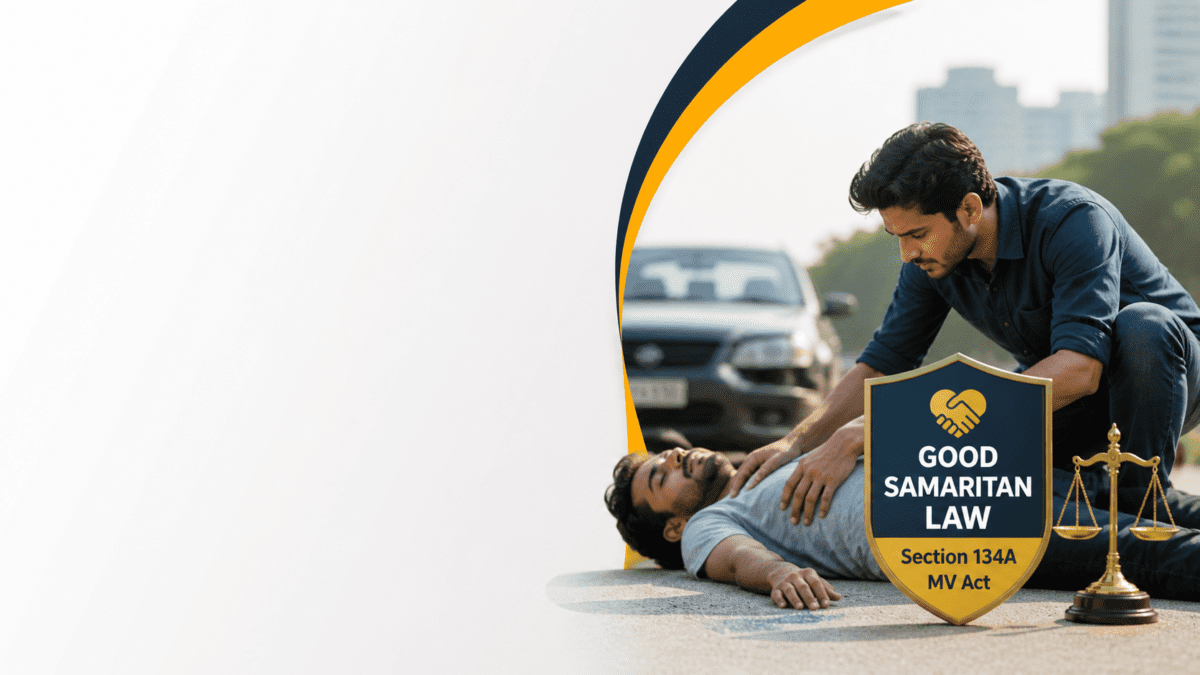
Good Samaritan Law in India — Section 134A MV Act Explained Simply (2026)
Good Samaritan Law India — Section 134A (MVA-10) Part of Motor Vehicles Act 1988 India:…
MACT Claims in India: Step-by-Step Process, Compensation & Rules (2026 Guide)
MACT Claim in India 2026 – MVA-09 Part of Motor Vehicles Act 1988 India: Complete…
Motor Insurance & Third Party Law in India : MV Act 1988 Complete Guide 2026
Motor Insurance & Third Party Law India -MVA-08 ← Previous: Traffic Rules & Fines (MVA-07)…
Traffic Rules and Penalties in India 2026 — Complete Guide (Challan, Fines & Sections)
Traffic Rules and Penalties in India 2026 MVA-07: Part of MVA Complete Guide ← Previous:…