Last Updated: June 6, 2026
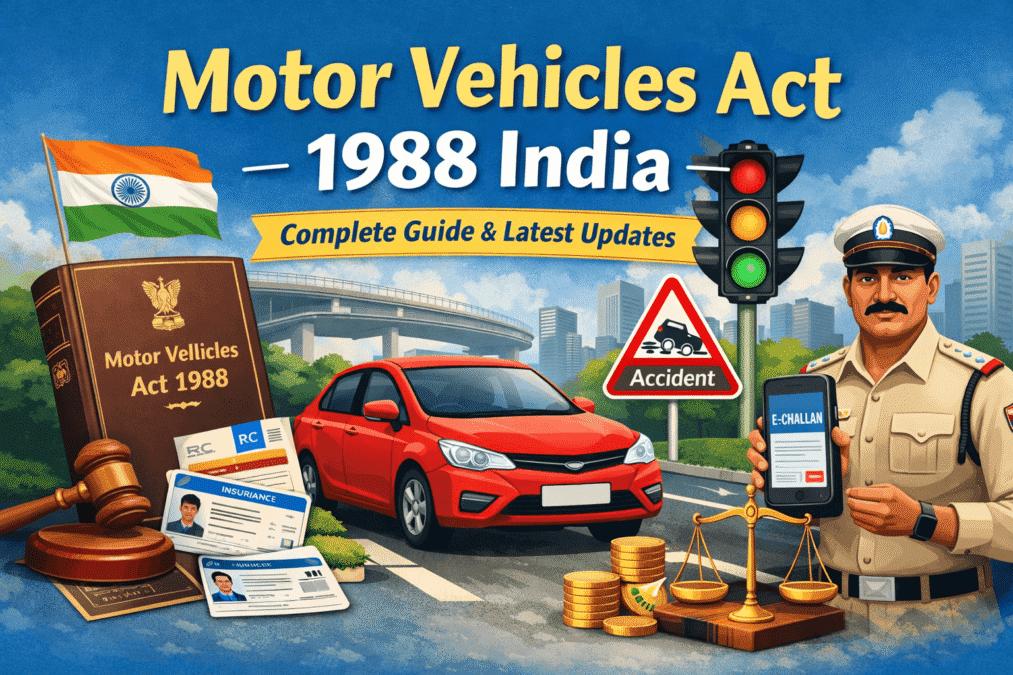
Motor Vehicles Act 1988 — India’s Complete Road Law Explained
Imagine this: you are driving to work on a Monday morning. A traffic police officer waves you over. You fumble for your phone to show your DigiLocker DL. The officer insists on a physical copy. You know you have rights under the law — but do you know exactly which section protects you?
This is exactly the kind of situation that the Motor Vehicles Act, 1988 was built to resolve — for drivers, vehicle owners, accident victims, and anyone who uses Indian roads. It is not just a law for lawyers. It is a law for every person who has ever sat in a car, taken a bus, or crossed a street in India.
This guide is your complete, plain-language reference to the Motor Vehicles Act, 1988 — India’s principal road law, last substantially amended in 2019, with the latest updates as of April 2026. We cover everything from learner’s licences to MACT claims, from helmet fines to the landmark Supreme Court judgments that changed how insurance claims are decided.
Quick Fact: The Motor Vehicles Act, 1988 (Act No. 59 of 1988) came into force on 1 July 1989. It replaced the 1939 Act and has 217 sections across 14 chapters. The 2019 Amendment was the most sweeping overhaul in 30 years.
Why the Motor Vehicles Act Matters More in 2026 Than Ever Before
India has the world’s highest road fatality rate. According to Ministry of Road Transport and Highways (MoRTH) data, over 1.5 lakh people die on Indian roads every year — roughly 17 deaths every hour. The Motor Vehicles (Amendment) Act, 2019 responded by raising fines five to ten times, creating a Good Samaritan law, and establishing a Motor Vehicle Accident Fund to compensate even uninsured victims.
In 2026, the law has become even more consequential: AI-powered cameras issue e-Challans automatically, DigiLocker documents are legally accepted, Aadhaar is linked to every driving licence, and the government has reportedly prepared 61 more amendments for Parliament. Understanding this law is no longer optional — it is a survival skill for every Indian road user.
| Year | What Changed | Impact |
| 1989 | MVA 1988 came into force | Replaced 1939 Act; modern road law framework |
| 2019 | MV(Amendment) Act — 63 major changes | Penalties x5–10; Good Samaritan; Accident Fund; Aggregators |
| 2021 | CMVR: ADTC Rules 31B–31J | Private driving training centres; RVSF for scrappage |
| 2022 | Gazette S.O.859(E) — Sec 50–57, 93 enforced | Insurance transfer + aggregator rules operative from April |
| 2023 | Jan Vishwas Act — Sec 177A compoundable | Minor offences decriminalised; compounding allowed |
| 2024 | SC Constitution Bench — Bajaj Allianz v. Rambha Devi | LMV licence valid for transport vehicles under 7500 kg |
| 2026 (Proposed) | 61-point Amendment Bill expected in Parliament | Watch this space — major uniformity changes planned |
What Is the Motor Vehicles Act, 1988? Overview
Think of the Motor Vehicles Act as the rulebook for everything that moves on Indian roads. It covers six broad areas:
- Who can drive — licensing rules (Chapter II, Sections 3–28)
- Which vehicles can be on the road — registration rules (Chapter IV, Sections 39–65)
- Who can operate transport services — permit rules (Chapter V, Sections 66–96)
- What safety standards vehicles must meet — construction rules (Chapter VII, Sections 106–120)
- What happens when you break road rules — traffic offences and penalties (Chapter XIII, Sections 177–210)
- How accident victims get compensated — insurance and MACT provisions (Chapters X–XII, Sections 140–176)
Every Indian who drives, rides, or commutes is affected by at least one of these areas. Let us walk through each one clearly.
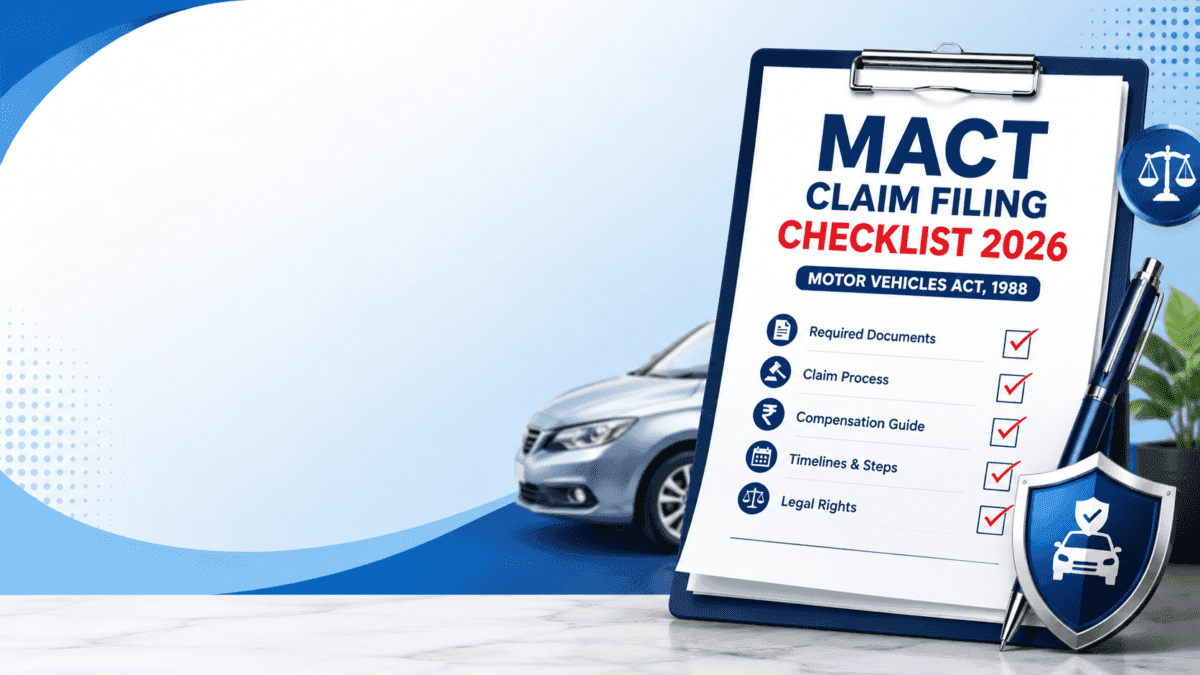
Download the free MACT Claim Filing Checklist PDF 2026 and stay prepared with the right legal information when it matters most.
Free MACT Claim Filing Checklist PDF 2026
The 14 Chapters of the Act
| Chapter | Sections | What It Covers |
| I | 1–2 | Preliminary provisions and definitions in Section 2 |
| II | 3–28 | LICENSING OF DRIVERS OF MOTOR VEHICLES |
| III | 29–38 | LICENSING OF CONDUCTORS OF STAGE CARRIAGES |
| IV | 39–65 | Registration of vehicles — RC, transfer, fitness certificate |
| V | 66–96 | Control of Transport Vehicles |
| VI | 97–105 | State Transport Undertakings (government bus services) |
| VII | 109–111 | CONSTRUCTION, EQUIPMENT AND MAINTENANCE OF MOTOR VEHICLES |
| VIII | 112–138 | CONTROL OF TRAFFIC |
| IX | 139 | MOTOR VEHICLES TEMPORARILY LEAVING OR VISITING INDIA |
| X | 140–144 | LIABILITY WITHOUT FAULT IN CERTAIN CASES |
| XI | 145–164 | INSURANCE OF MOTOR VEHICLES AGAINST THIRD PARTY RISKS |
| XII | 165–176 | Motor Accident Claims Tribunals (MACT) |
| XIII | 177–210 | OFFENCES, PENALTIES AND PROCEDURE |
| XIV | 211–217 | Miscellaneous — appeals, delegations, overriding effect |
Driving Licences — What You Must Know (Sections 3–28)
Section 3 of the Act says it simply: no person shall drive a motor vehicle in any public place without a valid driving licence. This sounds simple — but the devil is in the details.
Types of Driving Licences in India
Not all driving licences are the same. India has different licence classes for different vehicles:
| Licence Type | For | Min. Age | Validity |
| MCWOG (Gearless two-wheeler) | Activa, Dio, moped | 16 years | Until age 50: 20 yrs then renew After 50: Every 5 years |
| MCG (Motorcycle with gear) | Bullet, Pulsar, Splendor | 18 years | Until age 50: 20 yrs, then renew after 50: every 5 years |
| LMV (Light Motor Vehicle) | Car, Jeep, SUV | 18 years | Until age 50: 20 yrs, then renew after 50: every 5 years |
| Transport Vehicle (LMV-TR) | Taxi, auto-rickshaw (commercial) | 20 years | 3 years — must renew with medical certificate |
| HMV (Heavy Motor Vehicle) | Truck, bus | 20 years + LMV for 1 year | 3 years — medical certificate mandatory |
| Learner’s Licence (LL) | All classes — learning stage | 16/18 yrs (renewable once) | 30 days to 6 months |
The LMV Licence vs. Transport Vehicle Debate -Settled in 2024
One of the most litigated questions in Indian motor law was this: if you hold an LMV licence (for your personal car), can you drive a commercial taxi or delivery van? The Supreme Court answered this definitively in November 2024.
Case Law: Bajaj Allianz General Insurance Co. Ltd. v. Rambha Devi & Ors. | 2024 INSC 840 | 5-Judge Constitution Bench | 6 November 2024 A five-judge Constitution Bench unanimously held that a person holding an LMV driving licence is entitled to drive a transport vehicle whose unladen weight does not exceed 7,500 kg — without any separate endorsement. This means a standard car licence covers delivery vans, small taxis, and light commercial vehicles under 7,500 kg. The Bench upheld Mukund Dewangan v. Oriental Insurance (2017). Insurance companies cannot deny MACT claims on the ground that the driver held only an LMV licence for a sub-7,500 kg transport vehicle. Practical result: millions of gig workers and taxi drivers are protected.
Latest Update 2026 — Sarathi Portal: All driving licences are now issued through the Sarathi portal (sarathi.parivahan.gov.in). Your DL is linked to Aadhaar and assigned a Unique Driving Licence Number (UDLN) under the National Register of Driving Licences (Section 28A, inserted by 2019 Amendment). Digital DL stored in DigiLocker is legally valid — traffic police must accept it. For full Driving Licence Guide, see our Module MVA-03.
Vehicle Registration-Your RC Is Not Just a Document (Sections 39–65)
Section 39 of the Act makes registration mandatory for every motor vehicle before it is driven on a public road. Without a valid Registration Certificate (RC), driving is illegal — and can get both the driver and the owner in trouble.
- RC Validity: 15 years for private vehicles (Section 41(7)). After 15 years, renew every 5 years with a fitness test.
- Transfer of Ownership: If you buy or sell a vehicle, the transfer must be reported to the RTO within 14 days (Section 50). This provision became operative from 1 April 2022 per Gazette Notification S.O. 859(E) issued by MoRTH on 25 February 2022.
- e-RC: The Vahan portal (vahan.nic.in) issues digital RCs. Your RC in DigiLocker is legally equivalent to the physical card.
- Scrappage Policy (2022): Private vehicles older than 20 years and commercial vehicles older than 15 years must pass a fitness test. Failure means the vehicle is declared an End of Life Vehicle (ELV) and must be scrapped at a Registered Vehicle Scrapping Facility (RVSF). EPR mandates for vehicle manufacturers are fully operative from FY 2026–27.
Download the free MACT Claim Filing Checklist PDF 2026 and stay prepared with the right legal information when it matters most.
Free MACT Claim Filing Checklist PDF 2026
Traffic Fines in India 2024 -The 2019 Amendment Changed Everything
Before 2019, Indian traffic fines were almost laughably low — Rs. 100 for no helmet, Rs. 400 for speeding. The 2019 Amendment raised them by five to ten times. Here are the key offences every driver must know:
| Offence | Section | Old Fine | New Fine (2019) | Extra |
| Driving without licence | Sec 181 | Rs. 500 | Rs. 5,000 | Community service possible |
| No helmet (two-wheeler) | Sec 194D | Rs. 100 | Rs. 1,000 | 3-month licence DQ |
| No seat belt | Sec 194B | Rs. 100 | Rs. 1,000 | Community service |
| Drunk driving — 1st offence | Sec 185 | Rs. 2,000 | Rs. 10,000 | + 6 months jail |
| Over-speeding (car) Over-speeding (Medium vehicle) | Sec 183 | Rs. 400 | Rs. 1,000–2,000 for Car Rs.2,000–4,000 for (Medium vehicle) and Heavy vehicles up to ₹5,000 | Licence suspension for car and Licence seizure for medium & heavy vehicles |
| Phone while driving | Sec 184 | Rs. 1,000 | Rs. 5,000 | Licence suspension |
| Juvenile driver — guardian fine | Sec 199A | Rs. 500 | Rs. 25,000 | 3 yrs jail + (RC cancellation under Sec 195) |
| No insurance | Sec 196 | Rs. 1,000 | Rs. 2,000 | + 3 months jail |
| Block emergency vehicle | Sec 194E | None | Rs. 10,000 | New offence — 2019 |
Section 210A — Central Government sets the fine amount. State Government can multiply it (1–10 times). Most states use the base fine without multiplying it. No automatic yearly increase happens.
Motor Insurance – Not Optional, It’s the Law (Sections 145–164)
Section 146 of the Motor Vehicles Act makes third-party insurance compulsory for every motor vehicle on Indian roads. You cannot register a vehicle, and you cannot legally drive it, without at least third-party insurance. This is not a formality — it is the financial protection that ensures accident victims can receive compensation even if the driver is broke.
What Third-Party Insurance Actually Covers
- Death or bodily injury to any third party (other people on the road) — unlimited liability under 2019 Amendment.
- Damage to third-party property — up to Rs. 7.5 lakh for most vehicles.
- It does NOT cover damage to your own vehicle — that requires a comprehensive policy.
Motor Vehicle Accident Fund (Section 164B – New in 2019)
Motor Vehicle Accident Fund (Section 164B – New in 2019)
One of the most impactful additions of the 2019 Amendment is the Motor Vehicle Accident Fund. It covers victims who would otherwise get nothing — hit-and-run cases and vehicles with no insurance.
The payouts are:
✓ Rs. 2 lakh for death in a hit-and-run accident
✓ Rs. 50,000 for serious/grievous injury in a hit-and-run (NOT ordinary injuries)
Note: These amounts are part of the “Hit and Run Compensation Scheme” notified on 25 February 2022 (effective 1 April 2022).
BONUS: Cashless Treatment During Golden Hour
Separately, the Government launched the “Cashless Treatment Scheme-2025” under Section 162. This provides free, cashless emergency treatment up to ₹1.5 lakh during the critical first hour (Golden Hour) after any road accident. This is a DIFFERENT scheme under Section 162, NOT part of the Motor Vehicle Accident Fund under Section 164B. .
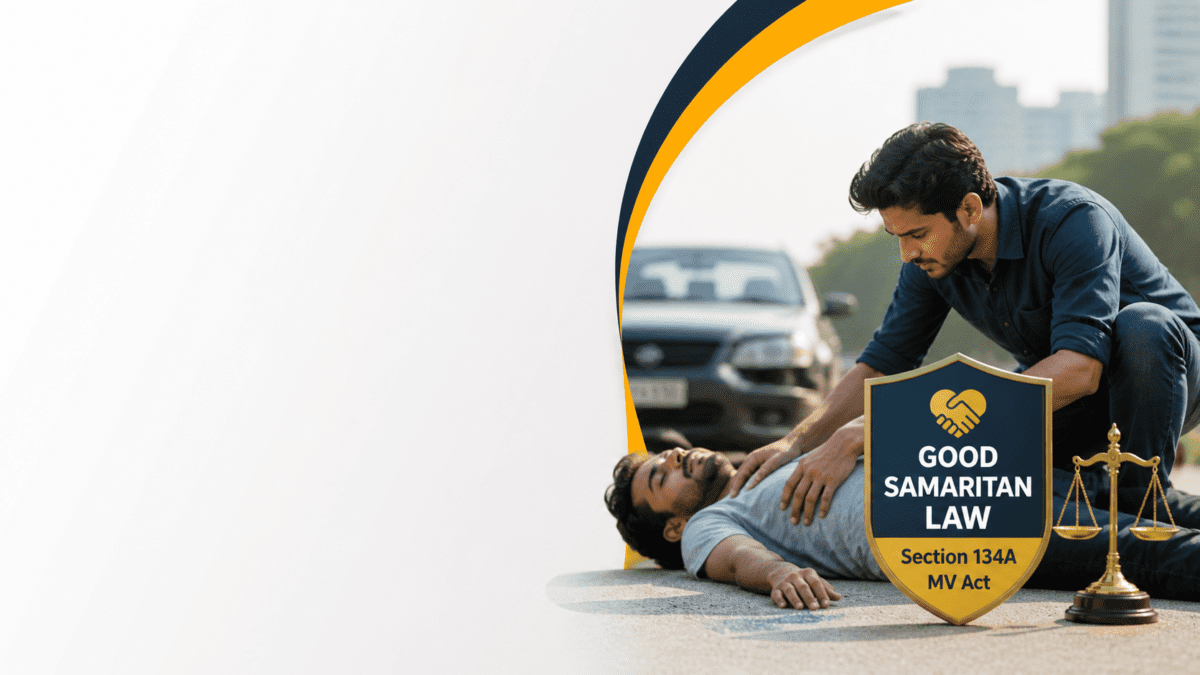
Good Samaritan Law (Section 134A): Are you afraid to help an accident victim in case the police harass you? The 2019 Amendment put that fear to rest. Section 134A gives complete protection to any person who voluntarily helps an accident victim in good faith. The police cannot force you to give a statement, cannot detain you, and you cannot be sued. India now has one of the most protective Good Samaritan laws in the world.
MACT – How Accident Victims Get Compensated in India (Sections 165–176)
If you or your family member is injured or killed in a road accident, you do not need to go to a regular court. Chapter XII of the Act establishes Motor Accident Claims Tribunals (MACTs) — special courts in every district designed to process claims quickly and without the technicalities of civil litigation.
How to File a MACT Claim – 4 Key Steps
- Step 1 — Get the FIR: File a First Information Report at the nearest police station immediately after the accident.
- Step 2 — Apply to MACT: File “Claim Petition under Section 166 (application for compensation) before the MACT in the district where the accident occurred, where you live, or where the vehicle is registered.
- Step 3 — Present evidence: Attach all supporting documents: Medical records and hospital bills, Death certificate (if applicable), Income proof (salary slips, ITR), FIR copy, Driver’s license, RC, and insurance copy, Disability certificate (if any) Photos of injuries/accident scene and Bank account details
- Step 4 — Award: The MACT tribunal examines the evidence, determines liability, and passes an award directing the insurer to pay compensation. If dissatisfied, you can appeal to the High Court under Section 173 within 90 days.
Time Limit: You must file your MACT claim within 6 months of the accident under Section 166. Courts have some discretion to condone delay in genuine cases, but do not wait — file early.
Download the free MACT Claim Filing Checklist PDF 2026 and stay prepared with the right legal information when it matters most.
MACT Claim Filing Checklist
Landmark Case Laws That Shaped Indian Road Law
The Motor Vehicles Act does not exist in isolation — it has been interpreted, expanded, and refined by decades of Supreme Court judgments. These are the cases that every law student, lawyer, and MACT practitioner must know:
Case Law: Sarla Verma v. Delhi Transport Corporation | (2009) 6 SCC 121 — Supreme Court The Supreme Court laid down the structured multiplier method for calculating compensation in motor accident death cases. The judgment standardized age-based multipliers — so that the family of a 30-year-old earns more compensation than the family of a 60-year-old, reflecting lost earning years. This formula is now the mandatory starting point in every MACT death compensation case. Why it matters: Without this judgment, compensation amounts were arbitrary and inconsistent. Sarla Verma brought uniformity, predictability, and fairness.
Case Law: Raj Kumar v. Ajay Kumar | (2011) 1 SCC 343 — Supreme Court This judgment clarified how compensation is calculated in permanent disability cases — distinguishing between functional disability (what the person can no longer do physically) and economic disability (what earning capacity they have actually lost). A person who loses a finger may have 100% functional disability in that finger but only 10% economic disability if they can still earn. The MACT must assess both. Why it matters: Ensures victims with partial disabilities are not over- or under-compensated.
Case Law: Khenyei v. New India Assurance Co. Ltd. | (2015) 9 SCC 166 — Supreme Court Where two or more vehicles cause an accident jointly, the victim can claim full compensation from any one insurer (joint and several liability). The insurer who pays can then seek contribution from the other insurer. Why it matters: Accident victims are no longer caught in the middle of owner-insurer disputes between multiple vehicles. They get paid first; the legal dispute between insurers happens separately.
Case Law: Pepsu Road Transport Corporation v. National Insurance Co. Ltd. | (2013) 10 SCC 217 — Supreme Court Even if the vehicle owner negligently allowed someone with a defective licence to drive, the insurer must first pay the accident victim and then recover from the owner. This is the ‘pay and recover’ principle. Why it matters: Victims never go uncompensated because of a technical dispute between the owner and the insurer about the driver’s licence.
Latest Updates — Motor Vehicles Act in 2026
The law is not static. Here are the most significant developments as of April 2026:
| Update | What It Means for You | Source |
| AI e-Challan cameras (2025–26) | Mobile phone detection cameras and toll booth insurance auto-checks are now nationwide. Violations are caught without a policeman being present. | MoRTH; NIC e-Challan platform |
| Bajaj Allianz Constitution Bench (Nov 2024) | LMV licence is now definitively valid for all transport vehicles under 7,500 kg. Insurance companies cannot use this to deny MACT claims. | 2024 INSC 840; |
| Jan Vishwas Act 2023 (effective Jan 2025) | Minor traffic offences under Section 177A are now compoundable — meaning fines can be paid without court appearance. Jail for minor violations removed. | Jan Vishwas (Amendment of Provisions) Act, 2023 (effective January 2025)” |
| Vehicle Scrappage EPR (FY 2026–27) | Automobile manufacturers must now take back and recycle End of Life Vehicles. Mandatory registration on the EPR portal. | MoEFCC; CMVR 2022 |
| CMVR 22nd Amendment (Dec 2022) | Armoured vehicle construction norms (AIS-194) added to CMVR. Standards for ballistic protection specified. | G.S.R. 2022; MoRTH |
| 61 proposed MV Act amendments (2026) | Government reportedly ready with 61 changes for the Budget Session of Parliament — targeting uniformity in permits, penalties, and digital enforcement. | New Indian Express, Jan 2026 |
More Updates for 2026:
- Jan Vishwas Bill 2025 (proposed): Further decriminalisation of minor offences
- WLTP Emission Testing Phase 1 (April 2027): All petrol vehicles to follow WLTP standards
- Nationwide 2-Helmet Rule (2025): Mechanical requirement with new 2-wheelers
- Aadhaar-linked Digital driving licence (2026): All DLs now linked and verified
Practical Guide — 5 Things Every Indian Driver Must Know in 2026
1. Your Digital DL Is Legally Valid
The Motor Vehicles (Amendment) Act, 2019 and subsequent MoRTH notifications have confirmed that a driving licence stored in DigiLocker or the mParivahan app is legally equivalent to the physical card. If a police officer refuses to accept your digital DL, you have the right to file a complaint. You can access your DL at digilocker.gov.in or via the mParivahan app.
2. An e-Challan Must Be Paid Within 60 Days
Every e-Challan issued through the AI camera system or by a traffic officer is uploaded to echallan.parivahan.gov.in. Pay within 60 days. After that, the challan is referred to a judicial magistrate — and court fees are added. Some states also block your vehicle’s fitness renewal if outstanding challans exist. Check your challan status regularly.
3. Your Child Driving Your Car Could Land You in Jail
Section 199A (2019 Amendment) makes parents and vehicle owners criminally liable if a juvenile (under 18) drives their vehicle. The fine is Rs. 25,000, imprisonment up to 3 years, and the vehicle’s registration certificate is cancelled. This is not a warning — it is a criminal charge. Never allow a minor to drive your vehicle.
4. Always Help Accident Victims – You Are Protected
Section 134A of the Act gives you complete protection when you help an accident victim in good faith. You cannot be arrested, detained, forced to testify, or sued. The only exception is if you cause deliberate harm. Seventeen people die every hour on Indian roads — many of those deaths are preventable if bystanders help. The law is on your side.
5. Third-Party Insurance Expiry = Illegal Vehicle
A vehicle without valid third-party insurance cannot legally be driven on Indian roads. The fine is Rs. 2,000 plus possible imprisonment. But more importantly — if you are in an accident and your insurance is expired, the Motor Vehicle Accident Fund may cover the victim, but you will face civil recovery proceedings. Renew your insurance before it expires. Check your policy status anytime through vahan.nic.in.
Summary — Motor Vehicles Act 1988 in 10 Points
The Complete Picture:
- Enacted 1988, effective 1989. Replaced 1939 Act. 217 sections, 14 chapters.
- Administered by MoRTH; enforced by State RTOs and traffic police.
- 2019 Amendment: penalties x5–10; Good Samaritan; Accident Fund; aggregator licensing; vehicle recall.
- Section 3: No driving without valid licence. Section 146: No driving without insurance. Both are criminal offences.
- LMV licence covers transport vehicles under 7,500 kg — confirmed by Constitution Bench, November 2024.
- MACT courts adjudicate accident compensation. No negligence proof needed under Section 163A.
- Digital DL and RC (DigiLocker/mParivahan) are legally valid everywhere in India.
- e-Challan: Pay within 60 days at echallan.parivahan.gov.in.
- Jan Vishwas 2023: Minor violations compoundable from January 2025.
- 61 amendments proposed for Parliament — major changes expected. Watch this space.
FAQ — Motor Vehicles Act 1988
Q1. What is the Motor Vehicles Act 1988?
The Motor Vehicles Act, 1988 (Act No. 59 of 1988) is India’s primary legislation governing all aspects of road transport — including driver licensing, vehicle registration, traffic rules, motor insurance, and accident compensation. It came into force on 1 July 1989 and replaced the Motor Vehicles Act, 1939. It has 217 sections organized across 14 chapters and is administered by the Ministry of Road Transport and Highways (MoRTH).
Q2. What are the major changes in the Motor Vehicles Amendment Act 2019?
The Motor Vehicles (Amendment) Act, 2019 (Act No. 32 of 2019) introduced: (1) Penalties increased 5–10 times for most traffic offences; (2) Good Samaritan protection under Section 134A; (3) Motor Vehicle Accident Fund for hit-and-run victims under Section 164B; (4) Vehicle recall provisions under Section 110A; (5) Licensing of aggregators (Ola, Uber) under Section 93; (6) National Register of Driving Licences under Section 28A; (7) Juvenile driver liability on guardians under Section 199A.
Q3. What is the penalty for drunk driving in India in 2024?
Under Section 185 of the Motor Vehicles Act as amended in 2019: First offence — fine of Rs. 10,000 and/or imprisonment up to 6 months. Second offence within 3 years — fine of Rs. 15,000 and/or imprisonment up to 2 years. The Blood Alcohol Concentration (BAC) limit is 30 milligrams per 100 millilitres of blood. Refusal to take the breath analyser test is itself an offence with the same penalty.
Q4. Can I show my driving licence on DigiLocker to traffic police?
Yes. The Motor Vehicles (Amendment) Act, 2019 and subsequent MoRTH notifications confirmed that digital documents stored in DigiLocker and the mParivahan app are legally valid throughout India and must be accepted by traffic police and courts. You do not need to carry the physical card, though it is advisable to have it as a backup.
Q5. How do I file a motor accident compensation claim in India?
File an application (Claim Petition) before the Motor Accident Claims Tribunal (MACT) in your district under Section 166 of the Motor Vehicles Act. The application should be filed within 6 months of the accident. Submit your FIR, medical records, income proof, and vehicle details. The MACT will issue notice to the vehicle owner and insurer, record evidence, and pass a compensation award. You do not need to prove negligence to receive interim relief under Section 163A (structured formula).
Q6. What happens if a minor drives your vehicle in India?
Under Section 199A of the Motor Vehicles Act (inserted by 2019 Amendment), if a person under 18 is found driving your vehicle: the registered owner and guardian face a fine of Rs. 25,000 and up to 3 years imprisonment; the vehicle’s Registration Certificate is cancelled; and the juvenile is treated as an adult for the motor offence under the Juvenile Justice Act, 2015. Do not, under any circumstances, allow minors to drive your vehicle.
Q7. Is my LMV car licence valid to drive a taxi or delivery van?
Yes — for vehicles under 7,500 kg unladen weight. The Supreme Court’s five-judge Constitution Bench in Bajaj Allianz General Insurance Co. v. Rambha Devi (2024 INSC 840, decided 6 November 2024) definitively held that an LMV driving licence covers transport vehicles whose unladen weight does not exceed 7,500 kg. No separate endorsement is required. For heavier commercial vehicles (trucks, large buses), a separate Heavy Motor Vehicle licence is required.
Explore the Complete Motor Vehicles Act Series — AspirixWriters.com
This is the pillar hub for the entire Motor Vehicles Act, 1988 series on AspirixWriters.com. Each linked module below is a deep-dive article with section analysis, case laws, and exam notes:
| Module | Topic | Best For | Read Next |
| MVA-02 | Key Definitions (Section 2) | Beginners, CLAT students | Motor Vehicles Act Section 2 Definitions Simply Explained |
| MVA-03 | Driving Licence Rules India | All drivers, law students | Driving Licence Rules India: Complete Guide Under MVA 1988 |
| MVA-04 | Vehicle Registration (RTO) | Vehicle owners, CLAT | Vehicle Registration Rules India — Complete Guide |
| MVA-07 | Traffic Fines & Penalties 2024 | All road users, Judiciary prep | Traffic Rules And Penalties In India 2026 — Complete Guide |
| MVA-08 | Motor Insurance & 3rd Party Law | Vehicle owners, lawyers | Motor Insurance & Third Party Law India 2026 |
| MVA-09 | MACT — Accident Claims Guide | Accident victims, MACT lawyers | MACT Claim In India 2026 — Step-by-Step Guide |
| MVA-10 | Good Samarithan Law | Everyone | Good Samaritan Law In India — Section 134A Explained |
| MVA-11 | 2019 Amendment Complete Guide | All audiences, UPSC, Judiciary | Motor Vehicles (Amendment) Act, 2019 Explained — Key Changes, Penalties & Latest Updates 2026 |
| MVA-12 | FAQs, MCQ Quiz & PDF Downloads | CLAT, UGC NET, Judiciary prep |
MV Act 1988 Permit Rules India 2026 : Complete Guide
Vehicle Safety & Emission Rules India 2026 Guide
Download the free MACT Claim Filing Checklist PDF 2026 and stay prepared with the right legal information when it matters most.
Free MACT Claim Filing Checklist PDF 2026
References:
- Motor Vehicles Act, 1988 (Act No. 59 of 1988)
Bare Act PDF – India Code - Motor Vehicles (Amendment) Act, 2019 (Act No. 32 of 2019)
PRS Legislative Summary
S.O. 859(E) – Sections 50-57 & 93 Notification - Jan Vishwas (Amendment of Provisions) Act, 2023 (Act No. 18)
Official Gazette PDF - MoRTH Official Notifications
- CMVR 22nd Amendment Rules, 2022
Armoured Vehicle Standards - Hit & Run Compensation Scheme, 2022
PIB Press Release G.S.R. 163(E) - Vahan Portal (Vehicle Registration)
https://vahan.parivahan.gov.in - Sarathi Portal (Driving License)
https://sarathi.parivahan.gov.in - e-Challan Portal
https://echallan.parivahan.gov.in - DigiLocker (Digital RC/DL)
https://digilocker.gov.in
Disclaimer: This article is for educational purposes only and does not constitute legal advice. All statutory provisions are subject to amendment. Verify current rules at indiacode.nic.in. For specific legal problems, consult a qualified advocate. Last Updated: April 2026.
About Author
Dr. Rekha Khandelwal is a Ph.D. in Law, legal researcher, and founder of AspirixWriters.com. She specializes in simplifying Indian laws and academic concepts into clear, practical knowledge for students, aspirants, and the general public.
Dr. Rekha Khandelwal | Academic Writer, Legal Technical Writer, AI Expert & Author | AspirixWriters
Free MACT Claim Filing Checklist PDF 2026
MACT Claim Filing Checklist Part of Motor Vehicles Act 1988 India: Complete Guide Road accidents…
Motor Vehicles (Amendment) Act, 2019 Explained — Key Changes, Penalties & Latest Updates 2026
Motor Vehicles Amendment Act 2019 — Complete Guide (MVA-11) Part of Motor Vehicles Act 1988…
Good Samaritan Law in India — Section 134A MV Act Explained Simply (2026)
Good Samaritan Law India — Section 134A (MVA-10) Part of Motor Vehicles Act 1988 India:…
MACT Claims in India: Step-by-Step Process, Compensation & Rules (2026 Guide)
MACT Claim in India 2026 – MVA-09 Part of Motor Vehicles Act 1988 India: Complete…
Motor Insurance & Third Party Law in India : MV Act 1988 Complete Guide 2026
Motor Insurance & Third Party Law India -MVA-08 ← Previous: Traffic Rules & Fines (MVA-07)…
Traffic Rules and Penalties in India 2026 — Complete Guide (Challan, Fines & Sections)
Traffic Rules and Penalties in India 2026 MVA-07: Part of MVA Complete Guide ← Previous:…