Last Updated: May 23, 2026
He Did Less, Paid Less, and Earned More
Vikram reads the markets. He follows fund manager interviews. He has spent years carefully picking actively managed mutual funds that he believes will beat the index.
His brother Arun does none of that. Every month, Arun’s SIP quietly buys units in a Nifty 50 Index Fund. He has never read a fund factsheet. His expense ratio is 0.10% per year.
After 10 years, the results are in:
- Vikram’s active large-cap funds: 11.2% per year
- Arun’s Nifty 50 index fund: 11.4% per year
Arun did less, paid less, and slightly outperformed in this illustration.
This reflects the long-term impact of lower costs and compounding — and it is exactly why passive investing has become one of the fastest-growing segments in India’s mutual fund industry in 2026.
Passive funds (index funds and ETFs) now account for approximately 19% of India’s total mutual fund AUM, crossing ₹10 lakh crore for the first time in 2025. And SEBI’s new expense rules, effective April 2026, are making them cheaper than ever before.
This article explains what index funds and ETFs are, exactly how they differ, why the new SEBI expense cap matters for your returns, and how to choose the right one.
All return figures are illustrative and based on historical data. Returns are market-linked and not guaranteed.
What Is a Low Cost Index Fund?
An index fund is a mutual fund that tracks a specific stock market index — such as the Nifty 50, Sensex, or Nifty Midcap 150 — by holding substantially the same stocks in broadly similar proportions as that index.
There is no fund manager making decisions. No research team picking stocks. The fund simply mirrors the index. When Reliance Industries is 9.5% of the Nifty 50, it is approximately 9.5% of your index fund. When the index adds or removes a company, the fund adjusts automatically.
This passive approach eliminates two costs that actively managed funds carry: the risk of a wrong call by a fund manager, and the expense of paying a team of analysts to make those calls. The result — as Arun discovered — is a simpler, cheaper, and surprisingly competitive investment.
Per SEBI’s mutual fund categorisation framework, index funds fall under the “Other Schemes — Passively Managed” category. Each fund must clearly disclose the benchmark it tracks, accurately replicate the index composition, and report tracking error regularly to investors. (Source: SEBI Mutual Funds Regulations)
What Is an ETF?
An ETF (Exchange Traded Fund) is essentially an index fund that trades on a stock exchange like a regular share. You can buy and sell ETF units at any point during market hours at the live market price — the same way you buy shares of any company.
The underlying portfolio is substantially similar to an index fund tracking the same benchmark. A Nifty 50 ETF holds broadly the same stocks in similar proportions as a Nifty 50 Index Fund. The difference is entirely in how you buy and sell it.
To invest in an ETF, you need a Demat and trading account. An index fund, by contrast, can be purchased through any mutual fund platform — Groww, Zerodha Coin, MF Central — without any Demat account.
Q1: What is the difference between an index fund and an ETF?
Both track the same index and hold substantially similar stocks. An index fund is purchased through a mutual fund platform at end-of-day NAV — no Demat account needed. An ETF trades on a stock exchange during market hours at a live price and requires a Demat account.
Q2: Which is the best low cost Nifty 50 index fund in India 2026?
Top Nifty 50 index funds from UTI, HDFC, ICICI Prudential, and Nippon India deliver near-identical returns since they track the same benchmark. Compare expense ratio (lower is better), tracking error, and AUM. Verify the latest data at amfiindia.com before deciding.
Index Fund vs ETF — Complete Side-by-Side Comparison
| Factor | Index Fund | ETF |
| How to buy | Through MF platform — no Demat needed | Through Demat + trading account |
| Trading timing | End-of-day NAV only | Any time during market hours at live price |
| Minimum investment | ₹500 via SIP | 1 unit at market price (varies) |
| SIP facility | Yes — full SIP support | No direct SIP — must buy manually |
| Demat account | Not required | Mandatory |
| Expense ratio | 0.10–0.20% (direct plan, typical) | 0.02–0.07% (often lower than index fund) |
| Tracking error | Slightly higher | Generally lower (real-time arbitrage helps) |
| Liquidity | T+2 settlement at NAV | Sell on exchange instantly — T+1 |
| Best for | Beginners, SIP investors, no Demat account | Experienced investors, large lump sum |
For most retail investors in India — especially those investing monthly via SIP — an index fund is the more practical choice. No Demat account, full SIP support, accessible from ₹500/month on any platform.
ETFs make more sense if you already have a Demat account, are deploying a large lump sum, and want real-time trading flexibility. The marginal ETF cost advantage (typically 0.05–0.10% lower per year) does not outweigh the operational simplicity of an index fund for a long-term SIP investor.
Why the Expense Ratio Matters Far More Than It Looks
Most investors glance at the expense ratio and move on. It is a small number — 0.10%, 0.50%, 1.00%. It does not feel significant. Compounded over 20 years, it absolutely is.
The true cost of a 1% expense ratio difference — ₹10,000/month SIP over 20 years:
| Option | Gross Return | Expense Ratio | Net Return | Value After 20 Years |
| Nifty 50 Index Fund (direct) | 12% CAGR | 0.10% | 11.90% | ~₹97,28,000 |
| Active Large Cap Fund (direct) | 12% CAGR | 1.00% | 11.00% | ~₹91,58,000 |
| Active Fund — Regular Plan | 12% CAGR | 1.50% | 10.50% | ~₹87,42,000 |
All figures are illustrative at a hypothetical 12% gross CAGR. Actual returns are market-linked and not guaranteed.
The index fund investor and the regular plan active fund investor both put in the same ₹10,000/month for 20 years. The index fund investor ends up with approximately ₹9.86 lakh more — purely because of the lower expense ratio. The fund manager does not even need to underperform for the cost difference to do significant damage over time.
SEBI’s New Expense Ratio Rules — Effective April 2026
SEBI introduced revised mutual fund expense disclosure and TER framework changes effective 1 April 2026. Verify the latest applicable circulars at sebi.gov.in. The impact on index funds and ETFs is particularly significant.
| What Changed | Before April 2026 | After April 2026 | Impact on You |
| TER cap for index funds and ETFs | Max 1.00% | Max 0.90% | Lower ceiling — aimed at improving cost efficiency for investors. |
| Expense breakdown transparency | Single combined TER figure | Separate disclosure: management fee vs regulatory charges | You now see a clearer breakdown of fund-related costs |
| Brokerage and transaction cost | Embedded in TER — not visible | Must be disclosed separately | True cost of ownership becomes fully transparent |
| GST on management fee | Included in TER figure | Shown separately | Cleaner comparison across AMCs |
| Investor education charges | Within TER | Moved outside TER — shown separately | TER comparisons become more meaningful |
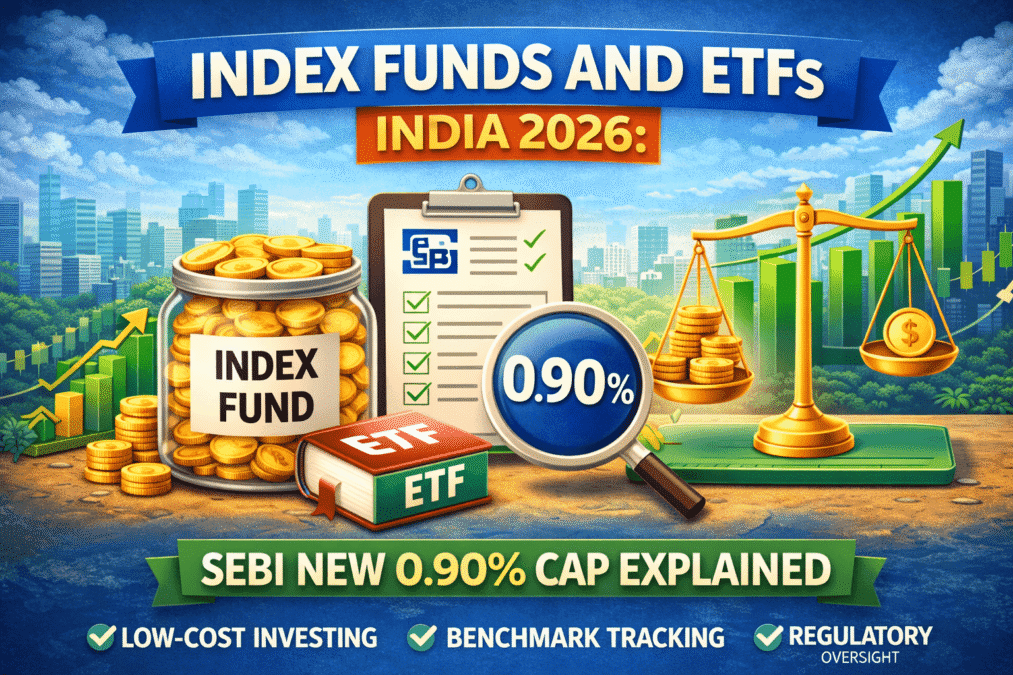
The 0.90% cap is the headline number — but the more valuable change is the transparency requirement. From April 2026, the expense ratio of every index fund shows a clear breakdown: fund management fee, SEBI regulatory charges, and other levies shown separately. Two funds with the same headline TER may have very different management fee structures — that difference is now visible.
For most established Nifty 50 index funds, the effective expense ratio is already well below 0.90% — many are at 0.10–0.20%. The new cap primarily sets a ceiling that protects new investors who may not know to check the expense ratio before investing, and prevents future funds from launching at inflated costs.
Verify the latest SEBI expense ratio guidelines at sebi.gov.in
Types of Index Funds and ETFs Available in India
Passive investing in India has expanded well beyond just Nifty 50. You can now track almost any market segment:
| Category | What It Tracks | Examples | Best For |
| Large Cap — Broad Market | India’s 50–100 largest companies | Nifty 50, Nifty 100, Sensex | Core equity holding — start here |
| Mid Cap | Companies ranked 101–250 | Nifty Midcap 150, Nifty Next 50 | Higher growth, more volatility |
| Small Cap | Companies ranked 251+ | Nifty Smallcap 250 | Aggressive, 10+ year horizon |
| Factor / Smart Beta | Stocks by specific factor — value, momentum, quality | Nifty Alpha 50, Nifty 200 Momentum 30 | Factor exposure at index cost |
| Sectoral ETF | Single sector | Bank Nifty, Nifty IT, Nifty Pharma | Tactical sector allocation |
| International ETF | Global indices | Motilal Oswal NASDAQ 100, S&P 500 | Geographic diversification |
| Gold ETF | Physical gold via custodian | Nippon Gold ETF, HDFC Gold ETF | Gold exposure without physical storage |
| Debt ETF | Government securities, bonds | Bharat Bond ETF, Nippon Liquid BeES | Short-term parking, lower risk |
Top Nifty 50 Index Funds and ETFs — 2026 Data
Data based on verified fund performance as of early 2026. Source: AMFI. Not a buy recommendation.
For SIP Investors — No Demat Account Required
| Fund Name | 3-Yr CAGR | 5-Yr CAGR | Expense Ratio | Tracking Error |
| UTI Nifty 50 Index Fund | ~13.9% | ~12.6% | 0.20% | Low |
| HDFC Index Fund — Nifty 50 | ~13.8% | ~12.5% | 0.20% | Low |
| ICICI Pru Nifty 50 Index Fund | ~13.9% | ~12.5% | 0.17% | Very Low |
| Nippon India Index Fund — Nifty 50 | ~13.8% | ~12.4% | 0.20% | Low |
| SBI Nifty Index Fund | ~13.7% | ~12.4% | 0.20% | Low |
For ETF Investors — Demat Account Required
| ETF Name | 3-Yr CAGR | Expense Ratio | Tracking Error | Liquidity |
| ICICI Pru Nifty 50 ETF | ~13.86% | 0.02% | 0.02–0.03% | Very High |
| Nippon India ETF Nifty 50 | ~13.86% | 0.04% | Very Low | High |
| UTI Nifty 50 ETF | ~13.85% | 0.03–0.05% | Very Low | High |
| SBI Nifty 50 ETF | ~13.85% | 0.07% | Low | High |
All figures are historical and illustrative. Past performance is not indicative of future results. Verify current expense ratios and NAV history at amfiindia.com before investing.
The three selection criteria that matter most — in order:
- Expense ratio — lower is always better, all else equal
- Tracking error — lower means more accurate index replication
- AUM — larger funds have better liquidity and lower operational costs
Returns will be nearly identical across well-run index funds tracking the same benchmark. The differentiator is cost and tracking precision.
How to Start Investing in an Index Fund — Step by Step
For an Index Fund (SIP — No Demat Required)
- Complete KYC once at MF Central using Aadhaar and PAN — free, 10 minutes, covers all future mutual fund investments
- Choose your fund — for most beginners: UTI Nifty 50 Index Fund, HDFC Index Fund — Nifty 50, or ICICI Pru Nifty 50 Index Fund. Check expense ratio and tracking error at amfiindia.com
- Open an account on Groww, Zerodha Coin, Paytm Money, or directly on the AMC’s website. Direct plans usually have lower expense ratios because distributor commissions are not included — compare direct and regular plan costs before deciding
- Set your SIP amount (minimum ₹500/month) and choose a date 3–5 days after your salary credit date
- Authorise the NACH mandate — your SIP runs automatically every month from the next due date
For an ETF (Demat Account Required)
- Ensure you have a Demat and trading account with a SEBI-registered broker — Zerodha, Groww, HDFC Securities, etc.
- Search for the ETF by symbol (e.g., ICICIB50 for ICICI Pru Nifty 50 ETF; SETFNIF50 for SBI Nifty 50 ETF)
- Place a buy order during market hours at the live price — exactly like buying a share
- ETFs have no automatic SIP — set a calendar reminder or use your broker’s recurring buy feature if available
Index Funds vs Active Funds —
| Factor | Index Fund | Active Fund |
| Expense ratio | 0.10–0.20% (direct) | 0.50–1.80% (direct) |
| Performance vs benchmark | Matches benchmark minus expense ratio | May outperform or underperform |
| Manager risk | None | Present — depends on manager quality and tenure |
| Consistency | Very consistent — market returns | Variable — depends on market cycle |
| Transparency | Always holds exactly the index stocks | Portfolio can change significantly month to month |
| Tax efficiency | Lower turnover — fewer taxable events | Higher turnover may trigger more capital gains distributions |
| Best category fit | Large Cap — hardest for active managers to consistently beat | Mid Cap and Small Cap — more inefficiency to exploit |
The practical answer for most Indian investors: Use a Nifty 50 Index Fund as your core holding (50–60% of your equity allocation) for cost efficiency and consistency. Add a well-rated active mid-cap or flexi-cap fund for the remaining portion to retain outperformance potential where active managers have historically had more room to add value.
Key Takeaways
- Index funds and ETFs both track the same benchmark — the key difference is how you buy them and whether you need a Demat account.
- For SIP investors: an index fund is more practical — no Demat needed, full SIP support, accessible from ₹500/month.
- For large lump sum investors with a Demat account: ETFs offer marginally lower expense ratios (as low as 0.02%) and real-time trading.
- SEBI’s new rules (effective April 2026): TER for index funds and ETFs capped at 0.90%. Expense breakdown must be shown separately — management fee, regulatory charges, and other levies disclosed individually.
- A 1% difference in expense ratio can result in ~₹9.86 lakh less wealth over 20 years on a ₹10,000/month SIP — at the same gross return.
- Select index funds by expense ratio first, tracking error second, AUM third — not by short-term return rankings.
- The ideal portfolio for most investors: Nifty 50 Index Fund as the core + active mid/flexi-cap fund for the satellite allocation.
Frequently Asked Questions
Q3: What is SEBI’s new 0.90% expense ratio cap?
SEBI introduced a revised TER framework effective April 2026, capping index funds and ETFs at 0.90% (down from 1.00%). Expense components — management fee, regulatory charges, and other levies — must now be disclosed separately, making fund cost comparisons more transparent.
Q4: What is tracking error and why does it matter?
Tracking error is the gap between a fund’s actual return and its benchmark index return. A lower tracking error (0.02–0.10%) means more accurate index replication. Check it alongside expense ratio — a fund with a low expense ratio but high tracking error may still lag a slightly costlier fund with tighter tracking.
Q5: Should I choose a direct plan or regular plan for an index fund?
Direct plans generally carry lower expense ratios because they do not include distributor commissions. Regular plans include distribution costs, which are reflected in a higher expense ratio. Compare both options on the AMC’s website or amfiindia.com and consult a SEBI-registered advisor if you need personalised guidance.
Q6: Should I choose an index fund or an active fund?
For large-cap investing, index funds have historically matched or beaten most active large-cap funds after fees. For mid-cap and small-cap segments, skilled active managers have historically found more room to outperform. A practical approach: use a Nifty 50 Index Fund as the core (50–60% of equity) and a well-rated active mid-cap or flexi-cap fund for the balance.
Q7: Is a Nifty 50 index fund safe?
A Nifty 50 index fund carries the same market risk as Indian equity markets, so values can rise or fall in the short term. Since it invests across 50 large companies, it reduces dependence on any single company or fund manager. Historically, longer holding periods have reduced the chances of negative returns in broad-market indices like the Nifty 50, though past performance does not guarantee future results. Investors should evaluate their financial goals and risk tolerance or consult a SEBI-registered advisor before investing.
Conclusion
Passive investing through low cost index funds and ETFs is not a shortcut or a compromise. It is a rational, evidence-backed approach to wealth creation that has rewarded patient investors across every major market in the world — and increasingly in India too.
SEBI’s new expense framework effective April 2026 makes passive investing in India more cost-transparent than it has been before. The Nifty 50, which has historically delivered approximately 12–14% CAGR over the long term, represents one of the most widely used long-term equity investment approaches available to Indian retail investors.
You do not need to follow markets, read fund manager interviews, or worry about whether last year’s top performer will repeat. You need a KYC, a platform, ₹500 a month, and the discipline to not stop when markets fall.
Long-term discipline and low costs remain the key drivers of passive investing outcomes.
Official References
- SEBI (Mutual Funds) Regulations, 1996 — sebi.gov.in
- AMFI — Fund Data, NAV History and Expense Ratios
- SEBI — Mutual Fund Circulars and Expense Guidelines
Continue reading: This article is part of our Mutual Funds India 2026 content hub at aspirixwriters.com
Mutual Funds India 2026: Complete Beginner’s Guide
- Top 10 Benefits Of Mutual Funds For Beginners In India 2026
- SIP In Mutual Funds 2026: How It Works, Calculator & Best Plans
- Mutual Funds Vs Fixed Deposits 2026: Which Is Better For You?
next read Life Cycle Mutual Funds India
Disclaimer: For educational purposes only — not personal financial advice. Mutual fund and ETF investments are subject to market risks; returns are market-linked and not guaranteed. Past performance is not indicative of future results. All figures are illustrative based on historical data. Consult a SEBI-registered Investment Advisor before investing — find one at sebi.gov.in.
Author
CA Ajay Khandelwal is a Chartered Accountant and financial expert with over 21 years of experience in taxation, compliance, and business advisory. As a key expert at AspirixWriters, he provides practical insights on income tax, financial planning, and regulatory matters, helping readers make informed financial decisions.
Author profile CA. Ajay Khandelwal

My SIP Is in Loss. Should I Stop Investing?
SIP in loss – Riya is a 28-year-old software engineer in Bengaluru. She started a…

Mutual Fund Vs FD? Which Is Better In 2026 for Salaried Employees
One Gives Stability. The Other Builds Long-Term Wealth. Most Salaried Employees Need Both. If you…

Mutual Funds India Complete Beginner’s Guide 2026
Mutual Funds India 2026 Complete Beginner’s Guide to Benefits, SIP, Types & SEBI New Rules…