
Last Updated: May 18, 2026
Your phone buzzes at 11 PM. An unknown number. You pick up — and hear your son’s voice, trembling: “Maa, accident ho gaya. Hospital mein hoon. ₹30,000 chahiye abhi.” The voice cracks. Every breath, every hesitation — exactly like him. You don’t question it. You open UPI immediately.
What you don’t know is that your son is fast asleep in his hostel room. And you’re about to hand over your savings to a stranger with a laptop and a five-second Instagram clip.
This is not science fiction. This is 2026.
UPI now processes over 20 billion transactions every month — making it the backbone of India’s digital economy and the most targeted platform for financial fraud. In 2025 alone, ₹2,500 crore was stolen through UPI fraud. The UPI scam trends we’re seeing in 2026 are a different beast entirely — no longer crude OTP tricks, but AI-powered psychological traps designed to fool even educated, tech-savvy people.
In April 2026, the Reserve Bank of India responded with Mandatory Two-Factor Authentication (2FA) for high-value transfers, AI fraud alerts across UPI apps, and NPCI’s recipient name verification to stop QR code fraud. But no regulation can protect you from a scam that targets your emotions, not your device.
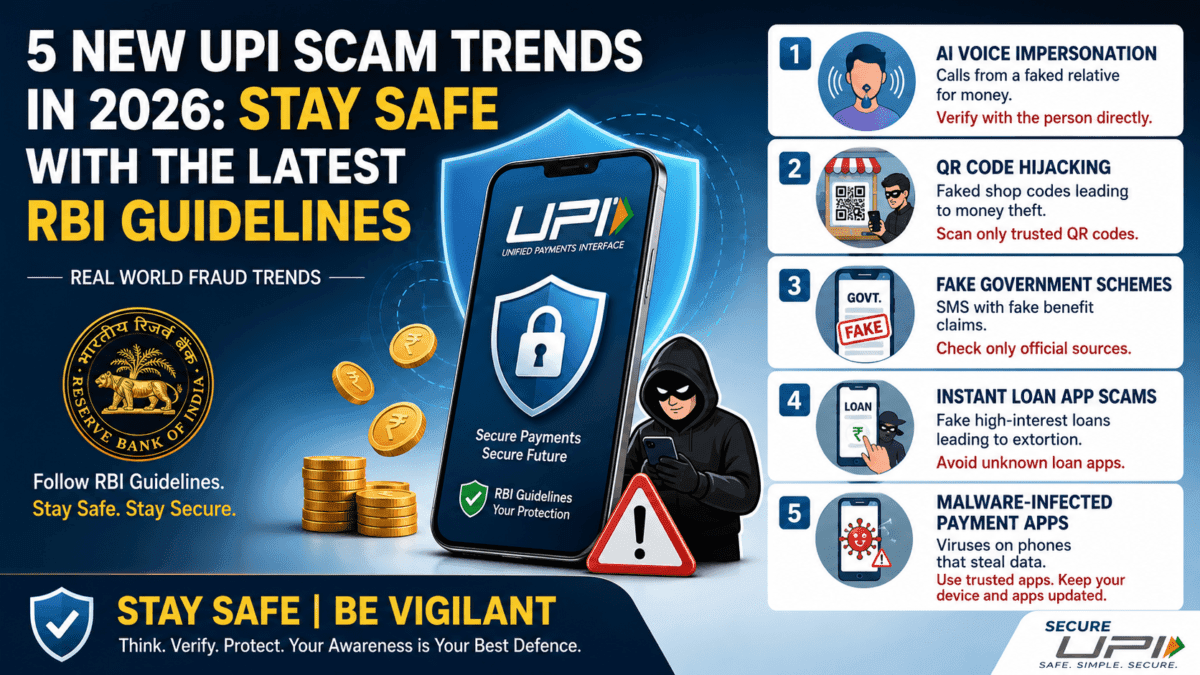
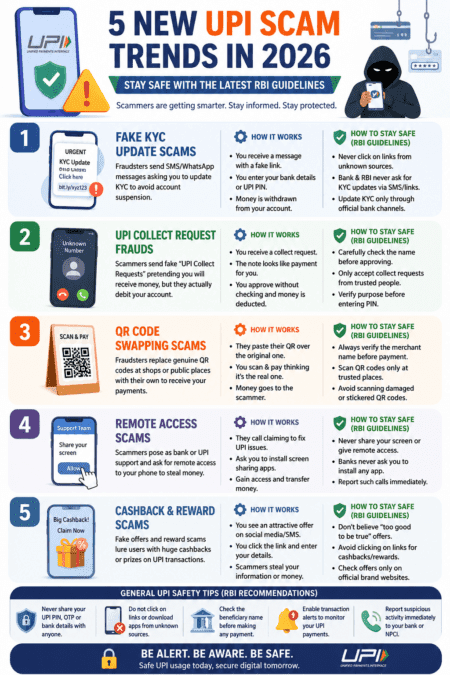
Here are the five latest UPI scams running right now — with real stories from real people, the psychology behind why they work, and exactly what you can do about each one.
Read this. Then share it with someone you love.
The ‘Digital Arrest’ Trap — When Fake Cops Come Calling
Rajesh runs a small hardware shop in Jaipur. One afternoon, a WhatsApp video call changed everything.
On screen: a man in a police uniform, badge visible, official-looking backdrop. He addresses Rajesh by name, reads out his Aadhaar number, and accuses him of being linked to a money laundering case. Then comes the line that freezes him: “You are under digital arrest. Do not leave your home. Send ₹50,000 as a security deposit immediately or face custody.”
Rajesh saw his own bank details on the scammer’s screen — stolen from a data leak. He transferred ₹50,000 within minutes. The panic had made the decision for him.
The Truth
‘Digital Arrest’ does not exist in Indian law. The Reserve Bank of India and Ministry of Home Affairs have both confirmed: real agencies summon citizens physically, with legal warrants. No official body operates over WhatsApp. Ever.
The panic is the weapon. When you believe you’re under arrest, your brain’s survival response shuts down rational thinking. You stop checking. You just react.
RBI’s 2026 update now flags high-value “verification” transfers automatically through AI fraud detection. But your first line of defence is simply knowing this scam exists.
If This Happens to You
• Hang up immediately — no legitimate authority operates this way
• Call 1930 (National Cyber Helpline) to report it — available 24/7
• Block the number and report it on the Sanchar Saathi portal
But the ‘digital arrest’ scam is just the beginning. What AI can now do with your family’s voice is far more disturbing.
AI Voice Cloning — When the Voice You Trust Is a Machine
Sunita, a 68-year-old grandmother in Lucknow, picked up a call and heard her grandson sobbing. Broken words, barely audible — accident, hospital, ₹45,000, please don’t tell anyone, just send it now.
She could not hang up. That was her grandson’s voice. She had known it his entire life. She was seconds away from completing the transfer when her neighbour walked in and physically stopped her.The voice was fake. Built by an AI model trained on a five-second clip from her grandson’s Instagram Reel. CERT-In — India’s official cybersecurity agency — has reported a 300% rise in AI voice cloning fraud in 2026. This is one of the fastest-growing UPI fraud trends this year, and one of the hardest to detect.
Why Your Brain Can’t Catch This
We are wired to respond to the voices of people we love before logic has a chance to kick in. Emotional urgency combined with a familiar voice creates a neurological trap. The rational part of your brain simply goes offline. That’s not weakness — that’s how you’re built. Scammers have weaponised it.
How to Protect Your Family
Create a secret family code word right now — something random only your family knows, like “Jaipur sunset 1984”. If the caller can’t say it, hang up.
· Always call back on the original saved number — no matter how urgent it sounds
· NPCI’s name verification now shows the recipient’s details before you pay — pause and read it every time
· Set all family social media profiles to private today
Even scarier? The next scam doesn’t need your voice. Just a QR code sticker on a dhaba wall.
QR Code Swapping — The Silent Theft at Your Local Shop
Ramesh owns a small dhaba in rural Rajasthan. One morning, while he was busy in the kitchen, a fraudster quietly peeled off his UPI QR sticker and replaced it with an identical-looking one — pointing to a stranger’s account.
Customers paid all day. Ramesh received nothing. By evening, the damage was done. QR code swapping has become one of the most reported UPI scam trends at street level, now making up nearly 40% of all local UPI fraud cases.
The 2026 Fix From NPCI
NPCI introduced the Validate Address API — UPI apps now show you the verified bank account name of the person you’re paying before you enter your PIN. One glance. That’s all it takes to catch a swapped QR. But only if you actually look.
Make This a Habit
· Before every payment, ask: “Does the name on screen match the merchant?”
· If anything looks off, peel the sticker — no honest merchant will mind
· Ask the shop owner to regenerate their QR code through their official app
And this is where thousands make a fatal mistake — handing a stranger complete access to their phone screen.
Fake Customer Support — When ‘Help’ Becomes the Heist
A Delhi student got a call from what sounded exactly like PhonePe support. Friendly, professional, patient. There was a refund stuck in the system — could he just download TeamViewer so they could fix it remotely?
He downloaded the app. The agent walked him through a quick demo. During the demo, he entered his UPI PIN. The agent was watching every keystroke on a mirrored screen. ₹25,000 was gone in under three minutes.
What RBI Did About It
RBI’s 2026 rules now require screen masking — UPI PIN fields automatically black out during any active screen-sharing session. That’s a real protection. But the simplest protection is even stronger:
No legitimate company — PhonePe, Google Pay, your bank, Amazon — will ever ask you to download a remote access app. Not once. Not ever. If someone does, it’s a scam. End the call.
Stay Safe
• Never download any app because an inbound caller told you to
• Genuine support works through official in-app channels only
• If you’ve already shared access, report it immediately at cybercrime.gov.in
5 New UPI Scam Trends in 2026
The most frightening part? The next scam drains you in amounts so small, your bank never even sends a notification.
Micro-Splitting — The Invisible Drain
Anita, a freelance designer in Pune, noticed something strange one evening — 20 small credits of ₹500 each had appeared in her account, followed immediately by 20 transfers out. She hadn’t touched her phone. Total loss: ₹10,000.
Her account had been converted — without her knowledge — into a relay point in a fraud network. Scammers split large stolen amounts into dozens of tiny transactions to fly under bank fraud alerts, bouncing money through “mule accounts” owned by unsuspecting people, often students paid ₹200 to share their account details.
How RBI Is Stopping This
RBI deployed MuleHunter.AI — a real-time system that scans 26+ banks simultaneously, identifying and freezing mule account chains before the money can disappear. It’s one of the most significant anti-fraud investments India has made. But it works best when you catch the early signs too.
Watch For These Signs
· Turn on SMS alerts for every transaction — even ₹1
· Block any unrecognised UPI ID the moment you spot a suspicious transfer
· Check your bank statement every day — it takes thirty seconds
The Golden Hour: What To Do in the 60 Minutes After a Scam
Recovery drops by 80% after 24 hours. If it happens, stop everything and do these three steps immediately:
1. Call 1930 — India’s National Cybercrime Helpline. This logs your complaint instantly and triggers alerts at your bank.
2. File a report at cybercrime.gov.in — upload your transaction ID, the scammer’s UPI ID, and screenshots. Takes under five minutes.
3. Call your bank directly and request a “reverse credit” or chargeback on the fraudulent transaction — within 24 hours.
A retired teacher in Jaipur followed all three steps within 20 minutes of being scammed. She recovered 70% of her money.
One warning: If anyone calls you after a scam offering to “recover” your money for a fee — that’s another scam. Do not pay a single rupee.
Quick Check: Is It a Scam?
| Scenario | Safe Action | Scam Warning Sign |
| Receiving money | No PIN or QR needed | “Enter PIN to receive money” |
| KYC update request | Visit bank branch or official app | WhatsApp or SMS with a link |
| Official-sounding call | Call back on verified number | “Digital Arrest” or “Send OTP now” |
| QR code payment | Check name on screen matches shop | Name mismatch or pressure to hurry |
| Family emergency | Use your secret family code word | Unknown number + familiar panicked voice |
FAQs about UPI scam trends
Which UPI scam trends should I worry about most in 2026?
The five biggest UPI scam trends right now are digital arrest calls, AI voice cloning, QR code swapping, fake customer support, and micro-splitting. All five are covered in detail above — along with what to do if you encounter each one.
Can I get my money back after a UPI scam?
Yes — 40 to 60% is recoverable if you report within the first hour. Call 1930 immediately and request a bank chargeback.
Is digital arrest actually legal in India?
No. It does not exist. The Reserve Bank of India and police confirm that arrests only happen physically, with legal warrants.
Can AI really copy someone’s voice?
Yes — a 3-second audio clip is enough. CERT-In has been warning about this since early 2026. Set family members’ social profiles to private right now.
What’s the fastest way to report UPI fraud?
Call 1930, then file at cybercrime.gov.in. Both together take less than five minutes.
I shared my UPI PIN. What now?
Report immediately — do not wait. Call 1930 and contact your bank. The faster you act, the better the chance of recovery.
Final Thoughts: The Most Powerful Fraud Prevention Tool Is You
Understanding these UPI scam trends is only half the battle. RBI’s new 2FA rules, NPCI’s name verification, MuleHunter.AI — all of it helps. The government and regulators are working harder than ever to protect you. But no system can override a panicked mind that sends money before asking a single question.
Scammers don’t hack your phone. They hack your emotions. They manufacture urgency, fear, and love — and then they watch you do the rest.
The most powerful thing you can do costs nothing: Pause. Verify. Then pay.
Never rush a UPI transaction under pressure. Never share your PIN. Never download an app because a stranger on the phone told you to.
The people most at risk aren’t those who lack tech knowledge. They’re the ones who love their families deeply enough to act before they think. That’s most of us.
Share this with your parents today. Send it to your family group. Because the best time to read this was before the call came. The second best time is right now.
Official Resources
Verified government links — bookmark these before you need them:
→ National Cyber Helpline — call 1930
→ Reserve Bank of India — digital safety
→ CERT-In — cyber threat alerts
About Author –
Dr. Rekha Khandelwal is a legal researcher and content strategist specializing in Indian laws, cybersecurity awareness, and SEO-driven educational content. Through AspirixWriters, she simplifies complex legal and digital topics into practical, reader-friendly guides.