
Image misuse online
The Moment You Realise It’s Happened
You’re scrolling through your phone, and someone tags you in a post. You open it — and your stomach drops. It’s a photo of you. One you never agreed to share. Maybe an old friend posted it as a “throwback.” Maybe an ex uploaded it out of spite. Maybe a stranger lifted it from your profile and put it somewhere you never imagined.
Whatever the story, the feeling is the same: violated, powerless, and unsure of what to do next.
Here’s the good news — you’re not powerless. India has real legal tools that can help you get the photo removed, hold the person accountable, and protect yourself going forward. This guide walks you through exactly what those tools are and how to use them, in plain language, without legal jargon.
Answer
If someone posts your photo online without your consent, you can report it directly to the platform for takedown, file a complaint with the platform’s Grievance Officer under India’s IT Rules, and — if the photo is intimate, morphed, or used to harass you — file a police complaint or report it on the National Cyber Crime Reporting Portal. The DPDP Act, 2023 also gives you a right to have your personal data, including images, corrected or erased.
1. Does This Apply to You?
| You are a… | Does this apply? |
| Individual whose photo was posted without consent | Yes — this guide is written for you |
| Parent of a minor whose photo was misused | Yes — with additional protections available |
| Business owner facing brand image misuse | Partially — different remedies apply (trademark/copyright) |
| Someone facing a morphed or intimate photo | Yes — stronger criminal remedies apply to you |
| Platform or content moderator | Useful for understanding user rights |
If your photo — private, casual, or professional — has been posted, shared, or morphed without your consent, this article is for you.
2.Why This Matters
Emotional impact: Having your image used without permission can feel like a loss of control over your own identity. This is real, and it’s valid.
Legal impact: Indian law increasingly recognises your photo as your personal data, not just a picture. That means you have enforceable rights over it.
Reputational impact: Misused images — especially morphed or out-of-context ones — can damage your reputation, relationships, and even job prospects.
Practical impact: The longer a photo stays up, the more it gets copied and reshared. Speed matters.
Practical Insight: Reporting directly to the platform, alongside the Grievance Officer and Cyber Crime Portal routes below, is generally the fastest way to start the process — exact removal timelines depend on the specific rule or the platform’s own policy, so it’s worth checking both when you file.
3. Understanding the Problem
Photo misuse online generally falls into a few categories:
- Simple non-consensual sharing – someone posts a real photo of you without asking.
- Context stripping – a photo taken for one purpose (say, a private group) is shared publicly.
- Morphing/editing – your face or body is digitally altered, often to create misleading or intimate content.
- Impersonation – your photo is used to create a fake profile.
- Harassment or extortion – photos are used to threaten, blackmail, or shame you.
A common misconception is that “if you posted it publicly once, you have no rights over it.” This isn’t accurate. Consent is context-specific — sharing a photo with friends is not the same as consenting to its use elsewhere, and India’s data protection law is built around this same idea of consent for a specific purpose (indiacode.nic).
Another misconception: “the law only protects women.” While some provisions were written with women’s safety in mind, other remedies — the data protection right to erasure, impersonation law, and platform grievance mechanisms — apply regardless of gender.
Practical Insight: Not every unwanted photo is a crime, and not every photo qualifies for every remedy below. The right response depends on what kind of photo it is and how it’s being used — that’s exactly what the next sections walk through.
4. What To Do — Step by Step
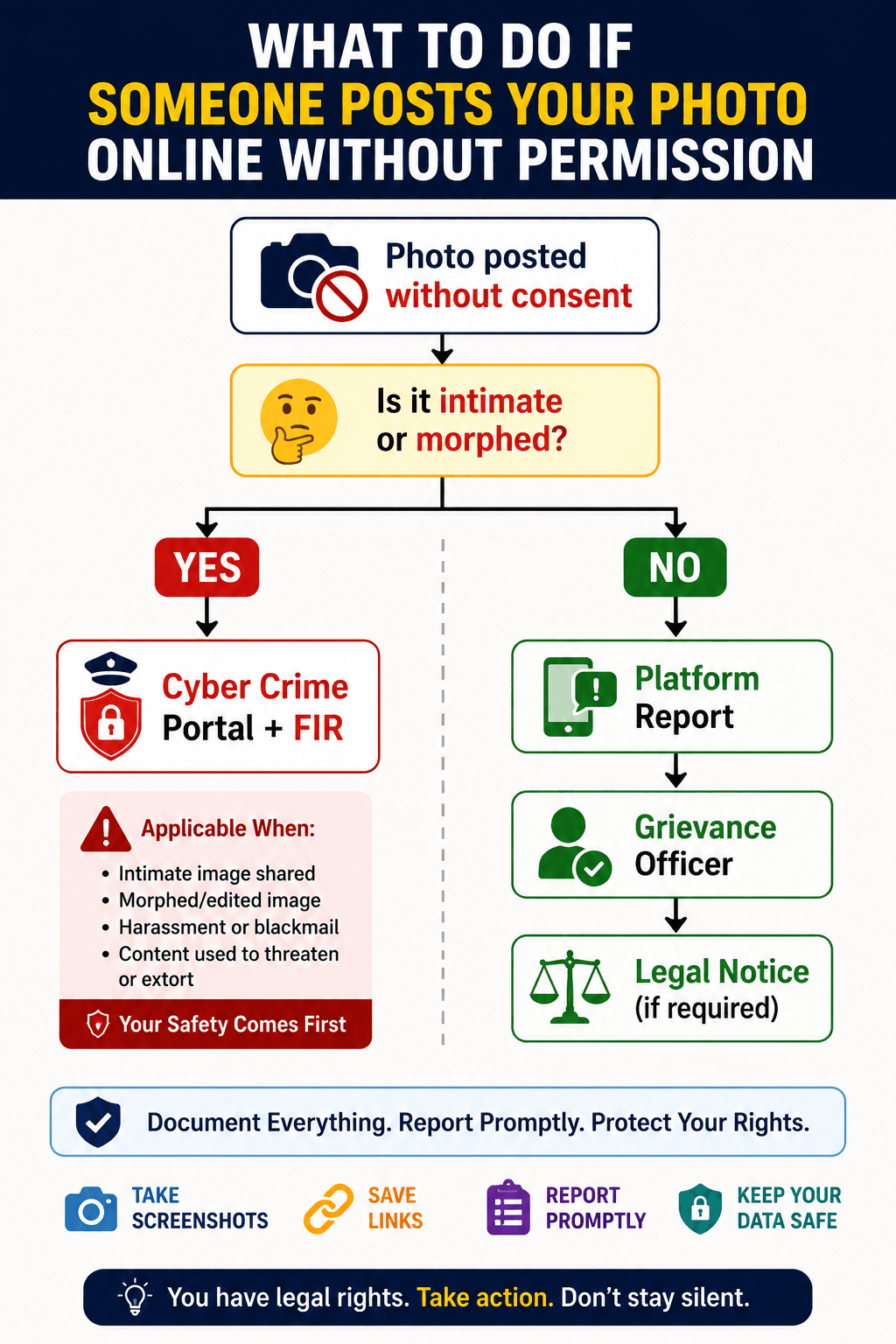
A. What to do immediately
- Stop engaging with the person who posted the photo, if you know who they are. Don’t argue, negotiate, or ask them to take it down yourself first — this can trigger further posting or deletion of evidence.
- Preserve the evidence (see Section on evidence below) before anything else.
- Decide which of the two main channels — the platform, or the Cyber Crime Portal — fits your situation, and use them together rather than one at a time.
B. How to report — platform and Cyber Crime Portal
On the platform: Every major platform has a built-in reporting tool for privacy violations or non-consensual imagery. Use it first — it’s usually the fastest way to get a photo taken down.
Grievance Officer: If the platform doesn’t act, India’s IT Rules require every significant social media intermediary to appoint a Grievance Officer, who must acknowledge your complaint within 24 hours and resolve it within 15 days (meity.gov). This is a formal escalation path, separate from the in-app “report” button.
National Cyber Crime Reporting Portal: For anything involving intimate content, morphing, harassment, or a minor, file directly at cybercrime.gov.in. The portal specifically states it caters to cybercrime complaints, with special focus on crimes against women and children (cybercrime.gov). It also has a dedicated “Report Abuse to Social Media” option, and lists three helplines: the Cyber Crime Helpline (1930), the National Police Helpline (112), and the National Women Helpline (181) (cybercrime.gov).
Police FIR: For blackmail, repeated harassment, or morphed intimate content, you can also file an FIR at your local police station.
Legal notice: Where the person is known to you, a lawyer’s notice demanding takedown can resolve things without going to court.
C. When BNS, 2023 may be relevant
The Bharatiya Nyaya Sanhita, 2023 (BNS) — India’s criminal code, in force since 1 July 2024 — has a specific provision for this kind of situation:
- Section 77 (Voyeurism): covers watching, capturing, or sharing images of someone in a private act — such as changing clothes or using a washroom — without their consent (indiacode.nic). Courts have clarified that an ordinary photo taken in a public setting, with no private act involved, does not fall under this section — so it applies specifically to private moments, not to every unwanted photo.
- Separately, creating a fake profile using someone’s photo is addressed under the Information Technology Act, 2000, Section 66D (cheating by impersonation using a computer resource).
- Sharing sexually explicit material electronically can also attract liability under the IT Act, 2000, Sections 66E and 67.
If your situation doesn’t clearly fall under one of these — for instance, an ordinary photo shared without consent but with no intimate or voyeuristic element — the platform and DPDP routes below are usually the more relevant ones, alongside civil remedies like defamation.
D. When the DPDP Act, 2023 applies
Your photo, where it identifies you, is personal data under the Digital Personal Data Protection Act, 2023. The Act is built around a few core ideas: processing your data requires a lawful basis (usually your consent), you have rights to seek correction or erasure of your data, and organisations must have a grievance redressal mechanism and notify you of certain data breaches (indiacode.nic). This is most relevant when a platform, app, or business is holding or misusing your photo — less so for a one-off post by an individual, where criminal law or platform reporting is usually the faster route.
E. What evidence to preserve
- Screenshots of the photo, the post, the profile that posted it, and any accompanying captions or comments
- The URL and the date/time you found it
- Any messages exchanged with the poster, if applicable
- A simple written log of every report you file and the response you get, with dates
F. What not to do
- Don’t confront the poster before you’ve preserved evidence.
- Don’t wait to see if it “goes away” — the longer it stays up, the more it can be reshared.
- Don’t assume a specific removal timeline unless it’s stated in an official rule or the platform’s own policy — timelines vary by channel and by the nature of the content.
- Don’t skip the Grievance Officer escalation if the in-app report goes unanswered — many people stop at the first step without knowing this formal path exists.
Practical Insight: Reporting through the platform and the Cyber Crime Portal at the same time isn’t overkill — it’s a reasonable way to use both available channels rather than waiting on one before trying the other.
5. Examples
- Grievance mechanisms under the IT Rules have been used to route complaints about non-consensual and morphed images to platforms and Grievance Officers for review, as described in the government’s own guidance on the Rules’ implementation (static.pib.gov).
- The Cyber Crime Reporting Portal is built to handle cybercrime complaints with a specific focus on crimes against women and children, and routes complaints to law enforcement based on the details provided (cybercrime.gov).
- Under the DPDP framework, the government has outlined how individuals will be able to request erasure of personal data and how organisations must notify people in case of data breaches involving their information (pib.gov).
6. Mistakes
- Waiting too long to report — the longer content stays live, the more it spreads.
- Not preserving evidence before reporting — some platforms remove content upon a report, leaving you without proof.
- Assuming nothing can be done because “it’s already out there” — takedown at source still limits further spread and is legally meaningful.
- Confronting the poster before filing a complaint — this can trigger deletion of evidence or retaliatory posting.
- Skipping the Grievance Officer route — many people report only to the platform’s general tool and give up when there’s no response, without knowing the IT Rules give them an escalation path with legal timelines.
7. Myth vs Fact
| Myth | Fact |
| “If I posted it once publicly, I lose all rights over it.” | Consent is context-specific; reuse elsewhere without permission can still violate your rights. |
| “Nothing happens if I report it — platforms don’t care.” | Platforms are legally required to respond within set timelines under the IT Rules. |
| “Only intimate photos are protected by law.” | Any personal photo used without consent can trigger privacy and data protection remedies. |
| “I need a lawyer to file any complaint.” | You can file directly on the Cyber Crime Portal or with a platform’s Grievance Officer without a lawyer. |
| “The DPDP Act doesn’t cover photos.” | Photos identifying a person are treated as personal data under the Act. |
8. Practical Checklist
- [ ] Screenshot the photo, post, profile, and URL with date/time
- [ ] Report the content via the platform’s in-app reporting tool
- [ ] Note the platform’s response, and escalate to the Grievance Officer if the in-app report goes unanswered
- [ ] File a complaint at cybercrime.gov.in if the content is intimate, morphed, or harassing
- [ ] Consider an FIR for repeated harassment, blackmail, or morphing
- [ ] Consult a lawyer for a formal legal notice if the person is known to you
- [ ] Keep a written log of every step and response for future reference
9. Comparison: Your Reporting Options
| Route | Best For | Typical Timeline | Needs a Lawyer? |
| Platform in-app report | Any non-consensual photo | Hours to a few days | No |
| Grievance Officer complaint | Unresolved platform reports | Up to 15 days (24-hr acknowledgment) | No |
| Cyber Crime Portal | Morphed, intimate, or harassing content | Days to weeks | No |
| Police FIR | Blackmail, repeated harassment, morphing | Weeks | Recommended |
| Legal notice | Known perpetrator (ex, colleague) | Days to weeks | Yes |
10. Key Takeaways
- Your photo is your personal data, and Indian law gives you enforceable rights over it.
- The fastest remedy is almost always platform reporting, followed by the Grievance Officer escalation.
- Serious cases — morphing, intimate content, harassment — call for the Cyber Crime Portal and possibly an FIR.
- Evidence preservation before you report is critical.
- You don’t need a lawyer to start the process, though one can help for serious or repeated violations.
11. What Should You Do Next?
If you’re an individual: Start with Step 1 above — preserve evidence, then report. If you’re a parent: Use the same steps, but also flag the content as involving a minor for priority handling. If you’re a business: Look into copyright and trademark remedies alongside privacy law, as your situation may differ. If you’re a student or researcher: This topic connects closely to India’s evolving data protection landscape — worth following as the DPDP Rules are finalised.
12. Frequently Asked Questions
1. Can I get a photo removed even if I can’t identify who posted it?
Yes — platform reporting tools don’t require you to know the poster’s identity to act on a privacy complaint.
2. Does this apply if the photo was taken years ago?
Yes. There’s no time limit on your right to request removal of a non-consensually shared photo.
3. What if the photo is morphed but not sexual in nature?
It can still fall under privacy violation and impersonation provisions, depending on how it’s used.
4. Can I sue for damages?
Yes, civil remedies for privacy violation and defamation may be available alongside criminal complaints, depending on the facts.
5. Is the Cyber Crime Portal only for serious crimes?
No — it accepts a range of complaints, though it’s especially built for sensitive content involving safety and exploitation.
6. What happens after I report on the Cyber Crime Portal?
Your complaint is typically routed to the relevant state cyber cell for investigation and action.
7. Do I need to pay to file a complaint?
No, filing complaints with platforms, Grievance Officers, or the Cyber Crime Portal is free.
8. Can minors use these remedies too?
Yes, and additional child-safety-specific protections and reporting channels apply for minors.
9. What if the platform is based outside India?
Platforms operating in India are still expected to comply with the IT Rules’ grievance mechanism if they meet the relevant user thresholds.
10. Will my complaint be kept confidential?
Confidentiality practices vary by platform and by the authority involved — it’s reasonable to ask about this directly when filing.
13. Conclusion
Finding your photo online without your permission is unsettling, but you’re not without options. India’s legal and regulatory framework — from platform-level grievance mechanisms to the DPDP Act to criminal law — gives you multiple, overlapping ways to act. The key is to move quickly, document everything, and use the right channel for the severity of what’s happened.
If you found this guide useful, explore our AI Regulatory Framework hub for more on how data protection law is evolving in India, and consider bookmarking the Cyber Crime Reporting Portal link for quick access if you ever need it. AspirixWriters
About the Author
Dr. Rekha Khandelwal Legal Researcher | AI Governance Writer | Author | Assistant Professor (Law) Founder – AspirixWriters
Dr. Rekha Khandelwal is a legal researcher, educator, author, and AI governance writer specializing in AI regulation, digital law, cyber law, legal research, and emerging technology governance. Through AspirixWriters, she publishes practical, research-backed guides that simplify complex legal and regulatory frameworks for businesses, professionals, researchers, and students.
Author’s Note This article is intended for educational and informational purposes only. It is based on official legal and regulatory sources available at the time of writing and should not be considered legal advice.
Last Reviewed: July 2026 Next Review: Within 6 months or upon major regulatory changes
Official References
- Information Technology (Intermediary Guidelines and Digital Media Ethics Code) Rules, 2021 (updated) — Ministry of Electronics and Information Technology: https://www.meity.gov.in/static/uploads/2024/02/Information-Technology-Intermediary-Guidelines-and-Digital-Media-Ethics-Code-Rules-2021-updated-06.04.2023-.pdf
- Digital Personal Data Protection Act, 2023 — India Code: https://www.indiacode.nic.in/handle/123456789/22037?view_type=browse
- Bharatiya Nyaya Sanhita, 2023 — India Code (see Section 77, Voyeurism): https://www.indiacode.nic.in/handle/123456789/20062
- National Cyber Crime Reporting Portal — Filing a Complaint (helplines and reporting guidance): https://cybercrime.gov.in/Webform/Accept.aspx
- Press Information Bureau — Summary on DPDP Rights and Breach Notification: https://www.pib.gov.in/PressReleseDetail.aspx?PRID=2190014
- Press Information Bureau — Government Guidance on Grievance Redressal for Social Media Users: https://static.pib.gov.in/WriteReadData/specificdocs/documents/2021/jun/doc202162411.pdf
- Information Technology Act, 2000 — Sections 66D, 66E, 67
Note on confidence levels:
- The law names, the DPDP Act’s core rights (notice, consent, correction/erasure, grievance redressal),
- The BNS Section 77 citation,
- The Cyber Crime Portal’s stated scope and helpline numbers (1930 for cybercrime, 112 for police emergencies, 181 for the women’s helpline)
My SIP Is in Loss. Should I Stop Investing?
Does the EU AI Act Apply to Indian Companies? A Complete Compliance Guide (2026)
- Academic Writing
- AI Governance
- AI in Business & Marketing
- AI in Content Creation
- AI in Research & Education
- AI In SEO
- AI Tools & Review
- Creative Writing & Storytelling
- General
- Income Tax
- Indian Laws
- Legal Drafting & Pleading
- Mutual Funds
- Trending

The EU AI Act Explained (2026): A Complete Guide for Businesses, Startups & AI Professionals
The EU AI Act Explained Reviewed Against: Regulation (EU) 2024/1689 and official European Commission guidance….

My Startup Uses ChatGPT. Do I Really Need an AI Policy? (2026 Guide)
Startup Chatgpt AI Policy Arjun runs a 12-person fintech startup in Mumbai. His team uses…

My SaaS Uses ChatGPT — Am I Regulated Under the EU AI Act? AI Act ChatGPT Integration Compliance
EIU AI Act ChatGPT Integration Compliance Rohan built a customer-support SaaS tool in Pune. Under…
How to Classify Your AI System Under the EU AI Act (Guide)
EU AI Act Risk Classification Step-by-Step How Do I Classify My AI System Under the…

How to Check Is Your AI System High-Risk Under the EU AI Act (2026)
Is Your AI System High-Risk Under the EU AI Act (2026)? Rohan is a product…
EU AI Act Compliance for Indian SaaS Startups (No Team Needed)
How Can an Indian SaaS Startup Comply with the EU AI Act Without Hiring a…