
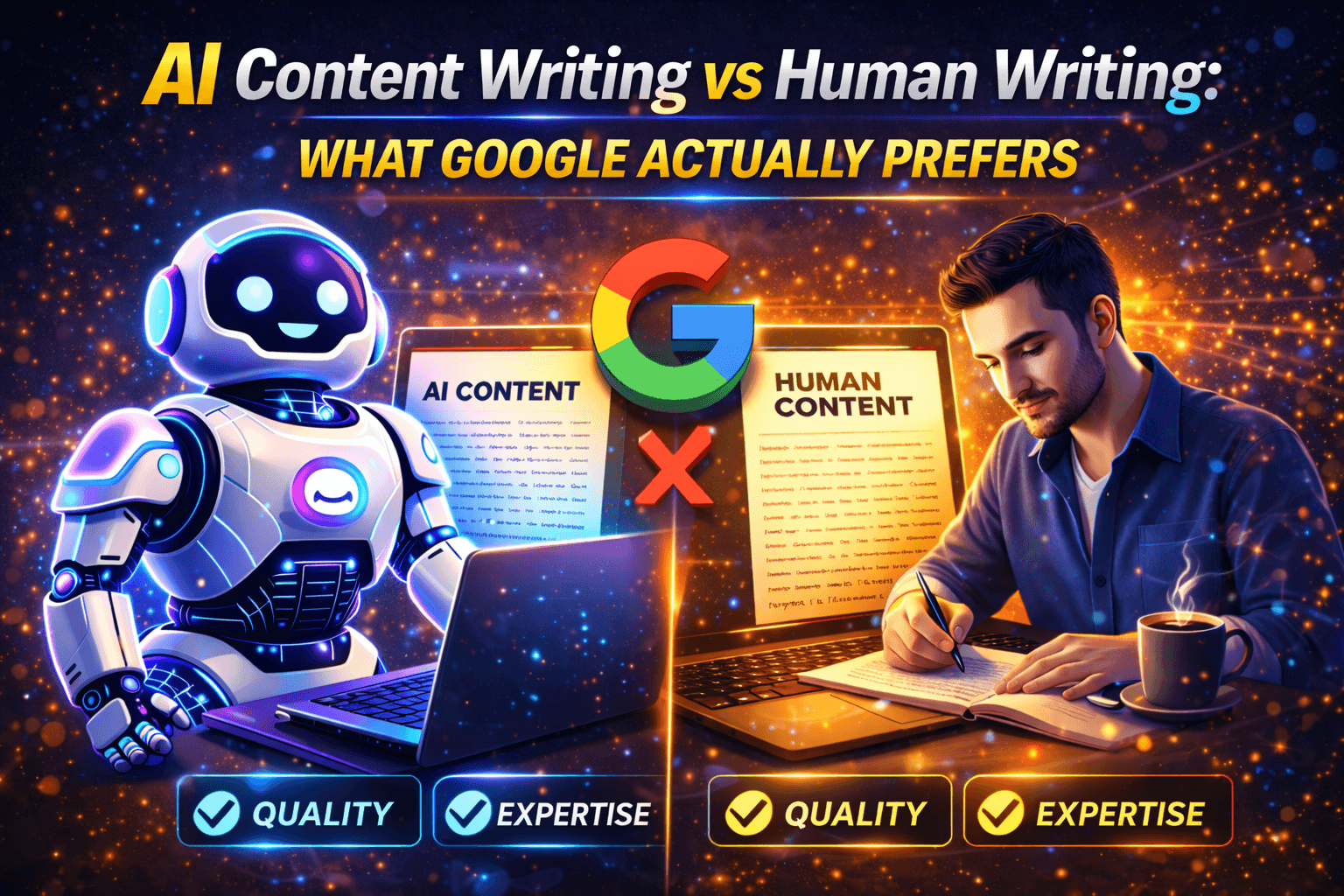
AI Content Writing vs Human Writing
AI In Content Creation: 2026 Guide, Tools & Best Practices
Every blogger, content writer, and business owner is asking the same question right now.
“If I use AI to write my content, will Google punish me for it?”
It is a fair question — and the answer is more nuanced than most people realise. The internet is full of confident claims on both sides. Some say AI content is perfectly fine. Others say Google will bury it. Most of the people making these claims have not actually looked at the data.
This post has. Here is the honest, research-backed answer.
What Google Has Actually Said
Before diving into strategies and studies, start with the source. Google has made its position clear in its official Search Central documentation, and it is not what many people assume.
Google does not prefer human or AI content specifically. Google prefers high-quality, helpful, and trustworthy content that satisfies user intent. Both AI and human content can rank if they meet Google’s quality guidelines.
Google has explicitly stated that AI-generated content is not against its guidelines — as long as it is helpful, original, and created for users rather than for search engines. The direct quote from Google’s own documentation: “Using AI to generate content is not against our guidelines.”
Google does not have a rule that says AI content is inferior to human-written content based only on how it was created. The usefulness of the final product is what matters to its ranking systems.
So the question is not “did a human or an AI write this?” The question is “does this content genuinely help the person who finds it?”
What the Ranking Data Actually Shows
Policy statements are one thing. What happens in practice is another. Fortunately, real data now exists.
A 16-month study tracking 4,200 articles across 140 domains found that pure AI content ranked 23% lower on average than human-written articles. However, AI-assisted content — AI drafts with substantive human editing, original data, and expert attribution — performed within 4% of fully human-written content on median ranking position. The real variable is editorial quality, not authorship.
Read that again carefully. The gap between AI-assisted and human-written content is 4%. That is essentially statistical parity. The gap between pure AI content and human-written content is 23%. That is significant — and it explains everything.
Across 50+ websites and 100+ ranking articles tested, AI-generated content ranks just as well as human-written content when it meets the same quality standards. The key difference is not the origin of the content — it is the execution. Most AI content fails because it is generic, surface-level, and does not demonstrate real expertise. But the problem is not AI. A human writing bad content performs equally poorly.
The data is consistent across every study. Content quality determines ranking. Content origin does not.
What Google Actually Penalises — The Real List
Google does not penalise AI content. It penalises specific characteristics that AI content often produces when published without human editing. Understanding this distinction is the most important thing in this entire post.
Here is what consistently triggers ranking problems:
1. Generic, surface-level information Content that states facts anyone could find in thirty seconds of Googling, without adding any depth, original angle, or genuine insight. AI produces this by default when given a vague prompt.
2. No evidence of real experience First-person insights increase trust by showing accountability and authenticity. When a writer says “I tested” or “we observed,” it signals responsibility for the information shared. This builds credibility and strengthens the experience signals Google values under its E-E-A-T framework.
AI cannot claim personal experience it does not have. Content that reads as though nobody has actually done the thing being described fails this test.
3. Mass-produced thin content Google’s current stance is simple — AI content is fine as long as it is helpful. What the search engine fights against is not the use of AI but the misuse of it. Over-templated phrasing, robotic sentence cadence, and topic repetition across domains send strong negative signals — what some SEO professionals now call “slop farming.”
4. Weak backlink profile The backlink gap is the single most structurally damaging finding for teams relying on AI publishing at scale. AI-only content acquired 61% fewer editorial backlinks than human-written articles on comparable topics. Backlinks remain a top-three ranking signal, making this the most damaging measurable consequence of unedited AI publishing.
Other sites link to content that is genuinely worth referencing — original research, real stories, unique perspectives, expert analysis. Pure AI drafts rarely earn these links because they rarely offer anything that existing content does not already provide.
5. Poor user engagement signals Google ranking in 2026 is strongly influenced by how users interact with pages after clicking. Content that earns attention, keeps users scrolling, and answers questions fully gains ranking protection during updates. Pages that only rephrase existing content often fail.
Understanding E-E-A-T — The Framework That Decides Everything
Google evaluates content quality through its E-E-A-T framework: Experience, Expertise, Authoritativeness, and Trustworthiness. Every ranking decision ultimately flows back to these four signals.
| E-E-A-T Signal | What It Means | Can AI Provide It? |
|---|---|---|
| Experience | Firsthand involvement with the topic | No — AI has not done things |
| Expertise | Deep knowledge of the subject area | Partially — AI knows facts but not nuance |
| Authoritativeness | Recognition from others in the field | No — authority is built over time by humans |
| Trustworthiness | Accuracy, transparency, accountability | Partially — only if fact-checked by humans |
This is why pure AI content structurally underperforms. It can synthesise existing information competently, but it cannot demonstrate firsthand experience, cannot build authority, and cannot be held accountable for its claims.
The human layer in content creation is what fills each of these gaps.
The Hybrid Approach — What Actually Ranks in 2026
How To Use AI To Write Blog Posts Faster In 2026 (Step-by-Step Workflow)
73% of content marketers now use a combination of AI and human writing. Only 5% rely mostly on AI without much human oversight. This trend is consistent with what works best — it is the synergy of AI and human work that produces the strongest results.
The practical model that ranks consistently looks like this:
What AI handles:
- Research synthesis and fact gathering
- Structural outlines and section planning
- First draft generation
- Meta description and title variations
- Repurposing existing content into new formats
What humans must provide:
- Original perspective and genuine opinion
- Firsthand examples and real case studies
- Fact-checking and source verification
- Brand voice and authentic tone
- Strategic editorial judgment
- The “I tested this and here is what happened” layer
Google does not choose sides. It rewards helpful, high-quality, experience-driven content. Use AI for speed and scalability. Use humans for trust and depth. When AI and humans work together, content performs better in rankings, engagement, and conversions.
Practical Checklist: Does Your AI-Assisted Content Pass Google’s Test?
Before publishing any AI-assisted post, run through these questions:
- Does the content answer the reader’s actual question completely — not just partially?
- Have you added at least one piece of firsthand experience or original insight that AI could not generate?
- Are all statistics and factual claims verified against primary sources?
- Does the author bio establish genuine credentials on this topic?
- Is the content meaningfully different from what already ranks for this keyword?
- Would another expert in this field find this worth referencing or linking to?
- Does it read like a real person wrote it — or does it feel templated?
If you answer yes to all seven, your content meets the standard Google rewards. If you answer no to any of them, revise before publishing.
When Human Writing Still Has a Clear Advantage
Data and nuance matter here. AI-assisted content approaches parity with human writing in most categories — but there are specific contexts where human authorship still holds a meaningful edge.
High-stakes topics (YMYL — Your Money, Your Life) Health, finance, legal, and medical content is evaluated under stricter E-E-A-T requirements. In important niches like health, finance, and legal writing, the human touch is absolutely essential. Users trust content that feels personal and contains real-life experience.
Original research and data If your content contains original survey data, proprietary case studies, or unique industry statistics, human-led research is irreplaceable. AI cannot conduct primary research.
Brand authority and thought leadership Building genuine authority in a niche over time requires consistent human perspective — recognisable voice, evolving positions, public accountability. AI can support this work but cannot replace it.
Community trust and audience relationships AI tools can amplify your expertise, but they cannot replace it. Slop farming dies because it scales mediocrity. Quality SEO writing survives because it scales trust, nuance, and originality.
The Bottom Line — What Google Prefers in 2026
The answer is clear, and the data confirms it consistently.
Google does not prefer AI content or human content. Google prefers helpful content — content that demonstrates real knowledge, satisfies genuine search intent, and gives readers something they could not find as well anywhere else.
The practical implication is straightforward:
- Pure AI content published without editing, fact-checking, or human insight consistently underperforms
- AI-assisted content with strong human editorial involvement performs essentially at parity with fully human-written content
- The quality of the human contribution is the variable that determines where on that spectrum your content lands
The writers and businesses winning in 2026 are not choosing between AI and human writing. They are combining both deliberately — using AI where it saves time without compromising quality, and investing human judgment where it cannot be substituted.
That is not a compromise. It is the most effective content strategy available.
AI For Social Media Content: How To Create 30 Days Of Posts In 2 Hours (2026 Guide)
Frequently Asked Questions
Q1. Does Google penalise AI-generated content in 2026?
No. Google only penalises content that is low-quality, spammy, misleading, or created solely to manipulate rankings. If AI content is helpful, original, and user-focused, it can rank well. The authorship method is not the ranking signal — content quality is.
Q2. Can AI-written articles rank on page one of Google?
Yes — with an important condition. AI-produced content that aligns with user intent and quality expectations performs just like human content in search rankings. However, a normal AI-written article without human editing will typically struggle. Human editing, fact-checking, and original insight are what bridge that gap.
Q3. What is the biggest mistake people make with AI content and SEO?
Publishing AI drafts without any human editing or original contribution. Pure AI content acquired 61% fewer editorial backlinks than human-written articles, which is the single most structurally damaging consequence of unedited AI publishing at scale.
Q4. Does Google have AI detection tools that affect rankings?
Google says it does not use AI detection tools for ranking. It does use them for spam detection. The key distinction is that content that reads like AI — generic, surface-level, over-structured — performs poorly not because Google detected it as AI, but because it is objectively low quality.
Q5. Is AI content suitable for YMYL topics like health or finance?
It requires extra caution. YMYL topics are held to stricter E-E-A-T standards. AI can assist with structure and research synthesis, but human expert review, authoritative attribution, and verified sourcing are non-negotiable before publishing in these categories.
Q6. How much human editing is enough for AI content to rank well?
A skilled editor applying four key transformations — adding firsthand insight, original data, expert attribution, and authentic voice — to an AI draft takes approximately 90 minutes for a 1,500-word article. This workflow produces ranking outcomes approaching parity with fully human-written content, at a fraction of the time.
References
- Google Search Central — Content guidelines: developers.google.com/search/docs
- Semrush — AI content ranking study (20,000 URLs): semrush.com/content-hub
- Digital Applied — 16-month Google ranking study, AI vs human content 2026
- Google — E-E-A-T quality evaluator guidelines: developers.google.com/search/docs/fundamentals/creating-helpful-content
About Author
Dr. Rekha Khandelwal is a certified expert in AI tools and academic content development, with a strong focus on leveraging platforms like ChatGPT, Claude, and Gemini for research and digital writing. With a Ph.D. in Law and specialized training in AI-driven content creation, she helps students, researchers, and professionals create high-quality, SEO-optimized, and impactful content.
Author Profile Dr. Rekha Khandelwal | Academic Writer, Legal Technical Writer, AI Expert & Author | AspirixWriters
- SEO Blogwriting Services
- Motivational, Creative & Ghostwriting
- Legal & Technical Writing Services
- Academic Writing Assistance
- Editing & Proofreading
AI Content Writing vs Human Writing: What Google Actually Prefers in 2026
AI Content Writing vs Human Writing AI In Content Creation: 2026 Guide, Tools & Best…
AI for Social Media Content: How to Create 30 Days of Posts in 2 Hours (2026 Guide)
AI for Social Media Content AI in Content Creation: 2026 Guide Most social media managers…
AI in Content Creation: 2026 Guide, Tools & Best Practices
Explore AI in content creation for 2026 — tools, workflows, benefits, real use cases, and…
How to Use AI to Write Blog Posts Faster in 2026 (Step-by-Step Workflow)
How to Use AI to Write Blog Posts Faster AI in Content Creation: 2026 Guide…