
Last Updated: March 30, 2026
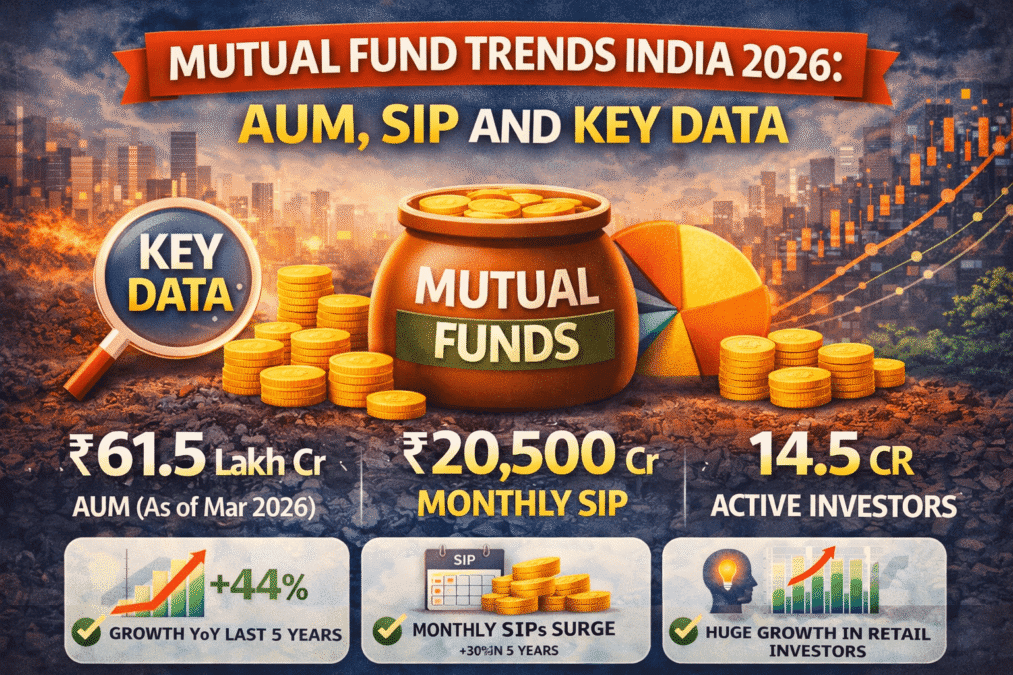
MUTUAL FUND TRENDS INDIA 2026
Mutual Fund Trends India 2026: AUM Hits Rs 82 Lakh Crore — Complete Industry Data and Analysis
Part of our Mutual Funds India 2026 hub: Complete Guide to Mutual Funds India 2026
It is March 2026. The West Asia conflict is rattling global markets. FPIs have been net sellers. The Nifty has fallen over 1,000 points in three sessions.
And yet — India’s mutual fund industry crossed Rs 82 lakh crore in Assets Under Management in February 2026. A record high.
Equity funds recorded their 60th consecutive month of positive inflows. SIP contributions reached Rs 29,845 crore in February. The number of investor folios crossed 27 crore for the first time.
While fear drove headlines, India’s retail investors quietly kept investing.
This article is the complete data reference for India’s mutual fund industry as of February 2026. Every number is sourced directly from AMFI’s official data release of March 10, 2026, and the statements of AMFI CEO Venkat Chalasani.
Whether you are an investor trying to understand where the industry stands, a researcher tracking trends, or a new investor trying to understand the scale of what you are joining — this article has the complete picture.
| Rs 82.03 Lakh Cr Total industry AUM — February 2026 | 27 Crore+ Total investor folios — February 2026 | Rs 29,845 Cr SIP contributions — February 2026 | 60 Months Consecutive months of equity inflows |
1. The AUM Story — From Rs 13 Lakh Crore in 2016 to Rs 82 Lakh Crore in 2026
India’s mutual fund industry has delivered one of the most remarkable growth stories in financial services history. It took 56 years — from 1964 to 2020 — for the industry to cross Rs 30 lakh crore. Then it crossed Rs 40 lakh crore in 2023, Rs 50 lakh crore in 2024, and Rs 82 lakh crore in February 2026.
AUM Milestones — India Mutual Fund Industry
| Year / Month | Industry AUM | Key Driver |
| March 2016 | ~Rs 13 lakh crore | Post-demonetisation push to formal finance. SIP awareness beginning. |
| November 2020 | Rs 30 lakh crore (first crossing) | COVID recovery. Retail investor explosion. Fin-tech platforms launch. |
| March 2023 | Rs 40 lakh crore | Post-COVID bull market. SIP accounts doubled in 2 years. |
| February 2024 | Rs 54 lakh crore | SIP inflows crossed Rs 18,000 crore/month. Passive fund explosion. |
| January 2026 | Rs 81.01 lakh crore | 60-month equity inflow streak. SIP crossed 9 crore active accounts. |
| February 2026 (latest) | Rs 82.03 lakh crore — RECORD HIGH | Despite market volatility. Retail investor resilience. 60th equity inflow month. |
The pace of growth is accelerating, not slowing. The industry added Rs 1.02 lakh crore in AUM in just one month (January to February 2026) despite market turbulence. This is not a coincidence — it is the structural consequence of millions of SIP mandates that automatically invest every month regardless of market conditions.
2. February 2026 Industry Data — The Complete Breakdown
The following data is sourced directly from AMFI’s February 2026 monthly release, published on March 10, 2026. All figures are verified.
Top-Level Industry Snapshot — February 2026
| Metric | February 2026 | January 2026 | Change |
| Total Industry AUM | Rs 82.03 lakh crore | Rs 81.01 lakh crore | +Rs 1.02 lakh crore (+1.26%) |
| AAUM (Average AUM for month) | Rs 83,42,617 crore | Rs 82.01 lakh crore | Sustained high |
| Total Folios (open-ended) | 27 crore+ (record) | 26.63 crore | +37 lakh new folios |
| Total Net Inflows (all categories) | Rs 94,530 crore | Rs 1,56,458 crore | Decline due to lower debt/gold flows |
| Equity Fund Net Inflows | Rs 25,977.91 crore | Rs 24,028.59 crore | +8% month-on-month |
| SIP Contributions | Rs 29,845 crore | Rs 31,002 crore | -4% (February shorter month) |
| Active SIP Accounts | 9.92 crore | 9+ crore | Growing steadily |
| Number of Schemes | 1,937 | 1,919 | +18 new schemes |
| NFOs Launched | 22 (21 open-ended + 1 close-ended) | — | Rs 4,979 crore raised from NFOs |
As AMFI CEO Venkat Chalasani stated on March 10, 2026: “February’s data reflects the continued stability and resilience of the mutual fund industry, with assets under management rising to Rs 82.03 lakh crore. Equity funds recorded net inflows of Rs 25,978 crore during the month, marking the 60th consecutive month of positive inflows. This sustained momentum reflects growing investor participation despite intermittent market volatility.”
3. SIP Data — India’s Most Powerful Investment Trend
The SIP story is the most remarkable transformation in Indian retail finance in the last decade. Systematic Investment Plans have moved from a product category to a national savings habit.
SIP Data — February 2026 and Historical Milestones
| SIP Metric | Current Data (Feb 2026) | Historical Context |
| Monthly SIP contributions | Rs 29,845 crore | Was Rs 18,000 crore in early 2024. 66% growth in 2 years. |
| Active SIP accounts | 9.92 crore | Was 5 crore in 2022. Doubled in 3 years. |
| Annual SIP contributions (2025) | Over Rs 3 lakh crore — first time ever | Previous year: Rs 2.2 lakh crore. 36% growth. |
| Average SIP ticket size | Approximately Rs 3,000 per month | Rising steadily — retail investors increasing amounts each year. |
| SIP AUM | Rs 16.36 lakh crore (January 2026) | Rs 15.5 trillion as on September 2025 — growing rapidly. |
| SIP as % of equity inflows | Approximately 55 to 60% of monthly equity inflows | Makes equity market less volatile — monthly inflow regardless of market. |
The SIP decline in February 2026 (-4% from January) was structural, not sentiment-driven. As AMFI CEO Venkat Chalasani explained: “The marginal moderation compared to recent months is primarily due to February being a shorter month, with some end-of-month SIP instalments typically getting processed in early March.”
February 2026 had fewer working days than January. The 28th fell on a Saturday. Some SIPs that would have processed on February 28 got processed in early March instead. This is a calendar artefact, not a trend reversal.
4. Equity Fund Inflows — 60 Months and Counting
February 2026 marked the 60th consecutive month of positive net inflows into equity mutual funds in India. This is an extraordinary streak that has survived two major market corrections (the 2022 global selloff and the 2025-2026 West Asia conflict), multiple FPI outflow periods, and sustained market volatility.
Equity Category Inflows — February 2026
| Equity Fund Category | February 2026 Inflows | vs January 2026 | Key Observation |
| Flexi Cap Funds | Rs 6,924.65 crore | -10% (from Rs 7,672 crore) | Still highest inflow category in equity. Reflects preference for diversified equity. |
| Mid Cap Funds | Strong — surged up to 32% | +32% month-on-month | Investors buying mid caps during correction. Value-seeking behaviour. |
| Small Cap Funds | Surged in February | Strong growth | Small cap corrections attracting bottom-fishers and SIP investors alike. |
| Large Cap Funds | Positive inflows | Stable | Core equity category maintaining steady participation. |
| Multi Asset Allocation | Rs 8,476.26 crore | Down from Rs 10,485 crore Jan | Highest inflow hybrid category. Investors want diversification across asset classes. |
| ELSS (Tax Saving) Funds | Elevated — March year-end proximity | Seasonal spike | Tax season (Jan to March) drives ELSS. Last quarter of financial year. |
5. The Passive Fund Surge — Index Funds and ETFs Take 19% of AUM
India’s passive fund industry — comprising index funds and ETFs — has been one of the fastest-growing segments of the mutual fund market. As of early 2026, passive funds account for approximately 19% of total mutual fund AUM, a significant jump from under 5% a decade ago. [5]
February 2026 showed a dramatic pattern shift: after a record Rs 39,954 crore of passive fund inflows in January (largely driven by gold ETFs), passive funds saw Rs 13,879 crore in February. But within that number, a fascinating rotation happened.
The Passive Fund Rotation — January to February 2026
| Passive Category | January 2026 | February 2026 | What It Means |
| Gold ETFs | Rs 24,040 crore — record high | Rs 5,255 crore — fell 78% | War fear drove gold rush in Jan. Equity correction attracted capital back in Feb. |
| Silver ETFs | Strong inflows | Net outflow Rs 826 crore | Profit-booking after January gold/silver spike. |
| Index Funds | Rs 27 crore — minimal | Rs 3,233 crore — up 11,874% | Investors rotating from crisis hedges to equity index funds as markets corrected. |
| Total passive inflows | Rs 39,954 crore | Rs 13,879 crore (-65.3%) | Lower due to gold/silver decline. Equity index up sharply. |
The index fund surge — from Rs 27 crore to Rs 3,233 crore in one month — is one of the most striking data points in the February 2026 AMFI release. It shows that Indian investors are becoming sophisticated enough to rotate from crisis hedges (gold) into equity index funds during market corrections, rather than panicking and staying in cash.
This is exactly the behaviour that long-term wealth creation requires. When markets fall, smart investors buy index funds at lower prices. The Rs 3,233 crore inflow into index funds in February 2026 represents hundreds of thousands of investors doing exactly that.
6. Category-Wise Inflows — Where Money Is Flowing in 2026
Understanding where money is flowing reveals investor sentiment and priorities. The February 2026 data shows a clear picture of what Indian investors are buying and selling.
| Fund Category | February 2026 Net Flow | January 2026 Net Flow | Trend |
| Equity Funds (total) | Rs 25,977.91 crore | Rs 24,028.59 crore | Rising — 60th consecutive positive month |
| Hybrid Funds (total) | Rs 11,983.37 crore | Rs 17,356.02 crore | Moderate — multi-asset strongest subcategory |
| Liquid Funds | Rs 59,077 crore | Rs 30,681 crore | Near doubled — corporate treasury parking cycle |
| Debt Funds (total) | Rs 42,106.31 crore | Rs 74,827.13 crore | Declined 43.7% — gold/silver FoF normalisation |
| Gold ETFs | Rs 5,255 crore | Rs 24,040 crore | Fell 78% — profit booking after January peak |
| Silver ETFs | Net outflow Rs 826 crore | Strong inflows | Sharp reversal — post-January correction |
| Index Funds | Rs 3,233 crore | Rs 27 crore | Surged 11,874% — risk-on rotation |
| Arbitrage Funds | Rs 591.85 crore | Rs 3,293.30 crore | Fell 82% — arbitrage spreads narrow in Feb |
7. B15 and B30 City Growth — India’s Next 100 Million Investors
One of the most significant structural trends in the Indian mutual fund industry is the rapid growth of investment from beyond the top 15 cities — what AMFI calls B15 cities (now B30 cities after the category was expanded).
Historically, mutual fund investment was concentrated in India’s top 5 to 8 cities — Mumbai, Delhi, Bangalore, Chennai, Hyderabad, Kolkata, Pune, and Ahmedabad. These cities still account for the majority of AUM. But the growth rate in smaller cities is dramatically faster.
B30 City Growth — Key Data Points
| Metric | Data | Significance |
| Share of SIP registrations from B15/B30 cities | 60%+ of new SIP accounts (FY26) | More than half of new investors come from non-metro cities. Fin-tech democratisation working. |
| Demat accounts growth (all India) | 207.1 million as of H1 FY26 | From 23.3 million in 2015 — 9x growth in 10 years. Capital market awareness exploding. |
| Retail investors as % of AUM | 60.7% (up from 52.4% in 2020) | Industry shifting from institutional to retail-driven — more stable, less volatile. |
| Individual vs institutional AUM | Individual: 60.9% | Institutional: 39.1% (Sep 2025) | Structural shift — institutional share fell from 47.6% in 2020. |
| Average SIP amount | ~Rs 3,000/month — growing | Increasing even among smaller city investors — income growth effect. |
The B30 city growth story has profound implications for the industry. A decade ago, a farmer in Rajasthan or a small business owner in a Tier 3 city in Odisha could not practically invest in mutual funds. Today, they can start a Rs 500 SIP in 10 minutes on their smartphone using UPI. The platform revolution has democratised wealth creation in a way that no government programme could have achieved in the same timeframe.
8. NFO Activity — New Fund Launches in February 2026
February 2026 saw 22 new mutual fund schemes launched — 21 open-ended and 1 close-ended. These 22 NFOs collectively raised Rs 4,979 crore from investors.
Notable February 2026 NFO Activity
| NFO | Amount Raised | Category | Significance |
| SBI Quality Fund | Rs 2,245 crore | Equity — Quality Factor | Highest NFO collection in February 2026. Investor appetite for quality stocks during volatile market. |
| 8 equity NFOs (total) | Rs 3,955 crore | Various equity categories | 4x higher than January equity NFO collections (Rs 806 crore). Strong investor interest in new themes. |
| Total 22 NFOs | Rs 4,979 crore total | Mixed — equity + debt | Continued product innovation. AMCs launching new themes and factor-based strategies. |
The SBI Quality Fund raising Rs 2,245 crore in its NFO period is significant. It shows investors are willing to explore factor-based investing (quality factor, in this case) rather than sticking only to traditional large-cap or flexi-cap categories. Quality funds invest in companies with strong return on equity, low debt, and stable earnings — characteristics that are particularly attractive during market volatility.
9. What These Trends Mean for You as an Investor
Industry data is most valuable when you understand what it means for your personal investment decisions. Here is how the key February 2026 trends translate into practical investor guidance.
| Industry Trend | What It Means for You |
| AUM at record Rs 82 lakh crore despite market fall | The Rs 82 lakh crore is invested by crores of Indians who did not panic. Market falls have not driven mass redemptions. Long-term investing culture is taking root. |
| 60th consecutive month of equity inflows | The SIP mandate has created automatic investing that ignores short-term news. If you have an active SIP, you are already doing what the data says works. |
| Index funds surged 11,874% in February | Smart money rotated from gold (crisis hedge) to index funds (cheap equity) when markets fell. If you are not in an index fund yet, corrections are good entry points. |
| Flexi cap still the highest inflow equity category | After all the sectoral and thematic fund excitement, diversified equity remains India’s preferred choice. This validates the core portfolio approach. |
| 27 crore folios — record high | India now has 27 crore investor folios. That is 1 in every 5 Indians with a mutual fund account. The industry is mainstream, not niche. Financial advisors and platforms are trustworthy. |
| Multi-asset funds highest inflow hybrid category | Investors want diversification across stocks, bonds, and gold in one fund. Multi-asset allocation funds deserve consideration in 2026’s uncertain environment. |
| B30 city SIP growth — 60%+ of new accounts | Mutual fund investing is no longer a metro phenomenon. If you are investing from a smaller city, you are part of the fastest-growing investor segment in the country. |
10. Frequently Asked Questions
Q1: What is the total AUM of mutual funds in India in 2026?
India’s total mutual fund AUM reached a record Rs 82.03 lakh crore (approximately Rs 82 trillion) as of February 28, 2026, according to data released by AMFI on March 10, 2026. This is up from Rs 81.01 lakh crore in January 2026 — an increase of Rs 1.02 lakh crore in a single month. The industry has grown approximately 6 times since 2016, when AUM stood at around Rs 13 lakh crore.
Q2: How many SIP accounts are active in India in 2026?
As of January 2026, India has 9.92 crore active SIP accounts. Monthly SIP contributions stood at Rs 29,845 crore in February 2026 and Rs 31,002 crore in January 2026. Annual SIP contributions in 2025 crossed Rs 3 lakh crore for the first time in history. The slight decline in February was due to fewer working days in the month, not any change in investor sentiment — confirmed by AMFI CEO Venkat Chalasani.
Q3: How many people invest in mutual funds in India in 2026?
As of February 2026, India has over 27 crore mutual fund folios — each folio represents one account of one investor in one fund. Since individual investors often hold multiple folios, the actual number of unique investors is estimated at 5 to 7 crore individuals. Retail and HNI individual investors now account for 60.9% of total mutual fund AUM — up from 52.4% in March 2020, reflecting the strong democratisation of investing.
Q4: Which mutual fund category got the highest inflows in February 2026?
Within equity funds, flexi-cap funds received the highest inflows at Rs 6,924.65 crore in February 2026. Among all categories, liquid funds received the highest overall inflows at Rs 59,077 crore — largely from corporate treasury management and institutional parking. Within hybrid funds, multi-asset allocation funds received the highest inflows at Rs 8,476.26 crore, reflecting investor preference for diversification across equity, debt, and gold in a single fund.
Q5: Is the mutual fund industry growing in India in 2026?
Yes — strongly. AUM hit a record Rs 82.03 lakh crore in February 2026. Folios crossed 27 crore for the first time. Equity funds recorded their 60th consecutive month of positive inflows. Index fund inflows surged nearly 12,000% month-on-month in February as investors rotated from gold into equity index funds during market corrections. B30 city investor growth is accelerating, with 60%+ of new SIP accounts now coming from non-metro cities. All structural indicators point to continued industry expansion in 2026.
Conclusion
The February 2026 AMFI data tells a story that cuts through the noise of daily market headlines.
Despite a West Asia conflict that wiped $447 billion off India’s market capitalisation in three sessions, equity funds recorded their 60th consecutive month of inflows. Despite market volatility, AUM hit a record Rs 82.03 lakh crore. Despite FPI outflows, retail investors were net buyers — and SIP investors barely blinked.
What this data reflects is a maturing investor base. The retail investors who drove India’s mutual fund revolution are not the nervous first-timers of 2018 who sold at every dip. They are experienced, SIP-habituated investors who have lived through the COVID crash and come out stronger. They know that market falls are buying opportunities, not exit signals.
For a new investor reading this article: you are joining an industry with Rs 82 lakh crore in assets, 27 crore investor folios, and a 60-month unbroken streak of positive equity inflows. The infrastructure is mature. The culture of long-term investing is established. The data says: this is a good time to start or continue.
Continue reading: This article is part of our Mutual Funds India 2026 content hub at aspirixwriters.com/mutual-funds/
Complete Guide to Mutual Funds India 2026
Next read SIP vs Lump Sum 2026: Which Is Better?
Author
CA Ajay Khandelwal is a Chartered Accountant and financial expert with over 21 years of experience in taxation, compliance, and business advisory. As a key expert at AspirixWriters, he provides practical insights on income tax, financial planning, and regulatory matters, helping readers make informed financial decisions.
Author profile CA. Ajay Khandelwal
Disclaimer
This article is for educational and informational purposes only. All data cited is from AMFI’s official monthly data release for February 2026, published March 10, 2026, and from verified secondary sources. While every effort has been made to ensure accuracy, readers are encouraged to verify all figures directly at amfiindia.com before making investment decisions.
Mutual fund investments are subject to market risks. Past industry growth does not guarantee future returns. Please read all scheme-related documents carefully before investing.
For personalised investment advice, consult a SEBI-registered Investment Advisor at: sebi.gov.in
References
[1] AMFI India — Monthly Data February 2026 (AUM Rs 82.03 lakh crore, folios 27 crore+, SIP Rs 29,845 crore, 60th consecutive equity inflow) | Venkat Chalasani CEO statement March 10, 2026 — https://www.amfiindia.com/research-information/amfi-monthly
[2] Zee Biz — AMFI Data Feb 2026: MFs buck trend with 8% jump; Gold and Silver ETF inflows plunge up to 78% | Complete category breakdown | March 10, 2026 — https://www.zeebiz.com/personal-finance/news-amfi-data-feb-2026-mf-see-rs-25978-crore-inflows-gold-etf-gets-rs-5255-crore-aum-tops-rs-82-lakh-crore-391740
[3] Business Standard — Equity MF inflows up 8% in Feb on lower redemption; AUM grows to Rs 82 trillion | SBI Quality Fund NFO Rs 2,245 crore | March 10, 2026 — https://www.business-standard.com/markets/mutual-fund/equity-mutual-fund-inflows-rise-8-in-february-on-lower-redemption-126031001187_1.html
[4] Republic World — Mid/Small Cap Inflows Surge up to 32% as Gold ETF Investments Crash 78% in February: AMFI | Index fund 11,874% surge | AUM record Rs 82.03 lakh crore — http://www.republicworld.com/business/mid-small-cap-inflows-surge-up-to-32-as-gold-etf-investments-crash-78-in-february-amfi
[5] CRISIL Intelligence — Assessment of Mutual Fund Industry in India (ICICI Pru AMC Report) | Retail investor 60.7% share | Demat accounts 207.1 million H1 FY26 | B15 city SIP growth | SIP AUM Rs 15.5 trillion September 2025 — https://www.icicipruamc.com/blob/investor-relations/IR_Documents/ICICI_Prudential_Industry_Report.pdf
[6] Venture Securities — AMFI Data: Equity Mutual Fund Inflows Jumps 8% February 2026 | 22 NFOs Rs 4,979 crore | All category breakdown — https://www.venturasecurities.com/news/amfi-data-equity-mutual-fund-inflows-jumps-8-february-2026/
[7] Outlook Money — AMFI February 2026 Data: Equity Mutual Fund Inflows Up 8% To Rs 25,978 Crore | Vaibhav Chugh CEO Abakkus MF quote — https://www.outlookmoney.com/invest/amfi-february-2026-data-equity-mutual-fund-inflows-up-8-to-rs-25978-crore
[8] Bajaj Finserv — Mutual Fund Industry in India: Size, AUM and Trends | AUM milestone history | January 2026 data Rs 81.01 lakh crore — https://www.bajajfinserv.in/investments/mutual-fund-industry
[9] Morningstar India — AMC-wise Average AUM rankings | February 2026 | morningstar.in — https://www.morningstar.in/tools/mutual-fund-amfi-average-aum-by-fund-house.aspx
[10] AMFI India — AUM milestone: Rs 30 lakh crore (November 2020) | Industry first crossed Rs 30 trillion | amfiindia.com — https://www.amfiindia.com/articles/indian-mutual
Classmate Pulse Spiral Notebook ✏️ Need a Spiral Notebook for Everyday Writing? A spiral notebook…

Latest Scholarships & Fellowships 2026–27: Open Opportunities for Upcoming call
Latest Scholarships & Research Fellowships 2026–27 Last Verified: 30 September 2026 Students, researchers, PhD scholars…
Writing & Research Resources: Useful Books, Tools & Essentials for Writers and Researchers
Whether you are an author, content writer, law student, academic researcher, PhD scholar, teacher, or…

International Treaties as a Source of International Law | LL.B. Notes
International Treaties as a Source of International Law Introduction International treaties are one of the…

The Ultimate Guide to Organizing LLB Notes for Exam Success
LLB Notes for Exam Success Studying law is not simply about reading hundreds of pages….
What Is the Best AI Tool for Legal Research in 2026? A Practical Guide for Lawyers, Law Students and Researchers
What Is the Best AI Tool for Legal Research in 2026? Last updated: September 2026…