

Cluster Post 5 | Module 1: Understanding the Structure of Research Papers and Theses
From Concept to Submission Series | 2026
← Back to Pillar Post: The Complete Guide to Research Paper Structure

The Discussion Section: How to Turn Findings Into Knowledge
Your pillar post listed what a Discussion should do. This post goes deeper: the six-part structure with worked examples for each part, how to restate findings without just repeating them, how to write about limitations honestly without undermining your work, the difference between three types of implications, and the single most common Discussion failure.
Why the Discussion Is the Hardest Section to Write Well
The Introduction, Methods, and Results sections all have relatively clear rules. You follow a structure, you include specific elements, you apply a standard. The Discussion has rules too — but it also requires something the other sections do not: genuine intellectual work.
You are not reporting what happened. You are thinking hard about what it means — why these findings emerged, what they reveal about the phenomenon you studied, how they change or extend what the field already knows. This is where your analytical ability becomes visible on the page. A weak Discussion is one of the clearest signals to a reviewer that a researcher is not yet thinking at the level their data requires.
The most common failure is writing a Discussion that simply re-describes the Results in slightly different language. This is not interpretation. It is repetition. The diagnostic test is simple: if a reader who has carefully read your Results section finds nothing genuinely new to think about in your Discussion, the section is not doing its job.
The Six-Part Structure
Part 1: Restate — don’t repeat — your main findings
Open your Discussion by summarising what you found. But summarise, do not repeat. Repetition copies language from the Results section. Restating means capturing the essence of your findings in fresh language at a higher level of abstraction.
Repetition: “Intervention students showed a retention rate of 82% compared to 71% for control students, χ²(1, N = 450) = 8.92, p = .003, φ = .14.” Restating: “Peer mentoring produced a meaningful improvement in first-year retention — an 11-percentage-point gap that was both statistically significant and practically substantial given the low cost of the intervention.”
The restating version adds something: it names the finding (11-point gap), situates it (statistically and practically substantial), and introduces a relevant context (low cost). It is not repeating data — it is beginning to build the argument of the Discussion.
Part 2: Interpret — explain why
This is the intellectual core of the Discussion. For each major finding, ask not just what you found but why you found it. What mechanism explains this pattern? What does it tell us about how the phenomenon works?
Interpretation is not speculation. It is reasoned inference grounded in your data and the existing literature. You are building an argument, not free-associating. Every interpretive claim should be traceable back to something in your data or something established in the literature.
“The retention advantage in intervention colleges is unlikely to be explained by academic support alone — both groups had access to the same tutoring resources. The qualitative findings point toward social integration as the operative mechanism: mentored students described gaining not just academic help but a sense of belonging and institutional navigation that first-generation students arriving from rural settings particularly lacked. This is consistent with Tinto’s (2012) integration theory, though our findings extend it by specifying that it is the navigational function — not just social contact — that drives early retention decisions.”
Notice what this paragraph does: it rules out an alternative explanation (academic support), points to the mechanism (social integration and navigation), grounds it in the data (qualitative findings), connects it to theory (Tinto), and adds something new (the navigational function specifically). That is what good interpretation looks like.
Part 3: Connect to the literature
Every study exists in a conversation with previous research. Your Discussion must show how your findings fit into that conversation — whether they support, contradict, extend, or complicate what others have found.
There are three possible relationships to previous work, and each requires different language:
- Your findings align: “These results are consistent with Smith’s (2020) finding that peer contact predicts retention in commuter student populations, and extend it to the Indian government college context.”
- Your findings contradict: “Unlike Jones (2019), who found financial support to be the primary retention driver, the current study suggests social integration is equally predictive when financial need is controlled for. This discrepancy may reflect differences in sample — Jones studied residential private colleges where financial precarity is less acute.”
- Your findings add nuance: “While Kumar (2022) demonstrated that peer mentoring improves retention broadly, our data suggest the effect is strongest in the first semester and attenuates by semester three — a temporal dimension Kumar’s cross-sectional design could not detect.”
The third type — adding nuance — is often the most interesting and the most publishable. It takes an established finding and specifies the conditions under which it holds, the mechanisms through which it operates, or the populations for which it does not apply.
Part 4: Address limitations — honestly, not defensively
Every study has limitations. Acknowledging them does not weaken your work. What weakens your work is a reviewer finding a significant limitation you did not mention — because then it looks like either you did not notice it or you were hiding it.
The key is to acknowledge limitations analytically rather than apologetically. An analytical limitation statement explains what the limitation is, why it exists, and what it means for the conclusions you can draw. An apologetic one simply lists problems without engaging with their implications.
Apologetic: “This study has several limitations. The sample was small and from only three colleges. The design was cross-sectional. Self-report measures may be inaccurate.” Analytical: “The three-college sample limits generalisability to other regional and institutional contexts. Government colleges in urban Rajasthan may differ meaningfully from those in other states or in tribal and hill regions where social infrastructure and student backgrounds differ. The cross-sectional design also means we cannot establish whether peer mentoring caused retention improvement or whether students who were already more likely to persist also sought out mentoring. A longitudinal randomised design would resolve this ambiguity.”
The analytical version tells the reader precisely what can and cannot be concluded, and what kind of future research would address the limitation. This is genuinely useful — to the field, not just to your ego.
Part 5: State implications — all three kinds
Implications are where your research connects to the world beyond the study. Most researchers write one type — usually practical recommendations — and stop. Strong Discussions address all three.
| Implication type | What it addresses |
| Practical | What should practitioners — teachers, administrators, policymakers — do differently based on your findings? Be specific about who does what. |
| Theoretical | What does this finding mean for the theories your field uses? Does it support, extend, qualify, or challenge an existing framework? |
| Policy | What should institutions, governments, or regulatory bodies change? Addressed to specific bodies, not to ‘society’ in general. |
Practical: “Government college principals can implement structured peer mentoring with minimal resources. Our model required eight hours of mentor training and bi-weekly coordinator check-ins — achievable within existing staff capacity.” Theoretical: “Results extend Tinto’s social integration theory by identifying institutional navigation as a distinct mechanism operating separately from general social belonging. Future theoretical work should model these as separate constructs with potentially different antecedents.” Policy: “UGC should link peer mentoring programme implementation to the retention performance metrics already required under NEP 2020 reporting — creating an incentive for colleges to adopt evidence-based models rather than ad hoc approaches.”
Part 6: Point toward future research — specifically
“Further research is needed” is not a future research direction. It is a filler sentence that reviewers have learned to ignore. Future research suggestions should be specific enough that another researcher could design a study from them.
Vague: “Future research should examine peer mentoring in different contexts.” Specific: “Future longitudinal research should track actual retention outcomes over three years rather than intentions, with attention to whether peer mentoring effects persist after the first year or are specific to the transition period. Intersectional analysis examining whether effects differ by caste, first-generation status, and gender would strengthen the equity implications of these findings considerably.”
Good future research directions come directly from your limitations and from the questions your findings raised but could not answer. They are the natural continuation of your work, not generic calls for more research on the topic.
A Self-Check Before You Submit
Read your Discussion draft and apply these tests:
- Does the opening paragraph summarise findings in fresh language, or does it copy language from Results?
- For each major finding, have you explained why — not just what — you found?
- Have you connected every significant finding to at least one prior study, either supporting, contradicting, or extending it?
- Are limitations described analytically (what they mean for conclusions) or just listed apologetically?
- Are there practical, theoretical, and policy implications — or only one type?
- Are future research suggestions specific enough that someone could design a study from them?
If any answer is no, that part of the Discussion needs another draft. The Discussion is the section that examiners and reviewers use to judge whether you think like a researcher, not just whether you followed procedures correctly.
For Law Students
In doctrinal legal research, the Discussion equivalent is the critical analysis section — where you move from presenting what the law is to arguing what it should be, where it falls short, or how it should be interpreted. The six-part structure translates directly, with legal content substituted for empirical content.
Restating findings in legal research
In legal writing, restating means summarising the doctrinal pattern you have identified across your case analysis before you begin to critique it. This is not repetition — it is synthesis. You are drawing together what individual case analyses showed into a coherent account of the current state of the law.
“Across the fifteen judgments examined, the Court has developed an implicit three-tier approach to AI surveillance: strict proportionality for biometric data collection, intermediate review for metadata aggregation, and minimal scrutiny for publicly disclosed information. This framework has emerged from case-by-case reasoning rather than explicit doctrinal architecture, producing inconsistencies that the cases themselves have not resolved.”
Interpretation in legal research: the doctrinal argument
The interpretive core of a legal Discussion is your doctrinal argument — what the current state of the law means, why the identified inconsistencies or gaps are problematic, and what interpretive framework would resolve them. This is where your original contribution to legal scholarship lives.
Strong doctrinal arguments do three things: they identify the principle underlying the existing cases (not just what the cases held, but why), they show why existing doctrine fails to resolve a specific problem, and they propose an interpretation or framework that is consistent with the broader constitutional or statutory scheme.
Limitations and future directions in legal research
Legal research has its own version of limitations: the scope boundaries you set in your introduction (jurisdictions excluded, time period limited, types of cases not considered) now need to be acknowledged in terms of what they mean for your conclusions. If you analysed Supreme Court judgments only, state explicitly that High Court developments and legislative responses are outside your analysis and may qualify your conclusions.
Future research directions in legal scholarship typically point toward specific doctrinal questions left open, comparative jurisdictions that could offer useful models, or legislative reforms that would need empirical evaluation after implementation. These are the legal field’s equivalent of calls for longitudinal studies — they are specific, actionable, and grounded in what your analysis revealed.
References
- Booth, W. C., Colomb, G. G., Williams, J. M., Bizup, J., & FitzGerald, W. T. (2024). The Craft of Research (5th ed.). University of Chicago Press.
- Belcher, W. L. (2019). Writing Your Journal Article in Twelve Weeks (2nd ed.). University of Chicago Press.
- Tinto, V. (2012). Leaving College: Rethinking the Causes and Cures of Student Attrition. University of Chicago Press.
- Creswell, J. W., & Creswell, J. D. (2022). Research Design: Qualitative, Quantitative, and Mixed Methods Approaches (6th ed.). Sage.
- K.S. Puttaswamy v. Union of India, (2017) 10 SCC 1. Supreme Court of India.
Next: Cluster Post 6 — Complete Thesis Structure: A Chapter-by-Chapter Guide
← Back to Pillar Post: The Complete Guide to Research Paper Structure

The Complete Guide to Research Paper Structure: IMRAD Format, Thesis Organization & Academic Writing (2026)
From Concept to Submission: A Complete Guide to Research Paper and Thesis Writing Module 1:…
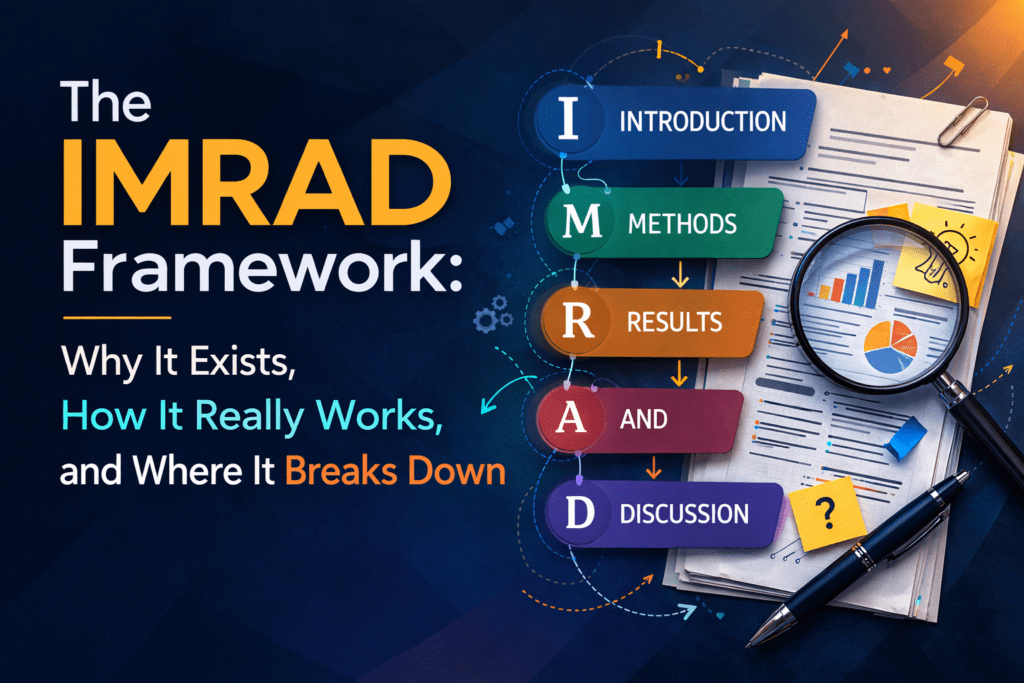
The IMRAD Framework: Why It Exists, How It Really Works, and Where It Breaks Down
Cluster Post 1 | Module 1: Understanding the Structure of Research Papers and Theses From…

How to Write a Research Introduction That Reviewers Cannot Ignore
Cluster Post 2 | Module 1: Understanding the Structure of Research Papers and Theses From…

How to Write a Methods Section That Reviewers Will Trust
Cluster Post 3 | Module 1: Understanding the Structure of Research Papers and Theses From…

The Results Section: How to Present Findings Without Letting Interpretation Slip In
Cluster Post 4 | Module 1: Understanding the Structure of Research Papers and Theses From…

The Discussion Section: How to Turn Findings Into Knowledge
Cluster Post 5 | Module 1: Understanding the Structure of Research Papers and Theses From…