
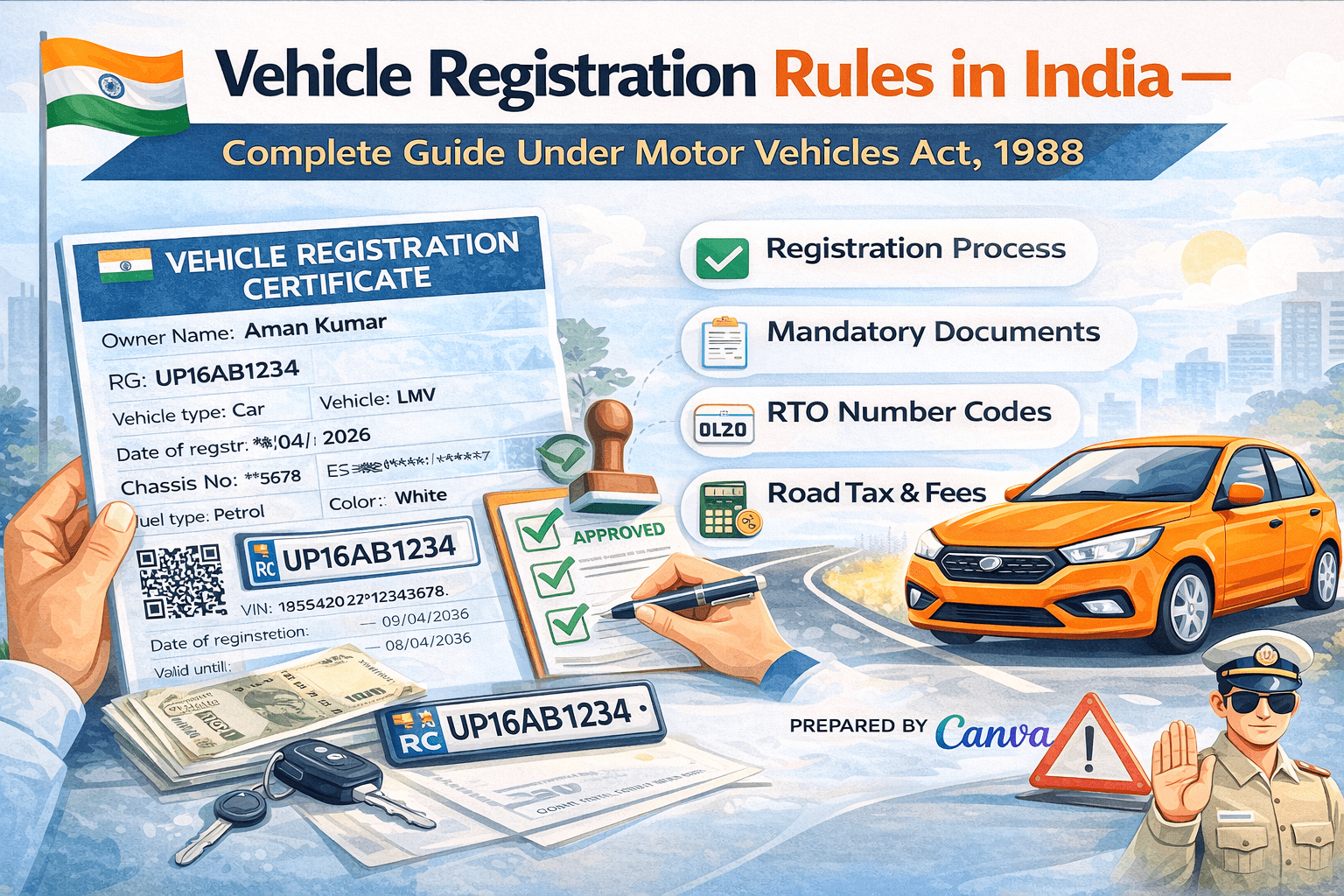
Vehicle Registration Rules India MVA-04 Part of Motor Vehicles Act 1988 India: Complete Guide
Rohan just bought his dream car — a shiny new hatchback, straight out of the showroom. He drives it home, parks it in the building’s parking lot and steps out feeling like a king.
Two days later, he decides to take it out for a weekend drive. A traffic officer stops him at a checkpost and asks for his Registration Certificate. Rohan stares blankly. He assumed the showroom had taken care of all the paperwork. They gave him a ‘temporary number’ on a slip. But that 30-day temporary registration has expired. Now he is staring at a fine of Rs. 5,000 and a possible impoundment of his brand-new car.
This is a situation that thousands of vehicle owners in India walk into every year — because they do not fully understand vehicle registration rules under the Motor Vehicles Act, 1988.
In this complete guide, we explain everything about vehicle registration in India — what it is, why it is legally mandatory, how the process works, what happens when ownership changes hands, and what the latest rules say in 2026. Whether you are buying your first vehicle or are a law student preparing for CLAT or Judiciary exams, this guide has you covered.
Driving Licence Rules in India:Complete Guide Under Motor Vehicles Act, 1988
What Is Vehicle Registration Under the Motor Vehicles Act?
Vehicle registration is the official process through which the government acknowledges that a specific vehicle exists, belongs to a specific person, and meets the required standards to be driven on Indian roads. The result of this process is the Registration Certificate — commonly known as the RC or RC Book.
Think of vehicle registration as the vehicle’s birth certificate combined with its passport. Just as a person needs their Aadhaar or passport to prove their identity, a vehicle needs its RC to prove it is legitimate, has a known owner, and is legally allowed on the road.
The Registration Certificate contains key details: the vehicle’s registration number (your number plate), the owner’s name and address, the vehicle’s make, model, and chassis number, insurance details, and the class of vehicle. Every single vehicle on an Indian road — from a moped to a 40-tonne truck — must have one.
Section 39 — The Law That Makes Registration Compulsory
Section 39 of the Motor Vehicles Act, 1988 is clear and absolute: no person shall drive any motor vehicle and no owner of a motor vehicle shall cause or permit the vehicle to be driven in any public place unless the vehicle is registered in accordance with Chapter IV and the certificate of registration of the vehicle has not been suspended or cancelled.
In simple: before your vehicle touches a public road, it must be registered at the Regional Transport Office (RTO). No exceptions. Even if you just bought the vehicle an hour ago, even if you are only driving it a hundred metres to the mechanic — the vehicle must either have a valid Temporary Registration or a Permanent Registration Certificate.
Motor Vehicles Act 1988 India: Complete Guide
The Three-Part Test for Legal Driving: Section 3 (valid driving licence) + Section 39 (valid registration certificate) + Section 146 (valid insurance) — all three must be in order at the same time. A vehicle with a valid RC but no insurance, or a registered vehicle driven by someone without a licence, is still breaking the law. Vehicle registration is just one piece of the legal puzzle.
Types of Vehicle Registration in India
1. Temporary Registration
When you buy a new vehicle, the dealer applies for a Temporary Registration Certificate before delivery. This gives the vehicle a TR (Temporary Registration) number and is valid for a maximum of one month from the date of issue. Within this one-month period, the owner must get a permanent registration done at the RTO.
- Who issues it: The vehicle dealer on behalf of the buyer, through the Vahan portal.
- Validity: Maximum 1 month — not extendable.
- Purpose: Allows the vehicle to be legally driven from the dealership to the owner’s address and to the RTO for permanent registration.
- Common mistake: Many buyers assume the temporary number is enough and delay the permanent registration. After 30 days, driving with only a TR number is an offence under Section 192.
2. Permanent Registration
Permanent registration is the full, official registration of a vehicle under Section 41 of the Motor Vehicles Act. Once completed, the vehicle is assigned a permanent registration number — the alphanumeric plate number you see on every registered vehicle in India. This registration is valid for 15 years for private vehicles.
- Who registers: The RTO of the district where the owner resides.
- Validity: 15 years for private vehicles (Section 41(7)). After 15 years, must be renewed every 5 years subject to a fitness test.
- Commercial vehicles: 5-year validity from initial registration, renewable upon passing a Certificate of Fitness test.
- Online: Permanent registration applications are filed through the Vahan portal (vahan.parivahan.gov.in) by the dealer or owner.
How to Register a New Vehicle in India — Step by Step
For most buyers of new vehicles, the dealer handles the registration process. But understanding each step gives you clarity on where your money goes and what documents to expect.
| 1 | Temporary Registration by Dealer When you finalise the purchase, the dealer applies for Temporary Registration on the Vahan portal. You receive a TR number. This allows you to drive the vehicle home legally. The dealer will ask you for your address proof and Aadhaar for this step. |
| 2 | Pay Road Tax and Registration Fee Before permanent registration, road tax must be paid to the State Government. The amount varies by state, vehicle type, and engine capacity. Registration fees are prescribed by the Central Government under the MV Act and are paid online through the Vahan portal. |
| 3 | Submit Documents at RTO Visit the RTO (or have the dealer’s representative do it) with all required documents. The RTO officer verifies the vehicle and documents. In many states, new vehicles from authorised dealers are processed without the owner needing to visit — the dealer handles it through the Vahan portal. |
| 4 | Permanent Number Assigned Once documents are verified and fees paid, the RTO assigns the permanent registration number. For high-security number plates (HSRP), the plate is fixed at the dealership or an authorised centre. |
| 5 | RC Issued — Download to DigiLocker The Registration Certificate is issued digitally through the Vahan portal. The owner can download it to DigiLocker (digilocker.gov.in) immediately. The physical smart card RC is dispatched by post within 30 days. Your digital RC is legally equivalent to the physical card. |
Documents Required for Vehicle Registration in India
| Document | New Vehicle | Used Vehicle (Transfer) |
| Form 20 (Application for registration) | Mandatory | Form 29/30 (transfer forms) |
| Sale certificate / Invoice | From dealer | From previous owner |
| Proof of address | Aadhaar / Voter ID / Utility bill | Same |
| Aadhaar card | Mandatory (linked to Vahan database) | Mandatory |
| Insurance certificate (valid 3rd party) | Mandatory before registration | Updated policy required |
| PUC certificate (if used vehicle) | Not required for new vehicles | Mandatory — valid PUC |
| Road tax payment receipt | Paid at time of registration | May be paid by seller or buyer |
| Form 21 (Road worthiness) | Issued by dealer / manufacturer | Certificate of Fitness (Form 38) for old vehicles |
| Hypothecation details | If vehicle financed — lender’s details | NOC from financier if loan exists |
RC Validity and Renewal — What Happens After 15 Years?
One of the most common questions vehicle owners ask is: ‘What happens when my RC expires after 15 years?’ The Motor Vehicles Act has a clear answer.
| Vehicle Type | Initial RC Validity | Renewal Condition | Scrappage Rule |
| Private car / two-wheeler | 15 years from date of registration | Renewable every 5 years after 15 years — subject to fitness test | Fitness test fail = End of Life Vehicle (ELV) |
| Commercial vehicle (goods/passenger) | 5 years from registration | Renewable every 1–2 years — Certificate of Fitness mandatory | Compulsory fitness test; non-compliant = ELV |
| Government vehicle | 15 years | Same as private after 15 years | Must be scrapped at RVSF after 15 years |
| Electric vehicle (EV) | 15 years | Same as private vehicle | Same rules apply |
After 15 years, your private vehicle is not automatically banned from the road. It needs to pass a fitness test at an authorised testing station. If it passes, the RC is renewed for 5 more years. If it fails, the vehicle is designated an End of Life Vehicle (ELV) under the Vehicle Scrappage Policy and must be scrapped at a Registered Vehicle Scrapping Facility (RVSF).
Scrappage Policy 2022 — Latest Update 2026: Private vehicles older than 20 years and commercial vehicles older than 15 years must pass mandatory fitness tests at Automated Testing Stations (ATS). Vehicles that fail are designated ELVs. Under EPR (Extended Producer Responsibility) mandates effective from FY 2026–27, manufacturers must take back and recycle ELVs. Scrapping your vehicle gives you an incentive certificate for a discount of up to 5–8% on a new vehicle purchase.
Transfer of Vehicle Ownership — Section 50 Rules (Buying and Selling Used Vehicles)
When you buy or sell a used vehicle in India, the ownership must be officially transferred through the RTO. This is one of the most frequently neglected legal requirements — and one of the most problematic when it is ignored.
Section 50 of the Motor Vehicles Act governs the transfer of ownership of a motor vehicle. It became operative in its current form from 1 April 2022 per Gazette Notification S.O. 859(E) issued by the Ministry of Road Transport and Highways on 25 February 2022.
The 14-Day Rule for Sellers and 30-Day Rule for Buyers
| Who | Obligation | Time Limit | Section |
| Seller (transferor) | Must inform the RTO of the transfer — provide buyer’s details, date of sale, and sale price | Within 14 days of the sale | Sec 50(1) |
| Buyer (transferee) | Must apply to the RTO to transfer registration into their name — submit transfer forms and updated insurance | Within 30 days of purchase | Sec 50(2) |
| Buyer with financed vehicle | Must note hypothecation (lender’s interest) on the RC if the vehicle was purchased on loan | At time of transfer | Sec 51 |
| Seller with existing loan | Must obtain NOC (No Objection Certificate) from the financier before selling | Before transfer | Sec 51 |
Certificate of Fitness for Transport Vehicles — Section 56
Real-Life Example — Why Transfer Matters: Suresh sells his 10-year-old car to Amit in January. He takes the cash and hands over the keys. Neither of them bothers with the RTO paperwork. In March, Amit gets into an accident. The police trace the car to Suresh (still the registered owner). Suresh gets a legal notice. He cannot prove he sold the car because there is no transfer record. This situation — known as ‘phantom ownership’ — is entirely preventable by completing the Section 50 transfer within the prescribed timeline.
Every transport vehicle — bus, truck, taxi, auto-rickshaw used commercially — must hold a valid Certificate of Fitness (CF) issued under Section 56 of the Motor Vehicles Act. A private car does not need this, but any vehicle used to carry passengers or goods for payment must have one.
- What it certifies: The vehicle meets the safety standards prescribed in the Central Motor Vehicles Rules — brakes, lights, tyres, emissions, load capacity, and structural integrity.
- Who issues it: Inspecting officers at authorised testing stations, or the Motor Vehicles Inspector at the RTO.
- Validity: 2 years for new transport vehicles; 1 year thereafter (in most states). Some states require annual renewal from year one.
- Without a CF: A transport vehicle cannot legally operate. Section 192 imposes a fine of up to Rs. 5,000 for driving a transport vehicle without a valid CF. The vehicle can also be impounded.
Penalties for Driving Without Registration — Section 192
Section 192 of the Motor Vehicles Act covers driving or allowing a vehicle to be driven without a valid registration certificate. The 2019 Amendment significantly increased these penalties:
| Offence | Section | Fine Before 2019 | Fine After 2019 | Other Consequence |
| Driving without RC | Sec 192(1) | Rs. 2,000 | Rs. 5,000 | Vehicle may be impounded |
| Owner permits driving without RC | Sec 192(1) | Rs. 2,000 | Rs. 5,000 | Owner also liable |
| Driving transport vehicle without CF | Sec 56 | Rs. 2,000 | Rs. 5,000 | Vehicle impounded until CF obtained |
| Failure to transfer ownership on sale | Sec 50 | Rs. 500 | Rs. 1,000+ | Civil liability risk for original owner |
Real-Life Challan Example: Kavita buys a used Maruti Swift. The previous owner transfers the keys but not the RC. Kavita drives the car for 3 months with the old RC (still in the seller’s name). A traffic officer stops her and runs the plate on the Vahan system. The RC shows a different owner. Kavita gets a challan for Rs. 5,000 under Section 192 and is asked to produce transfer documents. She has none. The car is impounded. The cost of avoiding this: one visit to the RTO within 30 days of purchase.
Key Changes Under the 2019 Amendment — Vehicle Registration
1. Digital RC — DigiLocker Is Legally Valid
The 2019 Amendment officially recognised digital documents. Your RC stored on DigiLocker (digilocker.gov.in) or accessible through the mParivahan app is legally equivalent to the physical RC card. Traffic police must accept it during checks. You no longer need to carry the physical RC at all times — though keeping it accessible on your phone is a good habit.
2. Centralised Vahan Database
The Vahan portal (vahan.parivahan.gov.in) is the national vehicle registration database. Over 1,400 RTOs across India are connected to it. When a police officer scans your number plate, they instantly see your registration status, insurance validity, PUC certificate status, and ownership details — all from the Vahan database. This means you cannot ‘get away’ with outdated documents the way you might have before this system.
3. Transfer of Ownership — Sections 50–57 Enforced from April 2022
The 2019 Amendment overhauled the transfer provisions. Sections 50 to 57 (covering ownership transfer, hypothecation, cancellation of registration) were notified as effective from 1 April 2022 per Gazette Notification S.O. 859(E) dated 25 February 2022. These sections now carry stricter procedures and timelines for all vehicle transfers — both buyer and seller have clear legal obligations within defined deadlines.
5 Common Mistakes Vehicle Owners Make About Registration
- Mistake 1 — Assuming the dealer handled everything. Dealers do the paperwork for new vehicles — but the legal obligation to ensure the vehicle is registered rests on the owner. Always verify your RC is received (physically or on DigiLocker) and the details are correct.
- Mistake 2 — Selling a vehicle without completing the transfer. As long as the RC shows your name, you are legally the owner. Any fine, accident liability, or crime connected to that vehicle can come back to you. Always complete Section 50 formalities within 14 days of selling.
- Mistake 3 — Ignoring the 15-year renewal. Many owners drive vehicles over 15 years old without renewing the RC. An unrenewed RC is treated as no RC — Rs. 5,000 fine. Book the fitness test and renew the RC on time.
- Mistake 4 — Not checking the RC when buying a used vehicle. Before buying any used vehicle, verify the RC details — owner name, hypothecation status, blacklist status — on the Vahan portal (vahan.parivahan.gov.in → Know Your Vehicle). A few minutes of checking can save you from inheriting someone else’s legal problems.
- Mistake 5 — Driving a commercially used vehicle without a Certificate of Fitness. If you use your vehicle for Ola, Uber, or any paid transport service, it becomes a transport vehicle. It then needs a Certificate of Fitness under Section 56 in addition to the standard RC. Missing this can result in vehicle impoundment.
- → Next: Permits & Transport (MVA-05)
Summary — Vehicle Registration Rules in 8 Quick Points
Quick Revision:
- 1. Section 39: No vehicle on a public road without valid registration. Applies to every motor vehicle — private, commercial, or two-wheeler.
- 2. Temporary RC: Valid for 1 month only. Must convert to permanent within 30 days of purchase.
- 3. Permanent RC validity: 15 years for private vehicles. After 15 years, renew every 5 years with fitness test.
- 4. Transfer of ownership: Seller must inform RTO within 14 days (Section 50). Buyer must apply for transfer within 30 days.
- 5. Certificate of Fitness: Mandatory for all transport vehicles under Section 56.
- 6. Penalty for no RC: Rs. 5,000 under Section 192 (post-2019). Vehicle may be impounded.
- 7. Digital RC on DigiLocker or mParivahan is legally valid. Vahan database is the national verification system.
- 8. Scrappage Policy: Private vehicles over 20 years, commercial over 15 years — must pass fitness test. Fail = ELV; must be scrapped at RVSF. EPR mandates from FY 2026–27.
FAQ — Vehicle Registration Rules India
Q1. Is it compulsory to register a vehicle in India before driving it?
Yes. Section 39 of the Motor Vehicles Act, 1988 makes registration compulsory for every motor vehicle before it is driven on any public place. Even a brand-new vehicle fresh from the showroom must have at least a Temporary Registration Certificate before it can be legally driven.
Driving without registration attracts a fine of Rs. 5,000 under Section 192 and the vehicle can be impounded.
Q2. How long is a vehicle registration certificate (RC) valid in India?
For private motor vehicles, the RC is valid for 15 years from the date of initial registration under Section 41(7) of the Motor Vehicles Act, 1988. After 15 years, the RC must be renewed every 5 years — but renewal requires passing a fitness test at an authorised testing station.
For commercial vehicles, the initial validity is typically 2 years, with annual or biannual renewal required thereafter. Electric vehicles follow the same 15-year rule as private vehicles.
Q3. What are the rules for transferring vehicle ownership when buying a used car in India?
Under Section 50 of the Motor Vehicles Act, 1988 (effective from April 2022), the seller must inform the RTO of the transfer within 14 days of the sale. The buyer must apply to the RTO to transfer the registration into their name within 30 days of purchase. Both parties must submit Form 29 and Form 30 along with supporting documents.
If the vehicle has an existing loan (hypothecation), the seller must first obtain a No Objection Certificate (NOC) from the financier before the transfer can proceed.
Q4. Can I show my vehicle’s RC on DigiLocker instead of the physical card?
Yes. Under the Motor Vehicles (Amendment) Act, 2019 and subsequent MoRTH notifications, the Registration Certificate stored on DigiLocker (digilocker.gov.in) or accessible via the mParivahan app is legally equivalent to the physical RC card. Traffic police throughout India are required to accept digital RC as valid proof.
The Vahan portal can also be used to verify any vehicle’s registration status in real time.
Q5. What is a Certificate of Fitness and which vehicles need it?
A Certificate of Fitness (CF) is a document issued under Section 56 of the Motor Vehicles Act that certifies a transport vehicle meets the prescribed safety and mechanical standards.
It is mandatory for all commercial vehicles — buses, trucks, taxis, auto-rickshaws used for hire, and any vehicle used to carry passengers or goods for payment. Private vehicles do not need a CF. For new transport vehicles, the CF is valid for 2 years; thereafter, it must be renewed annually in most states. Without a valid CF, a transport vehicle cannot legally operate.
Q6. What happens to my old vehicle that is more than 15 years old?
A private vehicle more than 20 years old and a commercial vehicle more than 15 years old must undergo a mandatory fitness test at an Automated Testing Station (ATS) under India’s Vehicle Scrappage Policy. If the vehicle passes the test, the RC can be renewed for 5 more years.
If it fails, the vehicle is declared an End of Life Vehicle (ELV) and must be scrapped at a Registered Vehicle Scrapping Facility (RVSF). Under EPR mandates effective from FY 2026–27, manufacturers are required to take back and responsibly recycle these ELVs.
Q7. What is the penalty for driving a vehicle without a registration certificate in India?
Under Section 192 of the Motor Vehicles Act, 1988 as amended by the 2019 Amendment, driving a motor vehicle without a valid registration certificate attracts a fine of Rs. 5,000. If the vehicle owner permitted the vehicle to be driven without registration, they are equally liable for the same fine.
For transport vehicles driven without a valid Certificate of Fitness, the same penalty applies and the vehicle can be impounded until the certificate is produced or obtained.
Continue Reading — Motor Vehicles Act Series on AspirixWriters.com
- ← Driving Licence Rules in India – Complete Guide
- ↑ Motor Vehicles Act, 1988 – Complete Legal Guide
- → Permits & Transport Vehicle Rules in India
Related Reads:
- Traffic Fines & Penalties in India
- Vehicle Insurance Rules in India
- Road Safety Rules in India
Disclaimer: This article is written for educational purposes only and does not constitute legal advice. All provisions are based on the Motor Vehicles Act, 1988 as amended, and the Central Motor Vehicles Rules, 1989 as on April 2026. Verify current rules at indiacode.nic.in and vahan.parivahan.gov.in. For specific legal queries, consult a qualified advocate.
References:
- Official Source: Motor Vehicles Act, 1988 (Sections 39–65, Chapter IV) and the Motor Vehicles (Amendment) Act, 2019.
- Online portal: vahan.parivahan.gov.in.
- Official text: indiacode.nic.in.
- CMVR 2022; MoEFCC; MoRTH.
About Author
Dr. Rekha Khandelwal is a Ph.D. in Law, legal researcher, and founder of AspirixWriters.com. She specializes in simplifying Indian laws and academic concepts into clear, practical knowledge for students, aspirants, and the general public.
Dr. Rekha Khandelwal | Academic Writer, Legal Technical Writer, AI Expert & Author | AspirixWriters

10 Common Content Writing Mistakes You Must Avoid in 2026
Common Content Writing Mistakes Why Most Content Fails (And It’s Not What You Think) Here’s…
MV Act 1988 Permit Rules in India : Complete Guide 2026
MV Act 1988 permit rules India MVA-05 -Part of Motor Vehicles Act 1988 India: Complete…
Vehicle Registration Rules in India : Complete Guide Under Motor Vehicles Act, 1988
Vehicle Registration Rules India MVA-04 Part of Motor Vehicles Act 1988 India: Complete Guide Rohan…
Driving Licence Rules in India:Complete Guide Under Motor Vehicles Act, 1988
Driving Licence Rules India: Part of: Motor Vehicles Act 1988 India: Complete Guide Imagine you…

10 Best Content Writing Tools in 2026 Every Writer must Know
10 Best Content Writing Tools in 2026 Why Every Content Writer Needs the Right Tools…
Key Definitions Under Motor Vehicles Act, 1988 — Section 2 Explained Simply
Motor Vehicles Act Section 2 definitions (Key Definitions) Part of: Motor Vehicles Act 1988 Series…