
Last Updated: May 1, 2026
Why Most Blogs Never Get Traffic (And What’s Actually Missing)
Here’s something I’ve noticed about bloggers and business websites that struggle to grow organically. It’s rarely a writing problem. The articles are often decent. The topics seem reasonable. The publishing is somewhat regular. What’s missing is a strategy.
Without one, content creation is essentially guesswork — picking topics based on what feels interesting that week, writing whatever comes to mind, publishing and hoping Google notices. Sometimes an article ranks by accident. Most of the time, it doesn’t.
When I started working on content seriously, I made this exact mistake. I published 20+ articles in my first year without any clear plan. A handful got some traffic. Most got nothing. When I finally sat down and built a proper SEO content strategy — defining my audience, researching keywords deliberately, mapping topics to a calendar — everything changed.
The same 20 hours of writing effort produced dramatically different results, simply because it was directed.
This guide walks you through every step of building an SEO content strategy for your website in 2026 — whether you’re a solo blogger, a startup founder, or a business owner trying to generate organic leads. No jargon, no fluff, just a practical process that works.
Step-by-Step Guide To Writing SEO-Optimised Blog That Rank On Google (2026)
What Is an SEO Content Strategy — Really?
Let’s define this clearly before diving in, because a lot of people confuse “having a blog” with “having a strategy.”
An SEO content strategy is a planned system for creating, publishing, and optimising content that:
- Targets keywords your audience is actively searching for
- Builds topical authority in your niche over time
- Guides readers from awareness to action (enquiry, purchase, sign-up)
- Compounds in value — each new piece strengthens the ones before it
A blog without strategy produces random articles. A blog with strategy produces a connected web of content that Google recognises as an authoritative resource on a subject.
The difference between the two is measurable — in rankings, in traffic, and in leads.
Step 1 — Define Your Goal and Target Audience
Every strategy starts here. Skip this step and everything that follows is built on sand.
Define your goal first. What do you actually want your content to achieve?
- Drive organic traffic to generate ad revenue (bloggers)
- Generate leads for a service business (CA firms, lawyers, agencies)
- Build brand authority in an industry (startups, consultants)
- Educate customers and reduce sales friction (e-commerce, SaaS)
- All of the above, in order of priority
Your goal shapes every decision that follows — which keywords you target, what content types you produce, and how you measure success.
Define your target audience second. Be specific.
Don’t say “people interested in finance.” Say “salaried professionals in India, aged 25–40, who want to understand how to invest their savings but feel overwhelmed by the options.”
The more precisely you can describe your reader, the more useful your content becomes — and the better Google understands who to show it to.
Ask yourself:
- What problems does my audience have?
- What questions are they typing into Google?
- What stage of awareness are they at? (Do they know the problem exists? Are they comparing solutions?)
Write your audience definition down. Reference it every time you plan a new article.
Pro Tip: Go to Reddit, Quora, or relevant Facebook groups in your niche. Read what real people are asking and complaining about. Their exact words become your content ideas and your headlines.
Step 2 — Choose Your Core Topics (Pillars)
Now that you know your audience, choose 3–5 core topic areas — called content pillars — that your website will focus on.
These are the broad themes that all your content will live under.
Example for a CA firm’s website:
- Income Tax & Filing
- GST Compliance
- Business Registration
- Financial Planning
- Audit & Accounting
Example for a content writing blog:
- SEO Writing
- Content Strategy
- Blogging for Beginners
- Content Tools & Resources
- Freelance Writing Tips
Every article you publish should belong to one of these pillars. This keeps your content focused, which is exactly what builds topical authority — the signal Google uses to decide whether your site is a reliable expert on a subject.
A website that publishes randomly on 15 different topics builds authority on none of them. A website that publishes consistently on 4–5 focused pillars becomes Google’s trusted source for those topics.
Pro Tip: If you’re just starting out, focus on just 2–3 pillars until you have 8–10 articles in each. Depth within a topic beats breadth across many topics, especially in early-stage SEO.
Step 3 — Do Keyword Research the Right Way
Keyword research is where strategy gets specific. This is the step that separates content that ranks from content that disappears.
The goal: Find keywords that your ideal readers are searching for, that you can realistically rank for, and that connect to your content pillars.
Tools to use:
- Ahref (free plan available) — great for beginners
- Google Search Console — shows what you already rank for
- AnswerThePublic — surfaces questions your audience is asking
- Google’s “People Also Ask” — free, real, high-intent question data
What to look for in a keyword:
- Search volume — Is anyone actually searching for this? Aim for 100–2,000/month for beginner sites
- Keyword difficulty — Can your site realistically rank? New sites should target low-difficulty (under 30) keywords first
- Search intent — What does the searcher actually want? (Information, comparison, or to take action?)
Three keyword types to balance:
Informational keywords — “How to file ITR online India” → great for blog posts, builds awareness Comparison keywords — “Grammarly vs Hemingway Editor” → great for review articles, captures mid-funnel readers Transactional keywords — “CA firm for GST registration Jaipur” → great for service pages, captures ready-to-buy visitors
A healthy content strategy targets all three — building awareness through information, trust through comparisons, and conversions through transactional content.
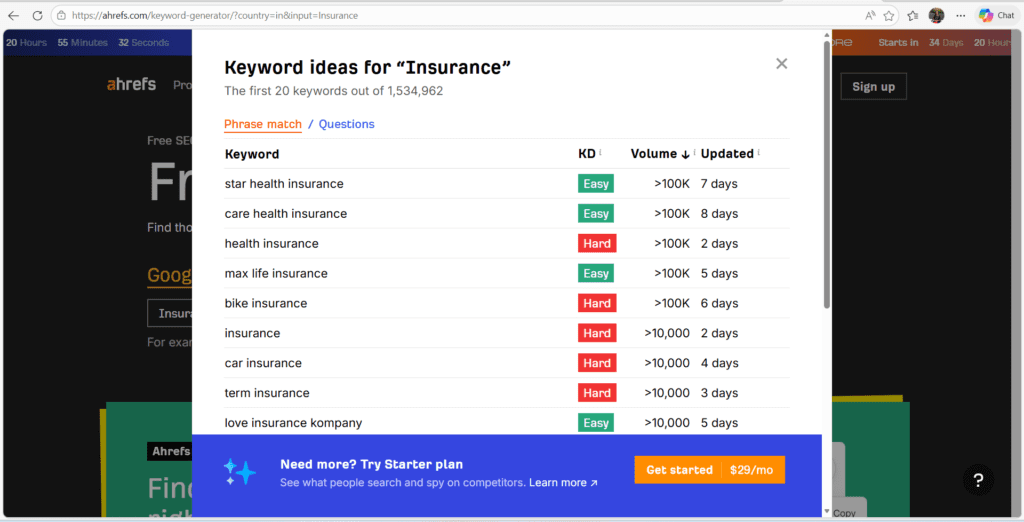
Long-tail keywords (3–5 word phrases) are your best friend as a new or growing website. They have lower competition, more specific intent, and convert better than broad single-word terms. “Content writing tools for beginners India” will rank faster than “content writing.”
Step 4 — Map Keywords to Content Types
Not every keyword deserves the same type of content. Matching keyword intent to content format is one of the most overlooked parts of an SEO content strategy.
Here’s a practical mapping framework:
| Keyword Type | Best Content Format | Example |
|---|---|---|
| “How to…” | Step-by-step guide | How to File ITR Online in India |
| “What is…” | Explainer / definition article | What is GST and How Does It Work? |
| “Best…” | Listicle / comparison | Best Free SEO Tools for Beginners |
| “X vs Y” | Comparison article | Grammarly vs Hemingway: Which is Better? |
| “[Service] in [City]” | Local SEO page | CA Firm for GST Registration in Jaipur |
| “[Topic] checklist” | Checklist / resource | Content Publishing Checklist for Bloggers |
| “[Topic] mistakes” | Problem-solution article | Common SEO Mistakes Businesses Make |
When you publish content that matches the format Google already shows for a keyword, you’re giving your page its best chance to rank.
Before writing any article, Google the keyword and study the top 3–5 results. What format are they in? How long are they? What questions do they answer? Your article should do all of that — and do it better.
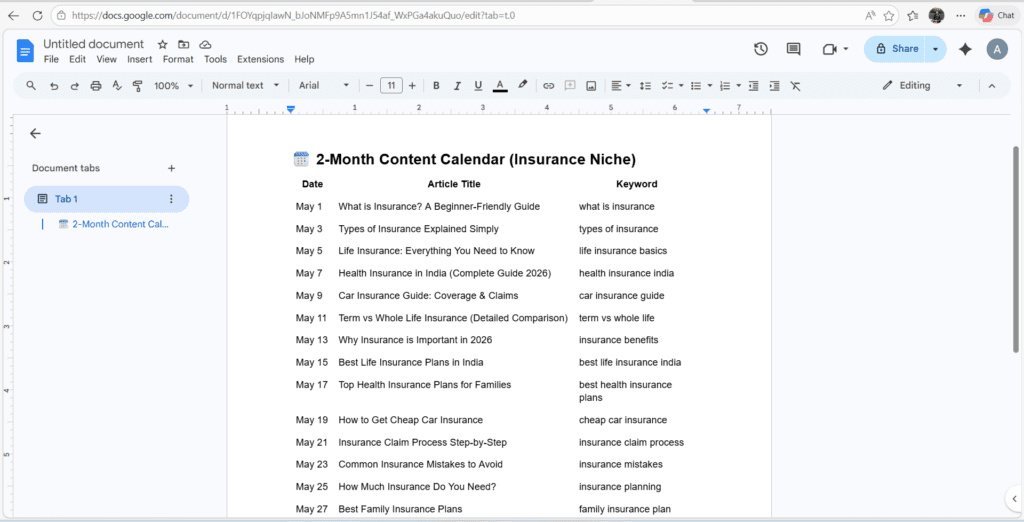
Step 5 — Build Your Content Calendar
Now you have your pillars, your keywords, and your content formats. It’s time to organise them into a publishing plan.
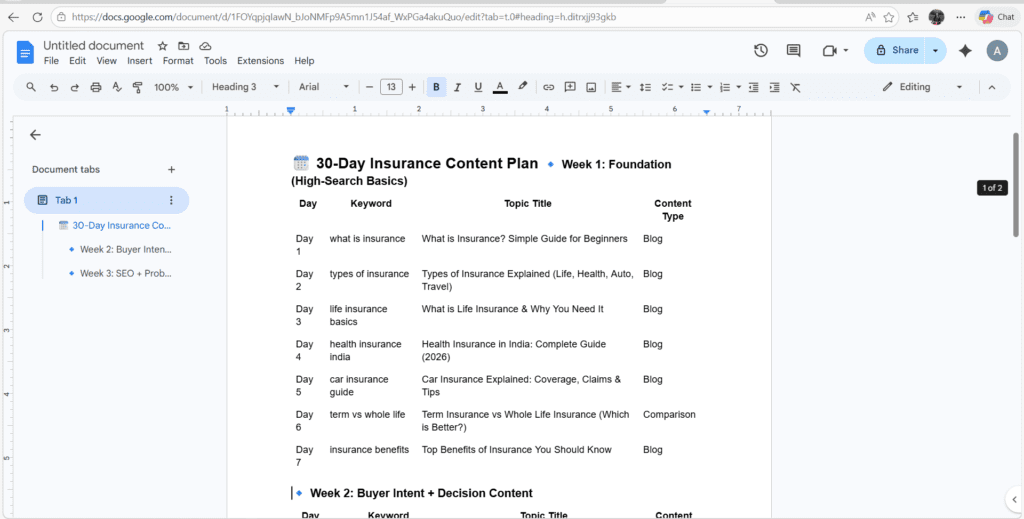
A content calendar doesn’t need to be complicated. A simple Google Sheet or Notion database works perfectly.
Minimum columns to include:
- Article title / working title
- Target keyword
- Content pillar it belongs to
- Content format (guide, listicle, comparison, etc.)
- Target publish date
- Status (idea / outline / draft / editing / published)
- Writer (if working with a team)
How often should you publish?
For most blogs and business websites, 2–4 articles per month is the sweet spot. This is frequent enough to build momentum and signal activity to Google, but not so demanding that quality suffers.
Consistency matters more than volume. Publishing 2 polished, well-researched articles every month beats publishing 8 thin, rushed ones.
Plan at least 4–6 weeks ahead. This removes the weekly panic of “what should I write about?” and lets you cluster related articles strategically — which strengthens topical authority.
Step 6 — Write, Optimise, and Publish
With your calendar set, each article goes through a consistent production process. Here’s the workflow I use and recommend:
Before writing:
- Confirm the target keyword and search intent
- Study the top 3 Google results for that keyword
- Build an outline (H2 and H3 headings) before writing a single word
While writing:
- Write the first draft freely — don’t edit as you go
- Use the target keyword naturally: in the title, introduction, one subheading, and 2–3 times in the body
- Use related terms (LSI keywords) throughout to reinforce topic relevance
- Keep paragraphs to 2–3 lines for mobile readability
After writing:
- Run through Grammarly for grammar and clarity
- Check Hemingway Editor for readability (aim for Grade 6–8)
- Add at least one visual — image, infographic, or table
- Write your meta title (under 60 characters) and meta description (under 160 characters)
- Add internal links to 2–3 related articles on your site
- Add alt text to all images
- Do a final read-aloud pass before publishing
This process takes practice, but it becomes faster with repetition. Most well-written 1,500-word articles can be researched, written, and optimised in 3–4 hours once you have the workflow down.
Step 7 — Track, Measure, and Improve
Publishing is not the end of the process. The best SEO content strategies are data-driven — meaning you regularly check what’s working and adjust.
Google Search Console is your primary tool here. Check it weekly.
Look for:
- Which articles are getting impressions but low clicks? → Improve the meta title to make it more click-worthy
- Which articles rank on page 2 (positions 11–20)? → These are your quick-win opportunities — update and improve the content, add internal links pointing to them
- Which queries are you ranking for that you didn’t target? → Create new articles around those keywords
Every 3–6 months, do a content audit:
- Update articles with outdated statistics or information
- Merge thin articles that cover similar topics
- Add new sections to articles that are close to ranking but not quite there
- Remove or redirect pages that have no traffic and no strategic value
SEO is not “publish and forget.” The sites that dominate search results treat their content like a garden — regularly tended, pruned, and grown.
Set a recurring monthly reminder to spend 2 hours reviewing your Search Console data and identifying one article to update or improve. This single habit drives more long-term growth than almost anything else.
SEO Content Strategy for Different Website Types
Freelance writers and bloggers: Focus on long-tail informational keywords. Build personal brand through consistent publishing in 2–3 niches. Monetise through AdSense, affiliate links, or client leads.
Service businesses (CA, lawyers, consultants): Balance informational content (builds trust) with local transactional pages (drives direct enquiries). Publish at least 2 blog posts per month on industry questions clients ask before hiring.
E-commerce stores: Target product comparison, “best X for Y” keywords, and buying guide content. Blog content drives top-of-funnel traffic that warms up buyers before they reach product pages.
Startups and SaaS: Build topical authority around the problem your product solves. Rank for the questions your ideal customer asks before they even know a solution like yours exists.
Common Strategy Mistakes to Avoid
- Targeting keywords that are too competitive too early. New sites need to earn authority before competing with established players. Start with long-tail, low-difficulty keywords.
- Publishing without an internal linking plan. Every new article should link to 2–3 existing articles and receive links from 1–2 relevant existing pages.
- Ignoring search intent. A “how to” keyword needs a tutorial, not a sales page. Mismatch between content and intent is one of the most common reasons pages don’t rank.
- Treating the strategy as fixed. Your keyword rankings, audience needs, and competition change over time. Review and adjust your strategy every quarter.
- Quantity over quality. Google’s Helpful Content updates in 2023–2025 made clear: thin, low-effort content hurts entire domains. Five excellent articles outperform twenty mediocre ones.
My Personal Content Strategy Template
Here’s the exact framework I use for every content strategy — a simple one-page reference document:
Website/Blog Name: _______________ Primary Goal: _______________ Target Audience (1 sentence): _______________
Content Pillars (3–5 topics):
Monthly Publishing Target: ___ articles/month
Keyword Difficulty Target: Under ___ (based on domain authority)
Content Calendar Tool: Notion / Google Sheets / Trello
Weekly Review Habit: ___ minutes every ___ (day)
Quarterly Audit Date: _______________
Print this. Fill it in. Stick it somewhere visible. It sounds simple — because it is. The businesses and bloggers that execute simple systems consistently always outperform those with complicated plans they never follow through on.
Frequently Asked Questions
Q1. How long does it take for an SEO content strategy to show results?
Most websites start seeing measurable organic traffic growth within 4–6 months of consistent publishing with a focused strategy. Long-tail keyword rankings often appear faster — sometimes within 6–10 weeks. The full compounding effect of a well-executed strategy typically becomes visible in months 9–12.
Q2. How many articles do I need before my blog starts ranking?
There’s no magic number, but most SEO professionals suggest having at least 10–15 quality articles in your core topic areas before expecting significant organic traction. It’s less about volume and more about depth — 10 excellent, interconnected articles in one niche outperform 30 scattered ones.
Q3. Do I need to pay for SEO tools to create a good content strategy?
No — especially when starting out. Google Search Console (free), Ubersuggest’s free plan, AnswerThePublic’s free searches, and Google’s own “People Also Ask” and autocomplete features give you enough data to build a solid strategy. Paid tools like Ahrefs or SEMrush help at scale, but they’re not necessary for most small websites.
Q4. Should I focus on one content pillar or multiple?
Start with one or two pillars if your site is new. Publish 8–10 articles in each before expanding. Google rewards sites that demonstrate deep expertise in a specific area. Spreading across too many topics too early dilutes your authority signal.
Q5. How do I know if my SEO content strategy is working?
rack these four metrics monthly in Google Search Console: total organic clicks, total impressions, average click-through rate (CTR), and average position. If all four are trending upward over a 3–6 month period, your strategy is working. If they’re flat, review your keyword targeting and content quality.
Q6. Is an SEO content strategy different for a new website vs an established one?
Yes — significantly. New websites should focus almost entirely on long-tail, low-competition keywords and building topical depth in 1–2 niches. Established websites with existing authority can target broader, higher-competition terms and run content audits to improve underperforming pages alongside publishing new content.
Final Thoughts
An SEO content strategy isn’t a complicated document that lives in a folder and never gets opened. It’s a simple, practical system that answers three questions before you write a single word:
Who am I writing for? What are they searching for? How will I help them better than anyone else?
Get clear on those three things, organise your answers into a keyword-mapped content calendar, and publish consistently over the next 6–12 months. That’s genuinely all an SEO content strategy is — and it’s what separates the blogs that grow from the ones that stagnate.
The best time to build your strategy was when you launched your website. The second best time is today.
References:
- Google Search Central — SEO Starter Guide: https://developers.google.com/search/docs/fundamentals/seo-starter-guide
- Google Search Central — Helpful Content System: https://developers.google.com/search/docs/appearance/helpful-content-system
- Ubersuggest by Neil Patel: https://neilpatel.com/ubersuggest
- AnswerThePublic by Neil Patel: Keyword Research & Content Ideas
Writing Services
- Academic Writing
- Editing & Proofreading
- SME Writing Services
- SEO Blogwriting Services
- Creative & Ghostwriting
No post found!