
Last Updated: March 21, 2026
Cluster Post 1 | Module 8: Grant Writing and Research Funding
From Concept to Submission Series | 2026
Academic Writing Mastery: The Complete 2026 Guide To Research Papers, Thesis & Dissertation Writing
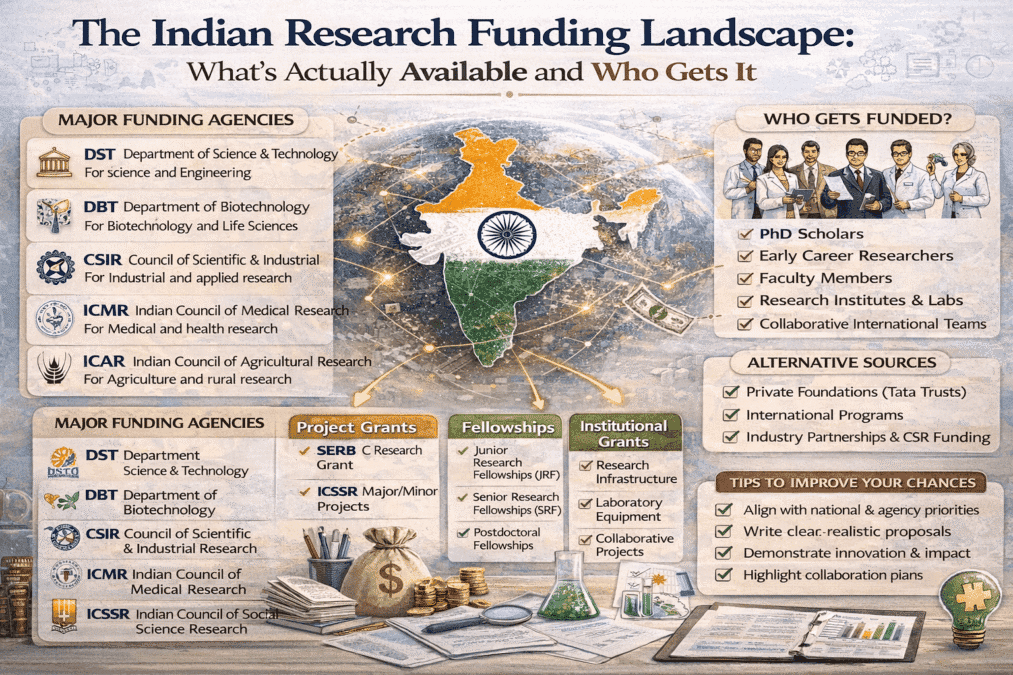
The Indian Research Funding Landscape
The module overview lists Indian funding schemes. This post goes deeper: an honest evaluation of each major scheme including realistic success rates, what strong applications look like, which schemes are genuinely open to social science and law researchers, and the institutional access differences that the funding lists never mention.
The Access Gap the Lists Do Not Show
The module lists Indian funding schemes accurately. What it does not show is the structural reality that shapes who actually receives this funding: institutional affiliation matters far more than the scheme guidelines suggest.
PMRF, SERB, and DST schemes disproportionately fund researchers at IITs, IISc, and IISERs, partly because their applications are stronger, partly because they have experienced grant offices that navigate the system, and partly because reviewers are more familiar with these institutions’ research cultures. A strong PhD student at a central university faces a structurally different competitive environment than an equally strong student at IIT Bombay, even for the same scheme.
This is not a reason to avoid applying to competitive schemes — the institutional advantage is real but not absolute, and social science researchers in particular face less IIT/IISc dominance than STEM researchers. But it is a reason to be realistic about which schemes are genuinely accessible to you, to invest in understanding the application requirements thoroughly, and to seek guidance from supervisors who have successfully navigated these schemes.
Major Schemes: Honest Evaluations
Prime Minister’s Research Fellowship (PMRF)
What it is: India’s most prestigious PhD fellowship, offering ₹70,000–80,000/month plus a contingency grant of ₹2,00,000/year. Awarded through a competitive selection process.
Who is eligible: Students who completed B.Tech/B.E./B.S./M.Sc./M.Tech from IITs, IISc, IISERs, NITs, and a small number of central universities — and who are now enrolled in or wish to enrol in PhD programmes at these institutions. Eligibility criteria are updated regularly; check pmrf.in for current requirements.
What strong applications include: A clearly articulated research problem with national significance, preliminary work or coursework demonstrating capability, a strong supervisor commitment letter, and evidence of prior academic excellence (typically CGPA above 8.0 or equivalent).
Realistic assessment: Highly competitive. Social science and law researchers at eligible institutions can apply — PMRF is not STEM-only — but STEM applications dominate. Acceptance rates are below 5% of applicants in competitive rounds. Worth applying if eligible; do not build a research plan around receiving it.
ICSSR Doctoral Fellowship
What it is: The Indian Council of Social Science Research provides doctoral fellowships of ₹20,000/month plus a contingency grant of ₹10,000/year. Duration: two years (extendable to three).
Who is eligible: Registered PhD students in social science disciplines at recognised Indian universities. Law, economics, sociology, political science, education, and related fields are eligible. ICSSR is the most relevant government fellowship for social science and law doctoral researchers.
What strong applications include: A well-developed research proposal demonstrating clear contribution to social science knowledge, evidence that the research addresses significant contemporary Indian social issues, and a supervisor letter confirming the research is ongoing and supported. ICSSR values applied and policy-relevant research — proposals that connect to India’s social development challenges are well-positioned.
Realistic assessment: More accessible than PMRF. The scheme has multiple windows and the institutional affiliation advantage is less pronounced for social science. Acceptance rates are competitive but more achievable — approximately 10–15% in recent cycles. Worth serious investment for eligible social science PhD students.
UGC National Fellowship and Other UGC Schemes
National Fellowship for Scheduled Castes / Other Backward Classes: The UGC provides doctoral fellowships of ₹25,000/month (JRF) and ₹28,000/month (SRF) for students from SC/OBC categories. These are need-based within eligible categories and have higher acceptance rates than open-category schemes.
STRIDE (Scheme for Trans-Disciplinary Research for India’s Developing Economy): Targets faculty and research groups rather than individual PhD students. Component 1 supports individual minor research projects; Component 2 supports larger institutional projects. Amounts from ₹2 lakh to ₹60 lakh depending on component. Relevant primarily for faculty applying for institutional research funding.
UGC Minor Research Projects: Small grants of ₹50,000–₹2,00,000 for faculty at affiliated colleges and universities. Not available to PhD students directly, but PhD work can sometimes be incorporated into a supervisor’s MRP.
DST/SERB Schemes for Early-Career Researchers
Start-up Research Grant (SRG): For researchers within two years of completing their PhD. Provides up to ₹30 lakh over two years for researchers at recognised institutions. Primarily STEM-oriented but social science applications are accepted for quantitative and empirical research.
Core Research Grant (CRG): For established faculty with a research track record. Not accessible to PhD students or very early-career researchers. Amounts up to ₹50 lakh for three years.
Realistic assessment for social science/law: DST/SERB schemes are significantly harder for social science and law researchers because the review panels and criteria are STEM-oriented. Empirical social science research that uses quantitative methods and addresses technology, environment, or health intersections is better positioned than purely doctrinal or interpretive research.
CSIR Junior Research Fellowship / Senior Research Fellowship
What it is: Fellowships of ₹37,000–₹42,000/month for researchers in CSIR-funded areas: physical sciences, chemical sciences, life sciences, and some engineering disciplines.
Honest assessment for readers of this series: CSIR fellowships are STEM-specific. Law, social science, education, and humanities researchers are not eligible. If you are in a relevant STEM-adjacent field, check eligibility; otherwise this scheme is not applicable.
Choosing the Right Scheme for Your Research
| Research type | Most relevant schemes | Notes |
| Law / legal studies (doctrinal) | ICSSR Doctoral Fellowship, UGC Minor Research Project (through supervisor) | DST/SERB generally not accessible for purely doctrinal work. International options (Fulbright-Nehru, Commonwealth) worth exploring — see Cluster Post 5. |
| Law / legal studies (empirical) | ICSSR Doctoral Fellowship, SRG (post-PhD) | Empirical legal research using quantitative methods may qualify for SERB review if the methodology is clearly scientific. |
| Social science (quantitative) | ICSSR, UGC National Fellowship, PMRF (at eligible institutions) | Quantitative social science can access a broader range of schemes. |
| Social science (qualitative) | ICSSR Doctoral Fellowship primarily | Most competitive schemes favour quantitative methods. Qualitative researchers should focus on ICSSR and foundation grants. |
| Education research | ICSSR, UGC, selected foundation grants (Azim Premji Foundation, Tata Trusts) | Education research with policy relevance is particularly well-positioned for foundation funding. |
| STEM / engineering | PMRF, CSIR JRF/SRF, DST/SERB, ICMR (biomedical) | Widest range of options. Competition is high but schemes are designed for this research type. |
Foundation Funding: The Underused Option
Private foundations are underused by Indian academic researchers, partly because they are less visible than government schemes, and partly because researchers assume they are for NGOs rather than academic work. Both assumptions are wrong for the right research.
Tata Trusts fund research in sustainable livelihoods, health, and education with genuine interest in rigorous academic work that has policy implications. The Sir Dorabji Tata Trust is particularly relevant for social science researchers studying rural development, tribal communities, and environmental issues.
Azim Premji Foundation funds education research and has a particular interest in teacher development, rural school systems, and educational equity. Their research arm (Azim Premji University) also offers collaborative research opportunities.
Ford Foundation funds social justice research, civil society, and democratic governance. Indian researchers studying constitutional law, human rights, labour rights, and gender can access Ford Foundation grants. Applications typically go through Indian partner organisations rather than directly.
What foundation applications require differently from government grants: foundations are more interested in the social impact narrative and less interested in methodological rigour for its own sake. A research proposal that could receive a SERB grant for its methodological sophistication may receive a foundation grant for its connection to a social problem. The writing approach and framing need to shift accordingly.
The most accessible schemes for law PhD students
Law PhD students at Indian universities have a narrower but still viable funding landscape. The most accessible routes, in order of realistic accessibility:
- ICSSR Doctoral Fellowship: The primary government scheme for law PhD students. Focus the application on the social science dimensions of your research — constitutional rights, access to justice, socio-legal analysis — rather than on purely doctrinal elements.
- UGC National Fellowships: For eligible categories (SC/OBC), these are more accessible than open-category schemes and provide meaningful funding for the PhD period.
- NLU-specific fellowships: Most NLUs have internal fellowship schemes funded by their own budgets, alumni networks, or specific endowments. These are highly accessible for NLU students and often require less elaborate applications.
- Bar Council of India Trust: The BCI Trust funds legal education and research. Check with your institution’s research office for current schemes.
- International law foundations: See Cluster Post 5 for Fulbright-Nehru, DAAD, and other international schemes that are accessible to law researchers.
How to frame legal research for ICSSR applications
ICSSR assesses social science contribution, not legal scholarship specifically. A successful ICSSR application from a law researcher frames the research in terms of its contribution to understanding Indian society, governance, or justice — not in terms of its contribution to legal doctrine. An empirical study of how marginalised communities access the courts is a social science study; a doctrinal analysis of the same issue is a legal study. The ICSSR application should foreground the former framing.
Legal Research and Writing: Complete Guide for Law Students and Legal Researchers
FAQs
Q: What research grants are available for Indian social science researchers?
Indian social science researchers can apply to: ICSSR Major Research Projects (Rs 10–25 lakh, 2–3 years); ICSSR Minor Research Projects (Rs 3–6 lakh, 1–2 years); ICSSR National Fellowships; UGC-STRIDE Major Research Projects; and state-level social science councils. ICSSR is the primary funder for sociology, political science, economics, education, and psychology research. Applications are submitted through your institution’s nodal officer. Eligibility typically requires a PhD and a faculty position at an ICSSR-affiliated institution.
Q: What is SERB and what grants does it offer Indian researchers?
SERB (Science and Engineering Research Board), under DST, is India’s primary funder for science and technology research. Key schemes: Core Research Grant (CRG) — Rs 15–50 lakh for established researchers with 3+ years post-PhD experience; Startup Research Grant (SRG) — Rs 15–30 lakh for early-career researchers within 3 years of PhD; National Science and Technology Entrepreneurship Development Board (NSTEDB) grants for applied research. SERB also funds international collaboration through bilateral schemes with UK, Germany, US, and other countries.
Q: Can PhD students apply for research grants in India?
PhD students can apply for: UGC Junior Research Fellowship (JRF) — a monthly stipend for full-time PhD students at recognised universities; ICSSR Doctoral Fellowship — for social science PhD research; CSIR JRF for science and technology PhD students; and ICMR JRF for health research PhD students. Most major project grants require the applicant to be a faculty member, not a student — PhD students typically participate as co-investigators or research assistants on faculty-led grants. Some NLUs have internal seed funding for PhD students.
Q: What is UGC-STRIDE and who can apply?
UGC-STRIDE (Scheme for Trans-disciplinary Research for India’s Developing Economy) funds interdisciplinary research projects at UGC-recognised universities. It has three components: Component 1 funds capacity building; Component 2 funds interdisciplinary research projects (Rs 5–50 lakh); Component 3 funds research in Humanities and Social Sciences. Faculty members at UGC-recognised universities (including NLUs) are eligible. Applications require a research proposal demonstrating interdisciplinary approach, societal relevance, and institutional support. Proposals must show connection to India’s development challenges.
Q: How do you find out about new research funding opportunities in India?
Monitor: the ICSSR website (icssr.org) for funding scheme announcements; UGC website (ugc.gov.in) for scheme notifications; SERB website (serb.gov.in) for DST-funded schemes; your institution’s research office (which receives notifications from funding bodies); and ResearchGate and academic mailing lists for fellowship announcements. Set up Google Alerts for ‘ICSSR grants,’ ‘UGC research funding,’ and ‘DST SERB.’ Application deadlines are often published only 4–6 weeks in advance — regular monitoring is essential.
References
- PMRF — Prime Minister’s Research Fellowship. pmrf.in
- ICSSR — Indian Council of Social Science Research. icssr.org
- SERB — Science and Engineering Research Board. serb.gov.in
- UGC — University Grants Commission schemes. ugc.gov.in
- Tata Trusts — Research and grants. tatatrusts.org
Next: Cluster Post 2 — Writing the Proposal Abstract and Problem Statement That Get Funded