
Last Updated: April 6, 2026
Artificial Intelligence: My Complete Guide, Real Tools & Workflow
How to Use AI to Write Blog Posts Faster
A client needed a detailed blog on UPI payment regulations — covering RBI compliance, merchant liability, and consumer dispute rights. Technically dense, legally sensitive, zero room for error.
Two years ago, I would have panicked and worked through the night. That weekend, I delivered all five by Sunday afternoon — without rushing, without shortcuts, and without any post failing the client’s legal review. Not because AI wrote them for me. Because I had a system that used AI at exactly the right stages and kept my judgment in charge of everything that mattered.
This is that system, exactly as I run it.
→ AI vs Human Writing: what Google rewards→ Best AI writing tools in 2026
The mistake most bloggers make: using AI for the part it is worst at — facts and domain judgment — and doing manually the part AI handles best — structure and language. Flip the order and everything changes.
The 6-step workflow — exactly how I run it
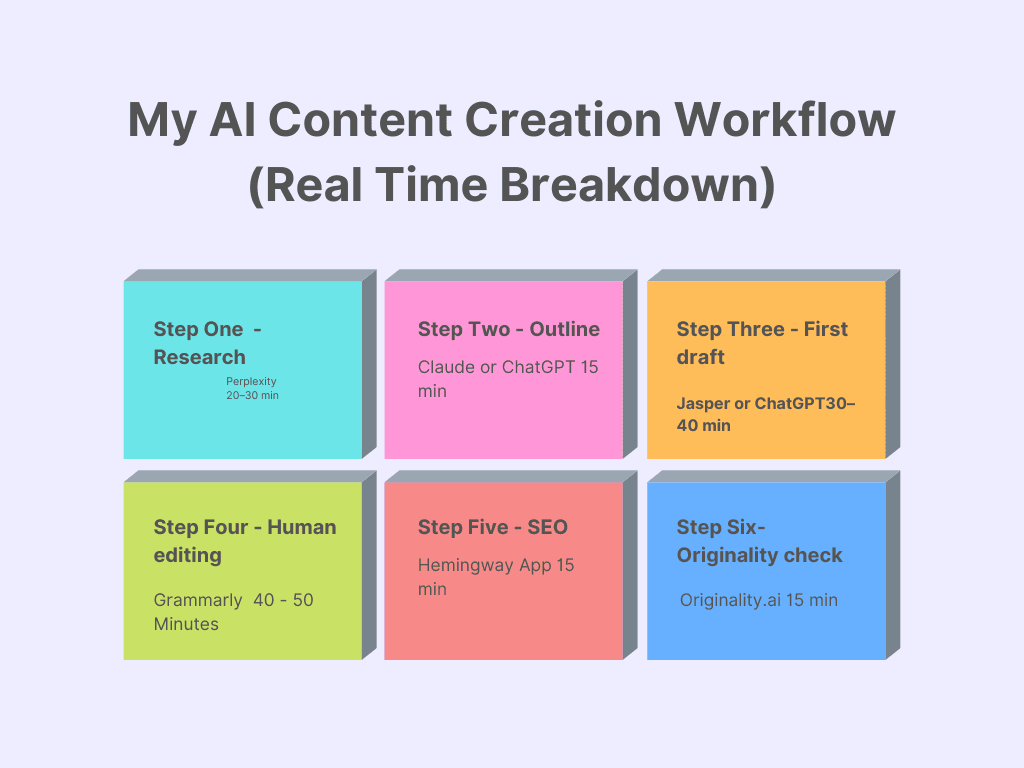
1.Research — before any AI tool opens
I spend 20–30 minutes on research before touching any AI. For the UPI posts: Perplexity for current RBI guidelines with source links, the client’s product documentation, one regulatory reference from Google Scholar. Everything goes into a single Google Doc I call the source brief. Every fact in the final post traces back to this document — not to AI output. This step is what stopped me from publishing an outdated merchant fee cap that ChatGPT confidently hallucinated when I tested it unguided.
Perplexity20–30 min
2.Outline — AI-assisted, human-controlled
I give Claude or ChatGPT: the topic, the target reader, the key angle, and three things the post must cover based on my research. I never use the output directly. I rearrange based on how the reader actually thinks about the problem — what they know already, where they get stuck, what they really need to know by the end. The final outline is roughly 60% AI structure, 40% my edits.
Claude or ChatGPT 15 min
3.First draft — section by section, not all at once
I generate one section at a time, giving AI the specific facts from my source brief for each one. Not “write a blog about UPI payments.” Instead: “Write a 180-word section explaining UPI merchant settlement timelines under NPCI’s 2025 guidelines, using these two facts: [pasted facts].” Specific input produces specific output. One large prompt for a full post produces the generic output that gives AI blogging a bad reputation.
Jasper or ChatGPT30–40 min
4.Human editing — the step that determines everything
I read every paragraph out loud. If it sounds like something any brand could have published, I rewrite the opening line. I add one specific, real detail per section — a client name, an actual outcome, a concrete number. I cut every hedge I find: “it is worth noting,” “it is important to understand,” “in today’s fast-paced world.” Every AI draft I receive has at least six of these. Every one gets removed.
Grammarly — consistency only, not creativity 40–50 min
5.SEO — after the content is right, not before
Primary keyword in: title, first paragraph, one H2, meta description. Readability check on Hemingway — target Grade 7–8, meaning short sentences, active voice, no jargon without explanation. A post that genuinely answers the search intent will contain the relevant terms naturally. Keyword-stuffing a post that does not satisfy reader intent is wasted effort that does not survive algorithm updates.
Hemingway App 15 min
6.Originality check — before every client submission
I run Originality.ai on the final draft. Target is 90%+ human score. If a section flags high AI detection, I do not just rephrase — I rewrite it with a specific example or first-person observation that only I could have written. That is what actually changes the score. Synonym replacement fools nobody — not the tool, not the reader, and not Google’s quality raters.
Originality.ai 15 min
Time-saving proof — real numbers from January 2026
I tracked both methods across 12 posts in January — same topics, same word counts, same quality standard required for publication.
| Manual writing — no AI | AI-assisted workflow |
| 5.5 hrs – Research 1.5 hrs · Outline 30 min · Writing 2.5 hrs · Editing 1 hr. For unfamiliar topics like the UPI brief: add 1–2 hours. | 2.1 hrs – Research 25 min · Outline 15 min · Drafting 35 min · Editing 45 min · SEO + proof 15 min. Consistent across topics because the system does not change. |
Time saved: 3.4 hours per post. Across the 5-post weekend: 17 hours saved. Quality outcome: all five posts passed legal review on first submission with zero revision requests.
Where AI actually fails at blog writing
Every AI blogging guide skips this section. Knowing these failure modes is exactly what makes the system above necessary.
Confident facts that are wrong
For the UPI posts, an unguided ChatGPT draft cited a merchant fee cap revised 8 months earlier. The language was authoritative. The number was outdated. A reader making a business decision based on that post would have been misled. Research first, AI second — always, on every topic.
Generic openings that lose readers in the first line
“In today’s fast-paced digital world…” / “Are you looking to improve your…?” — these openings are present in the majority of unedited AI blog posts. They signal to readers that what follows will not be specific or useful. I delete the AI-generated introduction and write the opening myself, on every single post.
Repetition that readers notice by section three
AI summarises at the end of each section, then summarises the summaries in the conclusion. A 1,400-word post can have the same idea restated four times. I cut all summary sentences that do not introduce new information. If removing a sentence changes nothing, it should not be there.
No first-hand experience — the E-E-A-T gap
Google’s quality raters are trained to identify whether content comes from someone with genuine experience. AI can describe a process. It cannot say “when I ran this on a fintech brief, here is what the client’s legal team flagged on review.” That sentence can only come from me — and it is the sentence that determines whether the post ranks.
Hedging language that kills authority
“It is worth noting,” “you may want to consider,” “it could be argued.” AI defaults to cautious, hedge-everything phrasing. Expert writers take positions. Every hedge I find gets replaced with either a direct statement or a real example that makes the point without softening it.
AI draft vs edited version — same post, same brief
From the UPI settlement post. Same facts given. This is what came out and what went live.
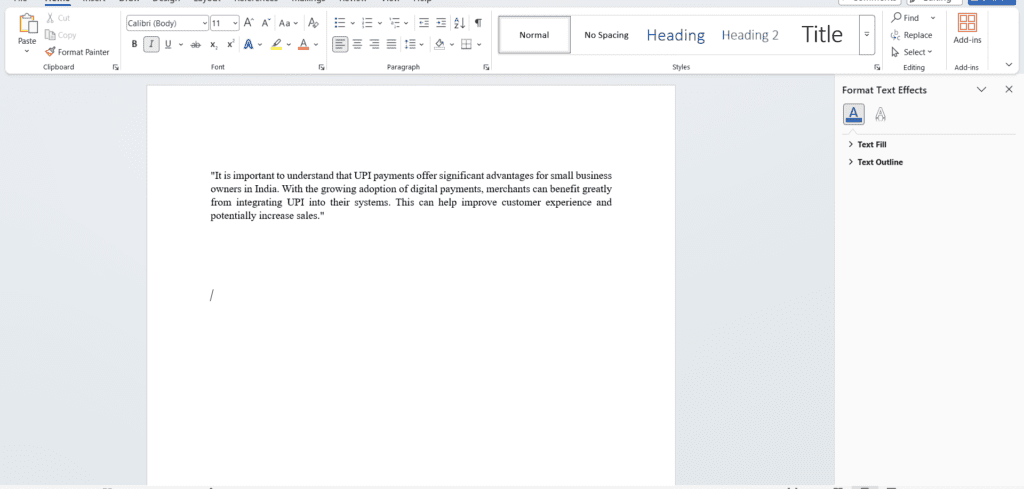
AI draft — unedited
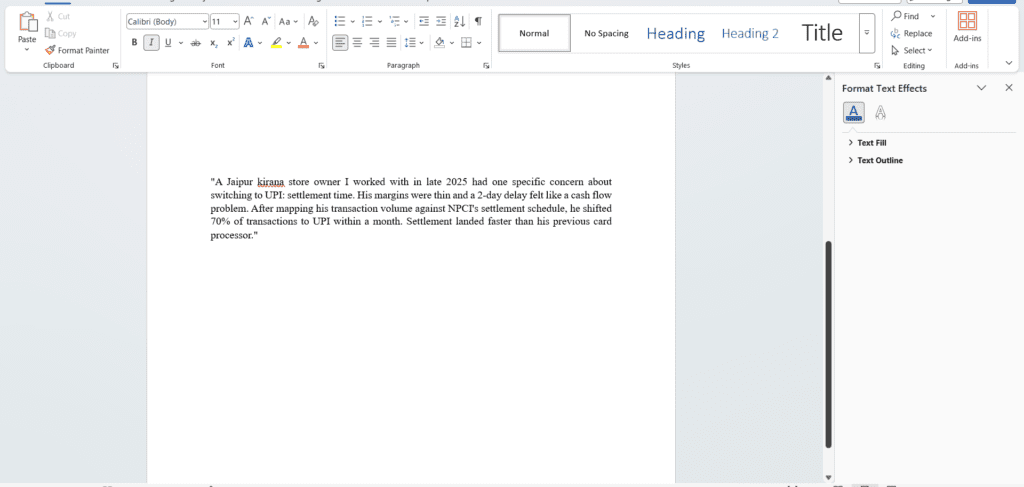
Human-edited version
AI version: 52 words · zero information · three hedges · no specific claim. Edited version: 72 words · one real situation · one measurable outcome · zero hedges. The second earns saves and return visits. The first earns a scroll and a bounce.
→ AI Content Writing Vs Human Writing: What Google Actually Rewards 2026→ Best AI tools tested in 2026
The hybrid model — why this is the only approach that scales
AI writes faster. Humans make it worth reading. That is not a tagline — it is the actual division of labour in every post I deliver.
AI contributes: first-draft language, structural scaffolding, consistent section tone, and speed. On a 1,400-word post, AI gets me to a readable first draft in 35 minutes. Done manually: 2.5 hours minimum. That saving compounds — across 20 client posts a month, it is the difference between a sustainable workflow and constant burnout.
Human expertise contributes: the fact-verification, the first-hand example, the opening line that makes a reader stay past the first paragraph, the judgment call about what a specific audience actually needs to know, and the E-E-A-T signals that determine whether the post ranks or gets filtered.
Pure manual blogging at the frequency SEO requires is economically unsustainable. Pure AI blogging produces content that is technically correct and genuinely not useful to anyone specific. The hybrid model is not a polite middle ground — it is the only approach that produces both volume and quality at the same time.
Expert insight
The bloggers who will lose work to AI are not the ones using it. They are the ones producing the kind of generic, experience-free content that AI already produces better and faster. The bloggers who gain are those whose specific knowledge, professional judgment, and real experience are what make AI output actually publishable.
FAQs
Q. Can AI-written blogs rank on Google?
Yes — when they contain genuine first-hand experience and go through real editing. I have AI-assisted posts in top-5 positions for competitive keywords. Every one has a specific client reference or professional observation that only I could have written. Unedited AI output rarely holds a competitive position because it lacks the E-E-A-T signals quality raters look for.
Q. Is AI content safe for AdSense approval?
Yes, as long as the content meets Google’s Helpful Content standard — original, useful, and experience-backed. AdSense reviews site-level content quality, not AI origin. A page with genuine expertise signals and specific first-hand examples will pass. A page that reads like assembled information without a human perspective will not.
Q. How much editing does AI content actually need?
More than most guides admit. I rewrite 35–40% of every AI draft before publication. The editing pass takes 40–50 minutes on a 1,400-word post. Skipping it is the single biggest mistake bloggers make with AI content — not using AI, not choosing the wrong tool, but publishing without a real editing pass.
Q. Which AI tool is best for blog writing?
Depends on the stage. Perplexity for sourced research. Claude for complex outlines where nuance matters. Jasper for long-form section drafts once structure is set. Hemingway for readability. Originality.ai for the final check. No single tool handles all six steps well — the workflow matters more than any individual tool choice.
Q. Can this workflow be used for regulated niches — legal, medical, financial?
Yes, with one adjustment: the research step becomes longer and a verification layer becomes mandatory. Every fact AI might have touched gets traced back to a primary source before publication. The UPI posts required exactly this — every regulatory detail verified against official NPCI and RBI documents before Step 3 began. The system is the same. The due diligence is higher.
References
ChatGPT vs Claude vs Gemini 2026
- OpenAI — ChatGPT official: openai.com
- Perplexity AI — Research tool: perplexity.ai
- Grammarly — Editing and clarity: grammarly.com
- Google — Search quality evaluator guidelines: google.com/search/docs
About the Author
Dr. Rekha Khandelwal is a certified expert in AI tools and academic content development, with a strong focus on leveraging platforms like ChatGPT, Claude, and Gemini for research and digital writing. With a Ph.D. in Law and specialized training in AI-driven content creation, she helps students, researchers, and professionals create high-quality, SEO-optimized, and impactful content.
Author Profile Dr. Rekha Khandelwal | Academic Writer, Legal Technical Writer, AI Expert & Author | AspirixWriters
- Motivational, Creative & Ghostwriting
- Legal & Technical Writing Services
- Academic Writing Assistance
- Editing & Proofreading
- SEO Blogwriting Services
AI For Social Media Content: How To Create 30 Days Of Posts In 2 Hours (2026 Guide)
How to Use AI to Write Blog Posts Faster — My Real Step-by-Step Workflow
Artificial Intelligence: My Complete Guide, Real Tools & Workflow How to Use AI to Write…

AI SEO Checklist 2026: How to Rank Your Website in ChatGPT, Perplexity & Google AI Overviews
Here is an uncomfortable reality:Read expert guide on AI SEO Checklist, Research by Dr. Rekha…

AI in Content Creation: 2026 Guide, Tools & Best Practices
AI in Content Creation A simple, beginner-friendly guide to using AI for writing, designing, and…
AI for Social Media: How I Create 30 Days of Posts in 2 Hours
Most people who try AI for social media content make the same mistake: they open…
AI Content Writing vs Human Writing: What Google Actually Rewards
Artificial Intelligence: My Complete Guide, Real Tools & Workflow AI Content Writing vs Human Writing:…