
Running a small business today is both exciting and challenging. You may be managing customers, marketing, finances, and daily operations—all at the same time. With limited staff and time, it can feel overwhelming. This is where AI for small businesses is becoming a powerful support system.
Artificial Intelligence is no longer limited to big companies. Today, even small shops, freelancers, and startups can use AI tools to save time, improve customer service, and grow more efficiently—without increasing costs.
This guide explains how AI helps small businesses, which tools are useful, and how you can start using AI in a simple and practical way.
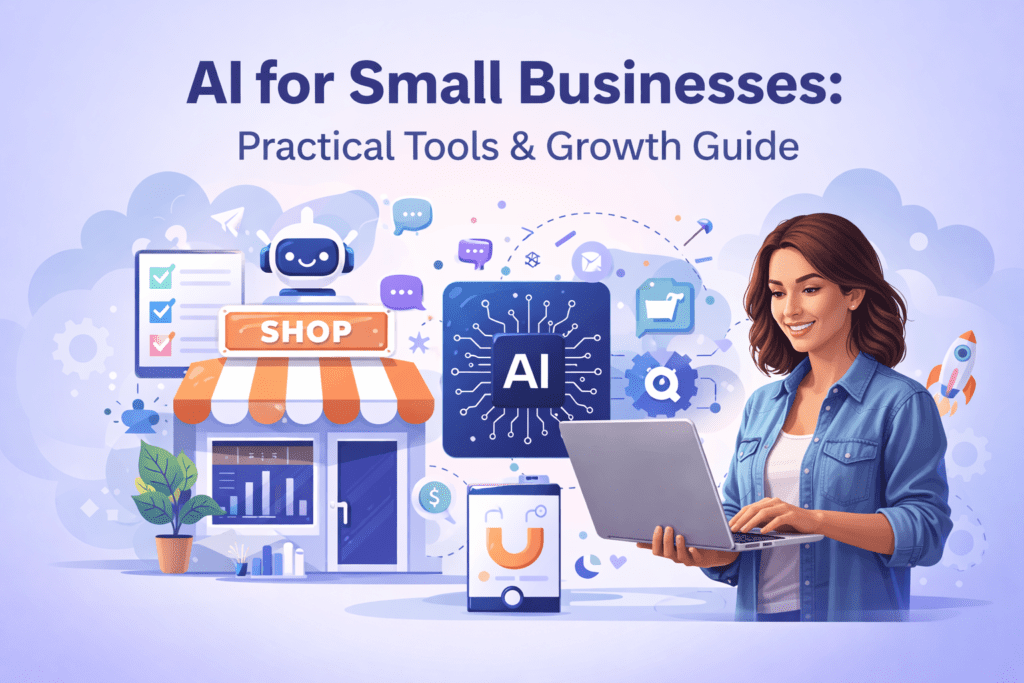
What is AI for Small Businesses?
AI for small businesses means using intelligent software that can perform tasks such as writing content, answering customer questions, analyzing data, or helping with marketing.
These tools learn from data and patterns to assist business owners in making better decisions and completing work faster.
In simple words, AI works like a smart assistant that supports your daily business tasks.
Why AI is Becoming Important for Small Businesses
Small businesses often compete with larger companies that have more resources. AI helps bridge this gap by improving efficiency and productivity.
Here are some key reasons why AI matters:
1. Saves Valuable Time
AI can automate repetitive tasks like replying to common customer questions or writing emails.
2. Improves Customer Experience
Customers receive faster responses, which builds trust and satisfaction.
3. Supports Marketing Efforts
AI helps create social media posts, email campaigns, and marketing content.
4. Helps in Better Decision-Making
AI tools analyze trends and customer behavior, helping business owners plan better.
5. Supports Growth Without Hiring More Staff
AI allows businesses to expand operations without significantly increasing costs.How AI Works in a Small Business
AI usually supports your work rather than replacing you.
Here’s a simple example:
- A customer sends a message on your website
- An AI chatbot answers basic questions instantly
- AI tools help create marketing posts
- You review and finalize important decisions
This saves time and improves efficiency.
Practical AI Tools Small Businesses Can Use
You don’t need technical knowledge to use AI. Many tools are simple and beginner-friendly.
1. Customer Support Tools
AI chatbots can:
- Answer FAQs
- Respond to customer queries
- Provide support anytime
This improves customer satisfaction.
2. Marketing and Content Tools
AI tools can help create:
- Social media posts
- Email marketing content
- Product descriptions
This makes marketing easier and more consistent.
3. Productivity Tools
AI can assist with:
- Writing emails
- Summarizing documents
- Managing tasks
This improves daily productivity.
4. Data and Analytics Tools
AI helps analyze:
- Customer preferences
- Sales trends
- Business performance
This helps you make smarter decisions.
Real-Life Examples of AI in Small Businesses
Many small businesses are already using AI successfully.
Example 1: Local Shop
A shop owner uses AI to create regular social media posts and attract more customers.
Example 2: Café
A café uses a chatbot to answer questions about menu and timings.
Example 3: Online Business
An online seller uses AI to understand which products are popular.
Example 4: Freelancer
Freelancers use AI tools to write proposals and communicate with clients.
These examples show that AI is practical and useful.
Benefits of AI for Small Businesses
Here are the major advantages:
Saves Time
AI handles repetitive tasks quickly.
Improves Efficiency
Business operations become smoother.
Enhances Customer Service
Customers get faster responses.
Supports Marketing
AI helps create better marketing content.
Helps in Business Growth
AI supports expansion without increasing workload.
Challenges and Things to Remember
While AI is helpful, it should be used wisely.
Learning New Tools
It may take some time to understand new tools.
Always Review AI Output
Human review is important to ensure quality.
Protect Customer Data
Privacy and trust are very important.
Maintain Human Connection
AI should support—not replace—human relationships.
Best Practices for Using AI in Small Businesses
Follow these simple tips:
Start Small
Use one AI tool first.
Focus on Your Needs
Choose tools that solve your real business problems.
Keep Learning
Understand how tools work.
Review and Improve
Check results and improve gradually.
Use AI Responsibly
Keep human control in important decisions.
Is AI Expensive for Small Businesses?
No. Many AI tools offer free versions or affordable plans.
You can start small and upgrade later when needed.
This makes AI accessible for everyone.
Future of AI for Small Businesses
AI will continue to become more useful and accessible.
In the future, AI will help small businesses:
- Understand customers better
- Improve marketing
- Automate operations
- Grow faster
Businesses that start using AI early will have an advantage.
Conclusion
AI for small businesses is not about replacing people—it is about helping people work smarter.
It saves time, improves efficiency, and supports business growth.
The best approach is to start small, use trusted tools, and keep human involvement in important decisions.
With the right balance, AI can become a powerful partner in your business journey.
Best AI Tools For Business & Marketing
FAQs
What is AI for small businesses used for?
AI for small businesses is used to automate customer support, assist with marketing content, analyze data, and streamline daily operations. It helps owners save time while improving consistency and decision-making without needing technical expertise.
Is AI for small businesses affordable?
Yes. Many AI for small businesses tools offer free or low-cost plans. Small businesses can start with basic features and scale gradually, making AI accessible without heavy upfront investment.
Which AI tools are best for small businesses?
Popular options include ChatGPT for content and support, Canva AI for design, HubSpot for CRM automation, and Notion AI for productivity. The best choice depends on the business goal and workflow.
Are there risks in using AI for small businesses?
Risks include data privacy concerns, over-automation, and reliance on inaccurate inputs. Businesses should review AI outputs, follow privacy regulations, and use AI as support rather than complete automation.
Does AI replace employees in small businesses?
No. AI for small businesses is designed to assist people, not replace them. It reduces repetitive work so employees and owners can focus on strategy, creativity, and customer relationships.
References
References
- U.S. Small Business Administration. Artificial Intelligence for Small Business. https://www.sba.gov
- National Institute of Standards and Technology. Artificial Intelligence Overview. https://www.nist.gov/artificial-intelligence
- UNESCO. Artificial Intelligence and Ethics. https://www.unesco.org/en/artificial-intelligence
- Harvard University. AI Tools and Resources. https://huit.harvard.edu/ai
Best AI Tools For Business & Marketing
- Academic Writing
- AI Ethics & Future
- AI in Academic Research
- AI in Business & Marketing
- AI in Content Creation
- AI in Design & Development
- AI in Education/Teaching
- AI in Research
- AI Tools & Review
- Indian Laws
- Motivation
- SEO & Digital Marketing
- Writing & Content Creation
AI Chatbots Customer Support: 24/7 Help Guide
Ever lost sales because customer questions came at 2 AM? Many small businesses struggle to…
AI for Small Businesses: Practical Tools & Growth Guide
Running a small business today is both exciting and challenging. You may be managing customers,…
AI in Digital Marketing: Trends Shaping Smarter Marketing
Digital marketing has changed dramatically in recent years, and AI in digital marketing is one…
AI in Email Marketing: Smarter Emails for Better Engagement in 2026
Email marketing remains one of the most reliable digital channels—but only when emails feel relevant….
AI in Market Research: 2026 Trends, Tools & Practical Insights
AI in market research helps businesses analyze data faster, predict trends, and personalize strategies. Learn…
AI in Sales Automation: Practical Guide & Trends
AI in sales automation helps teams save time, prioritize leads, and forecast pipelines accurately. Learn…
Best AI Tools for Business & Marketing 2026
Best AI Tools for Business & Marketing 2026-What if you could run campaigns, write content,…