
Last Updated: August 12, 2026
Best AI Tools for Business & Marketing
The real problem most businesses have with AI marketing tools
A Jaipur-based D2C startup owner recently described her situation to me: she was spending 3 hours every day on content — Instagram captions, email newsletters, product descriptions — and still falling behind. She had tried two AI tools. Neither had solved the problem. She was using them as faster typewriters, not as workflow components.
This is the pattern across small and mid-sized businesses in India using the best AI tools for marketing in 2026. The tools exist. The problem is not access — it is knowing which tool belongs at which stage of the marketing workflow, and understanding that no single tool handles all stages well.
This guide is not a ranking of the top AI tools for business growth. It is a workflow map. By the end, the question should not be “which is the best AI marketing tool” — it should be “which tool belongs at which stage of my specific marketing process.”
The best AI tool for your business is not a product. It is a system — a specific combination of tools, each doing the job it is actually built for, in the right sequence.
→ AI Tools Reviews: complete hub
→ AI vs Human Writing: what Google rewards
Where AI actually fits in a marketing workflow
AI does not replace marketing. It removes the mechanical burden of marketing — the repetitive, time-consuming tasks that do not require strategic judgment but consume hours that should go toward strategy.
In a practical marketing workflow, AI contributes at five specific stages: research and competitive intelligence, content creation, SEO optimisation, distribution and scheduling, and workflow automation. The mistake most businesses make is expecting one tool to serve all five stages. The businesses getting real results from AI content marketing tools in 2026 are the ones who have assigned a specific tool to each stage — and use each tool only for that stage.
What AI cannot do in marketing: make strategic decisions about positioning, understand the specific cultural context of a regional audience, build genuine relationships with customers, or produce content that demonstrates real professional expertise. Those remain human responsibilities. AI removes the mechanical work so the human time can go where it actually matters.
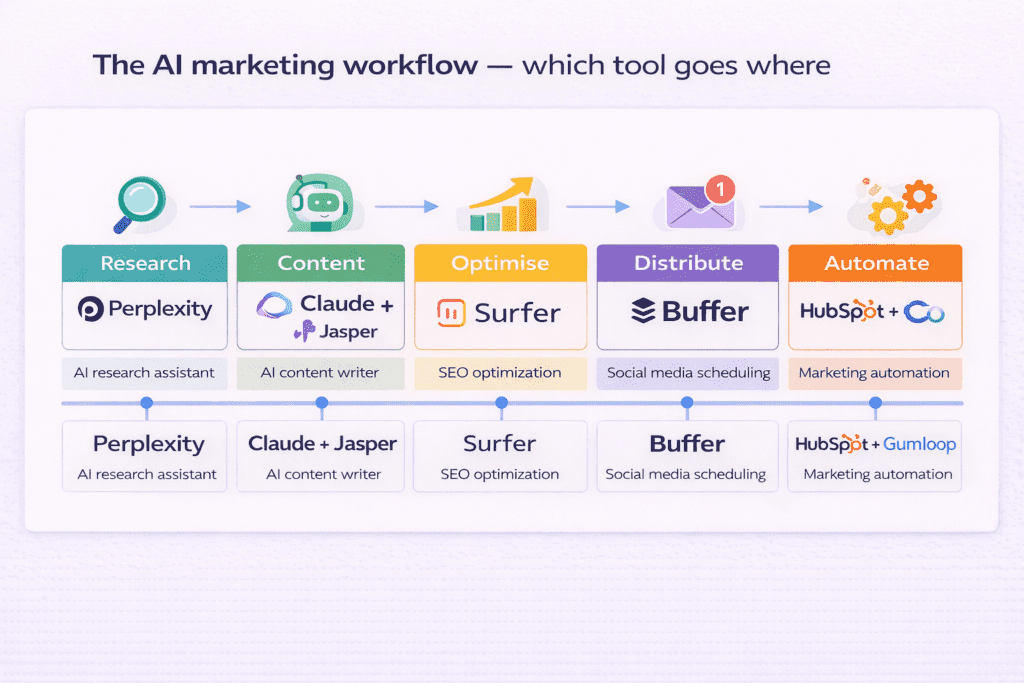
The 5-stage AI marketing workflow system
- Research — understanding market and audience – Start here
Before any content is created, current market intelligence is needed. What are competitors publishing? What questions is the target audience actually asking? What regulatory or industry changes affect the messaging? This stage requires real-time sourced information — not AI-generated guesses from training data.
Perplexity AI handles this stage for most businesses. It surfaces current information with clickable citations in under 5 minutes on queries that would take 30–45 minutes of manual search. For Indian businesses tracking GST updates, RBI guidelines, or sector-specific regulations, this current-sourcing capability is the difference between accurate and outdated marketing content.
- Perplexity AI
- Google Trends
- Semrush (research mode)
2. Content creation — drafts, captions, copy – Core stage
Content creation is where most businesses start their AI workflow — and where most get disappointing results because they use a general-purpose writing tool for a specific content type it was not optimised for. The tool matters less than the match between tool and content type.
Claude AI for marketers who need long-form content — blog posts, whitepapers, email sequences — where precision and context-following across 1,000+ words matter. ChatGPT for short-form variations, caption drafts, and brainstorming. Jasper for high-volume structured marketing content where templates reduce per-piece time for teams producing 20+ pieces per month.
- Claude AI
- ChatGPT
- Jasper
3. SEO optimisation — structure and discoverability – After drafting
SEO tools enter after the content exists — not before. Optimising for search before the content quality is right produces pages that rank poorly because they do not satisfy user intent, regardless of keyword placement. The sequence matters: content quality first, then SEO structure.
Surfer SEO analyses top-ranking content for a target keyword and provides specific recommendations for heading structure, word count, semantic term inclusion, and internal linking. Frase handles content briefs and FAQ generation based on People Also Ask data — useful for structuring content to answer the questions Google already knows users are asking.
- Surfer SEO
- Frase
- Hemingway App
4. Distribution — scheduling and social publishing – After content is ready
Distribution tools handle the mechanical work of getting content to the right platforms at the right times. For most Indian SMBs managing Instagram, LinkedIn, and WhatsApp Business simultaneously, manual scheduling across platforms is a significant time sink. Buffer and Later handle multi-platform scheduling with AI-suggested posting times based on audience engagement data.
The distribution stage is where AI saves the most time for the least cost — both tools have free tiers that cover basic multi-platform scheduling without requiring a paid subscription for businesses posting 10–15 times per week.
- BufferLater
- Business API
5. Automation — connecting the workflow – Advanced stage
Automation tools connect the stages above — triggering actions based on conditions, moving data between tools, and running multi-step workflows without manual intervention. This is where the workflow becomes a system rather than a series of manual tasks.
HubSpot AI features handle marketing automation for businesses with CRM requirements — lead scoring, email sequence triggering, and contact segmentation. Gumloop AI marketing automation is a newer workflow tool built for connecting AI actions — generating content, enriching data, sending to platforms — in automated sequences without requiring code. For Indian SMBs not ready for HubSpot’s pricing, Gumloop’s lower-cost entry point makes automation accessible at earlier stages of business growth.
- HubSpot
- AIGumloop
- Zapier
Perplexity→Claude / Jasper→Surfer SEO→Buffer→HubSpot / Gumloop
Research → Content → Optimise → Distribute → Automate. Each tool does one job well. No single tool does all five.
AI tools for small business marketing — India context
The AI tools small business marketing conversation in India has a specific challenge that global guides miss: pricing sensitivity. A $49/month Jasper subscription is not the same decision for a Jaipur startup as it is for a Mumbai agency. The tool stack for Indian SMBs needs to be built around what free tiers actually cover before adding paid subscriptions.
India SMB tool stack — free vs when to upgrade
| Perplexity free – Research queries with sources | ChatGPT free – Drafting, captions, variations | Buffer free – Up to 3 channels, 10 posts queued |
| Hemingway App free– Readability — no account needed | Canva free – Visual content, social graphics | Google Analytics free – Performance tracking |
| Upgrade Perplexity– When daily query limits hit on research-heavy projects | Upgrade ChatGPT – When context limits slow long-form work | Add HubSpot/Gumloop – When manual lead management takes 2+ hrs/day |
The most cost-effective AI marketing stack for an Indian small business producing consistent content is: Perplexity free + ChatGPT free + Canva free + Buffer free. This covers research, drafting, visuals, and scheduling at zero monthly cost. The total time saved on a typical content week — 10 posts, 2 blog articles, 4 emails — is approximately 8–10 hours. That time saving is the case for AI, not the features list.
→ Best Free AI Writing Tools 2026: tested and reviewed
→ AI for Social Media: 30 days of posts in 2 hours
AI marketing automation tools — HubSpot vs Gumloop
The question of which AI tool is best for email marketing automation depends almost entirely on business size and existing CRM infrastructure.
| HubSpot AI features marketing | Free CRM + paid AI features |
| Best for Businesses with established contact databases who need AI-assisted lead scoring, email sequence automation, and CRM-integrated content personalisation. HubSpot’s AI features sit inside an existing CRM — most powerful when the data already exists. | India consideration HubSpot’s free CRM is genuinely useful for Indian SMBs at early stages. The paid AI features become cost-justified when manual lead management is consuming more than 2 hours per day. |
| Gumloop AI workflow automation | Lower entry cost — workflow-first |
| Best for Businesses that want to automate multi-step AI workflows without building full CRM infrastructure first. Gumloop connects AI actions in sequences that previously required developer involvement. | India consideration For Indian startups not ready for HubSpot’s full pricing, Gumloop offers automation capability at an earlier stage of business growth. The use case is focused on content and outreach workflows. |
| Mailchimp AI automation | Free up to 500 contacts |
| Best for Email marketing automation for businesses with contact lists under 500 at zero cost. AI-suggested subject lines, send-time optimisation, and basic drip sequences included in free plan. | India consideration Most practical entry point for Indian SMBs starting email marketing. Free tier covers early-stage needs completely. Upgrade only when contact list or send volume requires it. |
AI content marketing tools 2026 — Claude vs Jasper
Claude AI for marketers produces content with stronger contextual accuracy, better instruction-following on complex briefs, and more distinctive output when given specific brand voice guidance. For businesses where content quality signals expertise — professional services, B2B, regulated industries — Claude’s output requires less editing and produces stronger E-E-A-T signals affecting both reader trust and search ranking.
Jasper’s advantage is template-driven volume. For businesses producing 30+ pieces of marketing content per month across multiple formats, Jasper’s structured templates reduce per-piece time significantly. The output is professional and readable. For high-volume content where consistency matters more than voice, that trade-off is acceptable.
HubSpot handles distribution and automation; Jasper handles content generation. They are not alternatives — businesses using both use Jasper to create content and HubSpot to distribute and track it.
→ Jasper AI Review 2026: is it worth it?
→ ChatGPT vs Claude vs Gemini: which wins for marketing?
SEO and optimisation tools — where they fit and where they do not
Surfer SEO analyses the top 10 results for a target keyword and tells the writer specifically what content needs to include — semantic terms, heading structure, word count, internal link count — to be competitive. This is not keyword stuffing advice. It is a structural brief built from what Google is already rewarding for that specific query.
Frase generates content briefs automatically from People Also Ask data and competitor analysis. For Indian businesses targeting specific regional search queries — “GST filing for small business Jaipur” or “legal contract format India” — Frase’s brief generation reduces research time for structuring SEO-ready content from 45 minutes to under 10.
Important note: Canva AI design tools sit at the distribution stage — not the SEO stage. Social graphics, presentation visuals, and marketing collateral are Canva’s domain. Conflating design tools with SEO tools is a common workflow mistake that leads to neither being used effectively.
What businesses get wrong with AI marketing tools
- Too many tools, no system
The most common pattern: a business subscribes to five AI tools because each sounds useful, uses none of them consistently, and concludes that “AI doesn’t work for us.” The problem is not the tools — it is the absence of a workflow that assigns each tool to a specific stage. Five tools used inconsistently produce worse results than two tools used systematically.
2. Using AI to replace strategy — not to execute it
AI content marketing tools accelerate execution. They do not generate strategy. A business that uses AI to produce more content without first knowing what content to produce, for whom, and why, produces more content that does not convert. The strategic decisions — audience, positioning, messaging — remain human work. AI handles the production after strategy is set.
3. Publishing AI output without editing — then blaming the tool
Unedited AI content has a consistent failure mode: it is structurally correct, professionally readable, and genuinely not useful to any specific audience. The business publishes it, gets no engagement, and decides AI tools do not work. The editing step — adding specific examples, brand voice, and real-world context — is not optional. It is what makes AI output actually work for a specific business.
The ROI from AI marketing tools comes from time saved on mechanical tasks, reinvested into strategic decisions only humans can make. Businesses that use AI to avoid thinking get worse results than before. Businesses that use AI to think less about execution and more about strategy see measurable growth.
FAQ
Q. Which AI tools are best for small business marketing in India?
Start with the free stack: Perplexity (research), ChatGPT (drafting), Canva (visuals), Buffer (scheduling). This covers research, content, and distribution at zero cost. Add Zoho AI or HubSpot when lead management exceeds 2 hours per day. Upgrade individual tools only when a specific free-tier limit actively slows your workflow.
Q. Are free AI tools enough for business growth?
For most Indian SMBs producing under 15 pieces of content per month — yes. The free stack covers research, drafting, visuals, and scheduling completely. Free tiers break down on high-volume, time-sensitive work. Upgrade based on a specific bottleneck you are consistently hitting, not on features you might use someday.
How should beginners start using AI tools for marketing?
Start with two tools only: ChatGPT free for content drafting and Canva free for visuals. Run these for 30 days on real work. Identify your specific bottleneck — is it research time, editing time, scheduling time? That specific answer tells you which third tool to add. Do not add tools before you know what problem they solve.
What is the best AI marketing workflow?
Research (Perplexity) → Content (Claude or ChatGPT) → SEO check (Surfer or Hemingway) → Visuals (Canva) → Schedule (Buffer) → Automate (Gumloop or HubSpot). Each tool does one job. The workflow is only as strong as the human strategy that defines what to research and what content to create.
References :
About the Author
Dr. Rekha Khandelwal is an academic content writer and AI prompt engineer specializing in research writing and AI-powered tools. She helps students and researchers simplify complex academic work through practical, technology-driven solutions.
Author Profile Dr. Rekha Khandelwal | Academic Writer, Legal Technical Writer, AI Expert & Author | AspirixWriters
Keep Learning
- AI in Digital Marketing: Trends Shaping Smarter Marketing
- AI for Small Businesses: Practical Tools & Growth Guide
- AI Chatbots Customer Support: 24/7 Help Guide
- AI in Sales Automation: Practical Guide & Trends
- AI in Market Research: 2026 Trends, Tools & Practical Insights
- AI in Email Marketing: Smarter Emails for Better Engagement in 2026

AI Chatbots Customer Support: 24/7 Help Guide for Small Businesses in India (2026)
AI Chatbots Customer Support The Customer Support Problem Every Small Business Knows It’s 9 PM…
AI for Small Businesses in India: Practical Tools, Costs & Growth Strategy (2026)
AI for Small Businesses in India: Artificial Intelligence My Complete Guide, Real Tools & Workflow…
AI in Digital Marketing: Trends and Tools (2026)
The India SMB Reality A Rajasthan startup founder shared her weekly content situation: three social…
AI in Email Marketing: Smarter Emails for Better Engagement in 2026
AI in Email Marketing Why email marketing still works in 2026 Social media is noisy….
AI in Market Research: 2026 Trends, Tools & Practical Insights
AI in Market Research The Research Gap That Costs Small Businesses More Than They Realise…
AI in Sales Automation: Practical Guide, Tools and Conversion Strategy for Small Businesses in India (2026)
AI in Sales Automation The Lead Problem Nobody Talks About Here’s a situation that most…
Best AI Tools for Business & Marketing: Complete Guide for Growth in 2026
Best AI Tools for Business & Marketing The real problem most businesses have with AI…