

From Concept to Submission: A Complete Guide to Research Paper and Thesis Writing
Module 1: Understanding the Structure of Research Papers and Theses
Why Research Paper Structure Is Your Foundation for Success
Here’s what successful academics won’t tell you: structure matters more than brilliance. I’ve seen excellent research rejected because it was poorly organized, and average research accepted because it was well-structured.
Whether you’re in sciences, social sciences, humanities, or law, understanding academic structure is your foundation. This guide teaches you:
- The IMRAD framework (Introduction, Methods, Results, Discussion)
- Complete thesis/dissertation organization
- How to structure each section effectively
- Common mistakes that get papers rejected
- Discipline-specific variations (including legal research)
Based on: Current academic standards (2024-2026), verified against Creswell & Creswell (2022), Booth et al. (2024), APA 7th edition (2020), and UGC thesis guidelines.
The Truth About Academic Structure
What Research Shows
Studies on academic publishing reveal:
- Structural clarity is the #2 acceptance factor (after research quality)
- Poor organization is the #3 rejection reason (Belcher, 2019)
- Well-structured papers receive 40% fewer revision requests (Sword, 2012)
In India, UGC thesis examiners report structural problems as the most common PhD dissertation weakness—more common than methodology or literature gaps.
The message: you cannot afford to ignore structure.
When Structure Actually Matters
During submission: Journal editors screen for structure before peer review. Papers with clear organization pass initial screening; poorly structured ones get desk-rejected.
During examination: Thesis examiners navigate your 200+ pages looking for specific sections. Good structure helps them find what they need. Poor structure frustrates them.
For publication: Well-structured work signals professional competence. Readers trust organized research more than disorganized work, even when content quality is similar.
The IMRAD Framework: Your Research Blueprint
What Is IMRAD?
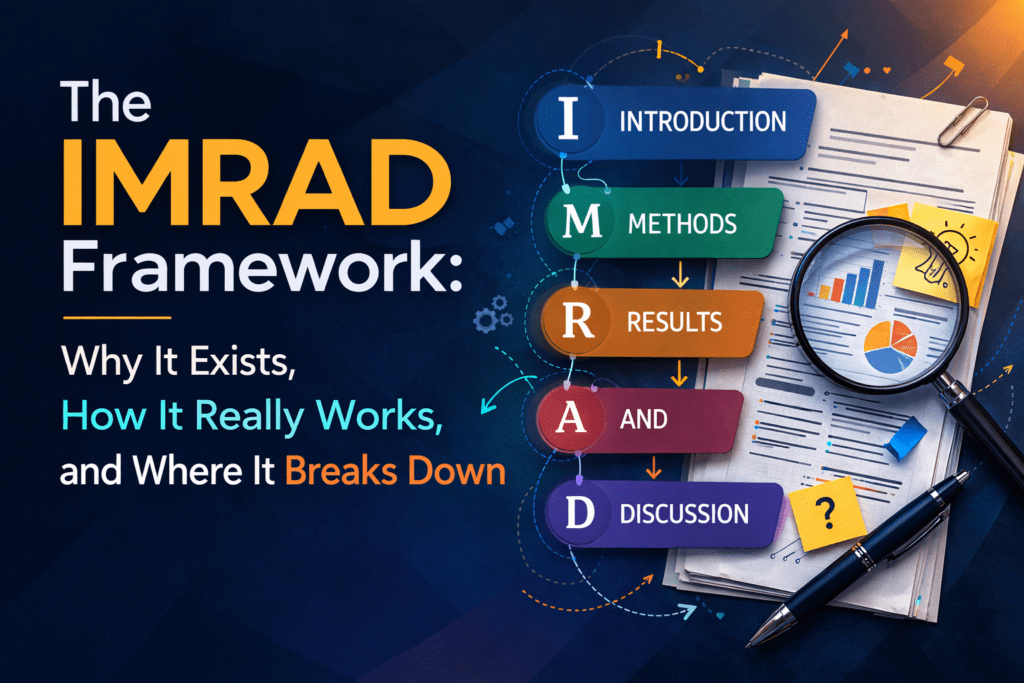
IMRAD = Introduction, Methods, Results, And Discussion
This format dominates scientific, medical, and social science publishing. It evolved because it mirrors the research process:
- Introduction: What problem are you solving?
- Methods: How did you investigate it?
- Results: What did you find?
- Discussion: What does it mean?
When to Use IMRAD
Use IMRAD for:
- Sciences (biology, chemistry, physics, engineering)
- Medicine and health sciences
- Psychology and education research
- Sociology and political science
- Economics and business research
- Quantitative or experimental studies in any field
Don’t use IMRAD for:
- Theoretical/philosophical papers (use essay format)
- Standalone literature reviews (use thematic organization)
- Humanities dissertations (use discipline-specific format)
- Legal doctrinal research (see law section below)
Writing a Powerful Introduction
Your introduction makes or breaks reader engagement. Examiners decide within the first page whether your research is worth their time.
The Funnel Structure: Broad to Specific
The Four-Part Formula:
1. Broad Context (1-2 paragraphs)
Start with the big picture problem.
Example from Education Research:
“Student retention in higher education remains a critical global challenge, with dropout rates exceeding 40% in many developing countries. As nations invest heavily in expanding university access, ensuring degree completion has become essential for both economic development and social equity.”
2. Narrow to Your Context (2-3 paragraphs)
Zoom into your geographic, temporal, or disciplinary focus.
“In India, the National Education Policy 2020 dramatically expanded higher education capacity, with enrollment reaching 41.4 million students in 2024-25. However, expansion hasn’t improved retention. Government colleges particularly struggle, with first-year dropout rates averaging 35%—nearly double that of private institutions (18%).”
3. Identify the Knowledge Gap (2-3 paragraphs)
What don’t we know? What’s missing?
“Existing research attributes dropouts to financial constraints and academic under-preparation. While important, these factors don’t fully explain retention differences between government and private colleges. Recent international studies suggest peer support networks significantly influence retention, but this remains understudied in the Indian context, particularly where students often lack traditional family support structures.”
4. State Your Research Contribution (1-2 paragraphs)
Clearly state what you’re investigating.
“This study examines how peer support networks influence first-year retention at three government colleges in Rajasthan. Through surveys (n=450) and interviews (n=30), we identify specific peer support mechanisms that predict retention and propose a low-cost intervention model for colleges.”
Introduction Essentials
Length guideline: 10-15% of total word count
Must include:
- Background and context
- Research problem/gap
- Research questions or hypotheses
- Study significance
- Brief methodology preview
Common mistakes:
- Starting too broad (“Since ancient times…”)
- Unclear research question
- No gap identification
- Jumping to results without context
Methods Section: Proving Your Research Is Valid
Your methods answer: “Can I trust this research?”
The golden rule: Another researcher should be able to replicate your study based on your methods description.
Essential Methods Components
For Quantitative/Experimental Research:
1. Research Design State clearly: experimental, quasi-experimental, correlational, survey?
Example:
“This study employed a quasi-experimental design with pre-test/post-test control groups. Three government colleges were randomly assigned to intervention (n=2) or control (n=1) conditions.”
2. Participants/Sample Who? How many? How selected? What characteristics?
Example:
“Participants were 450 first-year students (267 female, 183 male; mean age=18.3, SD=0.8) enrolled across three government colleges in Jaipur. Random sampling selected 150 students per college, stratified by discipline (40% Arts, 30% Science, 30% Commerce).”
3. Materials/Instruments What tools, surveys, tests, or equipment?
Example:
“Retention intentions were measured using the Retention Intention Scale (Kumar & Singh, 2023), a validated 15-item instrument (α=.89). Peer support was assessed via the Peer Network Strength Inventory (Johnson, 2021; adapted), a 20-item scale on 5-point Likert scales (α=.92).”
4. Procedures Step-by-step, what happened?
5. Data Analysis What statistical tests?
For Qualitative Research:
Must include:
- Research approach (phenomenology, grounded theory, ethnography?)
- Sampling strategy (purposive, snowball, theoretical?)
- Data collection procedures (interview protocols, observation methods)
- Analysis approach (coding process, theme development)
- Trustworthiness measures (member checking, triangulation)
Methods Writing Tips
Be specific: Wrong – “I interviewed students”
Right – “I conducted semi-structured interviews with 30 students lasting 45-60 minutes each”
Justify choices: “Interviews were chosen over surveys because they allow exploration of complex retention decisions that closed-ended questions cannot capture.”
Results: Presenting Your Findings
Critical rule: Results = facts without interpretation.
Save “what it means” for Discussion.
Presenting Results Effectively
Quantitative results order:
- Descriptive statistics (means, frequencies)
- Main findings (hypothesis tests)
- Additional analyses
Example:
“Retention rates differed significantly between intervention (82%) and control groups (71%), χ²(1, N=450)=8.92, p=.003. Among students receiving peer mentoring, retention intentions were significantly higher (M=4.2, SD=0.7) compared to controls (M=3.6, SD=0.9), t(448)=7.3, p<.001, d=0.74.”
Qualitative results structure: Present themes with supporting evidence.
“Three major themes emerged. First, ‘peer mentors as safety nets’—participants described mentors as critical supports during struggles. As one student explained: ‘When I was failing chemistry, my mentor spent hours helping me. Without her, I would have quit’ (P7, Science).”
Using Tables and Figures
Every visual needs:
- Clear, descriptive title
- All labels and units
- Legend if needed
- Referenced in text
- Numbered consecutively
Discussion: Interpreting What It All Means
Your discussion transforms data into knowledge.
Discussion Structure
1. Restate Main Findings (1 paragraph)
2. Interpret Findings (3-5 paragraphs) What do results mean? Why did you find this?
Example:
“The 11-percentage-point retention difference suggests peer mentoring addresses factors beyond financial or academic preparation. This aligns with Tinto’s (2012) integration theory, emphasizing social belonging in persistence decisions.”
3. Connect to Literature (2-4 paragraphs) How do findings relate to previous research?
4. Address Limitations (1-2 paragraphs) Be honest about weaknesses.
5. Explain Implications (2-3 paragraphs)
Practical implications:
“Colleges can implement peer mentoring at low cost. Our model required minimal resources—8 hours mentor training and bi-weekly coordination.”
Theoretical implications:
“Results extend retention theory by highlighting peer support mechanisms specific to Indian contexts where students attend college far from home.”
Policy implications:
“UGC should incentivize peer mentoring programs at government colleges through performance-based funding.”
6. Future Research (1 paragraph)
Complete Thesis Structure
Beyond IMRAD, theses require additional components:
Front Matter
- Title Page (name, title, degree, institution)
- Declaration (original work statement)
- Certificate (supervisor endorsement – India requirement)
- Acknowledgments
- Abstract (250-500 words)
- Table of Contents
- List of Tables (if >5)
- List of Figures (if >5)
- List of Abbreviations (if applicable)
Main Body
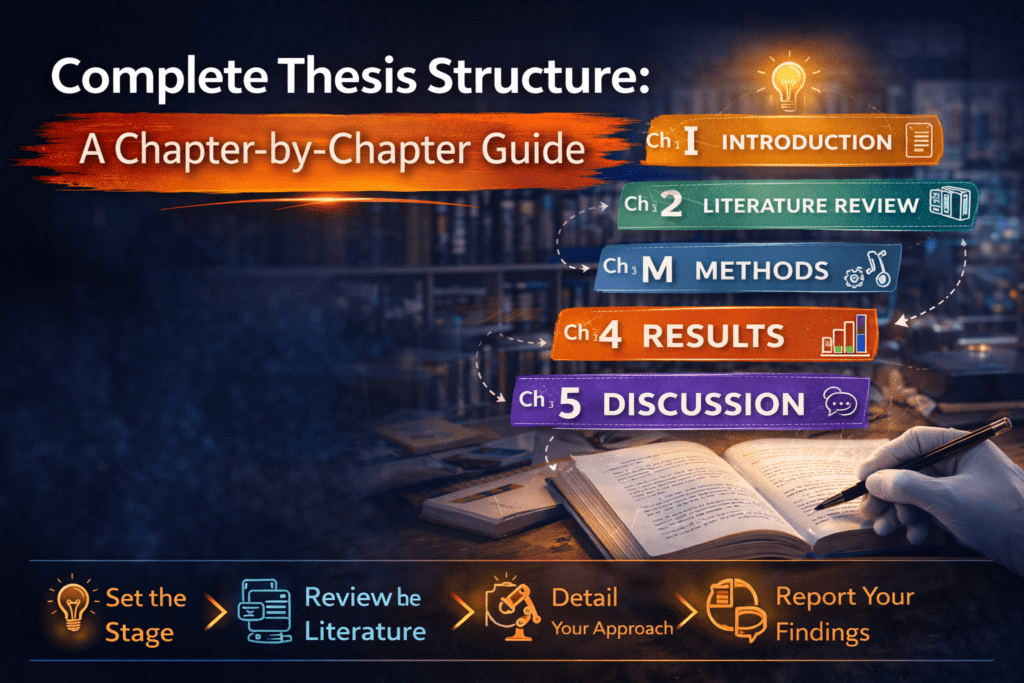
- Chapter 1: Introduction
- Chapter 2: Literature Review
- Chapter 3: Methodology
- Chapter 4: Results/Findings
- Chapter 5: Discussion
- Chapter 6: Conclusion
Back Matter
- References
- Appendices
- Publications from thesis (if any)
Abstract Writing Guide
Abstract Structure (250-350 words)
1. Background (1-2 sentences)
“Student retention challenges in Indian government colleges undermine equity goals.”
2. Problem/Gap (1-2 sentences)
“While research examines financial factors, peer support’s role remains understudied.”
3. Purpose (1 sentence)
“This study examined peer mentoring’s impact on first-year retention.”
4. Methods (2-3 sentences)
“A quasi-experimental design compared 300 intervention students with 150 controls across three Rajasthan colleges.”
5. Results (2-3 sentences)
“Intervention students showed significantly higher retention (82% vs. 71%, p=.003).”
6. Conclusions (1-2 sentences)
“Peer mentoring offers a scalable retention strategy for government colleges.”
Common Structural Mistakes
Mistake 1: Mixing Results and Discussion
Wrong– “Students showed higher retention (82%). This suggests peer support is important…”
Right- Separate them:
- Results: “Students showed 82% retention vs. 71%.”
- Discussion: “This difference suggests peer support plays a crucial role…”
Mistake 2: Vague Methods
Wrong- “I interviewed students.”
Right- “Semi-structured interviews (45-60 min) with 30 randomly selected students explored retention decisions using a validated protocol.”
Mistake 3: No Clear Gap in Introduction
Wrong- Describes context but never states what’s unknown
Right- Explicitly: “Despite extensive research on X, we know little about Y in Z context…”
Quick Reference Checklist
Before Submitting:
Introduction:
- [ ] Funnel structure (broad → specific)
- [ ] Clear research gap
- [ ] Explicit research question
- [ ] Significance explained
- [ ] ~10-15% of total length
Methods:
- [ ] Research design stated
- [ ] Sample fully described
- [ ] Instruments detailed
- [ ] Procedures step-by-step
- [ ] Analysis methods specified
- [ ] Replicable by another researcher
Results:
- [ ] Just facts, no interpretation
- [ ] Tables/figures properly labeled
- [ ] Statistical tests reported correctly
- [ ] Main findings clear
Discussion:
- [ ] Findings interpreted
- [ ] Connected to literature
- [ ] Limitations acknowledged
- [ ] Implications explained
- [ ] Future research suggested
Overall:
- [ ] Consistent formatting
- [ ] All citations in reference list
- [ ] Logical heading hierarchy
- [ ] Page numbers included
🔱 FOR LAW STUDENTS: Legal Research Paper Structure
Legal research differs significantly from other disciplines. While the principles above apply broadly, legal scholarship has unique structural conventions.
Why Legal Research Structure Differs
Primary sources are different: Your “data” consists of cases, statutes, and constitutional provisions—not experiments or surveys.
Methodology is different: Doctrinal analysis, statutory interpretation, and comparative legal methods don’t fit IMRAD.
Writing conventions differ: Legal writing follows judicial reasoning patterns, uses specific citation formats (Bluebook), and emphasizes legal argumentation.
Audience expectations differ: Law journals, thesis examiners, and legal practitioners expect structure that reflects legal reasoning.
Structure for Doctrinal Legal Research Papers
Standard Doctrinal Paper Structure:
1. Introduction (10-15%)
- Legal problem statement
- Importance and contemporary relevance
- Scope of research (jurisdictions, time period, types of law)
- Research questions
- Significance to legal doctrine or practice
Example Opening:
“The right to privacy under Article 21 of the Indian Constitution has evolved significantly since the Puttaswamy judgment (2017). However, judicial interpretation of privacy protections in the context of AI-powered surveillance remains underdeveloped, creating uncertainty for law enforcement agencies and civil liberties advocates alike. This paper examines Supreme Court privacy jurisprudence from 2017-2025 to identify doctrinal principles that can guide AI surveillance regulation.”
2. Doctrinal Framework (15-20%)
- Relevant constitutional provisions
- Statutory framework
- Existing legal principles
- Theoretical foundations
3. Case Law Analysis (30-40%)
- Chronological or thematic organization
- Analysis of landmark judgments
- Identification of legal principles
- Evolution of judicial reasoning
- Conflicts or inconsistencies in jurisprudence
Structure for case analysis:
- Facts (briefly)
- Legal issues
- Court’s reasoning
- Principle established
- Significance
4. Critical Analysis (20-25%)
- Strengths and weaknesses of current doctrine
- Internal contradictions
- Comparative perspectives (if relevant)
- Impact on practice
- Theoretical critiques
5. Conclusions and Recommendations (10-15%)
- Summary of doctrinal principles identified
- Proposed framework or interpretation
- Implications for future cases
- Legislative or policy recommendations (if appropriate)
Structure for Empirical Socio-Legal Research
When conducting empirical research about law (surveys, interviews, court observations), use modified IMRAD:
Empirical Legal Paper Structure:
1. Introduction
- Legal context and problem
- Why empirical research is needed
- Research questions
- Legal and social significance
2. Literature Review
- Legal scholarship on the issue
- Socio-legal research
- Relevant social science theory
3. Legal Framework Brief section on relevant law (so readers understand legal context)
4. Research Methodology
- Research design (survey, interviews, case study, etc.)
- Sample and selection criteria
- Data collection procedures
- Data analysis methods
- Ethical considerations (IRB approval, informed consent)
5. Findings/Results
- Present empirical data
- Statistical results or qualitative themes
- NO legal interpretation yet
6. Legal Analysis and Discussion
- Interpret findings in light of legal doctrine
- Implications for legal theory
- Impact on legal practice
- Connections to case law or statutory interpretation
- Law reform recommendations
7. Conclusion
Structure for Comparative Legal Research
1. Introduction
- Legal problem
- Jurisdictions being compared
- Why comparison is valuable
2. Methodology
- Selection criteria for jurisdictions
- Sources analyzed
- Analytical framework
3. Jurisdiction 1 Analysis
- Legal framework
- Relevant cases/statutes
- How the issue is addressed
4. Jurisdiction 2 Analysis (Same structure)
5. Comparative Analysis
- Similarities and differences
- Reasons for divergence
- Best practices identified
6. Implications for [Your Focus Jurisdiction]
- What can be learned
- Recommendations for adoption or reform
7. Conclusion
Legal Thesis Structure (PhD/LLM)
Indian Law University Requirements:
Most Indian law universities follow this structure:
Chapter 1: Introduction (15-20 pages)
- Background and context
- Statement of problem
- Research questions
- Objectives
- Hypothesis (if applicable)
- Significance
- Scope and limitations
- Research methodology
- Chapterization (overview of chapters)
Chapter 2: Research Methodology (10-15 pages)
- Doctrinal method explained
- Sources of data (primary: cases, statutes; secondary: books, articles)
- Analytical framework
- Comparative method (if used)
- Empirical methods (if used)
Chapter 3: Historical/Conceptual Framework (20-30 pages)
- Historical development of the legal issue
- Conceptual foundations
- Theoretical framework
Chapter 4-6: Substantive Analysis Chapters (30-40 pages each) Each chapter covers a specific aspect:
- Case law analysis
- Statutory interpretation
- Comparative analysis
- Empirical findings (if applicable)
Final Chapter: Conclusions and Recommendations (15-20 pages)
- Summary of findings
- Doctrinal contributions
- Legislative recommendations
- Judicial implications
- Future research directions
Legal Citation and Formatting
Bluebook Citation (International)
Legal research typically uses Bluebook citation style:
Case citation:
Puttaswamy v. Union of India, (2017) 10 SCC 1.
Statute citation:
Indian Penal Code, 1860, § 302.
Article citation:
Gautam Bhatia, The Transformative Constitution, 42 Delhi L. Rev. 1, 15 (2019).
Indian Legal Citation
Indian legal writing also follows specific conventions:
Supreme Court cases:
K.S. Puttaswamy v. Union of India, (2017) 10 SCC 1.
High Court cases:
State of Maharashtra v. Arun Gupta, AIR 2004 Bom 165.
Journal articles:
Upendra Baxi, “The Rule of Law in India” (1982) 27(1) Journal of the Indian Law Institute 117.
Indian Law Journals: Formatting Requirements
Leading Indian Law Journals:
1. Journal of the Indian Law Institute (JILI)
- Footnote citations (not in-text)
- Detailed case citations with neutral citation where available
- 8,000-12,000 words for articles
2. NLSIU Law Review (Bangalore)
- OSCOLA citation style
- Double-blind peer review
- Abstract (150-200 words)
3. NUJS Law Review
- Bluebook 21st edition
- Author biography footnote
- Abstract required
4. Delhi Law Review
- Oxford Standard for Citation of Legal Authorities (OSCOLA)
- Footnote citations
Common Mistakes in Legal Research Structure
Mistake 1: Using IMRAD for Doctrinal Research
Wrong – Don’t force doctrinal legal research into Introduction-Methods-Results-Discussion format
Right – Use legal structure: Introduction-Framework-Analysis-Conclusion
Mistake 2: Insufficient Legal Framework
Wrong – Jumping to case analysis without establishing relevant law
Right – First establish: What’s the constitutional/statutory framework? Then analyze how courts apply it.
Mistake 3: Case Summary Without Analysis
Wrong – Simply describing what courts decided
Right – Analyze: What principle did the court establish? Why? What are implications?
Mistake 4: No Clear Thesis/Argument
Wrong – Presenting information without a clear legal argument
Right – Develop a thesis: What’s your doctrinal contribution? What principle are you arguing for?
Legal Research in Indian Context
UGC Requirements for Law PhD
Research methodology must include:
- Doctrinal analysis methodology
- If empirical: clear empirical design
- If comparative: jurisdictions and selection criteria
- Ethical clearance (if human subjects involved)
Thesis examination criteria:
- Original contribution to legal knowledge
- Sound legal methodology
- Comprehensive analysis of relevant law
- Proper legal citation
- Recommendations for law reform (encouraged)
Bar Council of India Guidelines
For LLM dissertations:
- Minimum 15,000 words
- Proper citation format
- Supervisor certificate
- Anti-plagiarism declaration
Resources for Law Students
Legal Research Databases (India):
Primary sources:
- Manupatra (comprehensive case law and statutes)
- SCC Online (Supreme Court Cases)
- Indian Kanoon (free access to cases)
Secondary sources:
- HeinOnline (law journals, historical documents)
- JSTOR (academic articles)
- Westlaw India
Indian Law Journals to Target:
High-impact journals:
- Journal of the Indian Law Institute
- NLSIU Law Review
- NUJS Law Review
- Delhi Law Review
- Indian Journal of Constitutional Law
International journals accepting Indian law research:
- Asian Journal of Comparative Law
- International Journal of Constitutional Law
- Commonwealth Law Bulletin
Example: Constitutional Law Research Paper Structure
Title: “Privacy Rights Under Article 21: Developing a Doctrinal Framework for AI Surveillance”
I. Introduction (2,000 words)
- Privacy as evolving fundamental right
- AI surveillance challenges to privacy
- Gap in current jurisprudence
- Research questions
- Significance
II. Constitutional Framework (2,500 words)
- Article 21 interpretation history
- Puttaswamy judgment analysis
- Privacy as fundamental right: scope and limits
- State’s legitimate interests in surveillance
III. Judicial Interpretation of Privacy in Technology Contexts (4,000 words)
- Pre-Puttaswamy cases
- Post-Puttaswamy developments
- Technology-specific privacy cases
- Comparative analysis: US 4th Amendment, ECHR Article 8
IV. AI Surveillance: Doctrinal Gaps and Challenges (3,500 words)
- Nature of AI surveillance (capabilities, risks)
- Existing doctrine’s inadequacies
- Specific doctrinal questions unanswered
- Need for new framework
V. Proposed Doctrinal Framework (3,000 words)
- Interpretive principles for AI surveillance
- Balancing test modifications
- Procedural safeguards
- Judicial review standards
VI. Conclusion and Recommendations (1,500 words)
- Summary of proposed framework
- Implications for future cases
- Legislative recommendations
- Areas for future research
Total: ~16,500 words
Key Takeaways for Law Students
- Legal research structure differs from other disciplines—don’t force IMRAD
- Doctrinal research follows: Introduction → Framework → Analysis → Conclusion
- Empirical legal research uses modified IMRAD with legal analysis section
- Case analysis requires identifying principles, not just summarizing facts
- Legal citation follows Bluebook or OSCOLA, not APA/MLA
- Indian law journals have specific formatting requirements—check guidelines
- UGC thesis requirements include methodology chapter and original contribution
Conclusion
Research paper structure provides your foundation for academic success. Whether using IMRAD for empirical research or legal-specific structures for doctrinal work, understanding and applying proper organization separates accepted work from rejected work.
For most disciplines: Follow IMRAD framework religiously.
For law students: Use legal research structures that reflect doctrinal methodology and judicial reasoning patterns.
For everyone: Clear structure demonstrates professional competence and makes your work accessible to readers.
Master structure first. Everything else builds on this foundation.
References
- Booth, W. C., Colomb, G. G., Williams, J. M., Bizup, J., & FitzGerald, W. T. (2024). The Craft of Research (5th ed.). University of Chicago Press.
- Creswell, J. W., & Creswell, J. D. (2022). Research Design: Qualitative, Quantitative, and Mixed Methods Approaches (6th ed.). Sage Publications.Research Design (6th ed.) by John W. Creswell (ebook)
- American Psychological Association. (2020). Publication Manual (7th ed.).
- Swales, J. M., & Feak, C. B. (2012). Academic Writing for Graduate Students (3rd ed.). University of Michigan Press.
Part of: Complete Research Writing Guide Series (10 Modules)
From Concept to Submission: A Complete Guide to Research Paper and Thesis Writing
Module 1: Understanding the Structure of Research Papers and Theses
All 7 Cluster Posts
- The IMRAD Framework: Why It Exists, How It Really Works, And Where It Breaks Down
- How to Write a Research Introduction That Reviewers Cannot Ignore
- How to Write a Methods Section That Reviewers Will Trust
- The Results Section: How to Present Findings Without Letting Interpretation Slip In
- The Discussion Section: How to Turn Findings Into Knowledge
- Complete Thesis Structure: A Chapter-by-Chapter Guide
- 10 Structural Mistakes That Get Research Papers Rejected — And How to Fix Every One
Next in Series:
- The Academic Writing Process: From First Draft to Submission
- Research Methodologies: Quantitative, Qualitative & Mixed Methods
- For Law Students: Comprehensive Legal Research Methodology Guide

The Complete Guide to Research Paper Structure: IMRAD Format, Thesis Organization & Academic Writing (2026)
From Concept to Submission: A Complete Guide to Research Paper and Thesis Writing Module 1:…
The IMRAD Framework: Why It Exists, How It Really Works, and Where It Breaks Down
Cluster Post 1 | Module 1: Understanding the Structure of Research Papers and Theses From…

How to Write a Research Introduction That Reviewers Cannot Ignore
Cluster Post 2 | Module 1: Understanding the Structure of Research Papers and Theses From…

How to Write a Methods Section That Reviewers Will Trust
Cluster Post 3 | Module 1: Understanding the Structure of Research Papers and Theses From…

The Results Section: How to Present Findings Without Letting Interpretation Slip In
Cluster Post 4 | Module 1: Understanding the Structure of Research Papers and Theses From…

The Discussion Section: How to Turn Findings Into Knowledge
Cluster Post 5 | Module 1: Understanding the Structure of Research Papers and Theses From…
Complete Thesis Structure: A Chapter-by-Chapter Guide
Cluster Post 6 | Module 1: Understanding the Structure of Research Papers and Theses From…

10 Structural Mistakes That Get Research Papers Rejected — And How to Fix Every One
Cluster Post 7 | Module 1: Understanding the Structure of Research Papers and Theses From…

The Academic Writing Process: Complete Guide from First Draft to Submission (2026)
From Concept to Submission: A Complete Guide to Research Paper and Thesis Writing Module 2,…

Academic Writing Mastery: The Complete 2026 Guide to Research Papers & Thesis Writing
Academic Writing Mastery Your research deserves to be read. This complete guide transforms your ideas…

Research Methodologies: Complete Guide to Quantitative, Qualitative, Mixed Methods & Legal Research (2026)
Why Methodology Determines Research Quality Here’s what thesis examiners focus on first: your methodology section…