
Cluster Post 1 | Module 2: The Academic Writing Process
From Concept to Submission Series | 2026
← Back to Module 2 The Academic Writing Process: Complete Guide from First Draft to Submission (2026)
How to Start Writing — and Keep Going
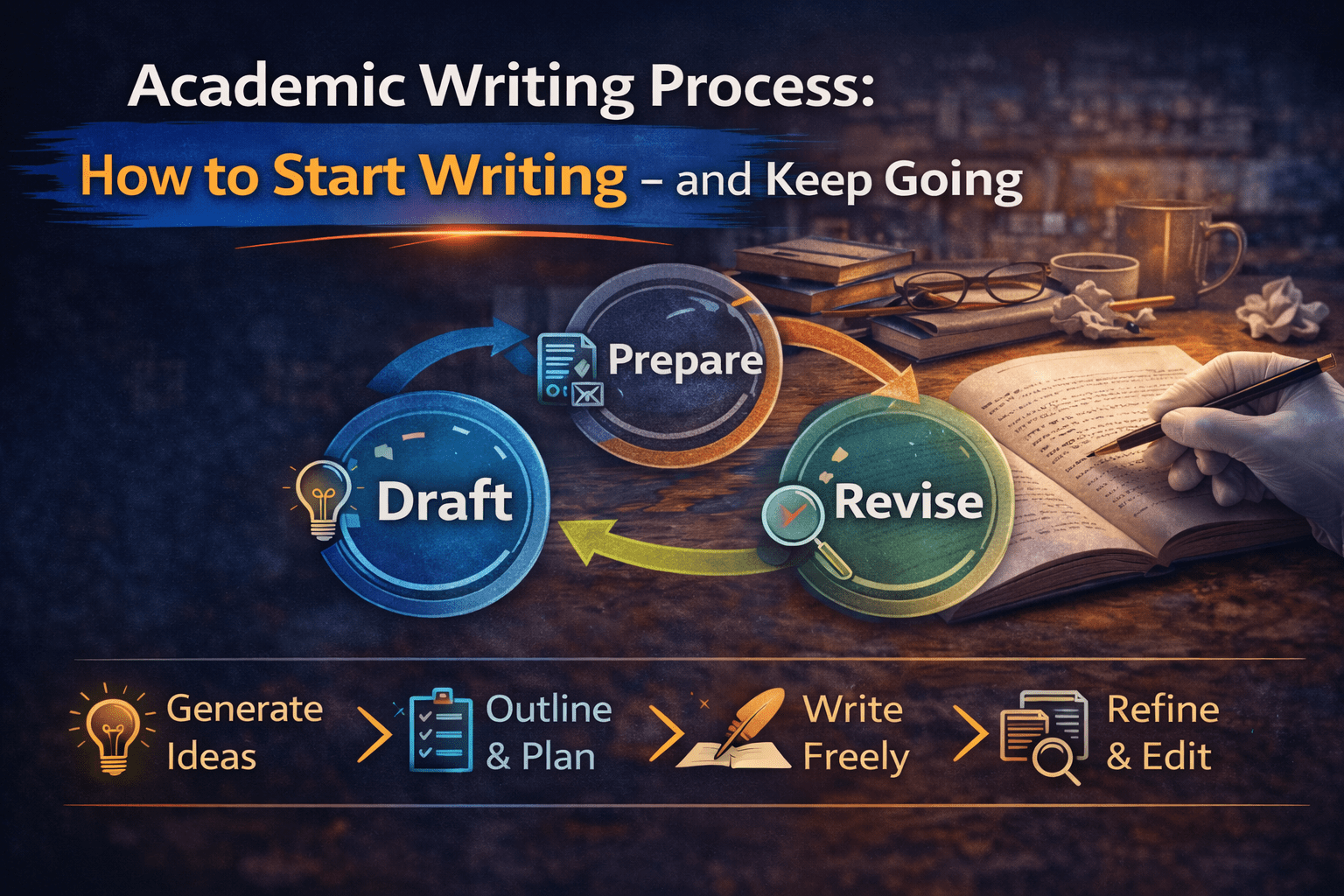
The Module 2 overview introduced the 12-week plan and daily quota system. This post goes deeper: why the order you write in matters more than most researchers realise, how to use freewriting as a genuine productivity tool rather than a warm-up exercise, the four-stage revision sequence that separates good writing from great writing, and how to build a writing routine that survives a busy academic life.
The Biggest Mistake: Writing in Order
Most researchers sit down to write and begin at the beginning — the introduction. This feels logical. The introduction comes first in the paper, so write it first. In practice, it is one of the least effective ways to start.
The introduction is the hardest section to write because it requires you to already know your whole argument before you can frame it persuasively. It needs to promise what the paper delivers. But when you are starting a draft, you do not yet know exactly what you will deliver. You think you do — but writing reveals things about your own thinking that reading and planning do not.
Professional researchers rarely write in order. They start with what they know best and work outward. The method section is almost always the easiest place to begin — you know exactly what you did, so writing it is closer to transcription than composition. Once the method is on the page, move to results (you are presenting facts you already have), then discussion, then introduction, then abstract last of all.
Writing the abstract last is not a quirk — it is the only logical approach. An abstract summarises a complete argument. You cannot summarise something that does not yet exist. Write it after every other section is in a state you are broadly happy with, and you will find it takes thirty minutes rather than three hours.
The 12-Week Plan: What Each Stage Is Actually For
The module overview gives you the 12-week timeline. This section explains the purpose behind each stage — which is what allows you to adapt the plan intelligently when life does not cooperate with your schedule.
Weeks 1–4: Getting the argument out of your head and onto the page
The goal of the first four weeks is not good writing. It is complete writing. A complete messy draft is infinitely more useful than a perfect half-draft, because you can revise what exists and you cannot revise a blank page.
Many researchers stall in the first four weeks because they try to produce polished prose from the start. Every sentence gets written, judged as inadequate, deleted, and rewritten. This is the single most common cause of the writing paralysis that turns a twelve-week project into a year-long one.
The discipline of the first four weeks is to keep moving forward. Leave notes to yourself — [transition needed here], [find stronger example], [check this statistic] — and continue. You are building a scaffold, not a finished structure. The scaffold does not need to be beautiful. It needs to stand.
Weeks 5–8: Making the argument actually work
This is where the real intellectual work happens, and most researchers underestimate how long it takes. Weeks 5–8 are not about polishing prose — they are about testing whether your argument actually holds.
Read your draft as a sceptical reviewer would. Does each section support the central claim? Is the evidence sufficient? Are there gaps in logic — places where you jump from one idea to another without establishing the connection? Are there sections where you are repeating yourself across two paragraphs that should be one?
This stage often involves cutting substantial material. Cutting is not failure — it is precision. A 6,000-word argument that holds together is more publishable than an 8,000-word argument with two weak sections padded out to meet a word count.
Weeks 9–11: The prose, not the argument
Only once the argument is solid do you focus on sentence-level writing. Cleaning up prose in weeks 2 and 3 — before the argument is stable — is wasted effort, because sections you improve at sentence level may be cut or restructured later.
In this stage: shorten sentences that have grown unwieldy, replace vague verbs with precise ones, check that every paragraph has a clear opening sentence that signals what it will do, and read sections aloud. Prose that is difficult to read aloud is usually prose that needs revision.
Week 12: Final checks and submission
The final week is not for major revisions. If you are still restructuring arguments in week 12, the earlier stages were not completed properly. Week 12 is for format checks, citation verification, proofreading, and writing the cover letter if the venue requires one.
The Daily Quota: Why 300 Words Works
The module overview introduces the 300-word daily quota. This section explains the psychology behind it — which is what makes the difference between using it as a rule and using it as a tool.
The reason 300 words is the right number is not arbitrary. It is achievable on any day, including busy ones. A researcher who writes 300 words every day produces 9,000 words in a month — a substantial journal article or two thesis chapters. A researcher who waits for large uninterrupted blocks of time and writes 3,000 words when they get them, but gets those blocks only twice a month, produces 6,000 words. The daily writer produces more, with less stress, and with better continuity of thought.
Continuity of thought is the underrated benefit. When you write every day, your research stays alive in your working memory. You think about it while walking, showering, cooking. Ideas connect. When you return to the page the next morning, you know what comes next. When you write only occasionally, you spend the first forty minutes of every session reconstructing where you were — which means large blocks are less productive than they appear.
Setting up your writing routine
The time you write matters less than the consistency. Some researchers write best at 6am before anything else intrudes. Others write better late at night. What kills writing routines is not choosing the wrong time — it is treating writing sessions as optional, to be done when everything else is finished. Everything else is never finished.
Protect your writing time the way you would protect a meeting with your supervisor. Do not schedule anything else in that slot. Do not check email first. Sit down, open the document, and start. The first five minutes are almost always the hardest. After five minutes, momentum usually takes over.
Track your daily word counts in a simple spreadsheet or even a notebook. Not to judge yourself on bad days, but to show yourself that progress is accumulating even when individual sessions feel unproductive. Seeing thirty days of entries, even if some are only 150 words, is more motivating than any writing advice.
Freewriting: Using It Properly, Not Just as a Warm-Up
Most researchers have heard of freewriting — write continuously for a set time without stopping to edit. Many have tried it once, found that the output was unusable, and concluded it does not work for academic writing. This conclusion is wrong, but it comes from a misunderstanding of what freewriting is for.
Freewriting is not a drafting method. It is a thinking method. Its purpose is to get ideas out of your head and onto the page so you can see them clearly enough to evaluate them. The output of a freewrite is almost never usable directly. But it almost always contains something useful — a sentence, a connection, a formulation you had not found before — that becomes your starting point for real drafting.
The 15-minute freewrite: how to do it effectively
Set a timer for 15 minutes. Write continuously about your research topic without stopping, without editing, without deleting. If you run out of things to say, write “I am not sure what to say next because” and finish the sentence. That completion almost always unlocks the next thought.
When the timer stops, spend 5 minutes reading what you wrote. Highlight anything that is worth keeping — a phrase, a sentence, an idea expressed more clearly than you managed in your main draft. Copy those highlights into your working document. The rest can be discarded.
Done twice a week, this practice consistently produces usable material. Done every day before your main writing session, it warms up your thinking and reduces the time spent staring at a blank page before words start coming.
Freewriting to break through specific blocks
When you are stuck on a specific section — you know what it needs to say but cannot find the right way to say it — write a freewrite addressed to the problem directly. “The reason I am stuck on this transition is…” or “What I am trying to argue in this paragraph is…” This externalises the difficulty and almost always produces a solution within a few minutes.
The block usually comes from trying to write and evaluate simultaneously — generating a sentence, immediately judging it as not quite right, deleting it, starting again. Freewriting breaks this cycle by removing evaluation from the equation temporarily. First generate. Then evaluate. Never both at once.
The Four-Stage Revision Sequence
The module overview mentions revision. This section gives you the specific sequence that makes revision efficient rather than exhausting — because without a sequence, revision becomes a kind of anxious re-reading that changes small things without addressing the real problems.
| Revision stage | What you are asking |
| Stage 1 — Argument | Is my central claim clear throughout? Does each section support it? Is anything in the wrong place? |
| Stage 2 — Paragraph | Does each paragraph have one clear main idea? Do all sentences in it relate to that idea? Does it connect logically to what comes before and after? |
| Stage 3 — Sentence | Are sentences clear? Are they as concise as they can be without losing precision? Does the prose read smoothly aloud? |
| Stage 4 — Proofreading | Grammar, spelling, punctuation, citation formatting, page numbers, heading consistency. |
The sequence matters because each stage depends on the previous one. If you proofread before you have stabilised your argument, you will spend time perfecting sentences that will later be cut. If you work on sentence clarity before paragraphs are coherent, you polish individual trees while the forest has no shape. Always move from large to small.
Take a break between stages — at least a day, ideally several days. You need distance from your own writing to see it clearly. When you are too close to a draft, you read what you intended to write rather than what is actually there. Time away resets this. Reading a printed copy rather than a screen version also helps — your eye catches different things.
Getting Feedback That Actually Improves Your Work
The module overview says to get feedback early and often. This section explains how to make feedback useful, because feedback given without guidance is often vague, and vague feedback is nearly impossible to act on.
Ask specific questions
“Is this any good?” produces answers like “yes, it’s interesting” or “it’s a bit unclear in places” — neither of which tells you what to do. Specific questions produce actionable answers.
- Does my argument in the introduction come through clearly — can you state it back to me in one sentence?
- Is the transition between sections 3 and 4 logical, or does it feel like a jump?
- Is the methods section detailed enough that you could evaluate whether the design fits the research question?
- Are there places where I am being vague when I should be specific?
Ask one or two specific questions per reader, not ten. Readers who feel they are being examined give less useful feedback than readers who feel they are being consulted.
Look for patterns, not individual opinions
One reader’s confusion might be their specific background. Three readers’ confusion about the same section is evidence that the section is confusing. Prioritise feedback that multiple readers agree on. And when readers disagree — one says your introduction is too long, another says it is just right — make your own judgment based on the purpose of the section, not a majority vote.
Receive feedback without defending
When someone says they are confused by something you wrote, the response “but what I meant was…” is not useful. What you meant and what you wrote are different things, and the reader can only respond to what you wrote. Listen, take notes, thank the reader. Evaluate their feedback later, when you are alone with the draft. Some suggestions you will follow; others you will not. But you cannot make that judgment in the moment while you are feeling defensive.
For Law Students
The writing process principles above apply directly to legal research writing, but three aspects of legal writing create specific challenges that are worth addressing directly.
The drafting order in legal writing
For doctrinal legal research, the equivalent of starting with the methods section is starting with your case analysis. You already know the cases — you have read them, taken notes, identified the principles. Writing the case analysis first gets substantive content on the page and clarifies what your doctrinal argument actually is, which then allows you to write the introduction more precisely.
Many law students write their introduction first and then find that their analysis does not quite support what the introduction promised. Writing analysis first and introduction second avoids this problem entirely. The introduction becomes a precise account of what the analysis actually shows, rather than a speculative account of what you hope it will show.
Freewriting for legal argument development
Freewriting is particularly useful in legal research for developing your doctrinal argument — the specific claim about what the law means or should mean. Many law students know the cases well but struggle to articulate the doctrinal thread connecting them into an argument.
Try this: set a timer for 15 minutes and write freely in response to the question “What am I actually arguing about this area of law?” Do not cite cases. Do not worry about precision. Just write what you think the law is doing, where it falls short, and what would be better. The resulting freewrite will often contain the core of your doctrinal argument in plain language — which you can then translate back into legal terms and support with cases.
Feedback for legal writing: who to ask
For legal research, the most useful feedback comes from two types of readers: a legal specialist who can evaluate whether your doctrinal analysis is accurate and your argument is legally coherent, and a non-specialist who can tell you whether your legal reasoning is explained clearly enough for a reader who does not already know the area. If only a specialist can understand your argument, your writing is not yet doing its job.
For Indian law students writing in English as a second or additional language: feedback on language clarity is separate from feedback on legal reasoning. Ask for both, from different readers if possible. A language tutor or writing centre consultant can improve your prose without needing to understand Article 21 jurisprudence.
References
- Belcher, W. L. (2019). Writing Your Journal Article in Twelve Weeks (2nd ed.). University of Chicago Press.Writing Your Journal Article in Twelve Weeks, Second Edition: A Guide to Academic Publishing Success, Belcher
- Silvia, P. J. (2019). How to Write a Lot: A Practical Guide to Productive Academic Writing (2nd ed.). APA.
- Sword, H. (2012). Stylish Academic Writing. Harvard University Press.
- Murray, R. (2011). How to Write a Thesis (3rd ed.). Open University Press.
- Booth, W. C., Colomb, G. G., Williams, J. M., Bizup, J., & FitzGerald, W. T. (2024). The Craft of Research (5th ed.). University of Chicago Press.
Next: Cluster Post 2 — How to Write Clear, Engaging Academic Prose

The Complete Guide to Research Paper Structure: IMRAD Format, Thesis Organization & Academic Writing (2026)
From Concept to Submission: A Complete Guide to Research Paper and Thesis Writing Module 1:…
The IMRAD Framework: Why It Exists, How It Really Works, and Where It Breaks Down
Cluster Post 1 | Module 1: Understanding the Structure of Research Papers and Theses From…

How to Write a Research Introduction That Reviewers Cannot Ignore
Cluster Post 2 | Module 1: Understanding the Structure of Research Papers and Theses From…

How to Write a Methods Section That Reviewers Will Trust
Cluster Post 3 | Module 1: Understanding the Structure of Research Papers and Theses From…

The Results Section: How to Present Findings Without Letting Interpretation Slip In
Cluster Post 4 | Module 1: Understanding the Structure of Research Papers and Theses From…

The Discussion Section: How to Turn Findings Into Knowledge
Cluster Post 5 | Module 1: Understanding the Structure of Research Papers and Theses From…
Complete Thesis Structure: A Chapter-by-Chapter Guide
Cluster Post 6 | Module 1: Understanding the Structure of Research Papers and Theses From…

10 Structural Mistakes That Get Research Papers Rejected — And How to Fix Every One
Cluster Post 7 | Module 1: Understanding the Structure of Research Papers and Theses From…
The Academic Writing Process: Complete Guide from First Draft to Submission (2026)
From Concept to Submission: A Complete Guide to Research Paper and Thesis Writing Module 2,…

Academic Writing Mastery: The Complete 2026 Guide to Research Papers & Thesis Writing
Academic Writing Mastery Your research deserves to be read. This complete guide transforms your ideas…

Research Methodologies: Complete Guide to Quantitative, Qualitative, Mixed Methods & Legal Research (2026)
Why Methodology Determines Research Quality Here’s what thesis examiners focus on first: your methodology section…