
Cluster Post 2 | Module 2: The Academic Writing Process
From Concept to Submission Series | 2026
How to Write Clear, Engaging Academic Prose
The module overview introduced the principles of engaging academic writing. This post goes deeper: exactly how to build paragraphs that work, how sentence length and voice affect readability, a complete list of wordiness patterns to cut, and how to write an opening sentence that makes readers want to continue. Every principle comes with before-and-after examples drawn from the kind of writing that actually appears in theses and journal submissions.
The Myth That Academic Writing Must Be Dull
There is a widespread belief among early-career researchers that academic writing should be dense, impersonal, and difficult — that complexity signals rigour and clarity signals superficiality. This belief produces some of the worst academic writing in existence, and it is wrong.
Research on what makes academic papers influential consistently finds that clarity is an asset, not a liability. Papers that are easier to read get cited more. Arguments that are expressed precisely and accessibly persuade more effectively than arguments buried in nominalisations and passive constructions. The researchers whose work has shaped their fields — from Darwin to Tversky to Amartya Sen — wrote with clarity and directness.
You are not being asked to simplify your ideas. You are being asked to express complex ideas in the clearest language that accurately represents them. These are different things. Unnecessary complexity is not a sign of sophistication. It is a failure of communication.
The Paragraph: Your Basic Unit of Argument
Most prose problems in academic writing are paragraph problems. Sentences that seem unclear in isolation often become clear when the paragraph around them is restructured. Before you edit at sentence level, make sure your paragraphs are working.
Every paragraph needs a job
A paragraph should do one identifiable thing in your argument — establish context, present evidence, introduce a counterargument, make a claim, connect two ideas. If you cannot describe what a paragraph is doing in one sentence, it probably needs to be split or restructured.
The clearest way to check this is the one-sentence summary exercise: for each paragraph in your draft, write one sentence describing what it does (not what it says — what it does). Read those sentences together. Do they show a logical progression? Are any two of them doing the same thing? Are there gaps — places where the argument jumps without establishing the connection?
The opening sentence carries the paragraph
The opening sentence of a paragraph is the most important sentence in it. It signals to the reader what the paragraph will do and why it follows from what came before. A weak opening sentence forces the reader to read the whole paragraph before understanding its purpose. A strong opening sentence orients the reader immediately and makes the rest of the paragraph easier to follow.
Weak opening: “There are many factors that influence student retention in higher education, and researchers have examined these from various perspectives over the past several decades.” Strong opening: “Financial hardship explains part of the retention gap between government and private colleges, but it does not explain why the gap persists even when students receive full fee waivers.”
The weak opening could begin almost any paragraph in a literature review. It tells the reader nothing specific. The strong opening names a relationship, introduces a tension, and implies the direction the paragraph will take. The reader knows immediately why this paragraph exists.
The closing sentence earns the transition
The final sentence of a paragraph should either consolidate what the paragraph established or create a bridge to the next paragraph. A paragraph that ends mid-thought — stopping at the last piece of evidence without drawing a conclusion — forces the reader to do the connecting work themselves. That is your job, not theirs.
Sentence Length: How to Use Variation Deliberately
The module overview recommends aiming for an average of 20–30 words per sentence. This post explains how to use variation — not just to avoid monotony, but as a rhetorical tool.
Short sentences have emphasis. They land. They create pause. Use them for your most important claims — the sentences you want the reader to remember. A short sentence after several long ones stops the reader and makes them pay attention.
Long sentences are for complexity — for ideas that genuinely have multiple moving parts that need to be held together simultaneously, for qualifications that must be attached to a claim to be accurate, for the development of a nuanced argument that would be distorted if broken into fragments.
Too uniform (all short): “Data shows bias exists. This is a problem. It affects outcomes. We must address it. Courts have not responded adequately.” Too uniform (all long): “Research across multiple datasets from different institutional contexts and covering a variety of demographic groups and jurisdictions has consistently and repeatedly demonstrated that AI-powered algorithmic decision-making systems exhibit what can be characterised as systematic, non-random bias that disproportionately affects individuals from marginalised groups and produces outcomes that undermine both the formal and substantive dimensions of equal access to justice.” With variation: “AI systems exhibit systematic bias. Research across multiple datasets and jurisdictions consistently shows approximately 15% ethnic skew in algorithmic decisions — a pattern too consistent to be random. This matters not as an abstract equity concern but as a concrete barrier: biased systems deny real people access to justice, employment, and essential services that non-biased assessment would provide.”
The third version uses a short emphatic opener, a long evidential sentence, and a medium closing sentence that connects the finding to its consequences. The variation creates rhythm and holds attention.
Active Voice: When to Use It and When Not To
The advice to use active voice has become so widespread that some researchers apply it mechanically, which produces its own problems. The principle is right but the application needs nuance.
Use active voice as your default because it is almost always clearer, more direct, and more concise than passive voice. “This study found that peer mentoring improves retention” is stronger than “It was found that retention was improved by peer mentoring.” The active version is eight words shorter and puts the agent (this study) and action (found) in their natural positions.
Passive voice is appropriate in three specific situations: when the action matters more than who performed it (“Participants were recruited from three government colleges” — the recruitment matters, not who did the recruiting), when the actor is unknown or obvious, and when you want to avoid repeating a subject that has just been named. In these cases, passive is the right choice.
The problem is not passive voice itself — it is passive voice used as a default, which produces prose that is evasive, impersonal, and harder to follow than it needs to be. A useful target: aim for active voice in at least 70% of your sentences. The remaining 30% should be passive for a reason, not by habit.
| Passive (weaker) | Active (stronger) |
| It was found that bias exists in AI systems. | This study found that AI systems exhibit systematic bias. |
| Concerns were raised by participants about fairness. | Participants raised concerns about algorithmic fairness. |
| The data was analysed using thematic analysis. | We analysed the data using thematic analysis. |
| It has been argued by scholars that… | Scholars have argued that… |
| Higher retention was shown by the intervention group. | The intervention group showed higher retention. |
Cutting Wordiness: The Patterns to Look For
Academic writing accumulates wordiness the way pipes accumulate scale — gradually, invisibly, until the flow is seriously impeded. The following patterns account for the majority of unnecessary words in academic prose. Search for them in your own drafts.
Throat-clearing openers
These are phrases that begin sentences without adding any information. They delay the actual point and signal uncertainty or hedging where none is needed.
- Cut: “It is important to note that…” → Just make your point.
- Cut: “It should be observed that…” → Just observe it.
- Cut: “It is worth mentioning that…” → If it is worth mentioning, mention it without announcing that you are.
- Cut: “This section will discuss…” → Just discuss it. Headings signal what sections do.
Inflated phrases
These are multi-word phrases that can be replaced by a single word without any loss of meaning.
| Inflated phrase | Replace with |
| In order to | To |
| Due to the fact that | Because |
| At this point in time | Now |
| In the event that | If |
| With regard to / with respect to | About / regarding |
| A significant number of | Many |
| In close proximity to | Near |
| Make a decision | Decide |
| Conduct an investigation | Investigate |
| Provide assistance to | Help |
Hedging chains
Hedging is appropriate in academic writing when genuine uncertainty exists. But hedging chains — multiple hedging words stacked together — signal not caution but anxiety.
Hedging chain: “The results of this study seem to suggest that there may be a possibility that AI systems could potentially contain some degree of bias.” Appropriate hedging: “These results suggest that AI systems exhibit systematic bias — a finding that warrants replication across broader datasets before strong causal claims are made.”
The second version hedges appropriately by specifying what warrants caution (replication before causal claims) rather than stacking uncertainty words until the sentence says almost nothing.
Redundant pairs
Academic writing is full of paired synonyms where one word does the job alone: “first and foremost,” “null and void,” “each and every,” “various and sundry,” “basic and fundamental.” Pick one. The second word almost never adds meaning.
Transitions: The Connective Tissue of Academic Argument
Transitions are not decoration. They are argument. Every transition signals a logical relationship between what came before and what comes next — and if that relationship is unclear, the transition makes it visible.
The most common transition problem in academic writing is the use of generic connectors — “furthermore,” “moreover,” “additionally” — where what is needed is a specific logical signal. “Furthermore” just means more is coming. It does not tell the reader whether what is coming supports, qualifies, contrasts with, or follows from what just appeared.
| Logical relationship | Specific transitions to use |
| Adding evidence that supports | This is consistent with… / This pattern holds across… / Similarly… |
| Introducing a contrast or complication | However… / Yet… / This finding contrasts with… / Against this… |
| Drawing a conclusion from what preceded | This suggests… / Together, these findings indicate… / The implication is… |
| Introducing a qualification | This does not mean… / The effect is limited to… / Caution is warranted because… |
| Moving from evidence to interpretation | What this reveals is… / Beneath this pattern lies… / The significance of this finding is… |
The transitions in the right column tell the reader exactly what is happening in the argument. The reader does not have to infer the logical relationship — you have stated it. This is what makes academic prose feel rigorous rather than merely dense.
For Law Students
Legal writing has its own prose conventions, and some of them conflict with the general academic writing advice above. Understanding where they diverge — and why — helps you apply the right principles in the right context.
Active voice in legal writing
The advice to use active voice applies to legal academic writing — theses, journal articles, law review notes — in the same way it applies to any academic writing. However, legal drafting (statutes, contracts, judgments) uses passive voice heavily and deliberately, because passive voice depersonalises legal obligations in ways that serve drafting purposes. Do not confuse the two registers. In your thesis or journal article, write actively. In a moot court memorial or legal opinion, follow the conventions of that specific form.
Precision over brevity in legal definitions
The general advice to cut wordiness applies to legal academic writing, but with one important qualification: legal writing sometimes requires apparent redundancy to achieve precision. When you define a legal term or describe a legal standard, every word may be doing load-bearing work. “Proportionate, necessary, and legitimate” in a constitutional law context is not a redundant triad — each term has a distinct legal meaning that courts have developed through case law. Before you cut, ask whether the words are genuinely synonymous in the legal context, or whether they carry distinct technical meanings.
Paragraph structure in legal analysis
The IRAC structure — Issue, Rule, Application, Conclusion — is the standard micro-structure for legal analysis paragraphs, and it is the legal equivalent of the strong-opening-sentence principle described above. The Issue sentence is your opening: it names what the paragraph will analyse. The Rule establishes the legal standard. The Application does the analytical work. The Conclusion draws the implication.
Issue: The question is whether automated facial recognition used to identify suspects for preventive detention constitutes a disproportionate interference with the right to privacy under Article 21. Rule: Puttaswamy established that state interference with privacy must be legally authorised, pursue a legitimate aim, and be proportionate — meaning the least restrictive means capable of achieving the aim. Application: Preventive detention based on algorithmic identification without human review fails the proportionality test because less restrictive alternatives — requiring human confirmation before detention — are available and would achieve the same security aim. Conclusion: Use of facial recognition for preventive detention without human review is therefore constitutionally suspect under current Article 21 jurisprudence.
This structure does exactly what a well-built academic paragraph does: opens with a clear signal of purpose, establishes the standard, does the analytical work, and draws a conclusion. The difference is that in legal writing, the structure is named and formalised, whereas in other academic disciplines it operates as an implicit norm.
References
- Sword, H. (2012). Stylish Academic Writing. Harvard University Press.
- Silvia, P. J. (2019). How to Write a Lot: A Practical Guide to Productive Academic Writing (2nd ed.). APA.
- Williams, J. M., & Bizup, J. (2017). Style: Lessons in Clarity and Grace (12th ed.). Pearson.
- Belcher, W. L. (2019). Writing Your Journal Article in Twelve Weeks (2nd ed.). University of Chicago Press.Writing Your Journal Article in Twelve Weeks, Second Edition: A Guide to Academic Publishing Success, Belcher
- K.S. Puttaswamy v. Union of India, (2017) 10 SCC 1. Supreme Court of India.
Next: Cluster Post 3 — The Revision Process: How to Turn a Draft Into a Submission
Module 1 (Overview)- The Complete Guide To Research Paper Structure: IMRAD Format, Thesis Organization & Academic Writing (2026)

The Complete Guide to Research Paper Structure: IMRAD Format, Thesis Organization & Academic Writing (2026)
From Concept to Submission: A Complete Guide to Research Paper and Thesis Writing Module 1:…
The IMRAD Framework: Why It Exists, How It Really Works, and Where It Breaks Down
Cluster Post 1 | Module 1: Understanding the Structure of Research Papers and Theses From…

How to Write a Research Introduction That Reviewers Cannot Ignore
Cluster Post 2 | Module 1: Understanding the Structure of Research Papers and Theses From…

How to Write a Methods Section That Reviewers Will Trust
Cluster Post 3 | Module 1: Understanding the Structure of Research Papers and Theses From…
The Results Section: How to Present Findings Without Letting Interpretation Slip In
Cluster Post 4 | Module 1: Understanding the Structure of Research Papers and Theses From…

The Discussion Section: How to Turn Findings Into Knowledge
Cluster Post 5 | Module 1: Understanding the Structure of Research Papers and Theses From…
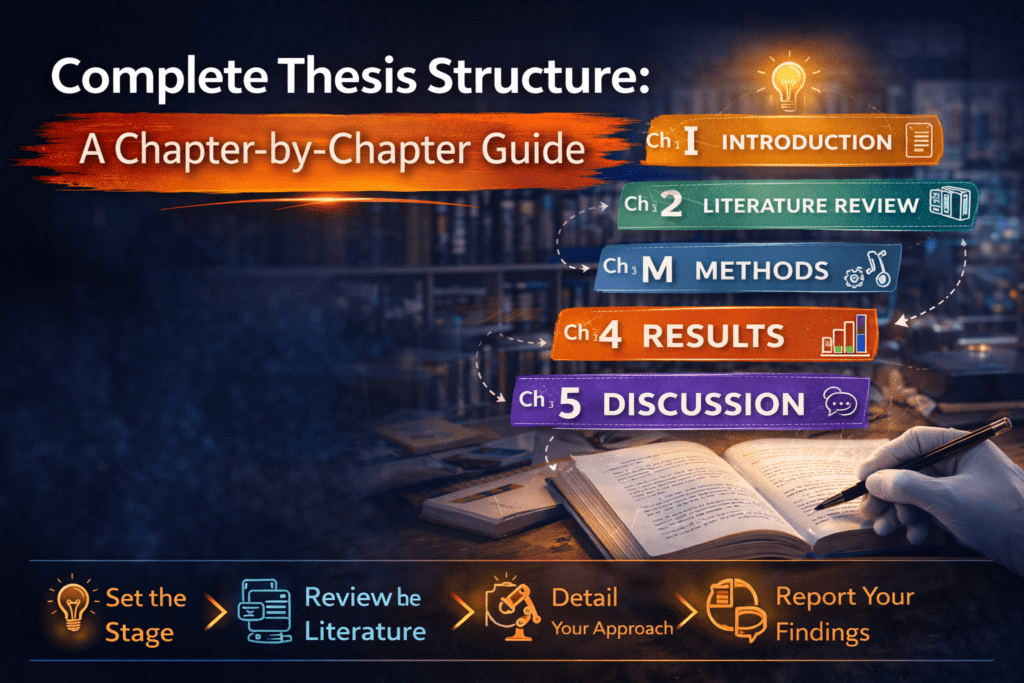
Complete Thesis Structure: A Chapter-by-Chapter Guide
Cluster Post 6 | Module 1: Understanding the Structure of Research Papers and Theses From…

10 Structural Mistakes That Get Research Papers Rejected — And How to Fix Every One
Cluster Post 7 | Module 1: Understanding the Structure of Research Papers and Theses From…
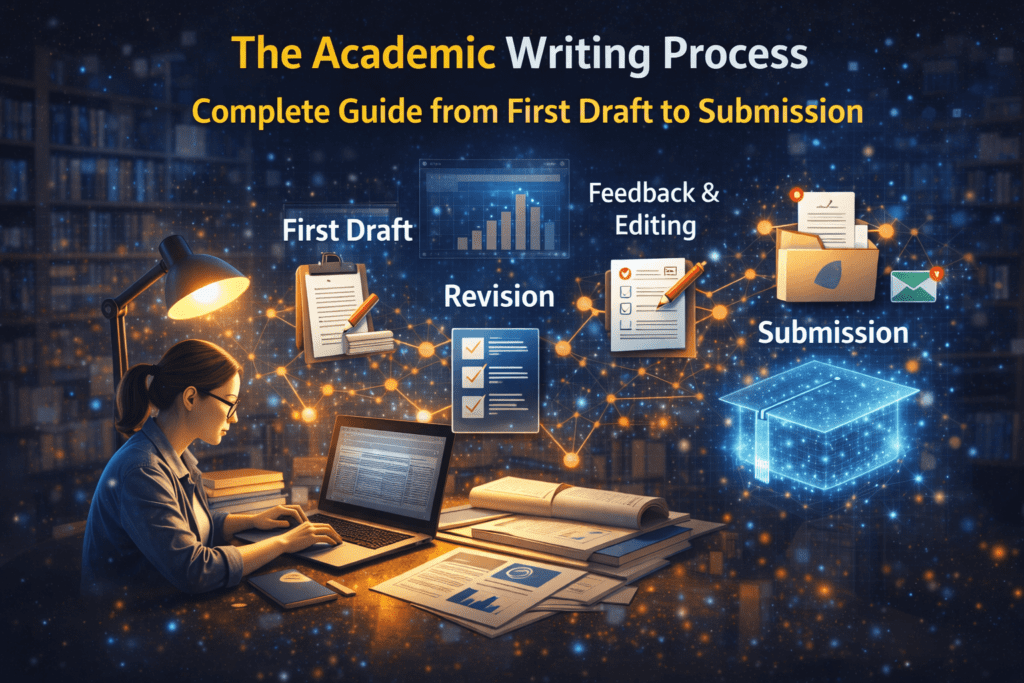
The Academic Writing Process: Complete Guide from First Draft to Submission (2026)
From Concept to Submission: A Complete Guide to Research Paper and Thesis Writing Module 2,…
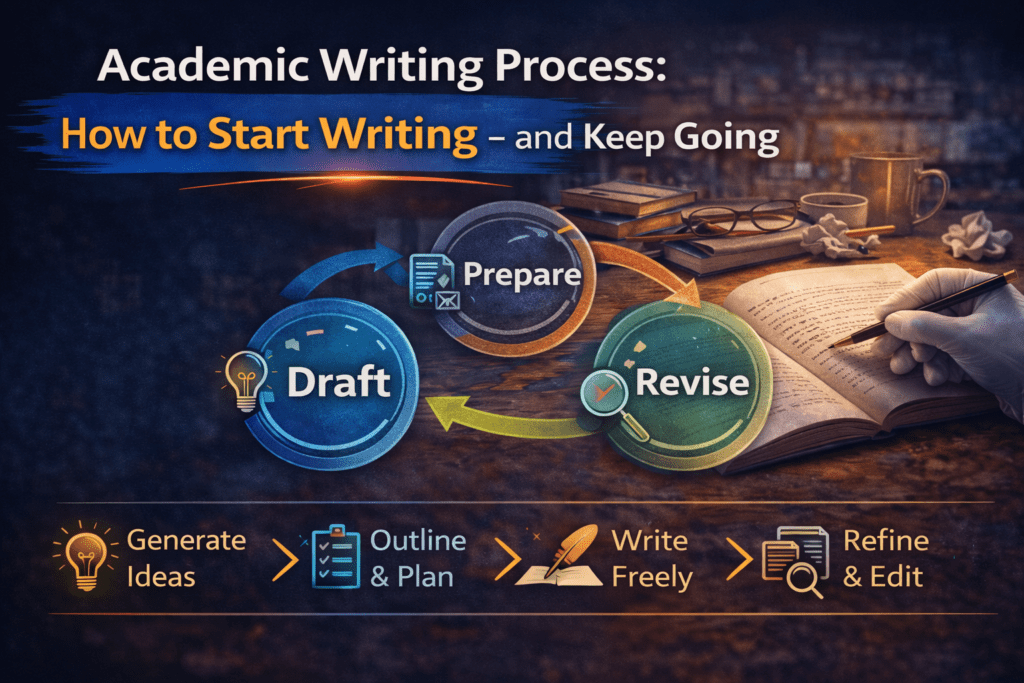
How to Start Writing — and Keep Going
Cluster Post 1 | Module 2: The Academic Writing Process From Concept to Submission Series …
How to Write Clear Engaging Academic Prose
Cluster Post 2 | Module 2: The Academic Writing Process From Concept to Submission Series …
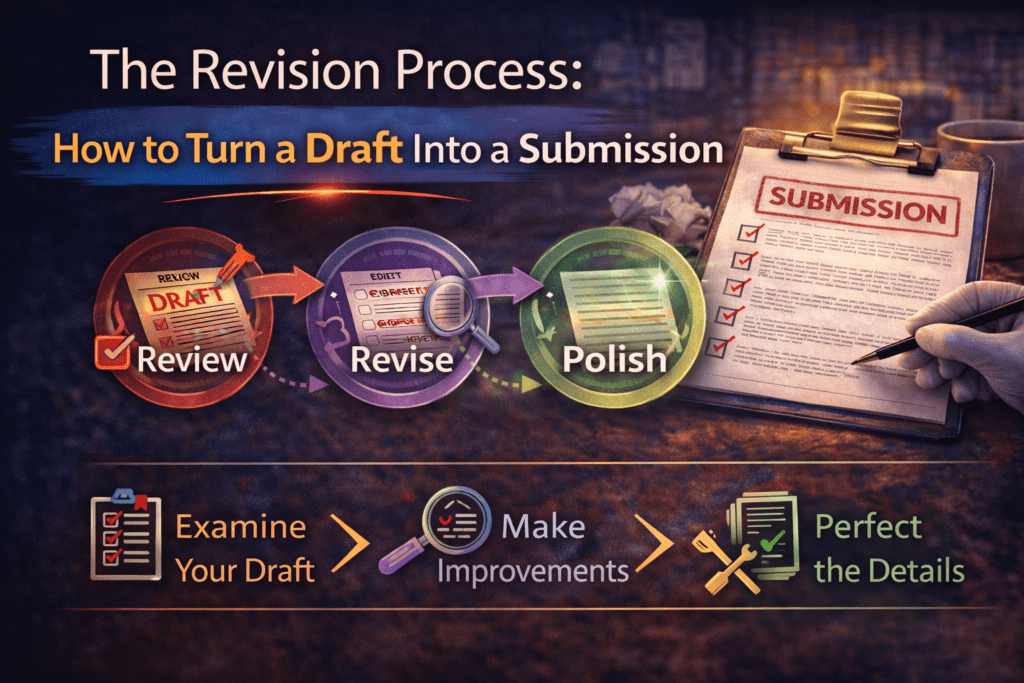
The Revision Process: How to Turn a Draft Into a Submission
Cluster Post 3 | Module 2: The Academic Writing Process From Concept to Submission Series …
Citation Styles Explained: APA, MLA, Chicago, IEEE, and Bluebook
Cluster Post 4 | Module 2: The Academic Writing Process From Concept to Submission Series …
Reference Management: Zotero and Mendeley from Setup to Submission
Cluster Post 5 | Module 2: The Academic Writing Process From Concept to Submission Series …

Research Methodologies: Complete Guide to Quantitative, Qualitative, Mixed Methods & Legal Research (2026)
Why Methodology Determines Research Quality Here’s what thesis examiners focus on first: your methodology section…