
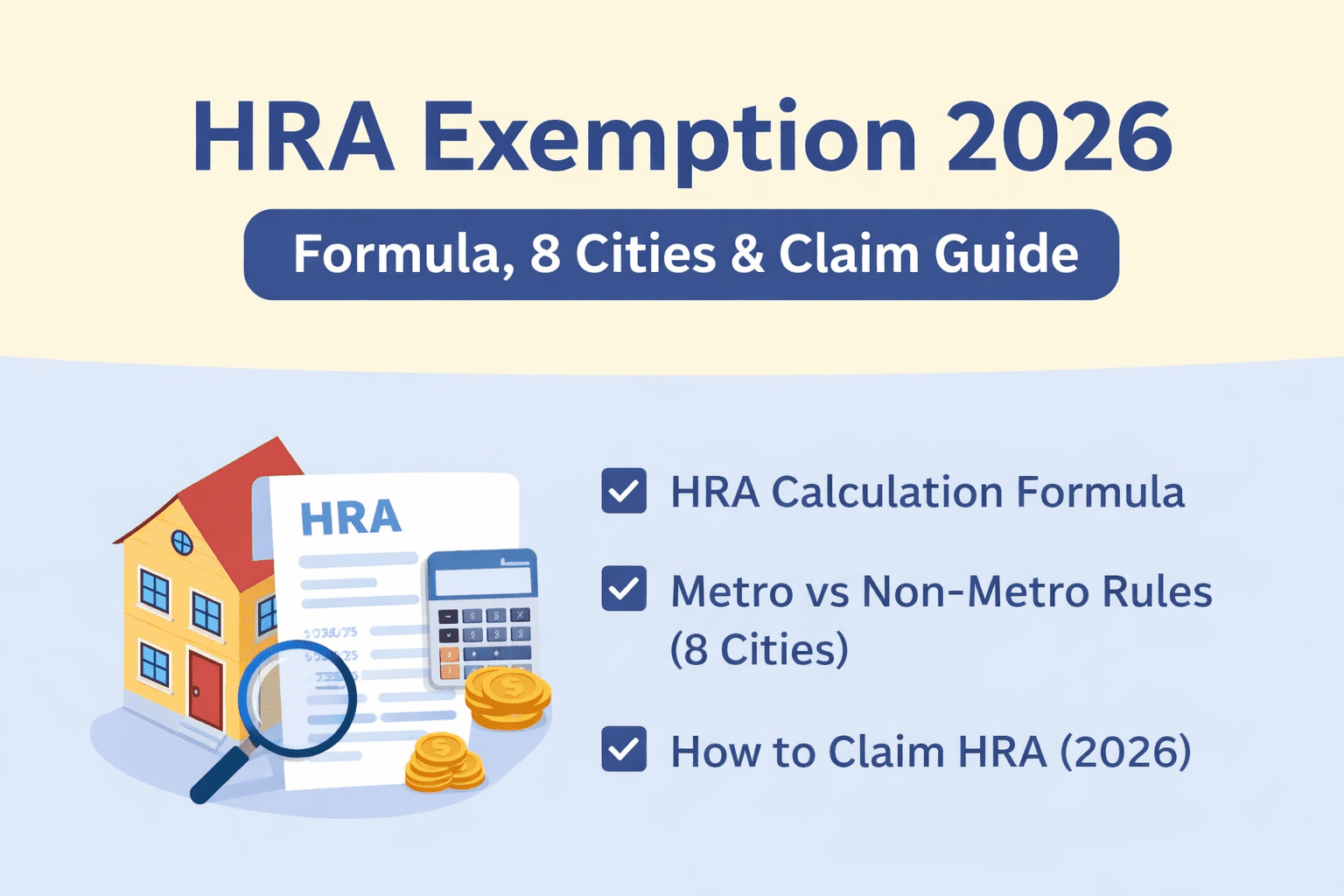
HRA Exemption 2026
Calculation Formula, 8 Cities at 50% and Complete Claim Guide (IT Rules 2026)
Part of the Income Tax India 2026 : Income Tax India 2026 : A Complete Guide
Ananya works at a tech company in Bengaluru and pays Rs 25,000 rent every month. Until March 2026, she could claim only 40% of her basic salary as HRA exemption — because Bengaluru was not classified as a metro city for HRA purposes.
From April 1, 2026, everything changed.
The Income Tax Rules 2026, notified by CBDT on March 20, 2026, expanded the list of cities eligible for the 50% HRA exemption. Bengaluru, Hyderabad, Pune, and Ahmedabad are now included. The 50% cities list has doubled from 4 to 8.
For Ananya, this means her HRA exemption ceiling just went up. At Rs 80,000 basic salary, her exemption cap was Rs 32,000 per month (40%) and is now Rs 40,000 per month (50%) — a difference of Rs 96,000 in annual deduction. At 30% bracket, that saves Rs 29,952 more in tax every year.
This article covers the complete HRA calculation formula, the new 8-city list, the landlord disclosure rule introduced in 2026, and a step-by-step guide to claiming your maximum exemption.
| 8 Cities Now eligible for 50% HRA exemption — 4 new cities added in IT Rules 2026 | Old Regime: HRA exemption available ONLY in old tax regime | 3 Conditions: Minimum of 3 conditions determines your HRA exemption | Rs 1 Lakh Annual rent threshold above which landlord PAN is mandatory |
1. What Changed in HRA Rules from April 1, 2026
The Income Tax Rules 2026 were notified by CBDT on March 20, 2026, under the Income Tax Act 2025. Rule 279 governs HRA exemption limits. Two key changes effective from April 1, 2026:
| What Changed | Before April 1, 2026 | From April 1, 2026 (IT Rules 2026) |
| Cities eligible for 50% HRA | Only 4 metro cities: Delhi, Mumbai, Kolkata, Chennai | 8 cities: Delhi, Mumbai, Kolkata, Chennai + Hyderabad, Pune, Ahmedabad, Bengaluru |
| Landlord-tenant disclosure | Not required in most cases | Mandatory to disclose name, address and PAN of landlord in specified form |
| Landlord PAN requirement | PAN required if annual rent exceeds Rs 1 lakh | Same threshold — Rs 1 lakh annual rent — PAN mandatory |
| Section / Rule reference | Rule 2A of Income Tax Rules, 1962 | Rule 279 of Income Tax Rules, 2026 |
| HRA exemption availability | Old tax regime only | Old tax regime only – unchanged |
Confirmed from incometaxindia.gov.in FAQs on new vs old regime: “Under the old tax regime, House Rent Allowance (HRA) is exempted under Schedule III (11) for salaried individuals. However, this exemption is not available in the new tax regime.”
2. The 3-Condition Formula — How HRA Exemption is Calculated
Under Schedule III (11) of the Income Tax Act and Rule 279 of IT Rules 2026, the HRA exemption is the MINIMUM of the following three amounts.
| Condition | Formula | What This Means |
| Condition 1: Actual HRA received | Actual HRA received from employer in the year | The HRA amount your employer pays — cannot claim more than what you receive |
| Condition 2: City percentage of salary | 50% of salary (8 metro cities) OR 40% of salary (all other cities). Salary = Basic + DA + commission as % of turnover | The city you LIVE in determines 50% or 40% — not the city of your employer |
| Condition 3: Rent paid minus 10% of salary | Actual rent paid minus 10% of salary (Basic + DA). Must be positive to claim any exemption. | If rent paid is less than 10% of basic, this condition is zero and entire HRA becomes taxable |
HRA Exemption = Minimum of (Condition 1, Condition 2, Condition 3)
The remaining HRA (Total HRA received minus Exempt HRA) is added to taxable income and taxed at your applicable slab rate.
Important: “Salary” for HRA calculation means Basic + Dearness Allowance (DA) + commission if it is a fixed percentage of company turnover. It does NOT include HRA itself, other allowances, bonuses, or employer’s EPF/NPS contributions. Source: incometaxindia.gov.in HRA calculator.
3. 8 Cities at 50% — Complete List and Calculation Difference
| City | 50% or 40% | Effective From | State |
| Delhi (NCR) | 50% | Long-standing metro city | Delhi / Haryana / UP (NCR) |
| Mumbai (including MMR) | 50% | Long-standing metro city | Maharashtra |
| Kolkata | 50% | Long-standing metro city | West Bengal |
| Chennai | 50% | Long-standing metro city | Tamil Nadu |
| Hyderabad | 50% | NEW from April 1, 2026 (IT Rules 2026) | Telangana |
| Bengaluru | 50% | NEW from April 1, 2026 (IT Rules 2026) | Karnataka |
| Pune | 50% | NEW from April 1, 2026 (IT Rules 2026) | Maharashtra |
| Ahmedabad | 50% | NEW from April 1, 2026 (IT Rules 2026) | Gujarat |
| All other cities and towns | 40% | Unchanged | All states — Noida, Gurgaon, Chandigarh, Jaipur, Lucknow, Kochi, Surat, Coimbatore etc. |
Note on Noida and Gurgaon: Despite being part of the National Capital Region (NCR), Noida (UP) and Gurgaon/Gurugram (Haryana) are NOT classified as “Delhi” for HRA purposes and receive only 40% HRA — unless specifically included in future notifications. The 50% benefit applies to employees posted in Delhi NCT specifically. Verify with your HR and CA.
4. Worked Examples — Metro and Non-Metro
Example 1 — Bengaluru Employee (50% from April 2026)
| Component | Annual Figures |
| Basic Salary | Rs 9,60,000 (Rs 80,000/month) |
| HRA Received | Rs 4,80,000 (Rs 40,000/month — typically 50% of basic) |
| Rent Paid | Rs 3,00,000 (Rs 25,000/month) |
| City | Bengaluru — 50% applicable from April 1, 2026 (IT Rules 2026) |
| Condition 1: Actual HRA received | Rs 4,80,000 |
| Condition 2: 50% of Basic (Bengaluru = metro) | Rs 4,80,000 (50% of Rs 9,60,000) |
| Condition 3: Rent paid minus 10% of Basic | Rs 3,00,000 minus Rs 96,000 = Rs 2,04,000 |
| HRA Exemption = Minimum of above 3 | Rs 2,04,000 |
| Taxable HRA | Rs 4,80,000 minus Rs 2,04,000 = Rs 2,76,000 (added to taxable income) |
Example 2 — Jaipur Employee (Non-Metro, 40%)
| Component | Annual Figures |
| Basic Salary | Rs 6,00,000 (Rs 50,000/month) |
| HRA Received | Rs 2,40,000 (Rs 20,000/month) |
| Rent Paid | Rs 1,80,000 (Rs 15,000/month) |
| City | Jaipur — 40% applicable (non-metro) |
| Condition 1: Actual HRA received | Rs 2,40,000 |
| Condition 2: 40% of Basic (non-metro) | Rs 2,40,000 (40% of Rs 6,00,000) |
| Condition 3: Rent paid minus 10% of Basic | Rs 1,80,000 minus Rs 60,000 = Rs 1,20,000 |
| HRA Exemption = Minimum of above 3 | Rs 1,20,000 |
| Taxable HRA | Rs 2,40,000 minus Rs 1,20,000 = Rs 1,20,000 (added to taxable income) |
5. Documents Needed and Claim Process
| Document | When Required | Details |
| Rent Receipts | Always — every month | Show date, amount, landlord name, address, signature. Mandatory for employer TDS reduction. Can be handwritten or printed. |
| Rental Agreement | Strongly recommended | Registered or notarised agreement with landlord. Shows start date, monthly rent, property address. |
| Landlord PAN | If annual rent exceeds Rs 1,00,000 | Mandatory under IT Rules. If landlord has no PAN, obtain a self-declaration signed by landlord. |
| Landlord-Tenant Relationship Disclosure | If rent paid to family member — NEW from April 2026 | New requirement under IT Rules 2026 Rule 279. Must disclose relationship (parent, spouse, sibling etc.) in specified form. |
| Bank Transfer Proof | Strongly recommended for all payments | Pay rent via bank transfer or UPI — creates clear audit trail. Cash payments above Rs 20,000/month are risky. |
| Form 124 | Submitted to employer at year start | Declaration form where employee declares HRA claim with landlord details. Employer uses for TDS calculation. |
How to Claim HRA in ITR
If you submitted rent receipts and Form 124 to your employer during the year, the HRA exemption will already be reflected in your Form 16 Part B. In this case, the ITR auto-populates the exempt HRA.
If you did NOT submit proofs to employer (or missed submitting), you can still claim HRA exemption while filing ITR. In ITR-1 or ITR-2, go to “Salary Details” > “Allowances to the extent exempt under Schedule III (11) ” > enter the HRA exempt amount calculated using the 3-condition formula.
Section 80GG alternative: if your salary does NOT include HRA as a component (rare in salaried jobs), you can claim deduction under Section 80GG up to Rs 5,000 per month or 25% of total income — whichever is lower. Conditions apply: you must not own any house, your employer should not provide HRA. Source: incometaxindia.gov.in Deductions page.
Income Tax India 2026 : A Complete Guide
6. Frequently Asked Questions
Q1: Which cities qualify for 50% HRA exemption in 2026?
From April 1, 2026, under Income Tax Rules 2026, Rule 279 notified by CBDT on March 20, 2026, the following 8 cities qualify for 50% HRA exemption: Delhi, Mumbai, Kolkata, Chennai (existing), and Hyderabad, Bengaluru, Pune, Ahmedabad (newly added). All other cities and towns receive 40% HRA exemption. This is a significant expansion from the previous 4-city list.
Q2: How is HRA exemption calculated under Schedule III (11)?
HRA exemption under Schedule III (11) is the MINIMUM of: (1) Actual HRA received from employer, (2) 50% of basic salary if in 8 metro cities or 40% of basic salary for other cities, (3) Actual rent paid minus 10% of basic salary. Salary for this purpose = Basic + Dearness Allowance + commission as fixed % of turnover. Whichever of the three conditions gives the lowest value becomes your HRA exemption for that year.
Q3: Is HRA exemption available in the new tax regime in 2026?
No. HRA exemption under Schedule III (11) is NOT available in the new tax regime. If you have opted for the new tax regime, your entire HRA received from employer will be taxable at applicable slab rates. This is confirmed at incometaxindia.gov.in FAQs: “Under the old tax regime, House Rent Allowance (HRA) is exempted under Schedule III (11) for salaried individuals. However, this exemption is not available in the new tax regime.”
Q4: Can I claim HRA if I pay rent to my parents?
Yes — you can claim HRA exemption if you pay rent to your parents, provided: (a) you have a valid rental agreement, (b) rent is paid via bank transfer (not cash) so there is a clear trail, (c) your parents own the property, (d) your parents declare the rental income in their ITR. From April 2026, under IT Rules 2026, you must also disclose the landlord-tenant relationship in a specified form. The arrangement must be genuine — do not fabricate rent payments. Your parents’ rental income is taxable in their hands.
Q5: What is the new landlord disclosure rule in 2026?
Income Tax Rules 2026, Rule 279, notified March 20, 2026, requires taxpayers claiming HRA to disclose their relationship with the landlord if rent is paid to a family member or relative — such as parents, spouse, or siblings. This must be done in a specified form. The rule is aimed at increasing transparency and ensuring that HRA claims for rent paid to related parties are genuine.
Q6: Is landlord PAN mandatory for HRA claim?
Yes — if the total rent paid in a financial year exceeds Rs 1,00,000 (Rs 8,334/month or more), the landlord’s PAN is mandatory. You must provide this to your employer (in Form 124) and mention it when claiming HRA in ITR. If your landlord does not have a PAN, obtain a signed self-declaration from them stating they do not have a PAN. Without landlord PAN above the Rs 1L threshold, your employer may not give TDS benefit for HRA and the IT Department may question the claim.
Q7: Can I claim both HRA exemption and home loan interest deduction?
Yes — you can claim both HRA exemption Schedule III (11) and home loan interest deduction (Section 22) simultaneously in the old tax regime, provided you can justify both. Common scenarios: you own a house in one city but live and work in another city where you rent. Or your owned property is let out while you rent in the city you work in. Both deductions are available in the old regime only. The arrangement must be genuine — IT Department may scrutinise cases where both are claimed.
Q8: What if I miss submitting HRA proof to my employer?
If you missed submitting rent receipts or rental agreement to your employer during the year, your employer would not have given HRA exemption in TDS calculation and the excess TDS would have been deducted. You can still claim the HRA exemption when filing your ITR. In ITR-1 or ITR-2, under salary income > exempt allowances under Schedule III (11) , enter the calculated HRA exempt amount. The refund of excess TDS will be processed by the IT Department after ITR filing and verification.
Conclusion
HRA exemption is one of the most valuable deductions for salaried employees paying rent — but only in the old tax regime. Key points for 2026:
- 8 cities now at 50%: Bengaluru, Hyderabad, Pune, Ahmedabad added from April 2026. If you live in any of these, your exemption ceiling just increased.
- 3-condition formula: Always minimum of (actual HRA, 50%/40% of basic, rent minus 10% of basic). Calculate all three and pick the lowest.
- Landlord disclosure mandatory: If paying rent to family members, disclose the relationship in specified form under IT Rules 2026.
- PAN above Rs 1 lakh: Annual rent above Rs 1 lakh requires landlord PAN. Collect this before March of each year.
For the complete guide on choosing between new and old regime (HRA is old regime only):New Tax Regime Vs Old Tax Regime 2026
For home loan deductions alongside HRA: Home Loan Tax Benefits 2026: Section 22(2), 123 Guide
Must Read
Mutual Funds India 2026: Complete Beginner’s Guide
Author
CA Ajay Khandelwal is a Chartered Accountant and financial expert with over 21 years of experience in taxation, compliance, and business advisory. As a key expert at AspirixWriters, he provides practical insights on income tax, financial planning, and regulatory matters, helping readers make informed financial decisions.
Author profile CA. Ajay Khandelwal
Disclaimer
This article is for educational and informational purposes only. It is not personal tax advice. HRA exemption rules are based on Section Schedule III (11) of the Income Tax Act 2025, Rule 279 of the Income Tax Rules 2026, notified by CBDT on March 20, 2026. Individual HRA exemption depends on salary structure, rent paid, and city of residence. Please consult your Chartered Accountant for your specific HRA calculation and ITR filing.
References
[1] Income Tax Rules 2026, Rule 279 — HRA limits under Section Schedule III (11) | 8 cities at 50% (Bengaluru, Hyderabad, Pune, Ahmedabad added) | Landlord-tenant relationship disclosure | Notified by CBDT March 20, 2026 | egazette.gov.in — https://egazette.gov.in
[2] Section Schedule III (11) of the Income Tax Act | Rule 279 of IT Rules 2026 | HRA calculator | Limits for purposes of Schedule III (11) | incometaxindia.gov.in
[3] Income Tax Department — FAQs on New Tax vs Old Tax Regime | HRA exemption not available in new regime | incometaxindia.gov.in/iec/foportal/help/new-tax-vs-old-tax-regime-faqs — https://www.incometax.gov.in/iec/foportal/help/new-tax-vs-old-tax-regime-faqs
Tax Exemption on Sale of Residential House
Section 123 Deductions 2026: Complete List of All Options
Section 123 Deductions 2026 Part of the Income Tax India 2026 : Income Tax India…

PPF Interest Rate, Limit,Withdrawal & EEE Benefits 2026
PPF Interest Rate, Limit,Withdrawal & EEE Benefits Part of the Income Tax India 2026: Income…
NPS Tax Benefit 2026
NPS Tax Benefit 2026: Section124 Rs 50K & Employer NPS Section 124 Extra Rs 50,000…
New Tax Regime vs Old Tax Regime 2026
New Tax Regime vs Old Tax Regime 2026 : Which is Better Every year between…