Last Updated: July 2, 2026
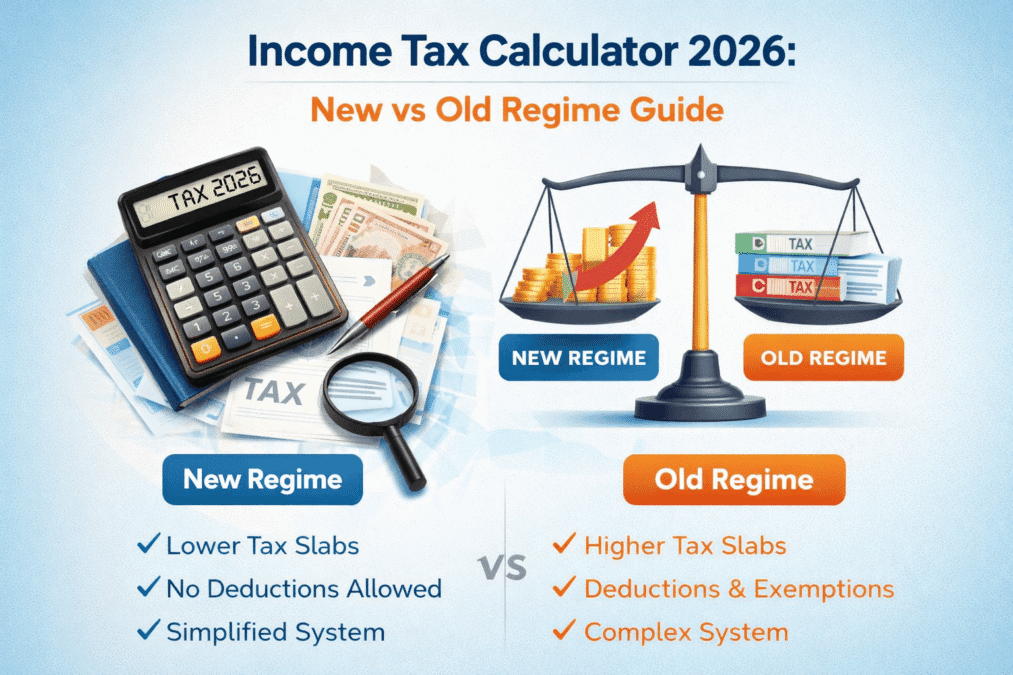
Income Tax Calculator 2026
New vs Old Regime — Step-by-Step Calculation at 5 Income Levels
Part of the Income Tax India 2026 hub: Income Tax India 2026 : A Complete Guide
Every year, millions of Indians search for an income tax calculator. Most arrive at a third-party website, enter their salary, and get a number — with no explanation of how it was calculated, no way to verify it, and no breakdown to understand what deductions are being assumed.
This article is different. Every calculation here is done step-by-step, using the official tax rates from incometaxindia.gov.in and Finance Bill 2026. You can see exactly how the tax is computed at every income level — and verify each number yourself.
Tax rates for FY 2025-26 (Tax Year 2026-27) are unchanged. All examples are for salaried individuals below 60 years. After working through this guide, you will know exactly which regime saves more at your income level.
| 5 Levels Worked examples: Rs 5L / 8L / 10L / 15L / 20L salary | Both Regimes New and old regime calculated for every income level | Official Rates All calculations from incometaxindia.gov.in Tax Rates page | 6 Steps Simple step-by-step method anyone can follow |
1. The 6-Step Manual Calculation Method
Before the worked examples, understand the method. These 6 steps apply to any salaried individual for Tax Year 2026-27.
| Step | What To Do | For New Regime | For Old Regime |
| Step 1 | Start with Gross Salary | Same starting point | Same starting point |
| Step 2 | Subtract Standard Deduction | Rs 75,000 | Rs 50,000 |
| Step 3 | Subtract other deductions | None — no deductions allowed (except Sec 124(1) employer NPS) | Sec. 123 up to Rs 1.5L + 126 + HRA + home loan + NPS Sec. 124 etc. |
| Step 4 | Calculate tax on taxable income using slab rates | New regime slabs: 0/5/10/15/20/25/30% | Old regime slabs: 0/5/20/30% |
| Step 5 | Apply Section 156 rebate if eligible | Deduct up to Rs 60,000 if taxable income up to Rs 12,00,000 | Deduct up to Rs 12,500 if taxable income up to Rs 5,00,000 |
| Step 6 | Add 4% Health and Education Cess | 4% on (tax after rebate) | 4% on (tax after rebate) |
Sec. 156 Rebate reminder: applies only if taxable income (after standard deduction and all deductions) is up to Rs 12,00,000 in new regime or Rs 5,00,000 in old regime. Does NOT apply to LTCG under Section 112A or STCG under Section 111A.
2. Quick Reference — New Regime Tax at Different Salary Levels
For salaried employees in the new regime with no deductions except the Rs 75,000 standard deduction.
| Gross Salary | Taxable Income (after Rs 75K SD) | Tax on Taxable Income | 156 Rebate Applicable? | Tax after Rebate/ marginal relief | 4% Cess | Total Tax Payable |
| Rs 5,00,000 | Rs 4,25,000 | Rs 1,250 | Yes — income below Rs 12L | Rs 0 (rebate > tax) | Rs 0 | Rs 0 — Zero Tax |
| Rs 8,00,000 | Rs 7,25,000 | Rs 16,250 | Yes — income below Rs 12L | Rs 0 (rebate covers) | Rs 0 | Rs 0 — Zero Tax |
| Rs 10,00,000 | Rs 9,25,000 | Rs 32,500 | Yes — income below Rs 12L | Rs 0 (rebate covers) | Rs 0 | Rs 0 — Zero Tax |
| Rs 12,00,000 | Rs 11,25,000 | Rs 52,500 | Yes — Rs 11.25L below Rs 12L | Rs 0 (full rebate) | Rs 0 | Rs 0 — Zero Tax |
| Rs 12,75,000 | Rs 12,00,000 | Rs 60,000 | Yes — exactly Rs 12L | Rs 0 (full rebate) | Rs 0 | Rs 0 — Zero Tax |
| Rs 13,00,000 | Rs 12,25,000 | Rs 63,750 | Yes in form of Marginal relief — income slightly above Rs 12L | Rs 25,000 (after Marginal relief) | Rs 1,000 | Rs 26,000 |
| Rs 15,00,000 | Rs 14,25,000 | Rs 93,750 | No | Rs 93,750 | Rs 3,750 | Rs 97,500 |
| Rs 20,00,000 | Rs 19,25,000 | Rs 1,85,000 | No | Rs 1,85,000 | Rs 7,400 | Rs 1,92,400 |
Note: At Rs 12,75,000 gross salary, taxable income = exactly Rs 12,00,000 after standard deduction. Tax = Rs 60,000 which equals the Section 156 rebate limit exactly. Zero tax payable. At Rs 13,00,000 gross, taxable income exceeds Rs 12L by Rs 25,000 and the entire Rs 63,750 tax becomes payable, but there is marginal relief which brings tax to Rs. 25,000. Let us know what is marginal relief.
Marginal Relief
If income slightly exceeds Rs. 12 lacs, it will come under normal slab rate as there is no relief after 12 lacs. Thus, if tax on Rs. 12 lacs comes out to be Rs. 60,000 but tax on Rs. 12,25,000 comes out to be Rs. 63,750. Just by increase of Rs. 25000 in taxable income tax has increased by Rs. 63,750. This was unjustified. So, Section 156 takes care of this.
Section 156 says that if income exceeds twelve lakh rupees and the income-tax payable on such total income exceeds the amount by which the total income is in excess of twelve lakh rupees, an amount equal to the amount by which the income-tax payable on such total income is in excess of the amount by which the total income exceeds twelve lakh rupees. Thus, if income is Rs. 12,25,000 which is Rs. 25,000 excess from 12L, so the tax on such income can’t exceed this excess of Rs. 25,000. Remaining Rs. 38,750 will be allowed as relief under this section itself which can be called Marginal Relief.
3. Worked Examples at 5 Income Levels — Both Regimes
Full step-by-step calculation for both regimes. Old regime examples assume a typical deduction set: 123 Rs 1.5L, 126 Rs 25K, standard deduction Rs 50K. No HRA or home loan assumed — actual savings would be higher with those.
Income Level 1 — Gross Salary Rs 5,00,000
| Step | New Regime | Old Regime |
| Gross Salary | Rs 5,00,000 | Rs 5,00,000 |
| Less: Standard Deduction | Rs 75,000 | Rs 50,000 |
| Less: 123 + 126 | Not available | Rs 1,50,000 + Rs 25,000 = Rs 1,75,000 |
| Taxable Income | Rs 4,25,000 | Rs 2,75,000 |
| Tax on taxable income | 5% on Rs 25,000 = Rs 1,250 | 5% on Rs 25,000 = Rs 1,250 |
| Section 156 Rebate | Rs 1,250 (full rebate — below Rs 12L) | Rs 1,250 (full rebate — below Rs 5L) |
| Tax after rebate | Rs 0 | Rs 0 |
| Cess (4%) | Rs 0 | Rs 0 |
| TOTAL TAX | Rs 0 — Zero Tax | Rs 0 — Zero Tax |
| BETTER REGIME | Both equal — zero tax in both | New regime simpler (no investment needed) |
Income Level 2 — Gross Salary Rs 8,00,000
| Step | New Regime | Old Regime |
| Gross Salary | Rs 8,00,000 | Rs 8,00,000 |
| Less: Standard Deduction | Rs 75,000 | Rs 50,000 |
| Less: 123 + 126 | Not available | Rs 1,75,000 |
| Taxable Income | Rs 7,25,000 | Rs 5,75,000 |
| Tax on taxable income | 5% on Rs 3,25,000 = Rs 16,250 | 5% on Rs 2,50,000 = Rs 12,500 + 20% on Rs 75,000 = Rs 15,000. Total: Rs 27,500 |
| Section 156 Rebate | Rs 16,250 (full rebate — below Rs 12L) | Nil (taxable income Rs 5,75,000 > Rs 5L) |
| Tax after rebate | Rs 0 | Rs 27,500 |
| Cess (4%) | Rs 0 | Rs 1,100 |
| TOTAL TAX | Rs 0 — Zero Tax | Rs 28,600 |
| BETTER REGIME | NEW REGIME — saves Rs 28,600 | — |
Income Level 3 — Gross Salary Rs 10,00,000
| Step | New Regime | Old Regime |
| Gross Salary | Rs 10,00,000 | Rs 10,00,000 |
| Less: Standard Deduction | Rs 75,000 | Rs 50,000 |
| Less: 123 + 126 | Not available | Rs 1,75,000 |
| Taxable Income | Rs 9,25,000 | Rs 7,75,000 |
| Tax on taxable income | 5% on Rs 4,00,000 = Rs 20,000 + 10% on Rs. 1,25,000 = Rs 12,500. Total: Rs. 32,500 | 5% on Rs 2,50,000 = Rs 12,500 + 20% on Rs 2,75,000 = Rs 55,000. Total: Rs 67,500 |
| Section 156 Rebate | Rs 32,500 (full rebate — below Rs 12L) | Nil (Rs 7,75,000 > Rs 5L) |
| Tax after rebate | Rs 0 | Rs 67,500 |
| Cess (4%) | Rs 0 | Rs 2,700 |
| TOTAL TAX | Rs 0 — Zero Tax | Rs 70,200 |
| BETTER REGIME | NEW REGIME — saves Rs 70,200 vs old with typical deductions | — |
Income Level 4 — Gross Salary Rs 15,00,000
| Step | New Regime | Old Regime |
| Gross Salary | Rs 15,00,000 | Rs 15,00,000 |
| Less: Standard Deduction | Rs 75,000 | Rs 50,000 |
| Less: 123 + 126 | Not available | Rs 1,75,000 |
| Less: Home Loan Interest (Section 24b) | Not available | Rs 2,00,000 |
| Taxable Income | Rs 14,25,000 | Rs 10,75,000 |
| Tax on taxable income | 5% on Rs 4L=Rs 20K + 10% on Rs 4L=Rs 40K + 15% on Rs 2.25L=Rs 33,750. Total: Rs 93,750 | 5% on Rs 2.5L=Rs 12,500 + 20% on Rs 5L=Rs 1,00,000 + 30% on Rs 75K=Rs 22,500. Total: Rs 1,35,000 |
| Section 156 Rebate | Nil (Rs 14.25L > Rs 12L) | Nil (Rs 10.75L > Rs 5L) |
| Tax after rebate | Rs 93,750 | Rs 1,35,000 |
| Cess (4%) | Rs 3,750 | Rs 5,400 |
| TOTAL TAX | Rs 97,500 | Rs 1,40,400 |
| BETTER REGIME | NEW REGIME — saves Rs 42,900 even with home loan in old regime | — |
Income Level 5 — Gross Salary Rs 20,00,000
| Step | New Regime | Old Regime (with full deductions) |
| Gross Salary | Rs 20,00,000 | Rs 20,00,000 |
| Less: Standard Deduction | Rs 75,000 | Rs 50,000 |
| Less: 123 + 126 + 124(3) | Not available | Rs 1,50,000 + Rs 25,000 + Rs 50,000 = Rs 2,25,000 |
| Less: Home Loan Interest | Not available | Rs 2,00,000 |
| Taxable Income | Rs 19,25,000 | Rs 15,25,000 |
| Tax on taxable income | Rs 1,85,000 | Rs 2,70,000 |
| Section 156 Rebate | Nil | Nil |
| Cess (4%) | Rs 7,400 | Rs 10,800 |
| TOTAL TAX | Rs 1,92,400 | Rs 2,80,800 |
| BETTER REGIME | NEW REGIME — saves Rs 88,400 even with Rs 4.75L deductions in old regime | Old regime wins only if total deductions exceed ~Rs 8.5L at Rs 20L salary |
4. New vs Old Regime — Which Wins at Each Income Level
Summary of all five worked examples with the deductions assumed in old regime. This is the most important table in this article.
| Gross Salary | Old Regime Deductions Assumed | New Regime Tax | Old Regime Tax | Winner | Tax Saving with New Regime |
| Rs 5,00,000 | Rs 1,75,000 (123 + 126 + SD) | Rs 0 | Rs 0 | Both equal | No difference — simpler to use new regime |
| Rs 8,00,000 | Rs 1,75,000 (123 + 126 + SD) | Rs 0 | Rs 28,600 | New Regime | Rs 28,600 saved |
| Rs 10,00,000 | Rs 1,75,000 (123 + 126 + SD) | Rs 0 | Rs 70,200 | New Regime | Rs 70,200 saved |
| Rs 15,00,000 | Rs 3,75,000 (incl. home loan) | Rs 97,500 | Rs 1,40,400 | New Regime | Rs 42,900 saved |
| Rs 20,00,000 | Rs 4,75,000 (incl. home loan + NPS) | Rs 1,92,400 | Rs 2,80,800 | New Regime | Rs 88,400 saved |
Note: Old regime calculations include typical deductions only (123 Rs 1.5L, 126 Rs 25K, standard deduction Rs 50K, and home loan interest Rs 2L at Rs 15L+ income). With higher deductions (HRA, additional NPS, higher home loan), old regime can become competitive.
The clear pattern: at every income level with typical deductions, the new regime saves more tax in 2026. The new regime only falls behind old regime when total deductions are very high.
For the complete breakeven analysis by salary level, see our: New Tax Regime Vs Old Tax Regime 2026
5. Frequently Asked Questions
Q1: What is the income tax on a salary of Rs 10 lakh in 2026?
In the new tax regime: gross Rs 10L minus Rs 75,000 standard deduction = Rs 9,25,000 taxable. Tax = Rs 26,250 (5% on Rs 5,25,000). 156 rebate of Rs 26,250 applies (taxable income below Rs 12L). Total tax = Rs 0. In the old regime with 123 Rs 1.5L + 126 Rs 25K + standard deduction Rs 50K: taxable income = Rs 7,75,000. Tax = Rs 67,500 + 4% cess = Rs 70,200. New regime saves Rs 70,200.
Q2: What is the income tax on a salary of Rs 15 lakh in 2026?
In the new tax regime: gross Rs 15L minus Rs 75,000 SD = Rs 14,25,000 taxable. Tax = Rs 93,750. No 156 rebate (above Rs 12L). Cess 4% = Rs 3,750. Total: Rs 97,500. In the old regime with 123 Rs 1.5L + 126 Rs 25K + SD Rs 50K + home loan interest Rs 2L: taxable income = Rs 10,75,000. Tax = Rs 1,35,000 + cess Rs 5,400 = Rs 1,40,400. New regime saves Rs 42,900 even with substantial deductions in old regime.
Q3: What is the income tax on a salary of Rs 5 lakh in 2026?
In both new and old regimes: income tax is zero at Rs 5 lakh salary. New regime: taxable income Rs 4,25,000. Tax Rs 1,250. 156 rebate covers it. Total: zero. Old regime: with 123 + 126 + standard deduction, taxable income drops below Rs 5L. Even without deductions, old regime 156 rebate (Rs 12,500) covers the tax at Rs 5L. Both regimes result in zero tax. New regime is simpler — no need to invest for deductions.
Q4: How do I calculate income tax on salary step by step?
Step 1: Start with gross salary. Step 2: Subtract standard deduction (Rs 75K new regime, Rs 50K old). Step 3: Subtract applicable deductions (old regime only — 123, 126, HRA, home loan). Step 4: Calculate tax on remaining taxable income using applicable slab rates. Step 5: Check if Section 156 rebate applies (taxable income up to Rs 12L new regime, Rs 5L old regime). Step 6: Add 4% Health and Education Cess on the tax after rebate. The result is your income tax liability. For the complete formula with worked examples, see Section 3 of this article.
Q5: Is there zero tax on income up to Rs 12 lakh in 2026?
Yes — in the new tax regime for non-salaried taxpayers with exactly Rs 12,00,000 taxable income. For salaried employees, the Rs 75,000 standard deduction means the gross salary limit is Rs 12,75,000 for zero tax. The mechanism: Section 156 rebate of Rs 60,000 exactly offsets the tax on Rs 12,00,000 taxable income.
Q6: Which income tax regime is better for Rs 12 lakh salary in 2026?
For a salaried employee with Rs 12L gross, new regime is clearly better: total tax = Rs 0 (taxable income Rs 11,25,000 after Rs 75K SD, 156 rebate covers Rs 52,500 tax). In the old regime without significant deductions, taxable income is higher and tax is payable. Even with 123 Rs 1.5L + 126 Rs 25K, old regime taxable income = Rs 9,75,000, tax = Rs 92,500 + cess = Rs 96,200. New regime saves nearly Rs 1 lakh at this income level. Use old regime at Rs 12L only if your total deductions exceed approximately Rs 4.5 lakh.
Q7: Where is the official Income Tax Calculator?
The Income Tax Department provides an official tax calculator at incometaxindia.gov.in. Go to the portal > Quick Links > Tax Calculator or search “Tax Calculator” on the portal. The official calculator is updated for both new and old regime, includes surcharge and cess, and handles special income like capital gains correctly. It is the most reliable source.
Q8: How does the Rs 12.75 lakh zero tax for salaried work?
For a salaried employee in new regime with gross salary Rs 12,75,000: Step 1 — gross Rs 12,75,000. Step 2 — standard deduction Rs 75,000. Taxable income = Rs 12,00,000. Step 3 — tax on Rs 12L (new regime slabs) = Nil Rs 4L + 5% Rs 4L=Rs 20,000 + 10% Rs 4L=Rs 40,000. Total tax = Rs 60,000. Step 4 — 156 rebate = Rs 60,000 (taxable income Rs 12L = limit exactly). Tax after rebate = Rs 0. Step 5 — cess = Rs 0. Total tax = Rs 0. Every rupee above Rs 12,75,000 gross creates taxable income above Rs 12L and the 156 rebate no longer applies to any of the tax.
Conclusion
After working through all five income levels and both regimes, the pattern is clear:
- Up to Rs 12,75,000 gross salary: Zero tax in new regime. No investment needed. No deductions required.
- Rs 13L to Rs 20L: New regime still wins with typical deductions. Old regime only wins when deductions exceed the breakeven (see C2).
- Marginal Relief : At exactly Rs 12L taxable income, tax = zero. Slightly above Rs 12L, full tax may apply. But, Marginal Relief concept saves from this cliff.
- Verify with official calculator: Always cross-check your final tax using the official IT Dept calculator at incometaxindia.gov.in.
For the complete regime comparison with breakeven analysis: New Tax Regime Vs Old Tax Regime 2026
For complete tax slab tables: Income Tax Slabs FY 2025-26: New & Old Regime Rates 2026
For the complete income tax guide: Income Tax India 2026 : A Complete Guide
Must read Mutual Funds
Author
CA Ajay Khandelwal is a Chartered Accountant and financial expert with over 21 years of experience in taxation, compliance, and business advisory. As a key expert at AspirixWriters, he provides practical insights on income tax, financial planning, and regulatory matters, helping readers make informed financial decisions.
Author profile CA. Ajay Khandelwal
Disclaimer
This article is for educational and informational purposes only. All tax calculations are illustrative and based on rates verified from incometaxindia.gov.in. Actual tax liability depends on exact income, applicable surcharge, cess, specific deductions, and regime choice. For capital gains income, LTCG/STCG rules apply separately and 156 rebate does not apply to such income. Please verify your final tax using the official Income Tax Department calculator at incometaxindia.gov.in and consult a qualified Chartered Accountant.
References
- Income Tax Department — Tax Rates FY 2025-26 and Tax Year 2026-27 | New regime slabs | Old regime slabs | Section 156 rebate — Rs 60,000 new regime, Rs 12,500 old regime | Footnote (b) — 156 not applicable on LTCG/STCG | 4% cess | incometaxindia.gov.in
- Finance Bill 2026, Bill No. 3 of 2026, Clause 2 — tax rates AY 2026-27 under IT Act 1961 | First Schedule | indiabudget.gov.in — https://indiabudget.gov.in
- Finance Act 2025 | Section 115BAC(1A) — new regime default | Standard deduction Rs 75,000 salaried | Deductions available and not available in new regime | incometaxindia.gov.in — https://incometaxindia.gov.in
- Income Tax Department — Official Tax Calculator | incometaxindia.gov.in/TaxCalc | For verification of manual calculations | incometaxindia.gov.in — https://www.incometax.gov.in/iec/foportal/
Tax Exemption on Sale of Residential House
Section 123 Deductions 2026: Complete List of All Options
Section 123 Deductions 2026 Part of the Income Tax India 2026 : Income Tax India…

PPF Interest Rate, Limit,Withdrawal & EEE Benefits 2026
PPF Interest Rate, Limit,Withdrawal & EEE Benefits Part of the Income Tax India 2026: Income…
NPS Tax Benefit 2026
NPS Tax Benefit 2026: Section124 Rs 50K & Employer NPS Section 124 Extra Rs 50,000…
New Tax Regime vs Old Tax Regime 2026
New Tax Regime vs Old Tax Regime 2026 : Which is Better Every year between…