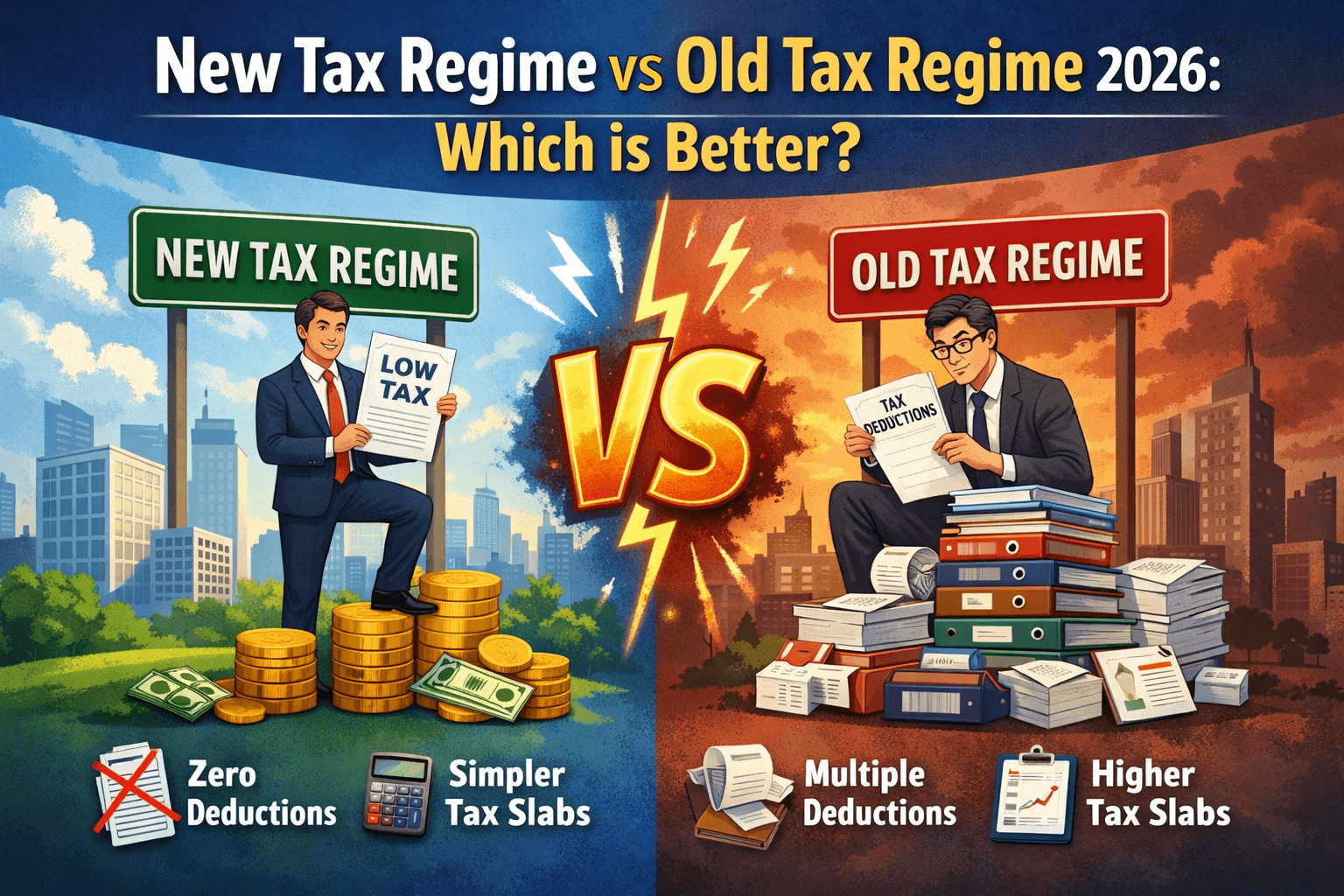
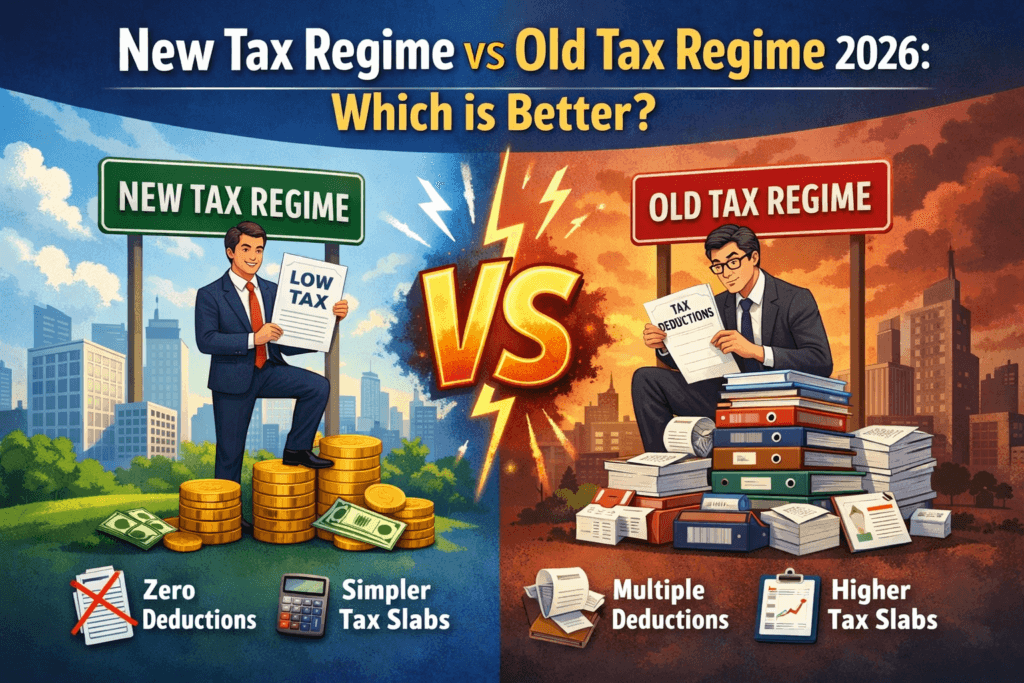
New Tax Regime vs Old Tax Regime 2026 : Which is Better
Every year between January and March, crores of salaried Indians face the same question from their HR or payroll department: “New regime ya old regime?”
Most people pick one without actually calculating which saves them more money. Some blindly follow their colleague’s choice. Some pick the same regime as last year without checking if anything changed.
This article ends the confusion. You will get the exact breakeven point, a salary-wise decision table from Rs 5 lakh to Rs 20 lakh, and a clear answer for your specific situation — all verified from incometaxindia.gov.in and Finance Bill 2026. From April 1, 2026, the new regime is the default for all taxpayers. If you do not declare your choice, you are automatically placed in the new regime.
Key Difference — New Tax Regime vs Old Tax Regime 2026 at a Glance
The fundamental trade-off is simple: new regime gives you lower tax rates in exchange for giving up almost all deductions. Old regime keeps all deductions but taxes you at higher rates.
| Factor | New Tax Regime | Old Tax Regime |
| Default status | Default — auto-selected if no choice made | Opt-in — you must actively choose this |
| Basic exemption limit | Rs 4,00,000 | Rs 2,50,000 |
| Standard deduction (salaried) | Rs 75,000 | Rs 50,000 |
| Section 156 rebate | Rs 60,000 if income up to Rs 12,00,000 | Rs 12,500 if income up to Rs 5,00,000 |
| Tax rates | Lower — 5% to 30% with more slabs | Higher — 5% / 20% / 30% |
| Section 156 (ELSS, PPF, LIC etc.) | Not available | Up to Rs 1,50,000 |
| Section 126 (medical insurance) | Not available | Up to Rs 25,000 / Rs 50,000 |
| HRA exemption | Not available | Available — minimum of 3 conditions |
| Home loan interest (Section 22) | Not available | Up to Rs 2,00,000 |
| NPS employer contribution 124 | Available — only major deduction | Available |
Tax Slab Comparison — New Tax Regime vs Old Tax Regime 2026
| Income Slab | New Regime Rate | Old Regime Rate (below 60 yrs) | Difference |
| Up to Rs 2,50,000 | Nil | Nil | Same |
| Rs 2,50,001 — Rs 4,00,000 | Nil | 5% | New regime better |
| Rs 4,00,001 — Rs 5,00,000 | 5% | 5% | Same rate |
| Rs 5,00,001 — Rs 8,00,000 | 5% | 20% | New regime much better |
| Rs 8,00,001 — Rs 10,00,000 | 10% | 20% | New regime better |
| Rs 10,00,001 — Rs 12,00,000 | 10% | 30% | New regime much better |
| Rs 12,00,001 — Rs 16,00,000 | 15% | 30% | New regime better — but deductions can bridge this gap |
| Above Rs 16,00,000 | 20% to 30% | 30% | New regime still better at base — deductions determine winner |
The slab comparison shows why the new regime wins at lower incomes — the 5-to-20 lakh range is taxed at 5-10% in new regime versus 20-30% in old regime. The only reason to choose old regime is when deductions are large enough to bring your taxable income down below the point where new regime rates kick in harder.
The Breakeven Point — When Does Old Regime Win?
The breakeven point is the total deduction amount at which old regime tax equals new regime tax. If your actual deductions exceed this breakeven — old regime saves more. Below it — new regime is better.
| Gross Annual Income | New Regime Tax | Old Regime Tax (zero deductions) | Breakeven Deduction | Old Regime Better If Deductions Exceed |
| Rs 5,00,000 | Zero (156 rebate) | Zero (156 rebate) | No breakeven | New regime always equal or better at Rs 5L |
| Rs 7,50,000 | Rs 19,500 | Rs 65,000 | ~Rs 2,00,000 | Old regime better if deductions exceed Rs 2L |
| Rs 10,00,000 | Rs 45,000 | Rs 1,12,500 | ~Rs 3,25,000 | Old regime better if deductions exceed Rs 3.25L |
| Rs 12,00,000 | Zero (156 rebate) | Rs 1,72,500 | ~Rs 5,00,000 | Old regime better only with very high deductions |
| Rs 15,00,000 | Rs 90,000 | Rs 2,62,500 | ~Rs 4,25,000 | Old regime better if deductions exceed Rs 4.25L |
| Rs 20,00,000 | Rs 1,70,000 | Rs 4,12,500 | ~Rs 5,50,000 | Old regime better if deductions exceed Rs 5.5L |
Note: All figures approximate. Old regime tax calculated before standard deduction Rs 50,000. New regime tax calculated before standard deduction Rs 75,000.
Practical reading: at Rs 10 lakh income, if your total deductions (123 + 126 + HRA + home loan interest + NPS) add up to more than approximately Rs 3.25 lakh — old regime saves more tax. If your deductions are less than Rs 3.25 lakh — new regime is better.
Who Should Choose What — Salary-Wise Decision Guide
| Your Profile | Annual Income | Typical Deductions Available | Recommended Regime | Why |
| Fresh graduate, first job, renting | Rs 5L — Rs 7.5L | Low — mostly only 123 EPF | New Regime | 156 rebate makes tax zero or minimal. No home loan, no HRA from employer. |
| Mid-career salaried, renting, no home loan | Rs 8L — Rs 12L | Moderate — 123, 126, some HRA | New Regime likely | New regime rates are so much lower in 5-12L range. Check calculation. |
| Salaried with home loan, max 123 | Rs 10L — Rs 15L | High — home loan Rs 2L + 123 Rs 1.5L + 126 Rs 25K + NPS Rs 50K = Rs 4.25L+ | Old Regime | Total deductions exceed breakeven. Old regime reduces taxable income significantly. |
| High earner, multiple deductions | Rs 15L — Rs 20L | Very High — home loan + 123 + 126 + HRA + NPS | Old Regime likely | Deductions can reduce taxable income by Rs 5-6L, making old regime better. |
| High earner, no home loan, minimal deductions | Rs 15L+ | Low — only standard deduction | New Regime | Without home loan and HRA, deductions rarely exceed breakeven at higher incomes. |
| Senior citizen (60+ yrs), pension income | Any amount | Low to moderate | New Regime usually | Basic exemption Rs 3L in old regime vs Rs 4L in new. New regime has higher exemption. |
The Section 156 Rebate Warning Most Articles Miss
Section 156 gives you a rebate of Rs 60,000 in the new regime (or Rs 12,500 in the old regime) that reduces your tax to zero within the specified income limit. But there is a critical caveat that almost every tax article fails to mention clearly.
| Income Type | 156 Rebate Applies? | Tax Rate |
| Salary income | Yes — rebate applies fully | Slab rate reduced by rebate |
| Interest income (FD, savings account) | Yes — rebate applies | Slab rate reduced by rebate |
| LTCG from equity mutual funds (Section 198) | No — rebate does NOT apply | 12.5% on gains above Rs 1.25 lakh |
| STCG from equity mutual funds (Section 196) | No — rebate does NOT apply | 20% on entire STCG amount |
| LTCG from property (Section 197) | No — rebate does NOT apply | 12.5% without indexation |
Practical example: Rahul has salary income of Rs 10 lakh and LTCG of Rs 2 lakh from mutual fund redemption. In new regime, his salary tax is zero (156 rebate covers it). But his Rs 2 lakh LTCG is taxed at 12.5% — Rs 25,000 tax (on the Rs 75,000 above the Rs 1.25 lakh exemption). He cannot use the 156 rebate to offset this LTCG tax.
How to Switch Between Regimes
Switching regimes is allowed but the rules differ based on your income type.
| Taxpayer Type | Can Switch? | How Often | How to Switch |
| Salaried (no business income) | Yes | Every year — different choice allowed each year | Inform employer at start of year for TDS. Formally opt when filing ITR. |
| Business or professional income | Limited | One-time switch from new to old only. Once switched from old to new, stays in new. | File Form 10-IE before due date to opt out of new regime. |
| HUF or AOP | Yes | Every year (if no business income) | Same as salaried — declare at time of ITR filing. |
Important: the new regime is the default. If you want old regime, you must actively opt for it. If you miss declaring and stay in new regime, you can correct this only at the time of ITR filing — not after.
Frequently Asked Questions (FAQs)
Is the new tax regime better than the old tax regime in 2026?
For most taxpayers with low to moderate deductions, the new regime is better. The new regime has lower slab rates in the Rs 4 lakh to Rs 12 lakh range and offers Rs 12.75 lakh effective zero-tax for salaried employees. Old regime becomes better only when total deductions (123 + 126 + HRA + home loan + NPS) exceed approximately Rs 3.25 lakh at Rs 10 lakh income or Rs 4.25 lakh at Rs 15 lakh income. Calculate both before deciding.
If I have filed ITR in old regime, can I file revised ITR in new regime ?
No, an ITR filed in one regime can be revised in that regime only. If you have filed ITR in old regime, you can file revised ITR in old regime only. For new provision regarding revised return Click Here.
Can I switch from new to old tax regime every year?
Salaried employees with no business income can switch between new and old regime every financial year. Business and professional income earners can switch only once from new to old — after switching from old regime to new regime, they cannot go back to old again.
In my declaration to employer at the start of the year for TDS purpose, I opted for old regime. Can I file ITR with new regime even if my Form 16 is based on old regime ?
Yes, at the time of ITR filing, you can formally choose either regime regardless of what you told your employer and regardless of your Form 16.
Is the new tax regime default in 2026?
Yes. in the year 2026, the new tax regime is the default regime under the Income Tax Act 2025 and Finance Act 2025. If you do not inform your employer or do not make a declaration when filing your ITR, you are automatically placed in the new regime. To choose old regime, you must actively opt out of the new regime.
Does 156 rebate apply to LTCG from mutual funds in 2026?
No. Section 156 rebate (Rs 60,000 in new regime, Rs 12,500 in old regime) does NOT apply to Long Term Capital Gains taxed under Section 198 (equity mutual funds and shares) or Short Term Capital Gains under Section 196. Even if your total income including LTCG is below Rs 12 lakh in the new regime, the LTCG portion will be taxed at 12.5% and you cannot use 156 to offset it. Section 156 has been amended to provide that special rate incomes will not get benefit of this rebate.
What deductions are allowed in the new tax regime in 2026?
The new tax regime allows only: standard deduction of Rs 75,000 for salaried employees and pensioners, and employer’s NPS contribution under Section 124. All other major deductions — 123, 126, HRA, home loan interest (Section 22), LTA, NPS employee contribution 124, and Section 129 education loan — are NOT available in the new regime. Home loan interest deduction is available only upto the rental income of that house property. To learn More on Housing Loan interest, Click Here.
How do I calculate which tax regime is better for me?
Step 1: Add up all deductions you can claim in old regime — 123, 126, HRA, home loan interest, NPS, LTA, standard deduction Rs 50,000. Step 2: Subtract from gross income to get taxable income under old regime. Step 3: Calculate tax on that taxable income using old regime slabs. Step 4: Calculate tax on gross income minus Rs 75,000 standard deduction using new regime slabs, then subtract 156 rebate if applicable. Step 5: Compare both.
Conclusion
The new vs old regime debate has one clean answer: it depends on your deductions. The new regime wins when deductions are low. The old regime wins when deductions are high enough to cross the breakeven.
For most young salaried professionals without a home loan, new regime is almost always better. For those with a home loan, max 123 investments, NPS, and medical insurance — old regime often saves more tax at incomes of Rs 10 lakh and above. The most important thing: do not guess. Calculate both using the tables in this article. And remember — switching is allowed every year for salaried employees. If your situation changes (you buy a house, you start NPS), recalculate and switch if needed.
For the complete tax slab tables for both regimes, read our: Income Tax Slabs FY 2025-26: New & Old Regime Rates 2026
For a step-by-step calculation with worked examples, use our: Income Tax Calculator 2026: New vs Old Regime Guide
Income Tax India 2026 : A Complete Guide
References
- Income Tax Department — Tax Rates FY 2025-26 and FY 2026-27 | Section 156 rebate details | Footnote (b): 156 not applicable on LTCG/STCG | incometaxindia.gov.in/charts tables/tax rates.htm — https://incometaxindia.gov.in
- Finance Bill 2026, Bill No. 3 of 2026, Clause 2 — Rates of Income Tax under IT Act 1961 | First Schedule — tax rate tables | As introduced in Lok Sabha, February 1, 2026 | indiabudget.gov.in — https://indiabudget.gov.in
- Finance Act 2025 | Section 115BAC — New tax regime provisions | Sub-section (1A): new regime default | Sub-section (6): switching rules | Deductions available and not available in new regime | incometaxindia.gov.in — https://incometaxindia.gov.in
Author –
CA Ajay Khandelwal is a Chartered Accountant and financial expert with over 21 years of experience in taxation, compliance, and business advisory. As a key expert at AspirixWriters, he provides practical insights on income tax, financial planning, and regulatory matters, helping readers make informed financial decisions.
Author Profile CA. Ajay Khandelwal
Disclaimer
This article is for educational and informational purposes only based on understanding of the author on the subject matter. It is not personal tax advice. All tax calculations are approximate and illustrative. Actual tax liability depends on individual income, applicable surcharge, cess, and deductions. Please consult a qualified Chartered Accountant for your specific tax calculation.
Mutual Funds India 2026: Complete Beginner’s Guide
Tax Exemption on Sale of Residential House
Section 123 Deductions 2026: Complete List of All Options
Section 123 Deductions 2026 Part of the Income Tax India 2026 : Income Tax India…

PPF Interest Rate, Limit,Withdrawal & EEE Benefits 2026
PPF Interest Rate, Limit,Withdrawal & EEE Benefits Part of the Income Tax India 2026: Income…
NPS Tax Benefit 2026
NPS Tax Benefit 2026: Section124 Rs 50K & Employer NPS Section 124 Extra Rs 50,000…
New Tax Regime vs Old Tax Regime 2026
New Tax Regime vs Old Tax Regime 2026 : Which is Better Every year between…