

Last Updated: March 27, 2026
NPS Tax Benefit 2026: Section124 Rs 50K & Employer NPS
Section 124 Extra Rs 50,000 and Employer NPS in New Regime
Part of the Income Tax India 2026 : Income Tax India 2026 : A Complete Guide
Most salaried employees max out their Section 123 limit with EPF, ELSS, and PPF — and then stop. They think they have done everything possible.
They are leaving Rs 50,000 on the table.
Section 124 allows an additional Rs 50,000 deduction for NPS Tier I contributions, completely separate from the Rs 1.5 lakh Section 123 limit. At the 30% tax bracket, that extra Rs 50,000 deduction saves Rs 15,600 in tax every year — money that stays in your pocket, not the government’s.
And for those in the new tax regime — NPS still has a card to play. Employer NPS contribution under Section 124 is the only significant deduction available in the new regime besides the standard deduction.
This article covers every NPS tax benefit in 2026 — all three sections, old vs new regime, Tier I vs Tier II, and the tax treatment at maturity.
| Rs 50,000 Extra deduction under Sec.124 — over and above Rs 1.5L 123 limit | Both Regimes Employer NPS Sec.124– only major deduction in new regime | Rs 2,00,000 Maximum total NPS deduction in old regime Sec.124 | 60% Tax-Free Lump sum withdrawal at maturity — at age 60 |
Three NPS Tax Sections — Complete Comparison
NPS tax benefits are spread across three sub-sections of Sec.124. Each operates independently with its own limit and regime availability.
| Section | Who Contributes | Deduction Limit | Regime | Over and Above 123 ? |
| 124 | Employee / Self-employed own contribution | Salaried: up to 10% of Basic + DA. Self-employed: up to 20% of gross total income. Subject to Rs 1.5L combined 123 ceiling. | Old regime only | No — within Rs 1.5L 123 ceiling |
| 124 | Employee / Self-employed own contribution (additional) | Up to Rs 50,000 per year | Old regime only | YES — extra Rs 50,000 above Rs 1.5L ceiling |
| 124 | Employer contribution to employee’s NPS account | Private sector: up to 10% of Basic + DA. Government employees: up to 14% of Basic + DA. No upper rupee limit. | BOTH regimes | YES — additional, no ceiling impact |
Aggregate cap: employee contributions (124) together cannot exceed Rs 2,00,000 in one year. Employer contribution under 124 is separate — no cap in rupee terms, only a percentage limit.
Old Regime vs New Regime — NPS Deductions
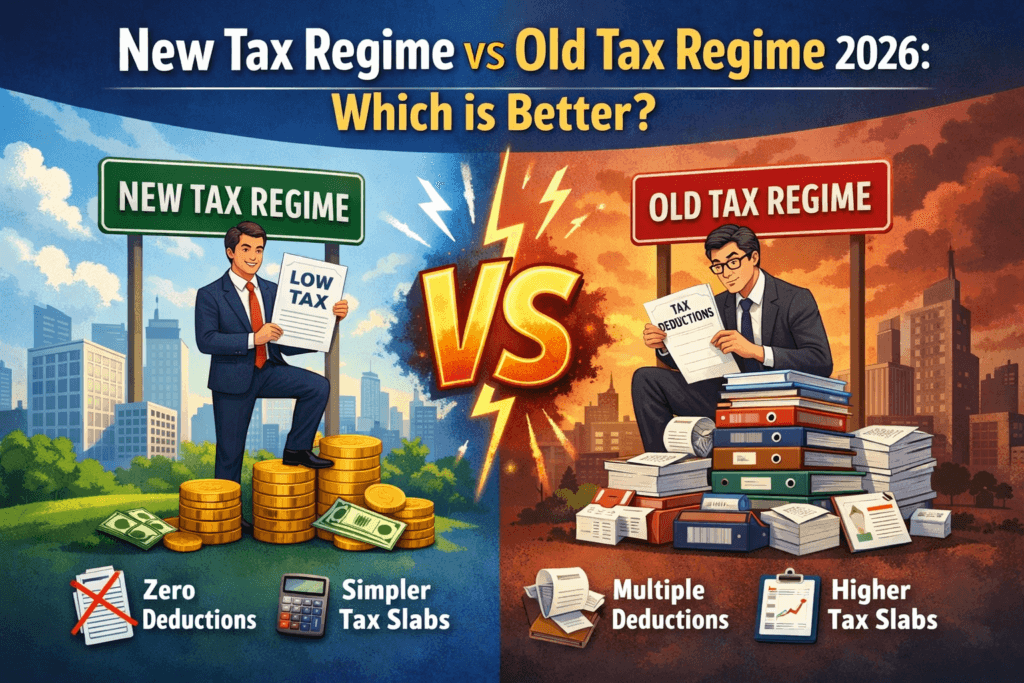
This is where most confusion lies. Here is a clear comparison of what NPS deductions you can claim under each regime.
| NPS Deduction | Old Tax Regime | New Tax Regime | Practical Implication |
| own contribution within 123 | Available — up to 10% of salary within Rs 1.5L ceiling | NOT available | Old regime allows NPS as part of 123 . New regime: no benefit. |
| extra Rs 50,000 own contribution | Available — Rs 50,000 above Rs 1.5L ceiling | NOT available | Most valuable NPS benefit — old regime only. Saves Rs 15,600/yr at 30% bracket. |
| employer NPS contribution | Available | Available — this is the ONLY major deduction in new regime | If your employer contributes to NPS, this is a significant advantage in new regime. |
Worked Example — NPS Benefit in Old vs New Regime at Rs 15L Salary
| Income Component | Old Regime Calculation | New Regime Calculation |
| Gross Salary | Rs 15,00,000 | Rs 15,00,000 |
| Standard Deduction | Rs 50,000 | Rs 75,000 |
| 123 (EPF + ELSS + PPF) | Rs 1,50,000 | Not available |
| 124 — extra NPS | Rs 50,000 | Not available |
| 124 — employer NPS (10% of Rs 8L basic) | Rs 80,000 | Rs 80,000 — available in new regime too |
| Taxable Income | Rs 15,00,000 minus Rs 3,30,000 = Rs 11,70,000 | Rs 15,00,000 minus Rs 1,55,000 = Rs 13,45,000 |
| Tax (approx) | Rs 161,000 + 4% cess = Rs 167,440 | Rs 81,750 + 4% cess = Rs 85,020 |
Note: Illustrative calculation only. Actual figures depend on exact salary structure, applicable regime slabs, and surcharge.
One has to check total tax in both the regimes after considering all the other available deductions like HRA, home loan interest, medical insurance, donation, etc. Thereafter, he can opt for the appropriate regime.
Tier I vs Tier II — Tax Difference
| Feature | Tier I (Pension Account) | Tier II (Voluntary Savings Account) |
| Purpose | Primary retirement account — mandatory for NPS | Voluntary savings — optional |
| Withdrawals | Restricted — only at retirement (60) or specific conditions before | Fully flexible — withdraw any time, any amount |
| 124 deduction | Yes — own contributions eligible | No — not eligible for any tax deduction |
| 124 deduction | Yes — Rs 50,000 extra deduction | No |
| 124 deduction | Yes — employer contributions eligible | No |
| Returns | Market-linked — equity, corporate bonds, govt securities | Market-linked — same investment options |
| Best suited for | Long-term retirement saving with tax benefits | Short to medium term savings with full liquidity — but no tax benefit |
NPS Maturity and Withdrawal Tax Rules
NPS maturity tax treatment is one of the most misunderstood aspects. Here is the complete picture from npstrust.org.in.
| Withdrawal Type | When | Tax Treatment |
| Lump Sum at Maturity (Age 60) | At age 60 or superannuation | 60% of total corpus is tax-free under Schedule II(6). This is a significant benefit. |
| Annuity Purchase at Maturity | Mandatory — at least 40% of corpus must be used to buy annuity | Amount invested in annuity is tax-free at purchase under Section 124. But annuity income received monthly/annually is taxable at your slab rate. |
| Partial Withdrawal (before 60) | After 3 years, for specified purposes — higher education, marriage, home purchase, critical illness | Up to 25% of own contributions is tax-exempt under Schedule III(4). Applies to specified purposes only. |
| Premature Exit (before 60) | After 5 years for any reason | Only 20% can be withdrawn as lump sum (taxable). 80% must be used to buy annuity (annuity income taxable at slab). |
| Death of Subscriber | Any time | Entire corpus paid to nominee — fully exempt from tax. |
The most important withdrawal rule: at age 60, you get 60% tax-free. But the 40% annuity income you receive monthly for the rest of your life is fully taxable at your slab rate. This is why NPS is excellent for building a corpus but has a tax liability at the income stage — unlike PPF, where even the interest received is tax-free throughout.
Frequently Asked Questions
Q1: What is the Section 124 NPS deduction limit in 2026?
Section 124 allows an additional deduction of up to Rs 50,000 per year for contributions to your NPS. This deduction is over and above the Rs 1,50,000 combined ceiling of Sections 123 and 124. So a taxpayer who has already invested Rs 1.5 lakh in 123 instruments can invest an additional Rs 50,000 in NPS and claim Rs 2,00,000 total as tax deduction. Available only in old tax regime.
Q2: Is employer NPS contribution deductible in the new tax regime?
Yes — employer NPS contribution under Section 124 is deductible in BOTH old and new tax regimes. This makes it the only significant tax deduction available to employees in the new regime besides the standard deduction of Rs 75,000. For private sector employees, the deduction is up to 10% of Basic + DA. For government employees, it is up to 14% of Basic + DA. There is no fixed upper limit in rupees — only a percentage limit.
Q3: How much tax can I save with NPS in the old regime?
In the old tax regime, maximum NPS tax saving: 124 up to 10% of salary within Rs 1.5L ceiling (not additional saving if 123 is already maxed) + 124 Rs 50,000 extra + 124 employer contribution. At 30% bracket: Rs 50,000 x 30% + 4% cess = Rs 15,600 saved from 124 alone. If employer also contributes Rs 80,000 (10% of Rs 8L basic), that saves another Rs 24,960 in tax. Combined potential saving: Rs 40,000+ per year in tax at 30% bracket.
Q4: Is NPS maturity amount tax-free?
Partially. At age 60, you can withdraw up to 60% of the total NPS corpus as a lump sum — this 60% is fully tax-free under Schedule II (6). The remaining 40% (minimum) must be used to purchase an annuity. The annuity purchase amount is tax-exempt at the time of investment under Section 124. However, the monthly annuity income you receive thereafter is fully taxable at your income tax slab rate.
Q5: Can I claim both 123 and 124 for NPS?
Yes. The 124 deduction of Rs 50,000 is separate from and in addition to the Rs 1.5 lakh ceiling of 123 /124. You can invest Rs 1.5 lakh in 123 instruments (EPF, ELSS, PPF etc.) AND invest an additional Rs 50,000 in NPS Tier I, claiming a total of Rs 2,00,000 as tax deductions. This combination gives you the maximum possible individual tax deduction under these sections. Old regime only.
Q7: Can self-employed people claim NPS tax benefits?
Yes. Self-employed individuals can claim Section 124 deduction for NPS Tier I contributions up to 20% of gross total income (within the Rs 1.5L 123 ceiling). They can also claim the additional Rs 50,000 under Section 124 on top of this. Section 124 (employer contribution) does not apply to self-employed individuals since there is no employer. Old regime only for both deductions.
Q8: Should I choose NPS or PPF for retirement savings?
NPS and PPF serve complementary roles. PPF gives guaranteed 7.1% tax-free returns with EEE status — safe, predictable, but locked at a modest rate. NPS gives market-linked returns (potentially 10-12%+ long-term) with Rs 50,000 extra deduction and employer NPS benefit — but annuity income at retirement is taxable. Best approach: use both. Max out PPF (Rs 1.5L) for guaranteed safe corpus. Use NPS for the Rs 50,000 extra deduction (old regime) and ask your employer to contribute via 124. Together, they create a balanced retirement portfolio.
Conclusion
NPS offers India’s most powerful additional tax deduction after 123 . Here is your action plan:
- Old regime: Invest Rs 50,000 in NPS Tier I under 124. At 30% bracket, saves Rs 15,600 in additional tax every year.
- New regime: Ask your HR if employer NPS contribution 124 can be included in your CTC restructuring. This is the only major deduction available.
- Maturity: 60% lump sum is tax-free at age 60. Plan for the annuity income being taxable at retirement.
For complete 123 options including NPS: NPS Tax Benefit 2026
For PPF vs NPS comparison in detail: PPF Interest Rate, Limit,Withdrawal & EEE Benefits 2026
For all 15 ways to save tax: How to Save Income Tax India 2026: 15 Legal Ways
Mutual Funds India 2026: Complete Beginner’s Guide
Author
CA Ajay Khandelwal is a Chartered Accountant and financial expert with over 21 years of experience in taxation, compliance, and business advisory. As a key expert at AspirixWriters, he provides practical insights on income tax, financial planning, and regulatory matters, helping readers make informed financial decisions.
Author profile CA. Ajay Khandelwal
Disclaimer
This article is for educational and informational purposes only. It is not personal tax or investment advice. NPS is a market-linked product — returns are not guaranteed. Tax rules for NPS are based on pfrda.org.in, npstrust.org.in, and incometaxindia.gov.in. Please consult your Chartered Accountant before making investment or tax decisions based on NPS.
References
[1] NPS Trust — Tax Benefits under NPS | 124 Rs 50,000 | 60% lump sum tax-free Section Schedule II(6) | Partial withdrawal Schecule III(4) | Annuity tax treatment | npstrust.org.in — https://npstrust.org.in/benefits-of-nps
[2] PFRDA — NPS for Corporates | Section 124 employer contribution | 10% private / 14% government | Both regimes | Rs 7.5L aggregate cap | pfrda.org.in — https://www.pfrda.org.in/web/pfrda/schemes/national-pension-system/nps-for-corporates
[3] Income Tax Department — Deductions | Section 124 limits | 124 old regime only | 124 both regimes | Combined ceiling with 123 | incometaxindia.gov.in —
[4] Income Tax Act 2025 (Act 30 of 2025), egazette.gov.in | Schedule II(6) — 60% lump sum tax-free | Schecule III(4) — partial withdrawal exempt | Section 124 — annuity taxable | Section 124 — annuity purchase exempt — https://egazette.gov.in

Tax Exemption on Sale of Residential House
Section 123 Deductions 2026: Complete List of All Options
Section 123 Deductions 2026 Part of the Income Tax India 2026 : Income Tax India…

PPF Interest Rate, Limit,Withdrawal & EEE Benefits 2026
PPF Interest Rate, Limit,Withdrawal & EEE Benefits Part of the Income Tax India 2026: Income…

NPS Tax Benefit 2026
NPS Tax Benefit 2026: Section124 Rs 50K & Employer NPS Section 124 Extra Rs 50,000…
New Tax Regime vs Old Tax Regime 2026
New Tax Regime vs Old Tax Regime 2026 : Which is Better Every year between…