
Cluster Post 7 | Module 3: Research Methodologies
From Concept to Submission Series | 2026
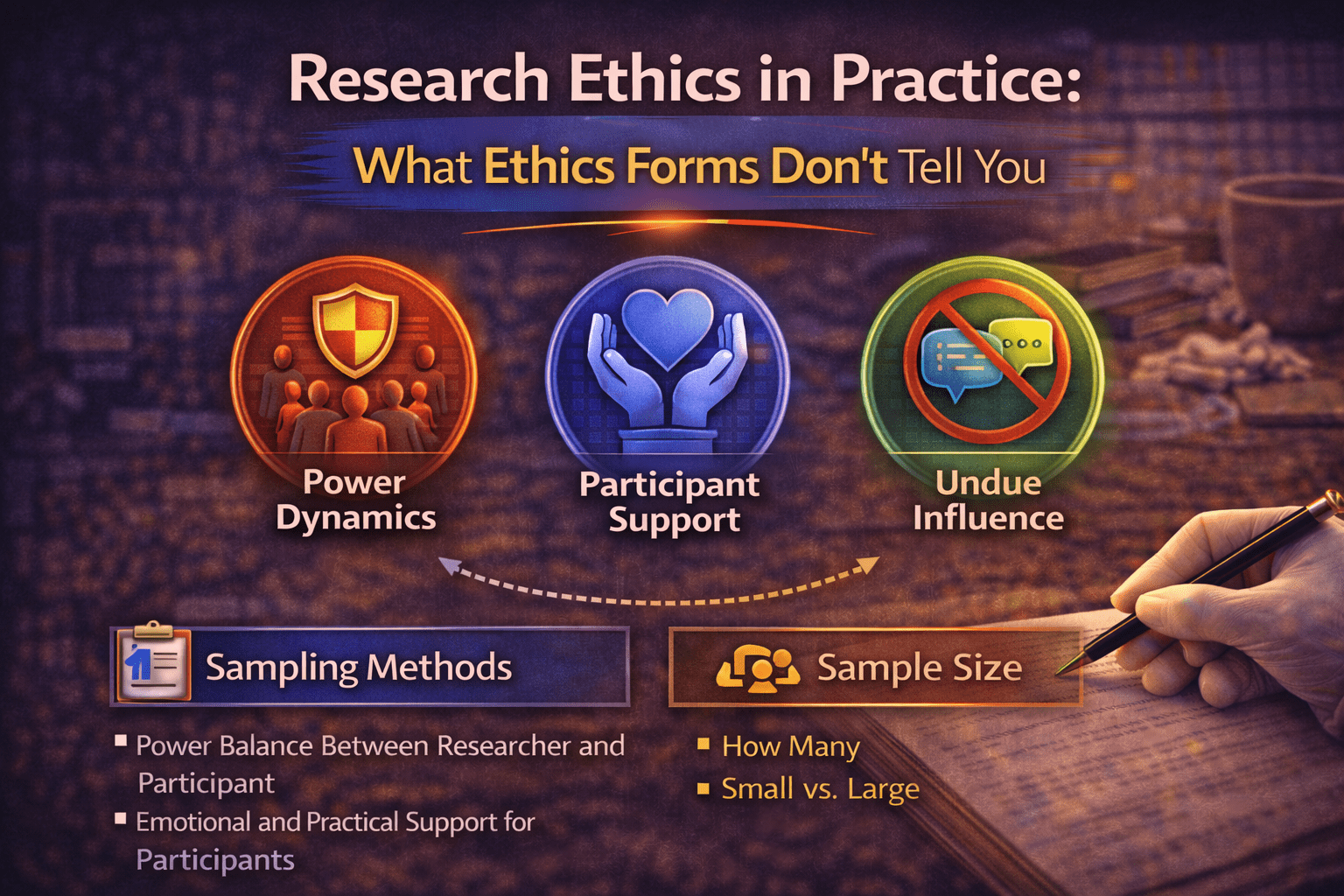
Research Ethics in Practice: What Ethics Forms Don’t Tell You
The module overview covered the three core principles and ethics review. This post goes deeper: what meaningful informed consent actually requires, the specific ethical challenges that arise in institutional and power-imbalanced research settings, the confidentiality limits that most researchers handle badly, and what the Indian university ethics review process looks like in practice — including what to do when your institution has no formal process.
Ethics as Practice, Not Compliance
The module frames ethics correctly: it is not box-ticking for a review committee, it is about respecting the people who participate in your research. But the ethics review process — with its standardised forms, consent templates, and committee sign-offs — can create the impression that ethics is something you complete before the research begins and do not need to think about again.
Real ethical challenges in research arise during data collection and analysis, not before it. A participant who discloses something unexpected and distressing. A power dynamic that becomes apparent only after you are in the field. A finding that could harm someone if published in the way you planned. An anonymisation approach that fails to protect a participant whose situation is distinctive enough to be recognisable.
Ethics in research is an ongoing practice of judgment, not a pre-research certification. The principles — respect, beneficence, justice — must be applied to specific situations as they arise, many of which you could not have anticipated when you completed your ethics form. This post prepares you for those situations.
Informed Consent: What It Actually Requires
The module lists what consent information should cover. This section addresses the three dimensions of consent that ethics forms often reduce to checkboxes but that require genuine attention in practice.
Comprehension, not just information
Consent requires not just that information is provided, but that it is understood. A participant who signs a consent form written in dense academic English without reading it has not given meaningful informed consent — they have signed a document. The distinction matters practically.
Write your consent form in plain language at approximately a Grade 8 reading level. This means short sentences, common words, active voice, and concrete rather than abstract language. If your research is being conducted in a language other than English — Hindi, Tamil, Kannada — the consent form must be in that language, not translated at the time of signing by the researcher. Have the translation reviewed by someone who is not involved in the research.
Dense: “Participation in this study is entirely voluntary and you may withdraw at any time without prejudice to any current or future relationship with the institution.” Plain: “You do not have to take part in this study. If you decide to stop at any time — even after we have started — that is completely fine and will not affect your studies or your relationship with the college in any way.”
Voluntariness in institutional settings
Voluntariness is the most frequently compromised element of consent in research conducted in institutional settings — schools, colleges, workplaces, hospitals. When the person asking for consent has authority over the potential participant, the power relationship may make refusal feel impossible even when it is formally permitted.
If you are a lecturer studying your own students, or a manager studying employees in your organisation, or a doctor studying patients in your clinic, the ethical obligation extends beyond obtaining signed consent. You must actively work to reduce coercion — by having someone other than yourself recruit participants, by being explicit that non-participation has no consequences and that you will not know who did and did not participate, and by designing the study so that participants’ responses cannot be traced back to individuals by anyone in a position of authority over them.
In Indian government college settings, additional power dynamics frequently arise: students may feel they cannot decline a request from a faculty member, and college administrators may pressure students to participate in research that reflects well on the institution. Acknowledge these dynamics in your ethics application and describe specifically how you will manage them.
Ongoing consent
Consent is not a one-time transaction. Participants should be reminded of their right to withdraw at the beginning of each data collection session, particularly for multi-session research or longitudinal studies. For research involving sensitive topics or vulnerable populations, it is good practice to check in explicitly at the end of each session: are you comfortable with what we discussed today? Is there anything you would like me not to include?
Confidentiality: The Limits Most Researchers Handle Badly
The module correctly notes that confidentiality has limits — that researchers may have obligations to report certain disclosures. Most researchers acknowledge this in their consent forms with a brief clause and then give it no further thought. This is insufficient. The limits of confidentiality need to be understood and communicated clearly before data collection begins, not discovered reactively during an interview.
The three main confidentiality limits in Indian research
- Child abuse and child protection: If a participant discloses that a child is being abused — including themselves if they are a minor — you have both a moral and, in most Indian states, a legal obligation to report this. The Protection of Children from Sexual Offences Act (POCSO) 2012 and the Juvenile Justice Act 2015 create mandatory reporting obligations for anyone who has knowledge of offences against children. Your consent form must state this limit explicitly.
- Serious self-harm or suicide risk: If a participant discloses active plans for self-harm or suicide, your ethical obligation to that person’s wellbeing supersedes your obligation to confidentiality. You should have a protocol prepared in advance: contact information for campus counselling services, crisis helplines (iCall: 9152987821; Vandrevala Foundation: 1860-2662-345), and a plan for how to connect the person with support before the session ends.
- Ongoing serious criminal activity: There is no general legal obligation for researchers to report crimes they learn about through research. However, if you learn about ongoing serious harm to identifiable third parties — particularly children — the ethical obligation to prevent harm may outweigh the confidentiality commitment. Think through in advance what you would do if this situation arose, and discuss it with your supervisor before data collection begins.
The consent form clause should be specific, not vague. “Confidentiality has limits” tells a participant nothing useful. “The only situations in which I would share what you tell me are: if I become concerned you might harm yourself, or if you tell me about abuse or harm happening to a child” — this tells them exactly what they are agreeing to and allows genuine informed consent.
Protecting Anonymity When Pseudonyms Are Not Enough
Anonymisation through pseudonyms is the default approach and is usually adequate. But in several research contexts it is insufficient, and recognising those contexts before you publish is significantly easier than recognising them after.
Anonymisation fails when the combination of contextual details — institution, department, year, role, or distinctive experience — makes a participant identifiable to anyone who knows the setting, regardless of whether their name is changed. This is most acute in small organisations, small professional communities, and studies of specific named institutions.
A study of faculty experiences at one named government college in Jaipur, where the college has twelve faculty in the History department. Even with pseudonyms, any colleague reading the published study who recognises “a female faculty member who joined in 2019 after returning from a break for family reasons” knows who is being described. Solution options: Change or omit identifying contextual details where they are not analytically necessary. Aggregate descriptions where possible. Use composite characters (clearly labelled as such) that blend features of multiple participants. Consider whether naming the institution is necessary — if the institutional context matters but its name does not, use a descriptive label instead.
Review your results chapter through the eyes of someone who knows your research site. If you can identify participants, so can they. Have a colleague unfamiliar with your site read it for identifiability — they will catch different things than you will.
Ethics Review in Indian Universities: The Practical Reality
The module describes the ethics review process as a committee that reviews protocols before data collection. In practice, the process varies enormously across Indian universities, and many social science and law researchers discover that their institution either has no formal ethics committee or has a committee that focuses primarily on clinical and biomedical research.
When your institution has a formal ethics committee
Apply early. Ethics committee review at Indian universities typically takes four to eight weeks; some committees meet only quarterly. Account for this in your timeline — begin your ethics application as soon as your research design is sufficiently developed to describe it accurately, which is usually after your literature review and research questions are established but before your instruments are finalised.
Prepare your application to address the committee’s specific concerns. Indian ethics committees following ICMR guidelines will focus on: informed consent procedures, data security, participant confidentiality, special protections for vulnerable groups, and researcher qualifications. A well-prepared application addresses all of these explicitly, which reduces the probability of requests for revision.
When your institution has no formal ethics process
This is more common than it should be in Indian social science and law research, and it places the ethical responsibility entirely with the researcher and supervisor. The absence of a committee does not reduce your ethical obligations — it increases them, because there is no external check.
In the absence of a formal committee, seek ethics review through alternative channels: your supervisor, your department’s research committee if one exists, or — for collaborative or externally funded research — the ethics committee of a partner institution. Document the review process whatever form it takes, because journals and examiners increasingly ask about ethics approval even when they cannot verify it was granted by a formal body.
| Research type | Minimum ethical documentation required |
| Surveys and questionnaires | Participant information sheet, consent form or implied consent statement for online surveys, data security plan, ethics approval or documented supervisor sign-off |
| Semi-structured interviews | Participant information sheet, signed consent form, audio recording consent, transcript confidentiality procedures, ethics approval |
| Focus groups | Participant information sheet, signed consent, reminder that group confidentiality cannot be guaranteed by the researcher, ethics approval |
| Observation (participant or non-participant) | Ethics approval, site access agreement, description of how observed individuals are protected, field notes security procedures |
| Secondary data analysis | Data access agreement from original data holder, confirmation that original collection had ethical approval, data security plan |
🔱 For Law Students
Empirical legal research raises specific ethical issues that general research ethics guidance does not adequately address. Three are particularly important for Indian law researchers.
Interviewing participants in ongoing legal proceedings
Interviewing parties, witnesses, or lawyers in cases that are actively before courts creates specific risks. Parties may be legally advised not to discuss their cases. Statements made in research interviews could theoretically be obtained through discovery or used to challenge witness testimony. Lawyers may face professional conduct concerns if they discuss pending cases.
The safe practice: limit your research to concluded proceedings, or obtain explicit guidance from the relevant court or bar association before interviewing participants in ongoing matters. Your consent form should specify that participants should not share information they are legally prohibited from disclosing, and you should not probe for information that would compromise legal proceedings.
Research involving marginalised communities and law
Research that investigates how marginalised communities — tribal communities, Dalit communities, sex workers, undocumented migrants — experience legal processes requires heightened ethical attention. These communities have often experienced research as extractive — researchers have taken knowledge and produced publications without returning benefit to the community. They may also be legally vulnerable in ways that mean research participation carries risks (exposure of undocumented status, exposure of survival practices that are criminalised) that the standard ethics framework does not capture.
Community consent — obtaining permission from community leaders or representatives as well as individual participants — is good practice for research in close-knit communities, though it does not substitute for individual informed consent. Plan for reciprocity: what will the community receive from this research? Sharing your findings with participants in accessible language, participating in community advocacy informed by your findings, or providing practical legal information are all ways of returning value to research participants.
Confidentiality and legal professional privilege
Research involving lawyers carries a specific confidentiality concern: information a lawyer shares in an interview may relate to client matters that are subject to legal professional privilege. Make clear in your consent form that you are seeking the lawyer’s own views and professional experience, not information about specific clients or cases, and that participants should not share anything that would breach their professional obligations. This protects both you and the participant from inadvertently compromising privilege.
References
- ICMR. (2017). National Ethical Guidelines for Biomedical and Health Research Involving Human Participants. Indian Council of Medical Research.
- Denzin, N. K., & Lincoln, Y. S. (Eds.). (2018). The SAGE Handbook of Qualitative Research (5th ed.). Sage.
- Flick, U. (2018). An Introduction to Qualitative Research (6th ed.). Sage.
- Protection of Children from Sexual Offences Act, 2012 (India). Ministry of Women and Child Development.
- Juvenile Justice (Care and Protection of Children) Act, 2015 (India). Ministry of Women and Child Development.
- iCall Psychosocial Helpline — TISS Mumbai. 9152987821.
- Vandrevala Foundation Mental Health Helpline. 1860-2662-345.
End of Module 3 Cluster Posts — all 7 complete.

The Complete Guide to Research Paper Structure: IMRAD Format, Thesis Organization & Academic Writing (2026)
From Concept to Submission: A Complete Guide to Research Paper and Thesis Writing Module 1:…
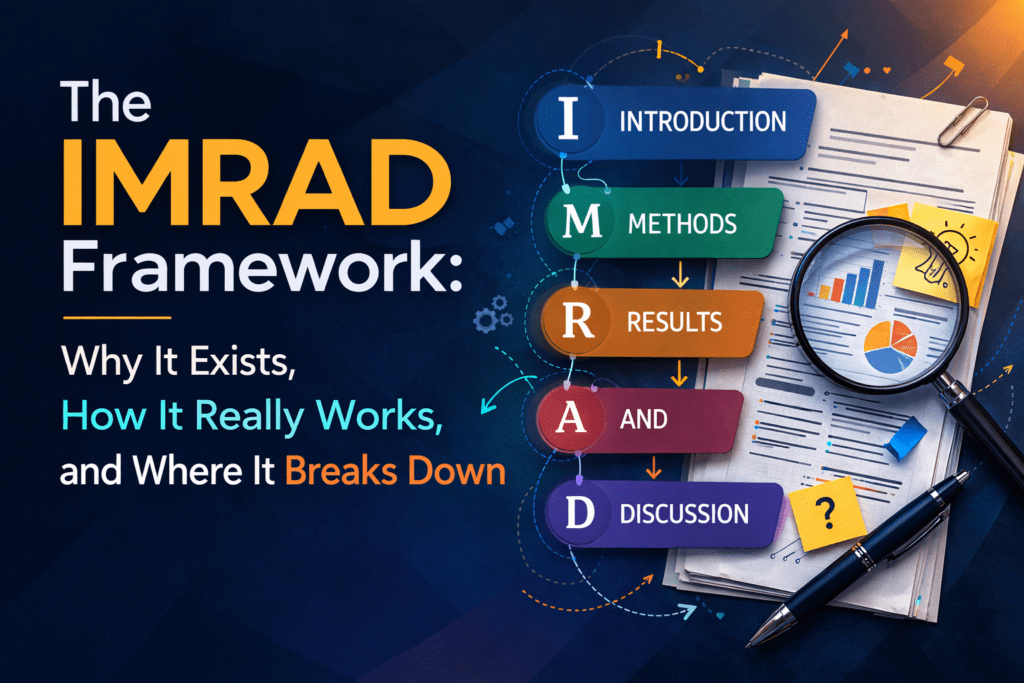
The IMRAD Framework: Why It Exists, How It Really Works, and Where It Breaks Down
Cluster Post 1 | Module 1: Understanding the Structure of Research Papers and Theses From…

How to Write a Research Introduction That Reviewers Cannot Ignore
Cluster Post 2 | Module 1: Understanding the Structure of Research Papers and Theses From…
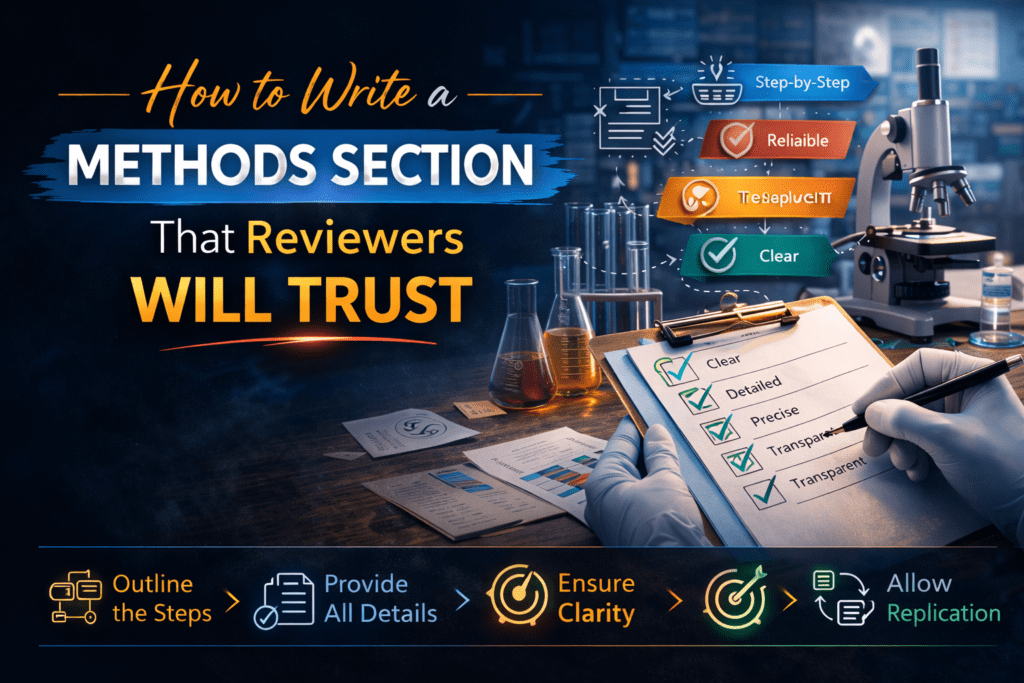
How to Write a Methods Section That Reviewers Will Trust
Cluster Post 3 | Module 1: Understanding the Structure of Research Papers and Theses From…
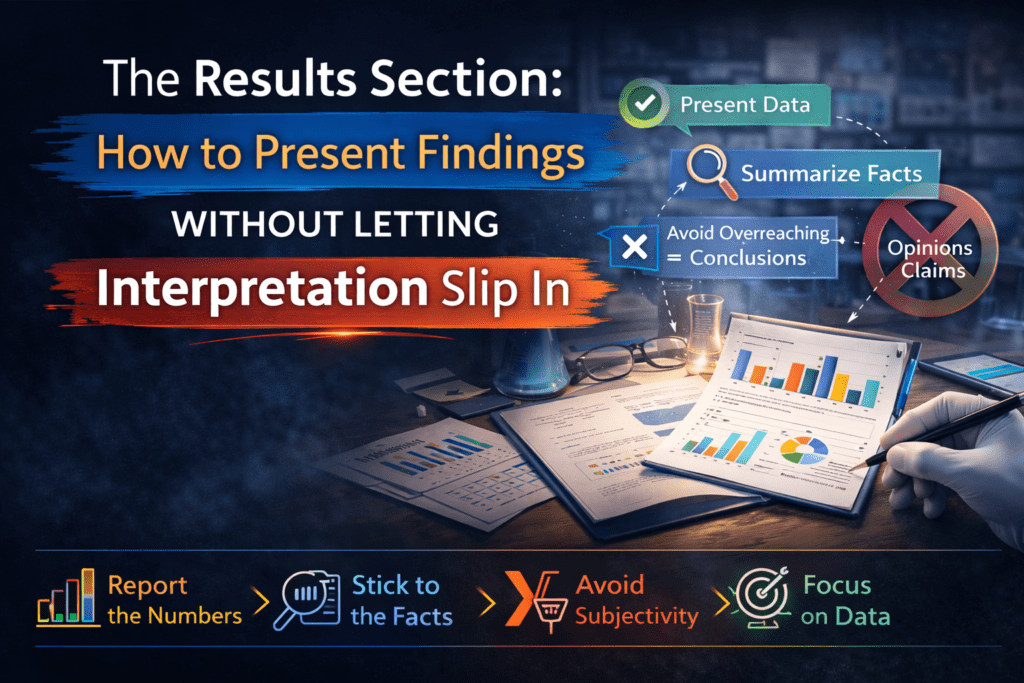
The Results Section: How to Present Findings Without Letting Interpretation Slip In
Cluster Post 4 | Module 1: Understanding the Structure of Research Papers and Theses From…

The Discussion Section: How to Turn Findings Into Knowledge
Cluster Post 5 | Module 1: Understanding the Structure of Research Papers and Theses From…