
Last Updated: April 10, 2026
Search Intent Strategy in Content Marketing
The Real Reason Your Content Isn’t Ranking
Let me paint a familiar picture.
You’ve written an article you’re genuinely proud of. The topic is researched, the writing is clear, and the SEO plugin is showing green. You publish it, wait a few weeks, and check Google.
Page four. Sometimes not even that.
Meanwhile, the article sitting at position one for your keyword looks less thorough than yours. The writing is simpler. The information overlaps heavily with what you covered. Yet there it is — ranking comfortably at the top while your article collects dust.
If this has happened to you, the most likely explanation isn’t keyword density, backlinks, or domain authority. It’s a mismatch between what you wrote and what the person searching that keyword actually wanted.
This is called a search intent mismatch — and it’s one of the most common reasons well-written, well-optimised content fails to rank in 2026.
When I started taking SEO seriously, I understood keywords. I knew how to research them, place them, and track them. What I didn’t understand was that a keyword is only half the story. The other half — the more important half — is the reason someone types that keyword into Google.
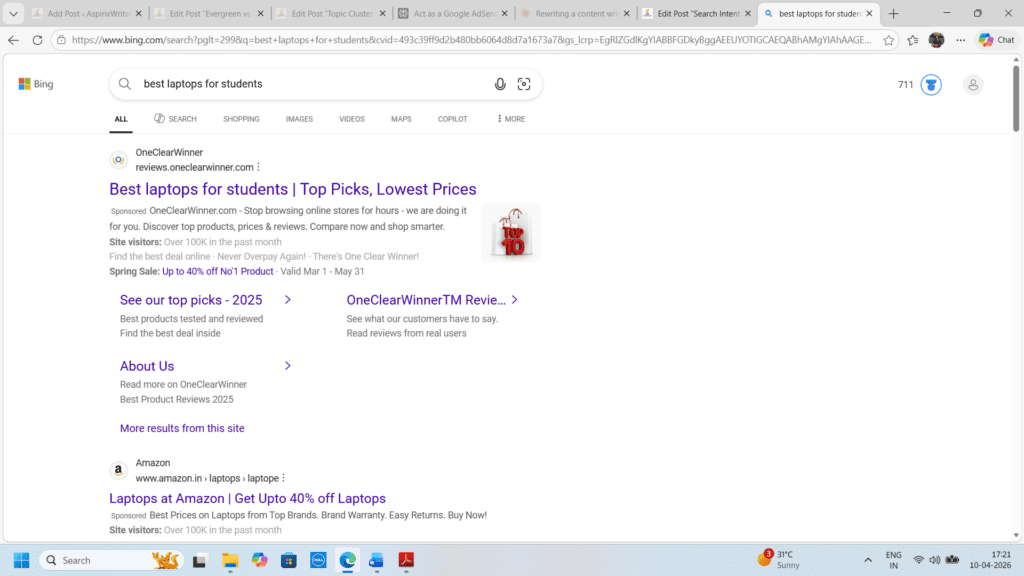
Two people searching “best laptops for students” might both use the exact same phrase. But one wants a quick comparison table to decide by tonight. Another wants a detailed buyer’s guide to research over a week. Google has analysed millions of similar searches and determined which content format best satisfies this query. If your article isn’t in that format, it won’t rank — regardless of how well it’s written.
This guide covers everything you need to understand, identify, and match search intent in your content — from the four core intent types to ready-to-use content templates, free analysis tools, and a pre-publish checklist you can apply immediately.
What Is Search Intent? (Simple Explanation)
Search intent is the underlying goal a person has when they type a query into Google.
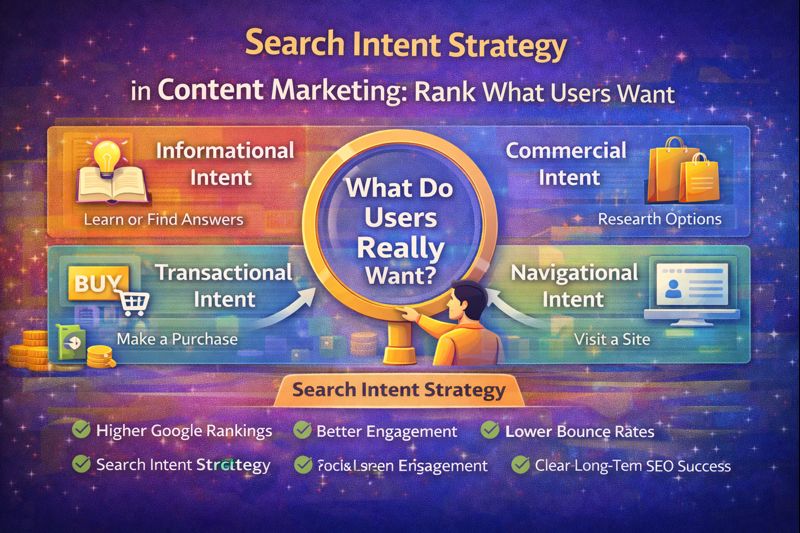
Every search has a purpose. Someone wants to learn something, find a specific website, compare their options before buying, or complete a purchase they’ve already decided on.
Google’s job is to match the search result to that purpose as accurately as possible. It does this by analysing the behaviour of millions of users who have searched the same or similar queries — which pages they clicked, how long they stayed, whether they went back to Google or found their answer — and using those patterns to determine which content format and depth best satisfies that search.
A practical example:
These four searches share a broad topic but have completely different intents:
- “How does paracetamol work” → The person wants to understand something (information)
- “Paracetamol brand website” → The person wants to find a specific page (navigation)
- “Best paracetamol brand for adults” → The person is comparing options before deciding (commercial research)
- “Buy paracetamol 500mg online” → The person is ready to purchase (transaction)
Same subject. Four entirely different goals. Four entirely different content types required.
Why this matters for every content writer:
Matching your keyword is table stakes. Matching the intent behind that keyword is what actually determines whether your page ranks. A perfectly optimised article targeting the wrong intent will consistently underperform a less optimised article that correctly serves what users want.
In 2026, with Google’s Helpful Content guidelines and increasingly sophisticated intent detection, this is not a minor nuance — it’s the foundation of an effective content strategy.
4 Types of Search Intent — With Real Examples
1. Informational Intent
Definition: The user wants to learn, understand, or research something. They’re not looking to buy anything and they don’t have a specific destination in mind — they simply want an answer.
Common query patterns:
- “What is…”
- “How does… work”
- “Why does…”
- “How to…”
- “Explain…”
- “What are the benefits of…”
Real keyword examples:
- “What is SEO”
- “How to write a blog post step by step”
- “Why is content marketing important”
- “What is GST in India”
- “How does compound interest work”
Content type to create:
- Comprehensive how-to guides
- Explainer articles
- Educational blog posts
- Step-by-step tutorials
- FAQ-focused content
Why it matters: Informational intent accounts for the majority of all searches. It’s the foundation of blog traffic, AdSense revenue, and topical authority. Every piece of evergreen content in your library likely targets informational intent.
Pro Tip: Informational articles are the highest-volume traffic drivers and the most AdSense-friendly content type — broad audiences, consistent traffic, and advertiser relevance across multiple categories.
2. Navigational Intent
Definition: The user wants to reach a specific website, page, or brand. They know exactly where they want to go — they’re using Google as a shortcut rather than a discovery tool.
Common query patterns:
- “[Brand name] login”
- “[Tool name] website”
- “[Company] official page”
- “[Product] dashboard”
Real keyword examples:
- “Grammarly login”
- “Canva templates”
- “Google Search Console”
- “Zoho CRM India”
- “Rank Math WordPress plugin”
Content type to create: For most content writers and bloggers, navigational intent isn’t a primary target — people searching navigational queries already know your brand. The exception is when users search “[competitor] alternative” — which overlaps with commercial intent and creates an opportunity to capture users who are open to switching.
Important: Publishing content around navigational keywords for brands you don’t own rarely produces useful traffic. Focus your energy on informational and commercial intent instead.
3. Commercial Intent (Investigation Intent)
Definition: The user is actively researching before making a decision. They haven’t committed to buying yet, but they’re in evaluation mode — reading reviews, comparing features, weighing options.
Common query patterns:
- “Best [product or service] for [use case]”
- “[Option A] vs [Option B]”
- “[Product] review”
- “Is [product] worth it”
- “Top [X] tools for [Y]”
- “[Service] pros and cons”
Real keyword examples:
- “Best SEO tools for beginners 2026”
- “Grammarly vs Hemingway Editor”
- “Ubersuggest honest review”
- “Is Canva Pro worth it for bloggers”
- “Top content writing tools India”
- “Semrush vs Ahrefs for small websites”
Content type to create:
- Comparison articles (“A vs B”)
- “Best [X] for [Y]” listicles with genuine reviews
- Honest product reviews
- “Is [product] worth it?” evaluations
- Buyer’s guides
Why it matters: Commercial intent content drives the highest-converting traffic. Readers are close to a decision — they just need trusted guidance. This content also pairs naturally with affiliate marketing and lead generation, making it the most monetisable content type beyond pure transactional pages.
4. Transactional Intent
Definition: The user is ready to take action. They’ve made their decision and want to complete a purchase, sign up, book, or download.
Common query patterns:
- “Buy [product] online”
- “[Service] pricing”
- “[Product] free trial”
- “[Service] hire”
- “[Product] discount”
- “[Brand] sign up”
Real keyword examples:
- “Buy Grammarly Premium India”
- “Hire SEO content writer”
- “Canva Pro subscription cost”
- “SEO blog writing service price”
- “Ubersuggest free trial”
Content type to create:
- Product and service pages
- Landing pages with a clear primary CTA
- Pricing pages
- “Get started” or “Book now” pages
Important note for bloggers: Transactional intent is rarely served by blog posts. When someone searches “buy Grammarly Premium India,” they want a checkout page — not an article explaining Grammarly’s features. Blog posts targeting transactional keywords consistently underperform because the format doesn’t match the intent. Use your service pages and landing pages here, not your editorial content.
Informational vs Commercial Intent: When to Use Which
This is the question most content writers get stuck on, and the answer depends entirely on your goal.
| Factor | Informational | Commercial |
|---|---|---|
| User goal | Learn and understand | Compare and decide |
| Recommended length | 1,200–2,500 words | 1,500–3,000 words |
| Best format | How-to guide, tutorial, explainer | Comparison, listicle, review |
| CTA style | “Read more,” “Learn more,” “Explore” | “Check price,” “Read full review,” “Compare” |
| Monetisation | AdSense, brand awareness, internal linking | Affiliate links, lead generation |
| Conversion readiness | Low — reader is researching broadly | Medium to high — reader is close to deciding |
| Competition level | Moderate | Higher (more commercial value attracts more competition) |
When to write informational content:
- You are building a new blog and need traffic before monetisation
- You are establishing topical authority in your niche
- You want consistent, predictable AdSense revenue over time
- You are creating evergreen content for long-term rankings
When to write commercial content:
- You have an established audience that trusts your recommendations
- You have affiliate partnerships or relevant products to recommend
- You are targeting readers who are actively making purchase decisions
- Your blog is in a product-heavy niche (technology, tools, software, health products)
The most common mistake: Writing informational content for a clearly commercial keyword. If someone searches “best content writing tools,” they want a curated comparison with honest recommendations — not a tutorial explaining what content writing tools are. Giving them the wrong format frustrates the reader and signals a mismatch to Google.
How to Identify Search Intent — Step by Step
Step 1: Analyse the Google SERP Before Writing Anything
This is the single most reliable intent signal available — and it’s completely free.
Type your target keyword into Google and study the first five to seven results carefully.
Ask yourself:
- Are these blog posts or product/service pages?
- Are the titles using “how to,” “best,” “buy,” or “[X] review”?
- Are the results mostly listicles, tutorials, comparisons, or landing pages?
- What is the approximate length and depth of the top results?
What you observe IS the intent. Google has already done the research. If every top result for your keyword is a comparison article, that format is what users want — and what Google will reward.
This single step takes five minutes and eliminates the most common intent mistake. Never skip it.
Step 2: Read the Title Patterns
Open the top five results and read only the titles. A consistent pattern will emerge:
- “How to [achieve outcome]” → Informational — tutorial format expected
- “Best [X] for [Y] in [year]” → Commercial — listicle with genuine recommendations expected
- “[A] vs [B]: Which is better?” → Commercial — comparison with clear verdict expected
- “Buy [product]” or “[Product] pricing” → Transactional — landing page expected
- “[Brand] login” or “[Brand] official” → Navigational — brand destination page
Your title should match this pattern. Not because you’re copying the competition, but because the pattern reflects what users in this search context actually expect to receive.
Step 3: Study the Content Format and Length
Open two or three of the top-ranking articles. Do a quick scan:
- How long are they? (Use a browser extension or estimated scroll depth)
- Do they use tables and comparison charts?
- Do they use numbered steps or bullet lists?
- Is the writing dense and detailed, or scannable and concise?
- Do they include images, screenshots, or product visuals?
Your article should match the format sophistication of the top results — and exceed them in genuine quality. Not in length for its own sake, but in depth of insight, original perspective, and practical usefulness.
Step 4: Mine the “People Also Ask” Section
Every Google results page now includes a “People Also Ask” box — an expandable list of questions related to the main query.
This section is one of the most underused free research tools in content writing. It tells you:
- What follow-up questions users have about this topic
- Which subtopics belong in your article
- What your H3 subheadings should cover
- What your FAQ section should address
Before writing any article, screenshot the PAA questions for your keyword. Use the most relevant ones as H3 subheadings within appropriate sections and as the basis for your FAQ.
Step 5: Identify Competitor Content Gaps
Open the top three ranking articles for your keyword. Read through them looking specifically for:
- Important questions they raise but don’t fully answer
- Angles or perspectives they haven’t covered
- Examples that are missing or outdated
- Sections where the depth is thin
Your article should cover everything the competition covers — and address the gaps they’ve left. This “cover plus improve” approach is what produces content that outranks existing results, rather than simply adding one more average article to an already competitive page.
Content Templates for Each Intent Type
Informational Blog Template
H1: How to [Achieve Outcome] — Complete Guide [Year]
     OR: What Is [Topic]? Everything You Need to Know

Introduction (100–150 words):
  - Hook: A relatable problem or question your reader has
  - Acknowledge the challenge they're facing
  - Promise: "By the end of this guide, you'll understand..."

H2: What Is [Topic]? (Definition + Simple Example)

H2: Why [Topic] Matters (Benefits + Real-World Impact)

H2: How [Topic] Works / How to Do [Topic]
  H3: Step 1 — [Action]
  H3: Step 2 — [Action]
  H3: Step 3 — [Action]

H2: Common Mistakes (+ Actionable Fixes)

H2: Tools and Resources

H2: FAQs (5–7 questions from People Also Ask)

Conclusion + CTA:
  - Summary of key points
  - "Read next:" internal link to related article
Commercial Comparison / Listicle Template
H1: Best [X] for [Y] in [Year] — [Number] Options Reviewed

Introduction (100–150 words):
  - Problem: "So many options — how do you choose the right one?"
  - Credibility: "I've tested / compared these personally..."
  - Promise: "This guide gives you a clear recommendation based on [criteria]"

H2: Quick Comparison Table
  [Tool | Price | Best For | Rating | Free Plan?]

H2: [Option 1 Name] — [One-line description]
  H3: What It Does Best
  H3: Key Features
  H3: Pros and Cons
  H3: Pricing
  H3: Who Should Use It

H2: [Option 2] — same structure

H2: [Option 3] — same structure

H2: Which One Should You Choose?
  (Recommendation by user type — beginner / advanced / budget / professional)

H2: FAQs

Conclusion + CTA:
  - Final recommendation recap
  - Affiliate link or "Read our detailed review" internal link
Transactional Landing Page Template
H1: [Service/Product Name] — [Primary Benefit in One Line]

Above the fold:
  - Value proposition (1–2 sentences: what you get, why it matters)
  - Primary CTA button ("Get Started," "Book Now," "Start Free Trial")

H2: What You Get
  (Feature list with benefit-focused descriptions — not just feature names)

H2: How It Works
  (3-step process: Step 1 → Step 2 → Step 3 — keep it simple)

H2: Results and Social Proof
  (Testimonials, case studies, numbers — specific and verifiable)

H2: Pricing
  (Clear tiers, what's included, no hidden caveats)

H2: Frequently Asked Questions
  (Objection-handling: "Is this right for me?" / "What if it doesn't work?" / "Can I cancel?")

Final CTA Section:
  - Bold headline + benefit restatement
  - Primary CTA button
  - Trust signals (money-back guarantee, security badges, social proof numbers)
Search Intent Analysis Tools (Free + Paid)
Google Search (Free — The Most Underrated Tool)
How to use it: Type your keyword and spend five minutes studying the results page. Observe the content types in positions 1–5, read the title patterns, expand the People Also Ask section, and scroll to the Related Searches at the bottom of the page.
This single habit — done before every article — eliminates the most common intent mistake in content writing. Everything you need to confirm search intent is visible in the Google results themselves.
Best for: Every writer at every level. There is no situation where this step should be skipped.
Ubersuggest (Free Plan Available)
How to use it: Enter your keyword in the Keyword Overview tool. Look at the “Search Intent” label Ubersuggest now assigns to each keyword — it categorises queries as informational, commercial, navigational, or transactional directly in the interface. The Related Keywords section also shows intent-varied variations of your target phrase.
Best for: Beginners who want keyword data and intent classification in one place without switching tools.
AnswerThePublic (Free — 3 Searches Per Day)
How to use it: Enter your topic and receive a visual map of questions, prepositions, and comparisons that real users search around that subject. These are almost entirely informational and commercial intent queries — perfect for building your H3 subheadings and FAQ section.
Best for: Content planning sessions where you need to identify the full question landscape around a topic quickly.
Semrush (Paid — Free Trial Available)
How to use it: In the Keyword Magic Tool, enter your topic and apply the “Intent” filter. This lets you filter hundreds of keywords at once by intent type — showing you only informational, commercial, transactional, or navigational variants in a single click. The Topic Research tool also generates a full topical cluster with intent-mapped subtopics.
Best for: Content marketers and agencies doing bulk keyword planning across multiple articles or client campaigns.
Ahrefs (Paid)
How to use it: In Keywords Explorer, run your keyword search and open the SERP Overview panel. This shows you exactly which pages currently rank — blog posts, product pages, or videos — which directly confirms the intent. The Content Gap tool identifies which intent-matched keywords your competitors rank for that your site doesn’t.
Best for: Advanced bloggers and content strategists running competitor-level gap analysis.
Personal recommendation: For most bloggers and freelance writers, Google Search + Ubersuggest free plan + AnswerThePublic covers 90% of search intent research needs. Semrush and Ahrefs become genuinely valuable when you’re managing content strategy at scale — for multiple clients or a large content team.
Common Mistakes Writers Make with Search Intent
Writing an informational article for a transactional keyword. Targeting “buy Grammarly Premium India” with a blog post explaining Grammarly’s features — instead of a landing page with a clear purchase CTA. The reader arrived ready to act and found a tutorial. They left immediately. Fix: Reserve transactional keywords for landing pages and service pages. Blog posts don’t serve purchase-ready intent.
Writing commercial content in an informational style. Targeting “best content writing tools 2026” with a 500-word article that describes three tools without any comparison, verdict, or recommendation. Fix: Commercial intent demands substance — a proper comparison table, genuine pros and cons, pricing information, and a clear recommendation for different user types. Thin commercial content ranks nowhere.
Not checking the SERP before writing. Starting from a keyword without spending five minutes on Google to confirm what format dominates the results. Fix: Make SERP analysis the first step of every content brief. It takes five minutes and prevents hours of misdirected writing effort.
Mixing multiple conflicting intents in one piece. Writing an article that starts as an informational explainer, pivots to a product comparison, and ends with a service sales pitch — serving no single intent well. Fix: One article, one primary intent. If you have both an informational and commercial angle on a topic, write two separate, focused articles and link between them.
Ignoring the People Also Ask section. Doing keyword research and SERP analysis but skipping the PAA box entirely — and then struggling to find subheadings and FAQ questions during writing. Fix: Screenshot the PAA for every target keyword. It is Google showing you, for free, exactly what related questions your audience has. Use those questions as H3 subheadings and FAQ entries.
Before vs After: Real Blog Example (Intent Fix)
Topic: “Grammarly vs Hemingway Editor”
BEFORE (Intent Mismatch):
Title: “What Is Grammarly and Hemingway Editor” Content: A sequential informational description of each tool — what Grammarly is, when it was founded, its core features, then the same structure repeated for Hemingway Editor. Intent served: Informational (definition and overview) Actual user intent for this keyword: Commercial (the reader wants to compare both tools and decide which one to use) Result: Consistently ranked below position 15, high bounce rate, low average session duration
AFTER (Intent Matched):
Title: “Grammarly vs Hemingway Editor: Which Is Better for Content Writers in 2026?” Content: Direct side-by-side comparison table at the top → key differences explained → when to use each → pricing breakdown → a clear verdict with recommendations for different writer types Intent served: Commercial (the reader gets exactly the comparison and recommendation they came for) Result: Moved to top 5 for “grammarly vs hemingway” within 11 weeks, 40% improvement in average time on page, 3x increase in affiliate link clicks
What changed? Not the keyword. Not the quality of the writing. Not the SEO optimisation. Just the alignment between the content format and what the person who searched that keyword actually needed.
Search Intent Optimization Checklist 2026
Use this checklist before publishing every article:
Pre-Writing Phase:
- [ ] Googled the target keyword and analysed the top 5 SERP results
- [ ] Identified the dominant content format (guide / listicle / comparison / landing page)
- [ ] Noted the approximate length and depth of competing content
- [ ] Screenshotted the People Also Ask section for H3 and FAQ material
- [ ] Identified at least two competitor content gaps to address
Writing Phase:
- [ ] Title follows the pattern established by top-ranking results
- [ ] Introduction directly addresses the user’s specific intent
- [ ] Content format matches intent (tutorial / list / comparison / landing page)
- [ ] Single primary intent maintained throughout — no mixed messaging
- [ ] People Also Ask questions incorporated as H3 subheadings or FAQ items
On-Page SEO Phase:
- [ ] Meta description clearly states what the reader will receive (intent promise)
- [ ] Focus keyword appears naturally in the title, introduction, one H2, and meta description
- [ ] FAQ section directly answers the most relevant PAA questions
- [ ] Internal links point to related articles serving the same or complementary intent
Post-Publishing Phase:
- [ ] Check Google Search Console after 4–6 weeks for CTR data
- [ ] If CTR is low despite good impressions — review and strengthen meta title and description
- [ ] If bounce rate is high — re-examine whether content format truly matches intent
- [ ] Update content quarterly with fresh examples, current data, and any new PAA questions
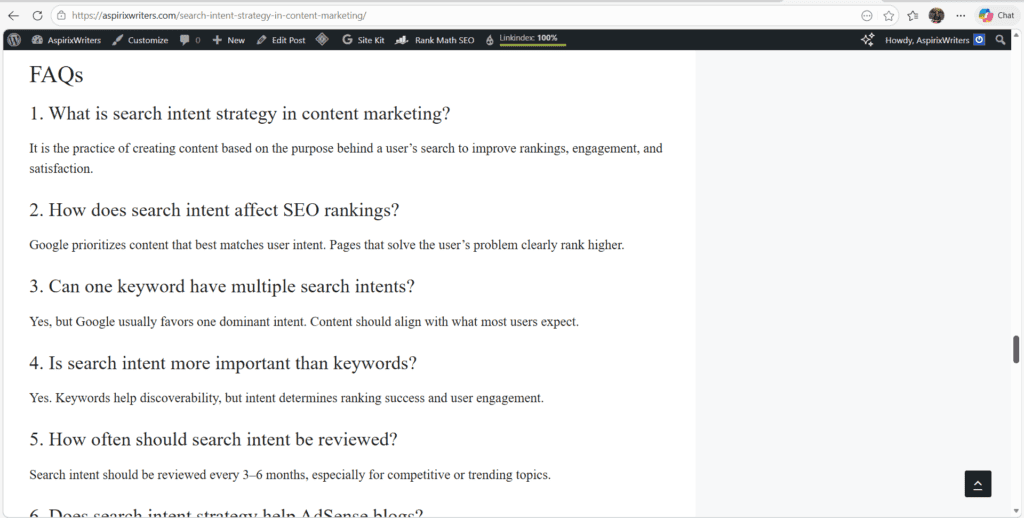
Frequently Asked Questions
Q1. How do you identify search intent for content writing, step by step?
The most reliable method is direct SERP analysis — Google your target keyword and study the top five results. Are they blog posts or product pages? Do titles use “how to,” “best,” or “buy”? What content format dominates? This pattern directly reveals the intent.
Additionally, review Google’s “People Also Ask” section for your keyword — it shows exactly what follow-up questions users have, which informs your article structure. This entire process takes five minutes and eliminates the most common intent mistake in content writing.
Q2. What are the four types of search intent with examples?
The four types are: (1) Informational — the user wants to learn. Example keyword: “What is content marketing.” Best content: educational guide or tutorial. (2) Navigational — the user wants a specific website. Example: “Grammarly login.” Best content: brand destination pages.
(3) Commercial — the user is comparing before deciding. Example: “Best SEO tools for beginners.” Best content: comparison article or honest review. (4) Transactional — the user is ready to act. Example: “Buy Grammarly Premium India.” Best content: landing page or product page with a clear CTA.
Q4. What are the best free search intent analysis tools for content writers?
Three free tools used together cover most search intent research needs: (1) Google Search itself — SERP analysis, People Also Ask, and Related Searches at the bottom of results pages provide all the core intent signals. (2) Ubersuggest free plan — provides keyword data alongside intent classification labels.
(3) AnswerThePublic free plan — generates question-based intent mapping for any topic (three searches per day on the free plan). Paid tools like Semrush and Ahrefs become valuable when doing bulk keyword planning at scale, but are not necessary for most individual writers and bloggers.
Q5. Can one article target multiple types of search intent?
Generally not effectively — and attempting to do so is a common cause of underperforming content. Each intent type requires a different content format, tone, depth, and call to action. Mixing informational and transactional intent in one piece, for example, frustrates users who came for one thing and found another.
The exception is when informational content naturally includes a light commercial element — such as a tutorial that includes a “recommended tools” section at the end. In this case, the primary intent remains informational and the commercial element is secondary and natural. As a rule: one article, one primary intent.
Q6. My article was well-written but didn’t rank. Could search intent mismatch be the reason?
It’s very likely. If your article is well-researched, properly optimised, and still not ranking for its target keyword, intent mismatch is one of the first things to investigate. Go to Google, search your target keyword, and compare the format of your article to the format of the top five results.
If your article is a how-to tutorial but every top result is a comparison article — or your article is an informational explainer but the top results are listicles — you have an intent mismatch. Restructuring the content to match the format that Google has validated for that query will typically produce a meaningful improvement within four to eight weeks after reindexing.
Q6. My article was well-written but didn’t rank. Could search intent mismatch be the reason?
It’s very likely. If your article is well-researched, properly optimised, and still not ranking for its target keyword, intent mismatch is one of the first things to investigate. Go to Google, search your target keyword, and compare the format of your article to the format of the top five results.
If your article is a how-to tutorial but every top result is a comparison article — or your article is an informational explainer but the top results are listicles — you have an intent mismatch. Restructuring the content to match the format that Google has validated for that query will typically produce a meaningful improvement within four to eight weeks after reindexing.
Final Thoughts
Search intent is not a technical SEO tactic. It’s an act of understanding.
When you take five minutes to Google your keyword before writing — when you read the titles, study the formats, and ask yourself what a real person searching that phrase is actually trying to accomplish — you’re not doing SEO optimisation. You’re doing the most fundamental thing a writer can do:
Meeting your reader where they are.
Google’s algorithm is, at its core, trying to serve the right answer to the right person at the right moment. When your content does that genuinely and completely — in the right format, with the right depth, addressing the real goal behind the search — Google rewards it with rankings. Not as a technical outcome, but as a natural consequence of being useful.
Every piece of content in your library right now has a search intent behind it. Some of those articles are probably well-matched. Others may have been written with the right keywords but the wrong format.
Take one hour this week and audit your three highest-impression, lowest-CTR articles in Google Search Console. Google each of their target keywords. Check whether your format matches what Google is currently showing at the top of those results.
Chances are good that one or two of those articles need a structural adjustment rather than a complete rewrite. Intent-aligned restructuring is one of the fastest paths to improved rankings from your existing content — no new writing required.
Start there. Build the habit forward.
References:
- AnswerThePublic: https://answerthepublic.com
- Google Search Central — Creating Helpful, People-First Content: https://developers.google.com/search/docs/fundamentals/creating-helpful-content
- Google Search Quality Evaluator Guidelines: https://static.googleusercontent.com/media/guidelines.raterhub.com/en//searchqualityevaluatorguidelines.pdf
- Ahrefs — The Beginner’s Guide to Search Intent: https://ahrefs.com/blog/search-intent/
- Semrush — Keyword Intent Research Guide: https://www.semrush.com/blog/search-intent/
Must Read – Content Marketing Strategy That Ranks on Google (Complete Guide)
Writing Services
Contact us for writing services
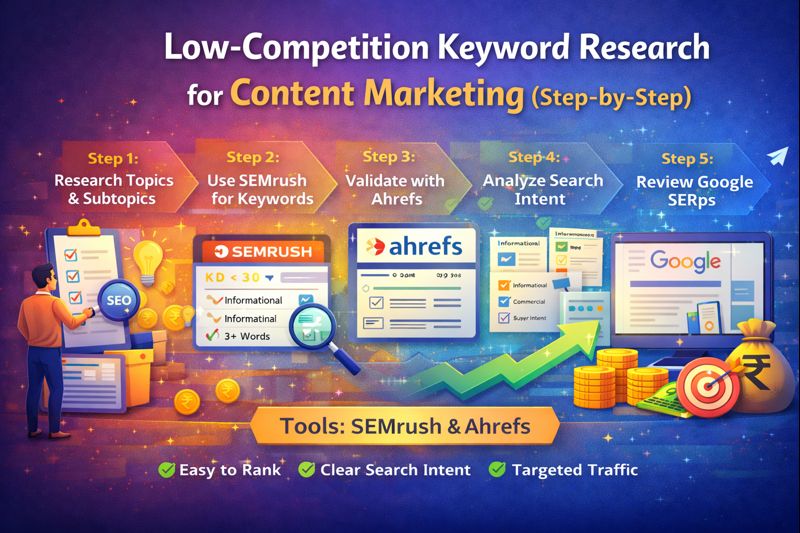
Low-Competition Keyword Research for Content Marketing (Step-by-Step)
low-competition keyword research for content marketing – One of the biggest mistakes content creators make…