
Last Updated: April 29, 2026
Creative Writing & Storytelling
Every Writer Starts Here – With a Blank Page and a Doubt
How to Create an SEO Content Strategy
You open a new document. The cursor blinks.
You have a feeling — some half-formed idea, a character who appeared in a dream, a situation you’ve been turning over in your mind for weeks. Something wants to be written. You can feel it.
And then the doubt walks in.
What if it’s not good enough? What if I don’t know how to structure it? What if I start and can’t finish? What if the idea that feels brilliant in my head comes out flat and lifeless on the page?
The cursor keeps blinking.
Here’s what I wish someone had told me when I first sat down to write a story: every single writer you have ever admired started exactly where you are right now. With uncertainty, with a half-formed idea, with the fear that they might not be able to pull it off.
The difference between the writers who learned to tell powerful stories and the ones who didn’t isn’t talent. It’s the willingness to start anyway, to learn the craft deliberately, and to keep going past the first awkward paragraph.
Creative writing is a skill. Like any skill, it has principles, techniques, and a learnable structure underneath what feels like pure instinct. Once you understand that structure — once you see the scaffolding beneath the stories that moved you — writing becomes less mysterious and more manageable.
This guide is everything I’ve learned about that structure, distilled into a practical, step-by-step form. Whether you want to write short stories, novels, blog narratives, or marketing content with emotional resonance — the same principles apply.
How to Write Clear and Engaging Blog Introductions
Let’s start from the beginning.
What Is Creative Writing and Storytelling, Really?
Creative writing is any form of writing that goes beyond purely informational or transactional communication. It uses narrative, character, emotion, and imagination to create an experience for the reader — not just transmit information.
But here’s the thing most beginner writers don’t realise: storytelling isn’t confined to fiction. It appears in:
- Short stories and novels (the obvious ones)
- Blog posts that open with a personal moment or scene
- Marketing copy that makes you feel something before it asks you to do something
- Essays that follow a character (often the writer) through a change
- Social media posts that begin with “Let me tell you about the day…”
- Speeches, speeches, TED talks — all narrative structures
What makes storytelling powerful isn’t elaborate vocabulary or clever structure. It’s the ability to make a reader feel something — and through that feeling, understand something they didn’t before.
The best stories do one thing above everything else: they make the reader feel less alone. They say, “Someone else has felt this. Someone else has been here. You are not the only one.” That recognition — that moment of being seen — is what keeps people reading at midnight when they should be sleeping.
The Five Elements Every Powerful Story Needs
These aren’t rules. They’re the bones that every memorable story is built on.
1. Character
Someone your reader can care about. Not necessarily like — care about. Even a flawed, complicated, morally grey character can command a reader’s full attention if they feel real and specific.
The test of a character isn’t whether they’re likeable — it’s whether the reader finds themselves thinking about them after they’ve closed the book.
2. Plot
What happens. But more specifically: the sequence of events that reveals who the character truly is under pressure. Plot is not just “things happening” — it’s what the character does when things happen, which reveals everything about who they are.
3. Conflict
The engine of every story. Conflict doesn’t have to mean fighting. It means something is preventing the character from getting what they want or need. The conflict creates tension — and tension is what keeps readers turning pages.
The four types of conflict: character vs character, character vs nature/circumstance, character vs society, character vs self. That last one — internal conflict — is often the most powerful.
4. Emotion
The vehicle through which readers experience the story. A story can have perfect structure, compelling characters, and fascinating plot — and still feel completely flat if the emotional texture isn’t there.
Emotion in writing comes from specificity, not declaration. You don’t write “she was sad.” You write “she sat in the car for eleven minutes before going inside, because she wasn’t ready to pretend yet.”
5. Message
Not a moral lecture — a human truth the story illuminates. The message doesn’t have to be stated. In fact, the best messages are never stated directly. They’re felt by the reader in the final pages, as a quiet realisation that something in them has shifted.
Time Management for Writers: How to Make Your Writing Journey Productive
Step-by-Step Story Writing Process
Step 1 — Generate Your Idea
Where stories actually come from:
- A “what if” question: What if a woman discovers she has been living someone else’s life?
- An emotion you want to explore: What does grief actually feel like from the inside?
- A character who appears: A man who has never cried, at his daughter’s wedding.
- A situation or image that won’t leave you: Two strangers on a train, both going to the same funeral.
- A truth you’ve observed and want to examine: How people perform happiness for others while suffering privately.
Beginner tip: Don’t wait for the “perfect” idea. Write the idea that’s already in your head, even if it seems small. Small ideas explored with full emotional honesty produce better stories than grand ideas explored superficially.
Step 2 — Build Your Story Structure (Beginning–Middle–End)
Every story — regardless of length, genre, or style — follows some version of this structure:
Beginning (Act 1):
- Establish the world, the character, and the “ordinary” before everything changes
- Introduce the inciting incident — the event that disrupts the ordinary and forces the character to act
- End the first act with a clear question the story will answer
Middle (Act 2):
- The character pursues their goal and encounters obstacles
- Stakes escalate — each obstacle is harder than the last
- The character is tested and revealed through how they respond
- The midpoint shifts something fundamentally — a revelation, a reversal, a loss
- The end of Act 2 is the lowest point — when all seems lost
End (Act 3):
- The character faces the central conflict at its most intense
- They make a decisive choice that reflects their true self
- Resolution — not necessarily happy, but emotionally complete
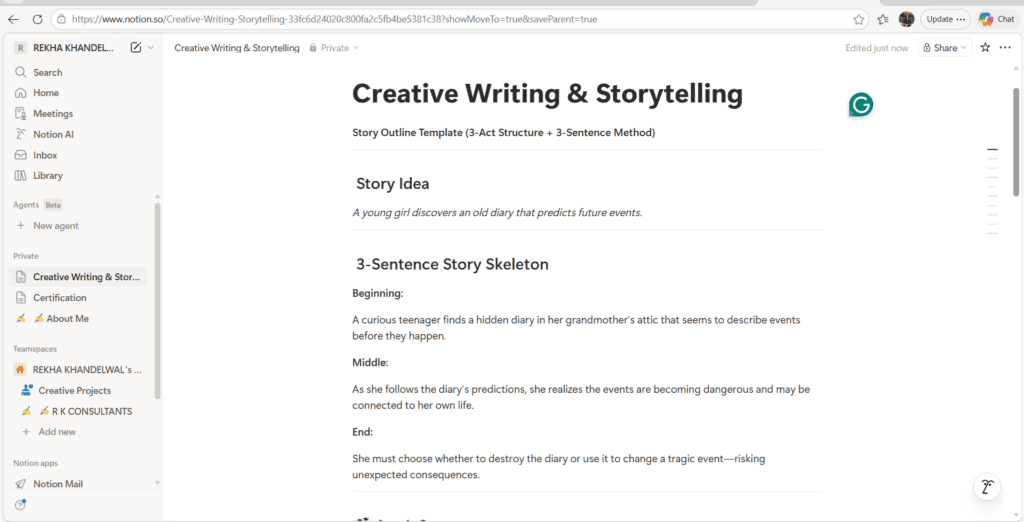
Beginner tip: Before you write a single scene, write these three sentences: “My character wants ___. They are prevented from getting it by ___. By the end, they learn ___.” This three-sentence skeleton will keep your story on track through the entire drafting process.
Step 3 — Develop Your Characters
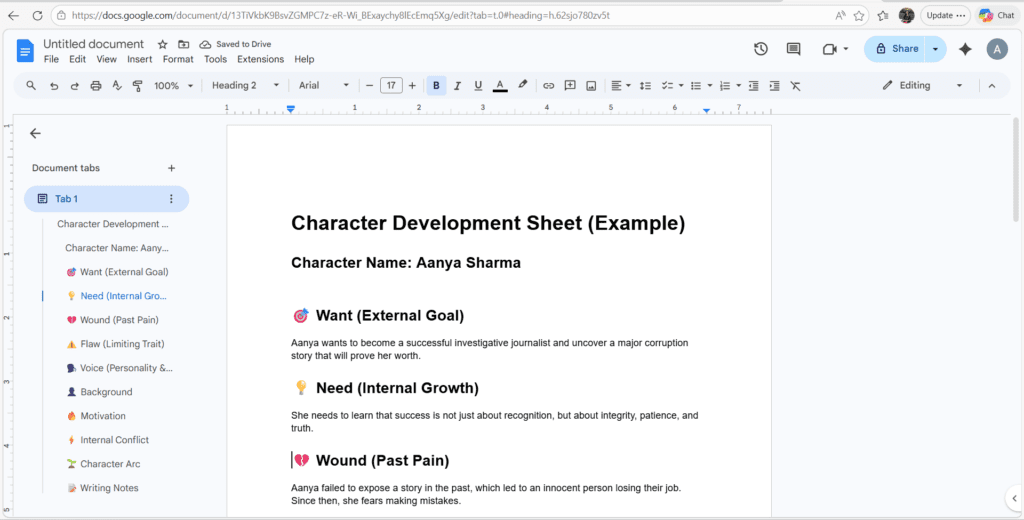
Give your main character at least these five things before you begin writing:
- A want (what they are consciously pursuing)
- A need (what they actually require to be whole — often different from what they want)
- A wound (a past experience that shapes how they see the world)
- A flaw (a specific way their wound distorts their behaviour)
- A voice (the specific way they speak and think, distinct from every other character)
The tension between want and need is often the engine of the entire story. A character who wants success but needs connection will behave in ways that create fascinating conflict.
Beginner tip: Interview your character. Sit down and ask them questions as if they’re a real person across from you. What do they regret? What do they never talk about? What small habit do they have that no one knows about? The answers you find surprising are the ones that will make the character feel real on the page.
Step 4 — Write Natural Dialogue
Dialogue is often where beginner writers struggle most — it either sounds impossibly formal or implausibly casual, but never quite real.
The core principle: People don’t talk to exchange information. They talk to get things, protect themselves, connect with others, or avoid saying what they actually mean.
Rules for natural dialogue:
- People interrupt, trail off, and change subject mid-thought
- People rarely answer the question that was actually asked
- What a character doesn’t say is often more revealing than what they do
- Each character should have a distinct speech pattern — vocabulary, rhythm, tendency to use certain phrases
- Avoid using dialogue to dump exposition (“As you know, Bob, we’ve been partners for fifteen years…”)
Example of unnatural dialogue: “I am very angry at you for what you did yesterday at the party,” said John. “I understand your feelings and I apologise for my behaviour,” said Maria.
Example of natural dialogue: “So that was you, then.” “John—” “No, it’s fine.” He folded the newspaper. “It’s completely fine.”
The second version reveals anger, evasion, and subtext without naming any of them.
Step 5 — Edit and Polish
The first draft’s job is to exist. The edit’s job is to make it good.
A practical three-pass editing approach:
Pass 1 — Story edit: Does the plot make sense? Does every scene move the story forward? Are there scenes that serve no purpose? Cut them without mercy.
Pass 2 — Character edit: Is every character decision believable given who they are? Are there moments where a character acts to serve the plot rather than their own genuine motivation? Fix those.
Pass 3 — Line edit: Is every sentence clear? Is every word earning its place? Read aloud — your ear catches what your eye misses.
Beginner tip: Never edit on the same day you finish writing. Sleep on it. Return the next morning with fresh eyes — you’ll see the draft clearly instead of seeing what you intended to write.
Character Development Techniques That Make Readers Care
Give them contradictions. Real people are contradictory — kind to strangers and unkind to their family, brave in crises and cowardly in conversations. Contradictions make characters three-dimensional.
Give them specific details. Not “she was nervous” but “she kept touching the clasp on her bag, opening it and closing it without taking anything out.” Specificity creates reality.
Let them be wrong. Characters who are always right — who always say the right thing, always make the correct choice — are boring and unbelievable. Let them make mistakes that come from genuine misunderstanding or weakness.
Give them something they love that has nothing to do with the plot. A detective who grows orchids. A soldier who collects stamps. These details don’t advance the story — but they make the person feel real in a way that advances nothing but humanity.
Advanced Storytelling Techniques
Show, Don’t Tell One of the most repeated pieces of writing advice — and one of the most frequently misapplied.
“Showing” means rendering a scene, emotion, or character through concrete sensory detail and action. “Telling” means summarising and labelling.
Telling: “He was devastated by the news.” Showing: “He sat down on the kerb outside the hospital and stayed there until a security guard asked him to move.”
Show the important moments. Tell the connective tissue between them. Both have their place.
The Emotional Hook The opening of any story — whether a novel, a short story, or a blog post — needs an emotional hook: something that creates a question in the reader’s mind that they need answered.
Not a dramatic event, necessarily. A question. A tension. A detail that doesn’t quite add up. A character in a moment we immediately want to understand.
Narrative Voice Your story’s narrator has a voice — a distinct personality, a specific way of observing and describing the world. First-person narrators are inside the experience. Third-person narrators can be close (inhabiting one character’s perspective) or distant (observing from outside).
The choice of narrative voice is one of the most consequential decisions in a story. Experiment with both before committing.
→ Step-by-Step Guide to Writing an SEO-Optimised Blog
Dialogue Writing Guide: Making Conversations Feel Real
Subtext is everything. Real conversations are full of what isn’t said. Two people fighting about the dishes are rarely actually fighting about the dishes.
Read dialogue aloud. If you can’t say it naturally, your character can’t say it naturally. If you stumble over a line, rewrite it.
Avoid adverb-heavy dialogue tags. “She said quietly” is weaker than writing the quiet into the words themselves. “She said excitedly” is weaker than writing excitement into the rhythm of the sentence.
Use action beats instead of tags. Instead of “I can’t do this anymore,” she said, try “I can’t do this anymore.” She set down the keys on the counter. Neither of them moved.
Action beats do double work — they attribute dialogue AND advance the scene simultaneously.
Content Writing Tips for Beginners
Plot Twist Techniques: Surprise Without Confusion
A plot twist only works if, looking back, the reader thinks: “Of course. I should have seen it.”
The secret of effective plot twists: They must be both surprising AND inevitable. The reader shouldn’t see it coming — but when it comes, the earlier scenes should suddenly recontextualize and make perfect sense.
Technique 1 — Foreshadowing: Plant the seed of the twist early, but hide it in plain sight. The reader passes over it once. They remember it when the twist lands.
Technique 2 — Misdirection: Lead the reader to expect one thing by consistently pointing their attention in that direction — then reveal the twist was in the direction they weren’t looking.
Technique 3 — Character-driven twists: The most satisfying twists emerge from character. When a character does something that surprises us but makes perfect sense given who they are — that’s a twist that resonates emotionally, not just plot-mechanically.
Technique 4 — The recontextualizing reveal: When the twist doesn’t just add new information, but changes the meaning of everything that came before. The reader goes back and re-reads the beginning. A story that rewards re-reading has achieved something rare.
20 Creative Writing Prompts to Start Today
Emotional Prompts:
- Write about the last conversation someone never got to finish.
- A character who has always been the strong one in the family finally breaks — what triggers it, and who is there?
- Two people sitting at the same hospital every day for different reasons begin to know each other without ever speaking.
- Write the moment a person realises they’ve become exactly who they swore they’d never be.
- A letter written but never sent — found by the wrong person, years later.
Fiction Prompts: 6. A city where everyone has forgotten why a certain ritual is performed — but they keep performing it. 7. The last lighthouse keeper on a coast that no longer has ships. 8. A woman inherits a house and discovers a room that wasn’t there when she was a child. 9. Two old rivals meet again at a crossroads — this time, neither of them is who they were. 10. A translator at a peace negotiation begins to suspect the two sides are saying completely different things in the same language.
Real-Life Story Ideas: 11. The smallest act of kindness you’ve ever witnessed — and its invisible consequences. 12. A moment when a stranger said exactly the right thing. 13. The place you return to in your mind when you need to feel safe. Write it in full detail. 14. A misunderstanding that changed a relationship permanently. 15. The version of yourself you left behind at a specific age — write them a letter.
For Indian and Hindi-English Writers: 16. Two cousins reunite at a family wedding after ten years — and neither is the person the other remembers. 17. A small-town shopkeeper discovers a letter addressed to his grandfather, never delivered. 18. A grandmother teaches her granddaughter to cook a dish — and what’s really being passed down is something else entirely. 19. A person who moved from their home city to a metro for work returns for the first time in five years. 20. A college friendship that ended without a fight, without a reason — just a gradual fading. Write the last day
10 Common Content Writing Mistakes You Must Avoid in 2026
Beginner Mistakes in Story Writing
Telling the reader how to feel instead of making them feel it. “The scene was heartbreaking” is an instruction. A scene that is heartbreaking doesn’t need the label.
Starting at the wrong place. Most first drafts begin too early — with backstory, context-setting, scene-establishing. The story almost always really begins later. When in doubt, start at the moment of conflict.
Passive characters who react rather than act. Characters who are entirely buffeted by events — who never make active choices — feel like bystanders in their own story. Let your protagonist want something and do things to get it.
Resolving conflicts too quickly. Real tension requires resistance. If a character overcomes every obstacle on the first try, the reader has no reason to worry — and without worry, there’s no engagement.
Writing to impress rather than to connect. One mistake I made in my early writing was trying to sound like a writer — using elegant constructions and impressive vocabulary — instead of trying to be understood and felt. Readers don’t finish stories because the writing is elegant. They finish them because they care.
Content Writing Tips for Beginners
My First Story Writing Experience
The first story I finished was seven pages long and deeply embarrassing.
The dialogue was stilted, the main character had no discernible flaw, and the plot resolved itself in the final paragraph through an unlikely coincidence that I genuinely thought was clever at the time.
I showed it to exactly one person — a friend who was kind enough not to laugh and honest enough not to call it good. She asked me one question: “What does your character actually want?”
I didn’t have an answer. My character wanted nothing specific — she simply moved through the events I had planned for her, responding but never choosing. She was a passenger in her own story.
That question changed how I approached every story I wrote afterward. It sounds simple. It is not simple. But once you understand that a character’s want is the engine of the story — and that the gap between what they want and what they actually need is where the meaning lives — everything clicks.
That seven-page embarrassment sits in a folder I never open. I’m grateful it exists. Every story I’ve written since is better because I wrote that one first.
Daily Writing Practice Plan
Building the craft of storytelling requires regular, deliberate practice — not marathon sessions, but consistent daily contact with the work.
| Week | Daily Commitment | Focus |
|---|---|---|
| Week 1 | 15 minutes | Free-writing — no prompts, no structure, just whatever comes |
| Week 2 | 20 minutes | Write from one prompt daily (use the list above) |
| Week 3 | 30 minutes | Write one complete scene with a beginning, middle, and end |
| Week 4 | 45 minutes | Develop one character fully using the five-element technique |
| Month 2 | 45–60 minutes | Draft a complete short story (500–1,500 words) |
| Month 3+ | 60 minutes | Write + edit + revise previous work |
The most important habit: Read for at least 15 minutes every day. Read the kind of stories you want to write. Read widely outside your comfort zone. Reading is practice — the kind that happens in your unconscious while you sleep, slowly reshaping how you see stories and how you tell them.
Time Management for Writers: How to Make Your Writing Journey Productive
CTA → Motivational, Creative & Ghostwriting | AspirixWriters
Frequently Asked Questions
Q1. How do I start creative writing as a complete beginner?
Start with what you already know: your own experience, a person you’ve observed, a situation you’ve been through. The most common beginner mistake is reaching for invented complexity when the most powerful material is usually something personal and specific.
Write a single scene — one moment, one character, one feeling — and see it through to its natural end. That completed scene, however imperfect, is worth more than ten unfinished grand ambitions.
Q2. How do I improve my storytelling skills quickly?
Two habits, consistently maintained: write every day (even 15 minutes) and read every day (even one chapter). Writing builds the muscle; reading supplies the material. Beyond that, study the stories that moved you most — try to articulate why they worked. Was it the pacing? A specific line?
The moment you understood the character’s real need? Conscious analysis of what you already love accelerates your craft faster than almost anything else.
Q3. How do I get ideas for stories when I feel like I have nothing to write about?
Ideas are everywhere — the barrier is usually not absence of ideas but failure to notice them. Keep a small notebook or phone note where you record: overheard conversations, observed moments, “what if” questions that occur to you, dreams, news stories that created an emotional reaction.
Review this notebook when you sit down to write. Most professional writers will tell you that the challenge is never having too few ideas — it’s choosing which one to commit to.
Q4. How do I write engaging, believable characters?
Give them a specific want, a deeper need they may not recognise, a wound that shaped their worldview, a flaw that flows from that wound, and a voice that is distinctly their own. Then let them be contradictory — brave in one area, cowardly in another. Let them be wrong.
Let them change their minds. Give them small, specific details that have nothing to do with the plot. Characters feel real when they behave with the same inexplicable, imperfect complexity that real people do.
Q5. What is the best story structure for beginners?
The three-act structure is the most practical starting point: beginning (establish character and world, introduce inciting incident), middle (character pursues goal against escalating obstacles), end (climactic confrontation and resolution).
Before writing, fill in this three-sentence template: “My character wants ___. They are prevented by ___. By the end, they learn ___.” This skeleton will keep your story on track through the entire drafting process.
Q6. How long should a short story be for a beginner?
For a first complete story, aim for 500–1,500 words. This is long enough to require all the structural elements — a character, a conflict, a resolution — but short enough to complete in a reasonable timeframe.
Completing a story, however short, teaches you more about narrative craft than starting and abandoning a novel-length project. Build the completion habit first. Length can come later.
Final Thoughts
Stories are how human beings have always made sense of the world.
Before we had language, we had gesture and image — paintings on cave walls telling the story of the hunt, the survival, the loss. The impulse to tell stories is not a hobby or a skill set. It is something closer to a basic human need: the need to take the chaos of experience and shape it into something that can be understood, shared, and remembered.
When you write a story — even a small one, even an imperfect one — you are participating in the oldest human tradition there is.
You don’t have to be ready. You don’t have to feel talented. You don’t have to know how it ends when you begin.
You just have to start.
Open a document. Pick one of the twenty prompts above. Write for fifteen minutes without stopping, without editing, without judging what comes out.
At the end of those fifteen minutes, you will have written something that did not exist before. Something that could not have been written by anyone else, because no one else has your specific eyes, your specific memory, your specific way of hearing the world.
That is not nothing. That is, in fact, everything.
References:
- Stephen King — On Writing: A Memoir of the Craft (Scribner, 2000)
- John Truby — The Anatomy of Story (Farrar, Straus and Giroux, 2007)
- Save the Cat! Writes a Novel — Jessica Brody (Ten Speed Press, 2018)
- Creative writing | The Guardian
Content Marketing Strategy That Ranks On Google (Complete Guide)
- Academic Writing
- AI Governance
- AI in Business & Marketing
- AI in Content Creation
- AI in Research & Education
- AI In SEO
- AI Tools & Review
- Creative Writing & Storytelling
- General
- Income Tax
- Indian Laws
- Legal Drafting & Pleading
- Mutual Funds
- Trending
No post found!