Last Updated: May 1, 2026
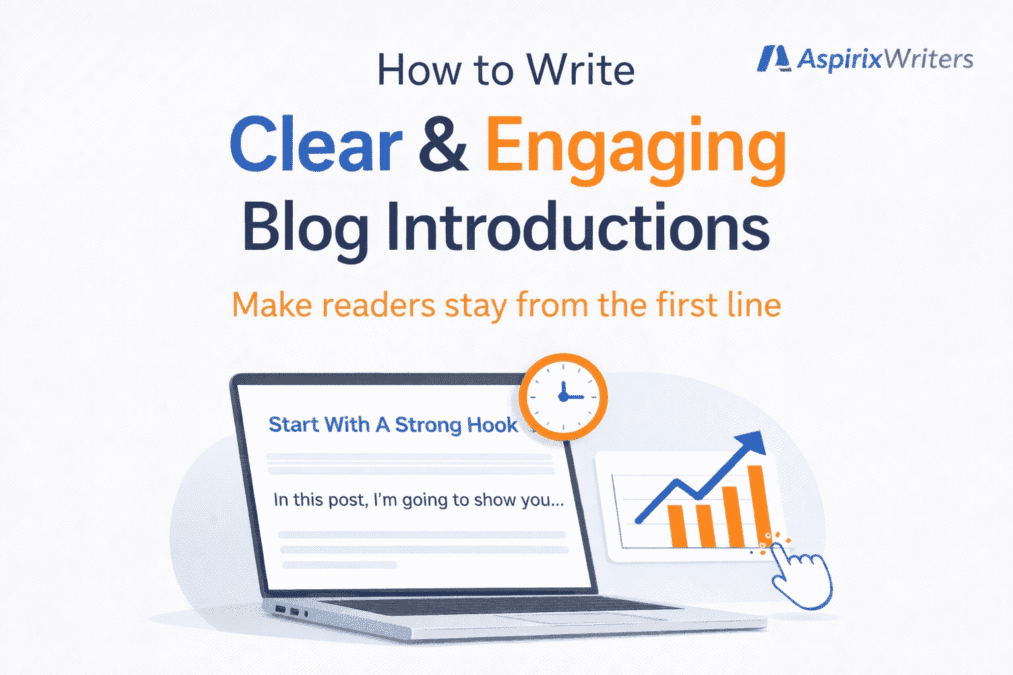
How to Write Clear and Engaging Blog Introductions
Step-by-Step Guide to Writing an SEO-Optimised Blog writing
The Real Reason Readers Leave in 8 Seconds
You’ve probably heard the stat — readers decide within a few seconds whether to keep reading or bounce.
But here’s what nobody tells you: they don’t leave because your topic is boring. They leave because your introduction gave them no reason to stay.
When I first started writing blog posts, I used to open every article the same way. Something like: “In today’s digital age, content writing has become extremely important for businesses and bloggers alike.”
Sound familiar? That sentence has appeared on roughly half the blogs on the internet — and it does absolutely nothing. It doesn’t speak to the reader’s problem, it doesn’t create curiosity, and it doesn’t promise anything valuable.
I changed the way I write introductions about a year into my writing journey — and it changed everything. Time on page went up. Bounce rate dropped. Readers actually reached the end of articles.
If you’re a student writing your first blog, a freelancer trying to impress clients, or a blogger chasing that AdSense approval — this guide will show you exactly how to write an introduction that makes people stay.

Before improving Introduction

After Improving Introduction
What a Strong Blog Introduction Actually Does
Before we get into techniques, let’s be clear about the job of an introduction.
A great blog introduction does four things — in order:
- Grabs attention — makes the reader look up from their scroll
- Creates connection — makes them feel understood
- Sets expectations — tells them what the article covers
- Earns the scroll — gives them a reason to keep reading
Notice what’s not on that list: impressing the reader with vocabulary, providing background history, or warming up slowly.
Your introduction is not the place to ease in. It’s your one shot to say, “Stay with me — this is worth your time.”
Technique 1 — Open with a Hook
The very first sentence of your introduction is your hook. It needs to do one thing: stop the reader from scrolling away.
Four types of hooks that work:
Question Hook — Ask something your reader is already wondering. “Why do some blog posts rank on page one while yours gets zero clicks?”
Surprising Fact Hook — Lead with something unexpected. “Most readers decide whether to leave your blog within 8 seconds of landing on it.”
Short Story Hook — A 2-line personal moment that connects to the topic. “I spent three months writing blog posts that got zero organic traffic. Turns out, it wasn’t the content — it was the first paragraph.”
Bold Statement Hook — A direct, confident claim. “Your blog introduction is more important than your entire article. Here’s why.”
In my experience, the short story and question hooks work best for Indian readers — they feel personal and relatable rather than lecture-y.
Pro Tip: Write 3 different hook options for every article. Pick the one that makes even you want to keep reading.
Technique 2 — Name the Reader’s Problem
Once you have their attention, prove that you understand why they’re here.
Readers stay when they feel seen. The moment your introduction reflects their exact frustration or confusion — they lean in.
Example for a “healthy eating” blog:
Weak: “Eating healthy is important for your body and mind.” Strong: “You’ve tried cutting sugar before. It worked for three days. Then the cravings hit, the discipline cracked, and you were back to square one — feeling worse than before you started.”
The second version doesn’t just acknowledge a problem. It mirrors a specific experience the reader has lived through. That emotional recognition is what makes them trust you before you’ve even given them one tip.
Pro Tip: Read 5–10 comments on Reddit threads or YouTube videos about your topic. The exact words people use to describe their frustration are the words you should use in your introduction.
Technique 3 — State Your Promise Clearly
After the hook and the problem, tell readers exactly what they’ll get from continuing.
This is sometimes called the “value promise” — and it directly answers the reader’s unconscious question: “What’s in it for me?”
Keep it specific. Vague promises don’t work.
Vague: “In this article, we’ll discuss blog introductions.” Specific: “By the end of this guide, you’ll have 6 proven techniques for writing introductions — plus a word-for-word before-and-after example you can use as a template.”
The specific version creates anticipation. The reader can picture what they’re about to receive. That picture is what earns the scroll.
Technique 4 — Use a Conversational Tone
One of the most common introduction mistakes I see from beginner writers — especially those from academic backgrounds — is writing like they’re submitting an essay.
Formal, impersonal, third-person introductions create distance. They signal to the reader: “This was written for everyone — and therefore, really for no one.”
Conversational writing feels like a direct conversation. Use “you.” Use “I.” Use contractions (don’t, you’ll, it’s). Write the way you’d explain something to a friend over chai.
Compare:
Formal: “This article provides a comprehensive examination of methods used by professional content writers to craft effective blog introductions.”
Conversational: “I’m going to show you exactly how I write blog introductions that keep readers reading — and how you can do the same.”
Same information. Completely different feeling.
Technique 5 — Add Your Focus Keyword Naturally
Your blog introduction should include your focus keyword — but it needs to appear naturally, not forced.
Google looks at your first 100 words to understand what your page is about. Getting your keyword in early (without stuffing) helps your content rank for that term.
Natural keyword placement example:
If your focus keyword is “blog introductions”: “Writing strong blog introductions is one of the most underrated skills in content writing — and one of the easiest to improve once you know the formula.”
The keyword fits. It doesn’t interrupt the sentence. The reader barely notices it’s there.
Pro Tip: If placing the keyword feels forced, rephrase the sentence until it sounds natural. Never sacrifice readability for keyword placement.
Technique 6 — Keep It Short and Purposeful
Long introductions are one of the most common reasons readers bounce.
Your introduction does not need to be 300 words. In fact, the best blog intros are usually 100–150 words — tight, punchy, and purposeful.
Every sentence in your introduction should earn its place. If a sentence doesn’t hook, empathize, promise value, or set context — cut it.
A good rule: read your introduction and ask, “Could I cut this sentence without losing anything important?” If yes — cut it.
Before vs After: Blog Introduction Makeover
Here’s the same article opening — the original version and the rewritten version:
BEFORE:
“Blog writing is a very important part of digital marketing. Many bloggers and content writers write blogs regularly. In this article, we will discuss how to write blog introductions. Writing a good introduction is necessary for any blog post. Let us look at the important points.”
Problems: No hook, no empathy, no promise, passive and vague, zero personality.
AFTER:
“Most readers decide whether to keep reading within the first 8 seconds of landing on your blog. That’s not much time — and a weak introduction wastes every one of those seconds. In this guide, I’ll show you 6 techniques I personally use to write introductions that hook readers, reduce bounce rate, and set up the rest of the article for success.”
What improved: Clear hook (surprising fact), specific promise, active voice, conversational tone, keyword placed naturally, half the word count.
Common Introduction Mistakes to Avoid
- Starting with “In today’s world…” — Overused, meaningless, skippable
- Summarising the article instead of selling it — Don’t describe what you’ll cover; make them want to find out
- Making the intro too long — Over 200 words before the first H2 is too much
- Writing in third person — “Writers often struggle…” feels distant; “You’ve probably struggled…” feels personal
- Burying the value promise — State what the reader gains within the first 3–4 sentences
Introduction Writing Checklist
Before publishing, check your introduction against this list:
- Does the first sentence make me want to keep reading?
- Does it name a pain point or problem the reader actually has?
- Does it include a clear value promise (what they’ll learn)?
- Is it written in a conversational, second-person tone?
- Is the focus keyword placed naturally in the first 100 words?
- Is it 150 words or fewer?
- Did I write the intro after finishing the article? (Strongly recommended)
10 Common Content Writing Mistakes
Why Businesses Need SEO Blog Writing Services for Sustainable Growth
Frequently Asked Questions
Q1. How long should a blog introduction be?
Ideally 100–150 words. Long enough to hook the reader and set context, short enough to not lose them before the real content begins. Anything over 200 words risks losing impatient readers — especially on mobile.
Q2. Should I write the introduction first or last?
In my experience, write it last. Once you’ve written the full article, you know exactly what it covers and what’s most valuable to the reader. That makes writing a compelling intro much easier.
Q3. Does a good introduction actually affect SEO?
Yes — indirectly but meaningfully. A strong introduction reduces bounce rate (readers stay longer), which signals to Google that your content satisfied the search intent. It also helps with keyword placement and readability scores.
Q4. What’s the most common introduction mistake beginners make?
Starting with generic statements like “In today’s digital world…” or “Content writing is very important.” These say nothing specific and give the reader no reason to care. Start with something that speaks directly to their situation.
Q5. Can I use a question as my first sentence?
Absolutely — and it’s one of the most effective hooks. Questions create an open loop in the reader’s brain. They naturally want the answer, which keeps them reading. Just make sure the question is one your reader is actually asking, not one that’s too broad or obvious.
Final Thoughts
Your introduction is the handshake before the conversation. Get it wrong, and no one stays for what comes next — no matter how good the rest of your article is.
The six techniques in this guide aren’t complicated. They don’t require a writing degree or years of experience. They just require intention — and a willingness to rewrite that first paragraph until it earns the reader’s next scroll.
Start with your hook. Name the problem. Make a specific promise. Keep it short.
Do that consistently, and you’ll notice the difference — in your bounce rate, your read time, your comments, and eventually, your rankings.
References:
- Google Search Central — Creating Helpful Content: https://developers.google.com/search/docs/fundamentals/creating-helpful-content
How to Create an SEO Content Strategy for Your Website (Step-by-Step Guide)
No post found!