Last Updated: May 1, 2026
Content Writing Tips for Beginners
Topic Cluster Strategy: How to Build Topical Authority — Complete Guide 2026
Nobody Starts Out Good at This
Here’s something no one tells you when you decide to become a content writer:
Your first few pieces will be bad. Not “needs improvement” bad — genuinely, cringe-when-you-re-read-it bad.
And that’s completely normal. That’s actually how it’s supposed to go.
When I wrote my first blog post, I spent four hours on it. I used words I’d never actually say out loud, sentences that went on forever, and an introduction that took three paragraphs to get to the point. I thought it sounded professional. Looking back, it just sounded confused.
But here’s what that experience taught me: writing is a skill, not a talent. It improves with the right guidance, the right tools, and — most importantly — consistent practice. You don’t need a degree in English. You don’t need to have always been “good with words.” You just need a place to start and someone to show you what actually works.
This guide is that place.
Whether you’re a college student in Chennai trying to build freelance clients, a blogger in Delhi who wants to finally get organic traffic, or a professional who needs to write better for their job — these tips will give you a clear, practical foundation to build from.
Creative Writing & Storytelling
Why Beginners Struggle with Content Writing
Before the tips, let’s talk about why this feels so hard at first. Because the struggle is real — and it’s not because you’re bad at writing.
No clarity on purpose or audience. Most beginners open a blank document without answering two basic questions: Who am I writing for? and What do I want them to do after reading? Without those answers, the writing wanders.
Overthinking the first sentence. The blank page anxiety is real. Many beginners spend 20 minutes trying to write a perfect opening line — and end up writing nothing. The pressure of “starting well” kills the start entirely.
Trying to sound impressive instead of helpful. This is probably the most common beginner trap. You use complex vocabulary, long sentences, formal tone — because it feels more “professional.” It doesn’t. It just makes the writing harder to read.
No structure before writing. Starting to write without an outline is like starting a road trip without a map. You might eventually get somewhere. But you’ll take a lot of wrong turns.
Fear of making mistakes. Many beginners don’t publish because they’re afraid their writing isn’t good enough. So they keep drafting, second-guessing, and delaying. The writing never improves because it never goes out into the world and gets read.
Recognising your own pattern here is the first step to breaking it.
9 Content Writing Tips That Actually Help Beginners
Tip 1 — Start with Clarity: Know Your Purpose and Your Reader
What it is: Before writing a single word, define who your reader is and what you want them to understand, feel, or do after reading.
Why it matters: Without this, every decision — what to include, what tone to use, how long to go — becomes guesswork. Clarity on purpose gives every paragraph a job.
Beginner mistake: Writing on a topic without thinking about who specifically needs that information.
Real example: “A beginner guide to investing” is a topic. “A guide for salaried employees in their 20s who want to start their first SIP but feel overwhelmed by the options” is a purpose. The second version writes itself.
Action step: Before your next piece, write one sentence at the top of your document: “This article is for [specific reader] who wants to [specific outcome].” Refer back to it every time you feel lost.
Tip 2 — Write Simply, Not Impressively
What it is: Use short sentences, everyday vocabulary, and direct phrasing.
Why it matters: Clear writing builds trust. Complex writing creates distance. Your reader is not impressed by big words — they’re impressed by how quickly they understand what you’re saying.
Beginner mistake: Using “utilise” when “use” works. Writing “in the event that” instead of “if.” Padding sentences with qualifiers that add length but remove clarity.
Real example: Complex: “The implementation of structured content frameworks facilitates enhanced reader comprehension.” Simple: “Organising your content clearly helps readers understand it better.”
Same meaning. Very different readability.
Action step: After your first draft, do a single pass looking only for complicated words and long sentences. Replace each one with the simpler version.
Tip 3 — Focus on One Idea Per Article
What it is: Each piece of content should explore one central idea thoroughly, not ten ideas superficially.
Why it matters: Articles that try to cover everything end up explaining nothing well. Focused articles rank better, read better, and are more useful.
Beginner mistake: Writing an article about “everything you need to know about content writing” — which ends up being 300 words of surface-level points on 15 different topics.
Real example: Instead of “Content Writing Guide,” write “How to Write a Strong Blog Introduction That Makes Readers Stay.” One focused topic, explored fully.
Action step: Write your article’s central idea in one sentence. If you can’t do it in one sentence, the scope is too broad. Narrow it until you can.
Tip 4 — Write Introductions That Hook Immediately
What it is: Your opening paragraph needs to grab attention, acknowledge the reader’s problem, and promise a clear outcome — all within the first 100–150 words.
Why it matters: Readers decide within seconds whether to stay or leave. A slow, generic introduction sends them back to Google.
Beginner mistake: Starting with “In today’s world…” or “Content writing is very important…” These are the most overused openings on the internet, and they signal immediately that nothing interesting is coming.
Real example of a strong opening: “Your first draft will be bad. That’s not an insult — it’s a promise. Every writer who got good at this started exactly where you are. Here’s what they figured out that most beginners never do.”
Action step: Rewrite your last introduction using this structure: one relatable sentence about the reader’s problem, one empathetic line, one clear promise of what they’ll gain.
→ How to Write Clear and Engaging Blog Introductions
Tip 5 — Always Use Headings and Structure
What it is: Organise your content with H2 and H3 headings, short paragraphs (2–3 lines), and bullet points where appropriate.
Why it matters: Most online readers scan before they commit to reading. Headings act as signposts — they tell the reader where they are, what’s coming, and whether it’s relevant to them. Without structure, even good content gets skipped.
Beginner mistake: Writing the entire article in one long block of text with no visual breaks. This is especially painful on mobile — and over 70% of readers in India read on mobile.
Action step: Before writing, create your H2 headings first. They’re your outline. If the skeleton doesn’t make logical sense, the full article won’t either.
Tip 6 — Edit with Fresh Eyes (Not a Tired Mind)
What it is: Leave at least 15–30 minutes between finishing your draft and beginning your edit. Then read it once for content, once for clarity, once for errors.
Why it matters: Writing and editing are two different mental modes. Your brain reads what you intended to write, not what’s actually there — especially immediately after writing it. Distance creates objectivity.
Beginner mistake: Publishing directly from the first draft with only a surface spell-check.
Action step: Use Grammarly for grammar and Hemingway Editor for readability. Then read the article aloud — your ear catches what your eyes miss every time.
Tip 7 — Practice Consistently (Not Perfectly)
What it is: Write something — anything — every day. Not always a full article. Sometimes just 200 words, a paragraph, or a rough outline.
Why it matters: Writing is muscular. The more you do it, the easier it gets. The writers who improve fastest aren’t the most talented — they’re the most consistent.
Beginner mistake: Waiting until they “feel ready” or “have a good idea” to write. This leads to writing once a week at best, and the skill never compounds.
Action step: Commit to 15 minutes of writing every day for the next 21 days. It doesn’t have to be good. It just has to exist.
Tip 8 — Learn Basic SEO (Even as a Beginner)
What it is: Understand the basics of keyword research, search intent, and on-page structure — so your content has a chance of being found.
Why it matters: Beautiful writing that no one finds helps no one. Even a basic understanding of how to research a keyword and match your content to what people are searching for will dramatically improve your results.
Beginner mistake: Writing entirely by instinct with no awareness of what people are actually searching for, then wondering why the article gets no traffic.
Action step: Before writing your next article, Google your topic and read the top 3 results. Note their format, headings, and what questions they answer. That’s your roadmap.
→ Step-by-Step Guide to Writing an SEO-Optimised Blog
Tip 9 — Read More Than You Write
What it is: Dedicate time to reading — good blogs, well-written articles, books on writing — as part of your development as a writer.
Why it matters: Writing improves fastest through exposure to good writing. You absorb rhythm, structure, vocabulary, and tone unconsciously when you read regularly. Every writer you admire reads far more than most people realise.
Action step: Identify 3 blogs in your niche that consistently publish excellent content. Read at least one article from each per week. Notice what works — and start doing it intentionally.
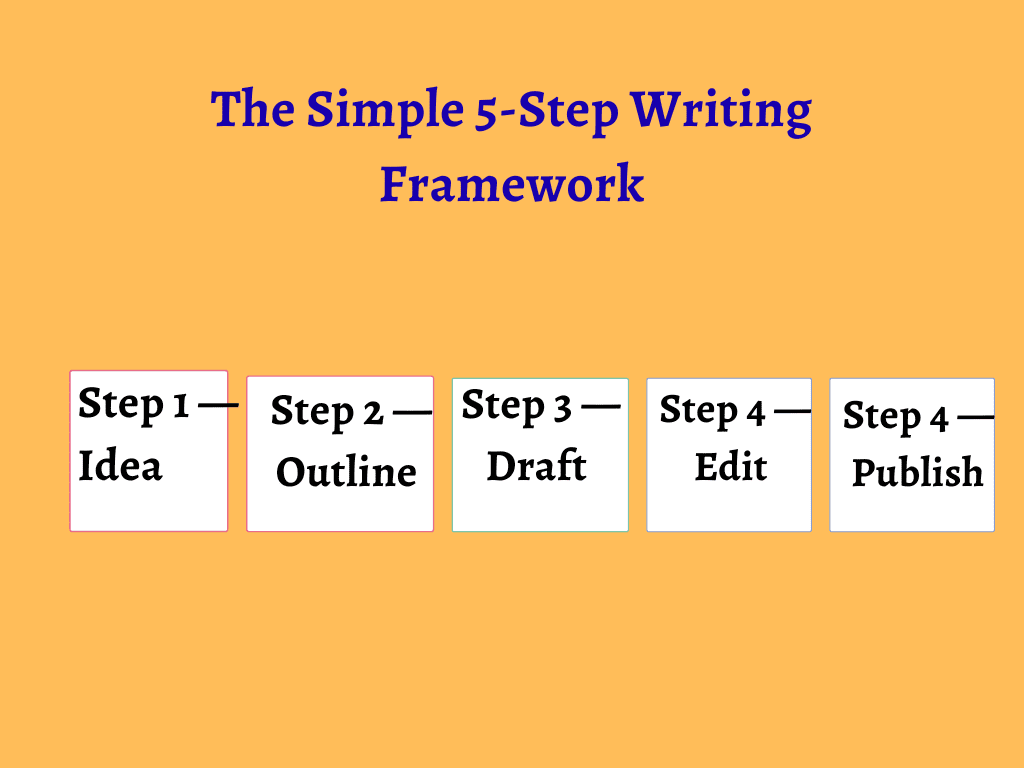
The Simple 5-Step Writing Framework
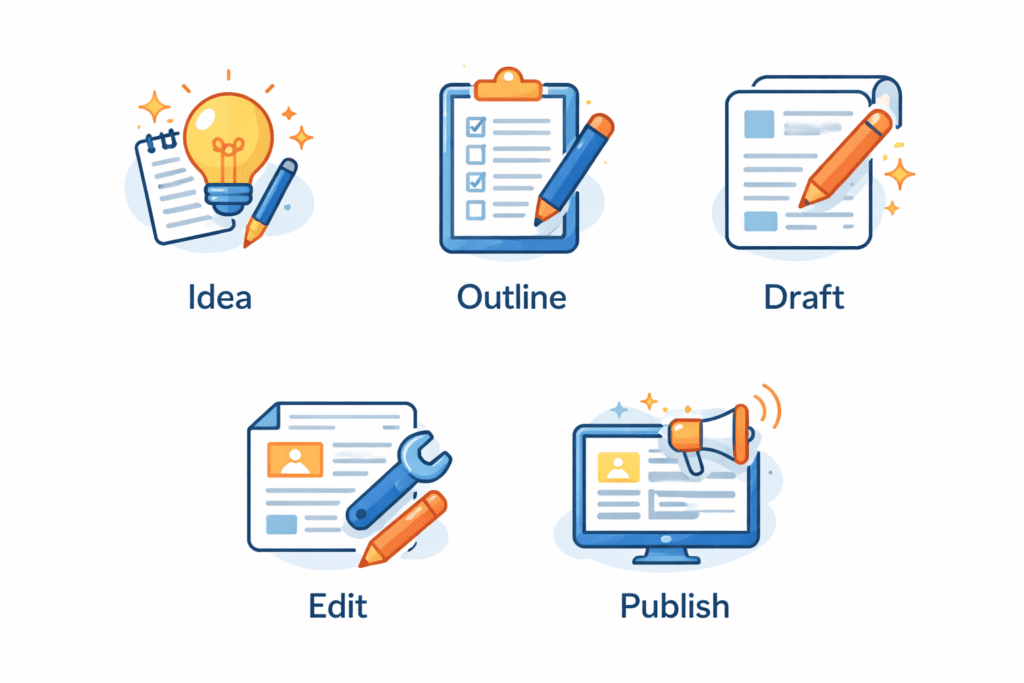
This is the process I wish someone had handed me on day one:
Step 1 — Idea Identify your topic and narrow it to one specific angle. Research what’s already ranking for that topic.
Step 2 — Outline Build your H2 and H3 headings before writing anything. Your outline is your map. A 10-minute outline saves 60 minutes of lost direction.
Step 3 — Draft Write fast and freely. Don’t edit while drafting — that’s the single biggest productivity killer for beginners. Get everything out first. Polish later.
Step 4 — Edit Three passes: content (does it deliver on its promise?), clarity (is every sentence clear and necessary?), errors (grammar, spelling, readability).
Step 5 — Publish Check your meta title, meta description, internal links, and images. Then publish — even if it feels imperfect. Good content that’s live beats perfect content that isn’t.
Common Beginner Mistakes (and How to Fix Them)
Trying to sound too professional. Fix: Write how you’d explain the topic to a smart friend. Clear, direct, and conversational always outperforms stiff and formal.
Writing without a structure. Fix: Never open a blank document and start writing. Build your heading skeleton first. Always.
Ignoring the reader’s intent. Fix: Ask yourself before every paragraph: “Does this serve my reader, or does it serve my ego?” If it’s the latter, cut it.
Not editing before publishing. Fix: Implement a minimum two-pass edit: once for content, once for errors. Use Grammarly and Hemingway as your baseline.
Publishing inconsistently and expecting consistent results. Fix: Set a publishing schedule you can actually keep — one article per week is better than four articles one month and none the next.
→ Common Content Writing Mistakes and How to Avoid Them
Tools Every Beginner Writer Needs
Google Docs — Your writing home base Free, accessible from any device, and distraction-free. The “suggesting mode” makes editing and client feedback painless. Version history means you never lose a draft. Start every article here.
Grammarly — Your editing safety net Run every draft through Grammarly before publishing. It catches grammar errors, spelling mistakes, awkward phrasing, and passive voice in real time. The free version handles everything a beginner needs.
Notion — Your writing organiser Notion is where your ideas, outlines, drafts, and content calendar live. Instead of ideas scattered across WhatsApp notes, sticky pads, and random docs — everything is in one searchable system. The free plan is more than enough to start.
→ 10 Powerful Tools Every Content Writer Must Use in 2026
My First Blog Experience (Short Story)
The first article I published got 11 views in its first month. Seven of them were probably me checking if anyone had read it.
I’d written about a topic I was genuinely interested in. The research was solid. The information was accurate. But the title was vague, the introduction was slow, there were no headings to speak of, and I had done zero keyword research.
Nobody found it because I’d given Google nothing to work with. And the few people who did land on it left quickly because the structure made it hard to read.
I rewrote that article four months later — after learning the basics of SEO and content structure. With the same information, organised and optimised properly, it started getting 200–300 visits a month within two months.
Nothing about the knowledge changed. Everything about the presentation did.
That experience is why I’m so insistent that beginners learn both writing and SEO from the start — not as separate skills, but as two parts of the same craft.
What I Wish I Knew as a Beginner
- Your first draft is not your final draft. Write fast, edit later. Never the other way around.
- Clarity beats cleverness every time. If your reader has to re-read a sentence to understand it, rewrite the sentence.
- Consistency compounds. Ten average articles published consistently outperform three brilliant ones published sporadically.
- Reader intent is everything. Always ask: what does my reader need from this? Then deliver exactly that.
- You don’t need permission to start. Publish before you feel ready. Feedback from real readers improves your writing faster than any amount of private drafting.
Daily Writing Habit Plan
This is a simple, sustainable plan for building the writing habit from scratch:
| Week | Daily Commitment | Focus |
|---|---|---|
| Week 1 | 15 minutes | Just write — anything. No pressure on quality. |
| Week 2 | 20 minutes | Write with a topic and basic outline |
| Week 3 | 30 minutes | Write + one editing pass |
| Week 4 | 45 minutes | Write + edit + check with Grammarly |
| Month 2+ | 45–60 minutes | Full article draft per session |
The goal in month one isn’t to publish great work. It’s to make writing a non-negotiable daily habit. Quality follows consistency — not the other way around.
→ Time Management for Writers: How to Make Your Writing
The 1-Hour Writing Method for Beginners
If you have one hour, use it like this:
| Time | Task |
|---|---|
| 0:00–0:10 | Choose your topic. Write your purpose sentence. Build your H2 outline. |
| 0:10–0:35 | First draft — write fast, no editing, just output |
| 0:35–0:40 | Short break — stand up, stretch, no phone |
| 0:40–0:55 | Edit pass — clarity, structure, and Grammarly |
| 0:55–1:00 | Write your title and introduction if not done. Note what to do next session. |
This won’t produce a finished, publishable article in your first few attempts. But it will produce a solid draft — which is the hardest part. Publishing gets easier once you trust your own process.
Frequently Asked Questions
Q1. How do beginners start content writing with no experience?
Start by reading — a lot. Find 3 blogs you admire in your area of interest and study how they write: their tone, sentence length, structure, and introductions. Then start writing. Don’t wait until you feel “ready.”
Your first pieces will teach you more than any course. Begin with topics you already know well, where research isn’t the bottleneck.
Q2. How can I improve my writing skills quickly?
The fastest path to improvement is: write daily, read widely, and get feedback. Use Grammarly and Hemingway Editor on everything you write — over time you’ll internalise their corrections and stop needing them as much. And publish your work. Real readers’ reactions teach you things no tool can
Q3. Is SEO necessary for beginners, or should I focus on writing first?
Learn both simultaneously, but in proportion. Spend 80% of your early energy on writing clearly and helpfully. Spend 20% on basic SEO — keyword research and proper structure. You don’t need to master SEO before you start, but ignoring it completely means writing that never gets found.
Q4. How much should I write every day as a beginner?
Start with 15–20 minutes and build up. The habit matters more than the volume in the beginning. Once writing daily feels natural — usually after 3–4 weeks — extend to 30–45 minutes. Most experienced writers produce their best work in 60–90 focused minutes per day, not marathon sessions.
Q5. How do I find topics to write about when I don’t know what to write?
Use Google’s “People Also Ask” boxes and Autocomplete for your niche — these show real questions real people are typing right now. AnswerThePublic (free plan) is also excellent for generating dozens of genuine audience questions. Start with problems you’ve personally faced — those make the most authentic, relatable content.
Q6. Do I need to be good at English grammar to be a content writer?
You need to be clear, not perfect. Many excellent content writers — especially in India — don’t have flawless grammar, but they communicate clearly and helpfully. Tools like Grammarly catch most errors automatically. Focus on clarity and usefulness; the grammar refines over time with practice.
Q7. When should a beginner start publishing publicly?
As soon as possible. Publishing early — even imperfect work — forces you to commit to quality in a way private drafting never does. It also builds your portfolio and gets your content indexed by Google. Don’t wait for perfection. Publish, learn from the response, and improve the next one.
Final Thoughts
Here’s the truth about content writing that nobody told me when I started:
You won’t be good immediately. But you will get good — if you stay consistent and stay curious.
Every tip in this guide is something I learned the hard way, usually by doing the opposite first. The good news is that you now have that learning without having to repeat those mistakes yourself.
Pick one tip from this guide that speaks most directly to where you’re stuck right now. Not all nine — just one. Apply it to your next piece of writing. Then come back for the next one.
That’s how writing skills actually build — one applied lesson at a time, repeated consistently over months until it becomes instinct.
You already took the first step by reading this far. Now go write something.
References:
- Creating Helpful, Reliable, People-First Content | Google Search Central | Documentation | Google for Developers
- Hemingway Editor: https://hemingwayapp.com
- Grammarly: https://grammarly.com
- Notion: https://notion.so
Writing Services
- Academic Writing
- Editing & Proofreading
- SME Writing Services
- SEO Blogwriting Services
- Creative & Ghostwriting
No post found!