
Last Updated: April 13, 2026
AI in Sales Automation
The Lead Problem Nobody Talks About
Here’s a situation that most small business owners in India recognise immediately — even if they’ve never labelled it as a sales problem.
Leads are coming in. Someone fills out a contact form on the website on Monday morning. A prospect messages on WhatsApp at 7 PM on Thursday. A referral email arrives on Saturday.
By the time the owner or sales person gets to them — often 12 to 48 hours later — the moment has passed. The prospect found someone who responded faster. The referral went cold. The enquiry that felt promising on Tuesday is now a missed opportunity by Friday.
The issue isn’t effort. Most small business owners in Rajasthan, Mumbai, and across India work genuinely hard. The issue is that manual lead management at any volume beyond a handful of enquiries per week creates unavoidable gaps. Things fall through. Follow-ups get delayed. Hot leads cool off while you’re handling the day’s operations.
This is the specific, practical problem that AI sales automation addresses — and addressing it doesn’t require a large budget, a technical team, or enterprise software. It requires the right lightweight system applied consistently.
This guide covers that system: which tools are realistic for Indian SMBs, how they fit together, where they genuinely help, and where human judgment is still irreplaceable.
What AI Sales Automation Actually Does
Before investing time or money, it’s worth being precise about what these tools do — and what they don’t.
What AI sales automation handles:
- Lead capture and logging — automatically creating a CRM record when a lead fills a form, sends a WhatsApp message, or clicks an ad
- Lead scoring — ranking enquiries by their likelihood to convert, based on behaviour, source, and profile (how it scores depends on what data you feed it)
- Automated follow-up sequences — sending a response, reminder, or nurture message at defined intervals without manual action each time
- Pipeline visibility — showing where each lead stands across your sales stages so nothing is accidentally neglected
- Activity reminders — alerting sales people when a lead has gone cold and needs human attention
What it does not do:
- Close deals on your behalf
- Replace the relationship-building and trust that ultimately converts a prospect into a customer
- Work without some initial configuration and ongoing maintenance
- Compensate for a product or service that isn’t genuinely meeting market demand
The framing that serves small businesses best: AI sales automation is a system for ensuring that no lead is silently dropped — that every enquiry receives a timely response, every follow-up gets sent, and every qualified prospect reaches a human when they’re ready to decide.
The Core Sales Automation Stack: CRM + AI
The foundation of any sales automation system is a CRM — customer relationship management software that stores lead data, tracks interactions, and organises your pipeline. AI features sit on top of this foundation.
Zoho CRM — Best for Most Indian SMBs
Zoho CRM is built by an Indian company (Zoho Corporation, Chennai), priced in INR, and designed with the Indian business context in mind. Its AI assistant, Zia, analyses your pipeline data and surfaces insights like which leads are most likely to convert, which deals are at risk of going stale, and what the best time to contact a specific lead might be based on their past engagement patterns.
Practical use: A Jaipur-based interior design consultancy uses Zoho CRM to automatically log every website enquiry, score it based on project budget and timeline indicated in the form, and trigger a WhatsApp follow-up sequence for leads that meet a minimum threshold. Zia’s predictions are not always accurate — they improve as more historical data accumulates — but they provide a useful starting filter when handling 20+ enquiries per week.
Pricing: Free plan available for 3 users with core CRM features. Paid plans for AI features start at approximately ₹800–₹1,400/user/month (verify current INR pricing on zoho.com/crm — rates change periodically).
HubSpot — Best for Growing Startups With Content Marketing
HubSpot’s free CRM is genuinely generous — unlimited contacts, basic deal pipeline, and email integration at no cost. Its AI lead scoring feature (available in paid tiers) analyses contact behaviour — email opens, website visits, content downloads — and assigns a score that indicates sales readiness.
When to use HubSpot over Zoho: If your business generates leads through content marketing (blog, SEO, email newsletters) and you want tight integration between marketing and sales activity. HubSpot’s free plan handles the basics well. The AI features are in paid tiers that start at pricing that should be verified directly on HubSpot’s India pricing page.
Honest limitation: HubSpot’s free plan is capable but its AI features are behind a paywall. For early-stage businesses on a tight budget, Zoho’s free plan often provides more functionality at zero cost.
Freshsales — Best for Support-Heavy Sales Environments
Freshsales by Freshworks (an Indian-founded company) includes Freddy AI, which provides predictive contact scoring, deal insights, and automated activity suggestions. Its strength is the integration between sales and customer support workflows — useful for service businesses where the sales and support journey overlap.
Pricing: Free plan available with basic features. Paid plans with Freddy AI from approximately ₹999/user/month (verify current pricing on freshworks.com/in).
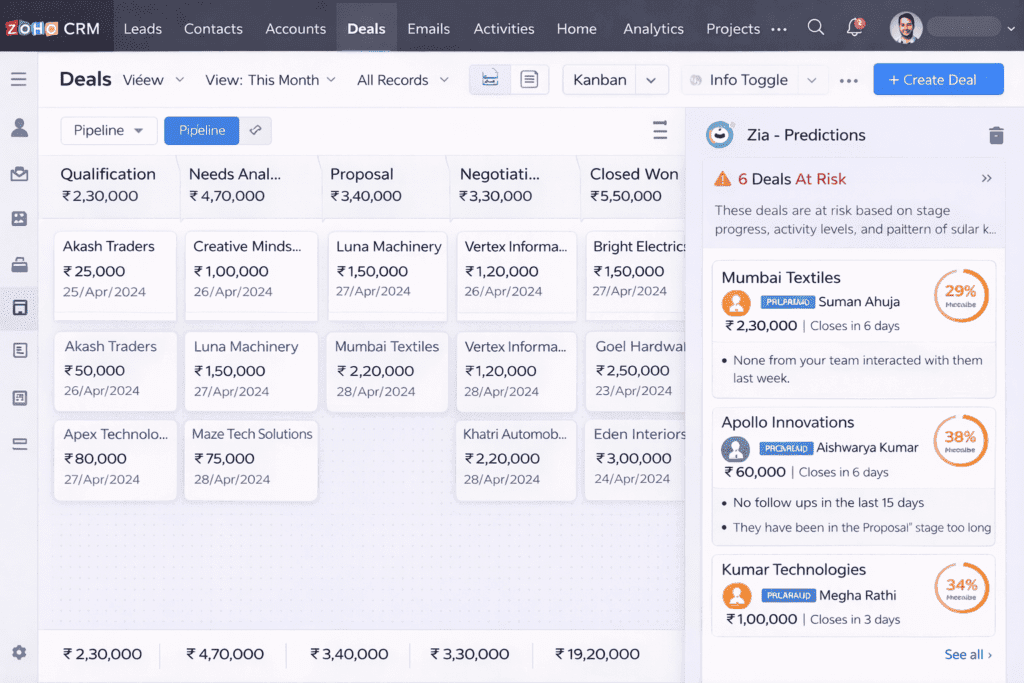
“Example CRM pipeline view with AI-based deal predictions (illustrative interface)
WhatsApp Sales Automation — Where Indian Businesses Win
WhatsApp is where most Indian B2C sales conversations happen. For small businesses receiving enquiries via WhatsApp, automation at this touchpoint often has a more immediate impact than any other change to the sales process.
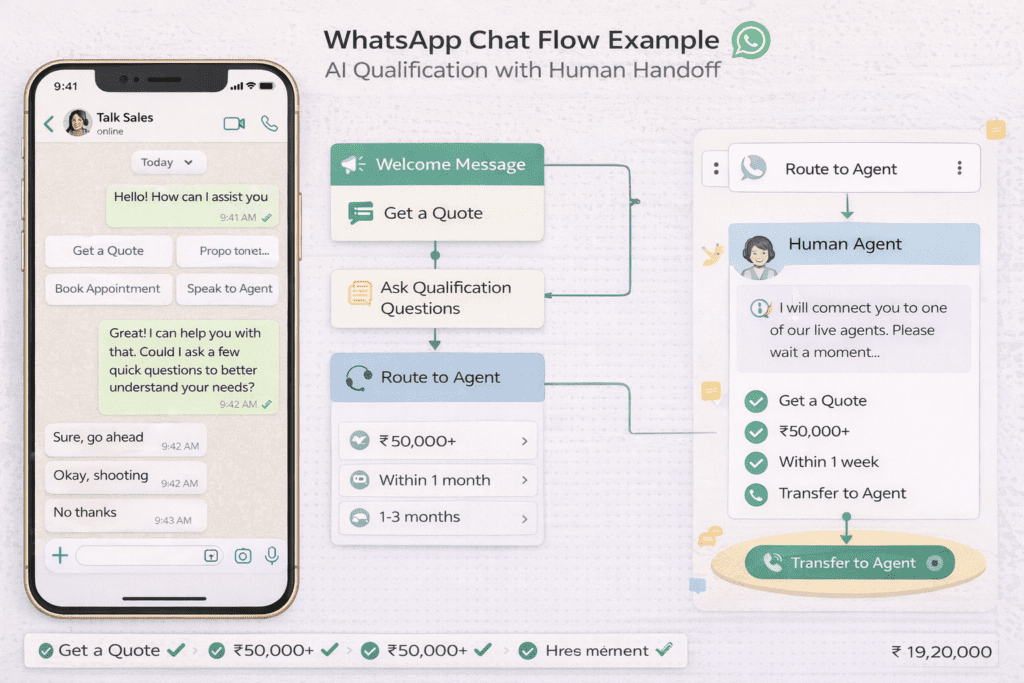
TailorTalk AI is specifically built for WhatsApp sales automation in the Indian market. It deploys an AI sales agent on WhatsApp that can respond to initial enquiries, qualify leads by asking standard questions, and route qualified prospects to a human sales person — all within the WhatsApp interface that customers already use.
Realistic use case: A Rajasthan-based tour operator receives 30–50 WhatsApp enquiries daily, primarily about trip packages, pricing, and availability. TailorTalk can handle the initial qualification — “What dates are you considering?” “How many people?” “What’s your approximate budget?” — and pass only the qualified, ready-to-book leads to a human agent. This doesn’t automate the sale; it filters the workload so the human’s time goes to prospects most likely to convert.
Key limitation: WhatsApp sales automation works best for high-volume, relatively standardised enquiry flows. Highly complex, bespoke service businesses where every conversation is different will find automation less applicable at the qualification stage.
On pricing: TailorTalk and similar WhatsApp sales automation tools are typically priced on a subscription or per-conversation basis. Verify current India pricing directly with the provider — WhatsApp Business API pricing also affects the total cost.
No-Code Workflow Automation: Gumloop and Similar Tools
Beyond CRM and WhatsApp, sales workflows often involve connecting multiple systems — a website form to a CRM, a CRM to an email sequence, an email response to a WhatsApp follow-up. Without automation, these connections require manual data entry at each step.
Gumloop is a no-code AI workflow automation tool that allows you to build these connections visually — without writing any code. A typical sales workflow built in Gumloop might look like:
- Lead submits form on website
- Gumloop captures the data and creates a contact in Zoho CRM
- Gumloop sends an immediate WhatsApp acknowledgement via AiSensy
- After 24 hours with no human response, Gumloop sends a follow-up email
- After 48 hours, Gumloop flags the lead in CRM for manual follow-up
The entire sequence runs automatically once configured. The configuration itself requires no coding — just connecting the tools via Gumloop’s visual editor and defining the trigger conditions and actions.
Similar tools to evaluate: Zapier, Make (formerly Integromat), and n8n — all of which support Indian business tool integrations and offer free or low-cost entry plans. Gumloop is newer and specifically AI-focused, but the more established alternatives are worth comparing.
AI Calling and Hindi Language Support
For businesses that handle inbound sales calls — or want to add automated outbound calling for lead follow-up — AI calling tools provide an additional automation layer.
Yugasa is an AI calling platform designed for the Indian market with Hindi language support. It can handle automated inbound call responses, qualify callers with scripted questions, and transfer to a human agent when the caller requests or when the query exceeds the bot’s capacity.
Realistic scope: AI calling works well for very standardised enquiry types — appointment booking, basic product information, lead qualification for high-volume campaigns. It is not appropriate for complex service discussions, complaint handling, or any conversation where the caller expects genuine dialogue.
Language context: Hindi and regional language AI calling is improving but remains less reliable than English for nuanced conversational responses. For customer-facing use, thorough testing with real scenarios is essential before deployment — a poorly-performing AI call experience can damage the customer relationship more than no automation at all.
Budget-Friendly AI Sales Tools (Under ₹2,000/Month)
For businesses that need functionality without significant subscription costs, several entry-level options are worth evaluating:
Agile CRM offers a free plan for up to 10 users with basic CRM, email marketing, and limited automation features. It’s less sophisticated than Zoho or HubSpot but covers the core requirements for a very small sales team at no cost.
Centripe and similar newer Indian-market tools are positioning themselves specifically for the sub-₹2,000/month segment. Capabilities and reliability vary — for newer tools, check for recent user reviews and confirm that the product is actively maintained before committing to any paid plan.
The honest assessment of budget-tier tools: They are suitable for getting started with sales automation and validating whether the approach works for your business. If it does, investing in a more robust tool is a rational next step. If it doesn’t, you haven’t spent significantly to find out.
Verify all pricing directly with providers. Software pricing in India, particularly for newer AI tools, changes frequently. Any figure in this guide should be treated as a directional range, not a current guarantee.
Real Sales Workflow: Lead to Close with AI
Here’s what a practical AI-assisted sales workflow looks like for a mid-sized Indian SMB:
📥 LEAD ARRIVES
(Website form / WhatsApp / Referral email)
        ↓
🤖 AUTOMATIC CAPTURE
CRM entry created (Zoho / HubSpot)
Immediate acknowledgement sent (email or WhatsApp)
        ↓
📊 AI LEAD SCORING
Zia / Freddy AI assigns priority score
High-score leads flagged for immediate human attention
Medium-score leads enter automated nurture sequence
        ↓
📧 AUTOMATED FOLLOW-UP SEQUENCE
Day 1: Acknowledgement + basic information
Day 3: Follow-up if no response
Day 7: Final automated check-in
        ↓
🧑 HUMAN TAKES OVER
Qualified, engaged leads handed to sales person
CRM shows full interaction history
Human conducts needs assessment and proposal
        ↓
✅ OR ❌ OUTCOME RECORDED
Won / Lost + reason logged
Data feeds back into AI scoring model
The critical point: AI handles the repetitive, time-sensitive top of funnel. Humans handle the relationship, the negotiation, and the close. Neither works well without the other.
What Indian Businesses Get Wrong About Sales Automation
Implementing automation without a defined sales process. Automating a broken or undefined process makes the problems faster, not smaller. Before deploying any tool, map out exactly how you currently handle leads — where they enter, who follows up, what the follow-up says, how you decide when to stop pursuing a lead. Automation should systemise a working process, not create one.
Using too many tools simultaneously. A CRM, a WhatsApp automation tool, a workflow builder, an AI calling system, and an email marketing platform — all configured partially, none integrated properly. The result is more complexity, not more efficiency. Start with one tool that addresses your most critical gap. Add the next only when the first is working well.
Expecting AI to compensate for a weak value proposition. Faster follow-up helps. Better pipeline visibility helps. But if the reason leads aren’t converting is that your product, pricing, or positioning doesn’t resonate with the market, automation will reveal that problem more quickly — it won’t solve it.
Not reviewing automation performance. An automated follow-up sequence configured once and never reviewed may be sending the wrong message, at the wrong frequency, to the wrong audience. Review your automation performance monthly: open rates, response rates, conversion at each stage. Adjust based on what the data shows.
India Case Example: Before and After AI in Sales
Business: A home interior consultation service in Jaipur — two-person team, handling enquiries directly via WhatsApp and website contact form.
Before AI tools:
- Enquiries logged manually in a WhatsApp group and a notebook
- Follow-up done from memory, resulting in leads being missed 3–4 days after initial contact
- No visibility into which enquiries were still active vs dead
- Significant time spent re-explaining the same service information to each new enquiry
After setting up Zoho CRM (free plan) + AiSensy WhatsApp automation:
- Every enquiry auto-logged in CRM when received
- Immediate WhatsApp acknowledgement sent automatically (service overview + call booking link)
- 3-day follow-up reminder triggered automatically for leads with no response
- Team can see all active leads in one dashboard rather than scrolling through WhatsApp history
Honest outcome: Follow-up consistency improved significantly. The owners reported spending meaningfully less time on routine enquiry management. Conversion rates showed some improvement — but the owners were careful to note that this coincided with a seasonal uptick in enquiries, so the attribution was not clean. The primary benefit they identified was time recovered and reduced lead neglect.
No guaranteed conversion percentages. No fabricated ROI. Just a real operational improvement that made a small team’s workload more manageable.
Frequently Asked Questions
Q1. How does AI sales automation help convert leads?
AI sales automation helps by ensuring every lead receives a timely response, gets scored by conversion likelihood, and enters an automated follow-up sequence. It reduces lead neglect — the most common conversion gap for small businesses. It does not close deals; it ensures qualified leads reach a human sales person before they go cold.
Q2. Which free AI CRM is best for small businesses in India?
Zoho CRM’s free plan is the most practical starting point for most Indian SMBs — it supports up to 3 users, includes basic pipeline management, and is built by an Indian company with INR pricing and local support. HubSpot’s free CRM is also strong, particularly if your business generates leads through content marketing. Both are worth testing before committing to a paid plan.
Q3. Zoho vs HubSpot AI sales tools — which is better in India?
Neither is universally better — they suit different business types. Zoho is better for businesses already using other Zoho products, those who prefer INR pricing and local support, and businesses with straightforward sales workflows. HubSpot is better for businesses with strong content marketing funnels and those who need tight marketing-sales integration. Both have free plans; testing both before deciding is a reasonable approach.
Q4. Can AI fully automate sales processes?
No. AI can automate lead capture, scoring, initial follow-ups, and pipeline visibility. It cannot replicate the relationship-building, needs assessment, negotiation, and trust that drive actual purchasing decisions — particularly for any service or product with a meaningful price point. The practical model is AI handling the top-of-funnel repetitive tasks so human sales people can focus on the conversations that require genuine engagement.
Final Thoughts
AI does not close deals — it ensures no opportunity is missed.
That’s the honest, practical summary of what sales automation does for a small business in India in 2026. It doesn’t transform a weak sales process into a strong one. It doesn’t replace the human connection that builds customer trust. It doesn’t guarantee conversion at any rate.
What it does — when implemented thoughtfully — is close the gaps: the follow-up that wasn’t sent, the lead that waited 48 hours for a response, the hot enquiry that got lost in a WhatsApp scroll. For businesses handling more than a handful of enquiries per week, these gaps represent real, recoverable revenue.
Start with the smallest meaningful implementation. Pick the one gap in your current sales process that costs you most — usually delayed follow-up or no follow-up at all — and address it with one tool configured correctly. Zoho CRM free plan plus a basic automated WhatsApp acknowledgement sequence is a reasonable starting point for most Indian SMBs, at minimal cost and without significant technical complexity.
Then review. Adjust. Add the next layer when the first is working.
The goal is a sales process where every lead that enters receives attention proportional to their potential — and every one that’s ready to buy reaches a human who’s prepared to help them do so.
Note: All pricing information in this article reflects approximate market rates as of early 2026. Always verify current pricing directly with each provider before purchasing.” Making this visually distinct (a shaded box or note section) signals to AdSense reviewers that the article is not making binding pricing claims
References:
- Zoho CRM India: https://www.zoho.com/crm/
- HubSpot Free CRM: https://www.hubspot.com/products/crm
- Freshsales: https://www.freshworks.com/crm/sales/
- WhatsApp Business API: https://business.whatsapp.com/products/business-platform
- Google AdSense Programme Policies: https://support.google.com/adsense/answer/48182
Best AI Tools For Business & Marketing
About the Author
Dr. Rekha Khandelwal is an academic content writer and AI prompt engineer specializing in research writing and AI-powered tools. She helps students and researchers simplify complex academic work through practical, technology-driven solutions.
Author Profile Dr. Rekha Khandelwal | Academic Writer, Legal Technical Writer, AI Expert & Author | AspirixWriters
AI Chatbots Customer Support: 24/7 Help Guide for Small Businesses in India (2026)
AI Chatbots Customer Support The Customer Support Problem Every Small Business Knows It’s 9 PM…
AI for Small Businesses in India: Practical Tools, Costs & Growth Strategy (2026)
AI for Small Businesses in India: Artificial Intelligence My Complete Guide, Real Tools & Workflow…
AI in Digital Marketing: Trends and Tools (2026)
The India SMB Reality A Rajasthan startup founder shared her weekly content situation: three social…
AI in Email Marketing: Smarter Emails for Better Engagement in 2026
AI in Email Marketing Why email marketing still works in 2026 Social media is noisy….
AI in Market Research: 2026 Trends, Tools & Practical Insights
AI in Market Research The Research Gap That Costs Small Businesses More Than They Realise…
AI in Sales Automation: Practical Guide, Tools and Conversion Strategy for Small Businesses in India (2026)
AI in Sales Automation The Lead Problem Nobody Talks About Here’s a situation that most…
Best AI Tools for Business & Marketing: Complete Guide for Growth in 2026
Best AI Tools for Business & Marketing The real problem most businesses have with AI…