AI in Email Marketing: Smarter Emails for Better Engagement in 2026

Last Updated: April 15, 2026

AI in Market Research: 2026 Trends, Tools and Practical Insights for Small Businesses in India


🔍 ON-PAGE SEO PACKAGE

SEO Title: AI in Market Research: 2026 Tools and Practical Insights for Small Businesses in India Meta Description: A practical guide to AI market research tools for Indian SMBs and startups. Perplexity, competitor analysis, surveys, social listening — honest, no-hype, India-focused. URL Slug: /ai-market-research-tools-small-business-india


🎯 Keyword Strategy (Low-KD, High-Intent)

KeywordVolume (Approx.)DifficultyType
best AI tools for market research small business India200–500LowFocus Keyword
Perplexity AI market research tutorial 2026150–350Very LowPrimary Long-Tail
free AI competitor analysis tools startups200–400LowPrimary Long-Tail
Brandwatch AI social listening small business100–250Very LowSecondary Long-Tail
Crayon AI competitive intelligence setup100–200Very LowSecondary Long-Tail
Quantilope AI survey automation guide100–200Very LowSupporting Long-Tail
GWI Spark AI audience profiling India100–200Very LowSupporting Long-Tail

Table of Contents

  1. The Research Gap That Costs Small Businesses More Than They Realise
  2. What AI Market Research Actually Does (And What It Doesn’t)
  3. Free AI Tools for Market Research and Competitor Analysis
  4. Using Perplexity AI for Business Research — A Practical Tutorial
  5. Understanding Your Audience: GWI Spark and Survey Tools
  6. Social Listening and Brand Monitoring with Brandwatch
  7. Competitor Analysis: Crayon and Essense.io
  8. Survey Automation for Indian Audiences with Quantilope
  9. AI Research Report Generation with Aomni
  10. Real Research Workflow: From Question to Strategy
  11. What Indian Businesses Get Wrong About AI Research
  12. India Case Example: Before and After AI Market Research
  13. 🎨 Visual Strategy
  14. ❓ FAQs
  15. Final Thoughts
  16. 📊 Bonus: Keyword Analysis + AdSense Safety Report

The Research Gap That Costs Small Businesses More Than They Realise

Most small business decisions are made on instinct.

Not because business owners don’t care about data — but because gathering proper market research has historically been expensive, time-consuming, or inaccessible to a business without a dedicated research team or a significant budget for agencies and surveys.

A startup founder in Jaipur launching a new service doesn’t have ₹2 lakh to commission a market research report. A local retailer in Rajasthan doesn’t have the time to manually track what five competitors are doing across social media, website updates, and pricing changes. A student entrepreneur testing a business idea doesn’t know where to start finding reliable information about their target market.

The result is decisions made on assumption rather than evidence. A product launched for an audience that wasn’t properly understood. A pricing strategy built on what feels right rather than what the market actually bears. A marketing message crafted without clear knowledge of what competitors are saying or what customers actually care about.

AI market research tools don’t eliminate the need for research expertise or good business judgement. But they meaningfully lower the cost and time barrier to gathering real market information — making research accessible to businesses that have historically had to skip it.

This guide explains which tools are genuinely useful, how to use them practically, what they can and cannot reliably tell you, and where human interpretation remains essential.


What AI Market Research Actually Does (And What It Doesn’t)

Before exploring specific tools, it’s worth being honest about the scope of what AI market research delivers — and where it falls short.

What it handles well:

  • Aggregating publicly available information — news, competitor websites, social media, product reviews, industry reports — faster than manual research
  • Identifying patterns in large datasets — customer sentiment across hundreds of reviews, trending topics within a niche, shifts in competitor messaging over time
  • Structuring research questions into organised outputs — summaries, comparison tables, draft reports — that would take significantly longer to produce manually
  • Generating survey structures and analysing response data at scale
  • Monitoring brand and competitor mentions across social platforms and news sources

What it doesn’t do reliably:

  • Provide “perfect” or guaranteed-accurate insights — AI tools can misinterpret data, surface outdated information, or miss context that a human researcher would catch
  • Replace direct customer conversations — qualitative insights from real customer interviews still provide depth that no AI tool currently matches
  • Understand the specific nuances of your local market — a Jaipur-based business serving a primarily Hindi-speaking regional customer base may find globally-trained AI tools less attuned to local dynamics
  • Make strategic decisions — it surfaces information, but what to do with that information requires human judgement

The honest framing: AI speeds up the research process and lowers its cost. It does not replace thinking.


Free AI Tools for Market Research and Competitor Analysis

Several capable tools are available at no cost or with meaningful free plans — making them genuinely accessible to small businesses and startups without research budgets.

Perplexity AI (Free and Pro plans) A conversational AI search tool that cites sources for every claim it makes — unlike standard AI chatbots that generate unsourced text. For market research, this source citation is critical: you can follow up on any claim, verify the original source, and assess how current the information is.

ChatGPT and Claude (Free tiers available) General-purpose AI assistants are useful for structuring research, drafting survey questions, analysing qualitative feedback (pasting in customer reviews for sentiment analysis), and generating competitive positioning frameworks. They work best when you bring them specific data to analyse rather than asking them to generate market information from their training data, which may be outdated.

Google Trends (Completely Free) Consistently underestimated as a research tool. Google Trends shows search interest over time, regional variation by Indian state, and rising related queries. For a business trying to understand whether interest in their product category is growing or declining in Rajasthan specifically, this is directly actionable information at zero cost.

Similarweb (Free basic tier) Provides traffic estimates and source breakdowns for competitor websites. Useful for understanding how much web traffic a competitor is getting and where it’s coming from — though free tier data is limited and estimates, not precise figures.


Using Perplexity AI for Business Research — A Practical Tutorial

Perplexity AI is particularly well-suited to market research for one specific reason: it searches the web in real time and cites every source, rather than generating text from training data alone. For research purposes, this makes it significantly more reliable than standard AI chatbots.

How to use Perplexity for competitor research:

  1. Go to perplexity.ai and use the standard search bar or “Copilot” mode for more guided research
  2. Ask specific, structured questions rather than broad ones:
    • “What are the main competitors in the [your product category] market in India in 2026?”
    • “What are customers saying about [competitor name] in recent reviews?”
    • “What pricing strategies do Indian [your industry] businesses typically use?”
  3. Review the cited sources — don’t just accept the summary. Click through to the original sources to verify recency and accuracy
  4. Follow up with progressively more specific questions based on what you find

Practical example: A Jaipur-based gifting startup used Perplexity to research the Indian corporate gifting market — identifying the main players, common price points, and recurring customer complaints in competitor reviews — in approximately two hours. The same research done manually across multiple websites, review platforms, and industry publications would have taken several days.

Honest limitations: Perplexity draws on publicly available information. Information that isn’t publicly documented — private competitor pricing, unreported market share data, internal strategy — won’t appear. Treat Perplexity research as a starting point for understanding the publicly visible landscape, not a complete picture.

📸 Screenshot Suggestion: A Perplexity AI research result showing a market overview with source citations visible and highlighted. Place after this section. Purpose: shows users exactly what a cited AI research output looks like, distinguishing it from unsourced AI-generated text.


Understanding Your Audience: GWI Spark and Survey Tools

Understanding who your customer actually is — beyond assumptions — is the foundation of any effective business strategy. AI tools help gather and structure this understanding, though the quality of insight depends heavily on the quality of data input.

GWI Spark GWI Spark is an AI-powered audience intelligence tool built on GWI’s large consumer research database. It allows businesses to ask questions about their target audience in natural language and receive structured profiles — demographics, interests, media habits, purchasing behaviour.

For Indian small businesses, GWI Spark’s practical value is in understanding broad audience patterns rather than hyper-local specifics. It’s better suited to understanding “what Indian consumers aged 25–35 in urban metros care about” than “what customers in Jodhpur specifically prefer.”

Pricing: GWI Spark is a paid enterprise tool — pricing is not publicly listed and should be requested directly. It’s not a budget tool for early-stage startups. For businesses at the research-investment stage, it’s worth a demonstration call.

More accessible survey alternatives:

  • Google Forms (Free): For businesses creating their own surveys, Google Forms remains the most accessible, free, and widely used tool. Pair it with a Google Sheets analysis for basic quantitative research.
  • Typeform (Free and paid plans): More polished survey experience than Google Forms, with basic analytics. Free plan available with limited responses.
  • SurveyMonkey (Free plan available): More structured analytics than Google Forms, useful when you need cross-tabulation of responses.

Social Listening and Brand Monitoring with Brandwatch

What social listening does: Social listening tools monitor mentions of your brand, your competitors, and your industry keywords across social media platforms, forums, news sites, and review platforms — automatically, in near real-time.

Brandwatch Brandwatch is one of the more comprehensive social listening and consumer intelligence platforms. Its AI capabilities include sentiment analysis (automatically categorising mentions as positive, negative, or neutral) and trend identification across large volumes of social data.

Honest scope for Indian SMBs: Brandwatch is primarily an enterprise tool. Its pricing is not publicly listed and is typically out of range for small businesses without a dedicated marketing budget. It’s more relevant for growing businesses that have already established a social presence and need systematic monitoring at scale.

More accessible alternatives for small businesses:

  • Google Alerts (Free): Set up alerts for your brand name, competitor names, and industry keywords. You’ll receive email notifications when new mentions appear in Google-indexed content. Basic but genuinely useful.
  • Mention (Free and paid plans): More comprehensive than Google Alerts, monitors social media and web mentions. Free plan is limited but functional for small-scale monitoring.
  • Talkwalker Alerts (Free): Similar to Google Alerts with slightly broader coverage.

Practical starting point for Indian SMBs: Google Alerts + manual weekly checks of Google reviews, Justdial ratings, and relevant Facebook groups is often sufficient before investing in paid social listening tools.


Competitor Analysis: Crayon and Essense.io

What AI competitive intelligence tools do: These tools automatically track changes to competitor websites, pricing pages, product descriptions, and marketing messaging — alerting you when something significant changes rather than requiring you to manually check competitor sites regularly.

Crayon Crayon monitors competitor digital activity — website changes, blog publications, job postings, social media activity, review platform updates — and presents them in a structured competitive intelligence feed. It’s particularly useful for B2B businesses where competitor strategy shifts are slow-moving but high-impact.

Pricing: Crayon is a paid tool. Pricing is not publicly listed and requires a demo request. It’s best suited for businesses that compete directly with three or more established competitors where monitoring their activity has clear strategic value.

Essense.io Essense.io focuses specifically on analysing customer review data across platforms — extracting themes, sentiment, and competitive differentiators from large volumes of reviews. Useful for understanding what customers genuinely value about competitors and where gaps exist.

Free competitor research approach for budget-constrained businesses:

  • Manually review competitor Google Business profiles and Justdial listings monthly for rating changes and new reviews
  • Subscribe to competitor email lists to track their promotional messaging and offers
  • Use Perplexity AI (as described above) to research competitor positioning and recent news
  • Check competitor social media profiles for content strategy and audience engagement patterns

This free stack requires time rather than money and gives a reasonable competitive picture for most small business contexts.

📸 Screenshot Suggestion: A competitor analysis comparison table built in Google Sheets showing competitor names, key features, pricing tiers, and customer review themes. Place after this section. Purpose: shows that practical competitive intelligence doesn’t require expensive tools — a structured manual approach is entirely viable.


Survey Automation for Indian Audiences with Quantilope

Quantilope is an AI-powered survey and research automation platform that handles questionnaire design, data collection, and analysis within a single interface. Its AI features assist with survey structure suggestions and automated analysis of results.

For Hindi and regional language audiences: Quantilope supports multiple languages in survey creation. For businesses researching customers in Tier 2 and Tier 3 Indian cities where Hindi is the primary language, survey accessibility in Hindi can meaningfully improve response quality. The respondent who answers in their first language typically provides more nuanced, accurate responses than one navigating questions in a second language.

Pricing and scope: Quantilope is primarily positioned for mid-to-large businesses with active research programmes. For small businesses beginning to do structured customer research, Google Forms in Hindi (which supports Unicode text input) combined with careful question design provides a functional starting point at no cost.

Practical advice: The most valuable customer research for most small businesses is not a sophisticated automated survey — it’s five to ten direct conversations with existing customers asking what they value, what they’d change, and why they chose you over alternatives. AI tools are better at analysing large datasets than they are at replicating the depth of a direct qualitative conversation.


AI Research Report Generation with Aomni

Aomni is an AI research assistant specifically designed to generate structured research reports on markets, companies, and competitors. It aggregates publicly available information and presents it in organised report format — useful for quickly creating a research overview before a meeting, pitch, or strategy session.

Practical use cases:

  • Generating a competitive overview of an industry before entering it
  • Creating a structured briefing on a potential business partner or investor
  • Building a quick market landscape summary for an internal strategy discussion

Limitations to be aware of: Like all AI research generation tools, Aomni’s outputs are based on publicly available information and should be verified before being used as the basis for significant business decisions. Treat generated reports as starting points that require human review and additional verification, not finished deliverables.


Real Research Workflow: From Question to Strategy

Here’s how a realistic AI-assisted market research workflow looks for a small business or startup:

❓ RESEARCH QUESTION DEFINED
"What does the corporate gifting market in Jaipur look like,
who are the main competitors, and what do customers care about?"
        ↓
🔍 INITIAL LANDSCAPE RESEARCH
Perplexity AI: market overview, key players, recent trends
Google Trends: search interest patterns by region
        ↓
🏢 COMPETITOR ANALYSIS
Perplexity: competitor positioning and customer feedback themes
Manual: competitor website review, Google Business ratings,
        pricing pages, social media content
        ↓
👥 AUDIENCE RESEARCH
Google Forms survey to 20–30 existing or potential customers
Google Alerts for brand and keyword mentions
GWI Spark / secondary research for broad audience data
        ↓
📊 SYNTHESIS
ChatGPT / Claude: paste in findings, ask for structured summary
         and identification of key themes and gaps
        ↓
🎯 STRATEGY OUTPUT
"Our competitors focus on corporate volumes. Customers
 prioritise personalisation. Our gap: premium personalised
 gifting for SMBs who want quality without corporate minimums."

The critical step: The synthesis and strategy output require human judgement. AI tools support every stage above it — they don’t replace the thinking that turns data into a decision.


What Indian Businesses Get Wrong About AI Research

Treating AI outputs as verified facts. AI research tools surface information — they don’t validate it. A Perplexity summary, an Aomni report, or a ChatGPT competitor analysis may contain outdated information, misinterpreted statistics, or gaps where public data is limited. Every significant AI-generated claim should be traced to its source and verified before being used as a basis for business decisions.

Skipping direct customer research entirely. The most common mistake after discovering AI research tools is assuming they replace the need to talk to actual customers. They don’t. A tool like Brandwatch analyses what customers say publicly. A Google Forms survey gathers structured feedback. But a 20-minute conversation with five actual customers about their real frustrations, decision-making process, and unmet needs typically generates more actionable insight than any AI tool.

Using global data for hyper-local decisions. A GWI Spark audience profile based on national Indian data may not accurately reflect customer behaviour in Tier 2 cities. A Brandwatch analysis of social media sentiment may over-represent the digitally vocal minority. For businesses serving specific regional or demographic audiences, global and national AI tools provide useful context but not a complete picture.

Researching once and never updating. Market conditions, competitor strategies, and customer preferences shift. Research done once in January is partially stale by June. Build a lightweight, regular research habit — monthly Perplexity checks on key competitor news, quarterly customer feedback surveys, ongoing Google Alerts — rather than treating research as a one-time project.


India Case Example: Before and After AI Market Research

Business: A student-founded startup in Jaipur developing a subscription service for home-cooked tiffin delivery targeting working professionals.

Before AI tools:

  • Product and pricing designed based on the founder’s assumptions about what working professionals wanted
  • No systematic understanding of what existing competitors were offering or at what price points
  • Marketing messaging crafted without clear knowledge of what customer pain points to address

After using Perplexity + Google Forms + Google Trends:

  • Perplexity research revealed three established competitors in the Jaipur market with publicly visible pricing and recurring customer complaints about consistency and hygiene documentation
  • Google Trends confirmed growing search interest in “home food delivery Jaipur” and “tiffin service near me Jaipur” over the previous 12 months
  • A 15-question Google Forms survey sent to 40 working professionals via college alumni networks revealed that reliability (delivery on time) and hygiene certification were the top two purchase factors — not price, which the founder had assumed was primary

What changed: The startup repositioned around hygiene certification and delivery reliability guarantees rather than price competitiveness. The marketing messaging shifted accordingly.

Honest outcome: The research improved the clarity of positioning before launch. Whether this leads to commercial success depends on execution, product quality, and market dynamics that no AI tool can predict. Research reduces uncertainty — it doesn’t eliminate it.


🎨 Visual Strategy

  1. Featured Image: “AI Market Research for Indian Small Businesses — 2026 Guide” — data visualisation aesthetic, research tools interface preview, professional navy and teal palette
  2. Research Workflow Diagram: “AI-Assisted Research Process: Question → Landscape → Competitors → Audience → Strategy” — horizontal flowchart with tools mapped at each stage
  3. Tool Comparison Card: “Free vs Paid Market Research Tools for Indian SMBs” — two-column card showing which tools are accessible at what cost
  4. Competitor Research Template: “Manual Competitor Analysis Table” — Google Sheets-style grid showing competitor names, features, pricing, and review themes
  5. Pinterest Pin: “Making Business Decisions Without Research? Here’s a Better Approach” — bold vertical card, problem/solution format

❓ Frequently Asked Questions

Q1. How can small businesses do market research using AI? Start with free tools: Perplexity AI for competitor and market landscape research (with cited sources), Google Trends for search interest patterns, and Google Forms for direct customer surveys. These three cover the core research needs for most early-stage small businesses at no cost. Add paid tools as your research needs and budget grow.

Q2. Which free AI tools are best for competitor analysis? Perplexity AI (free plan) is the most useful starting point — it searches in real time and cites sources. Google Alerts monitors competitor mentions in news and indexed content automatically. Similarweb’s free tier provides rough website traffic estimates for competitors. Manual review of competitor Google Business profiles and Justdial listings rounds out a basic no-cost competitive intelligence approach.

Q3. Is AI market research reliable for business decisions? AI market research is a useful starting point — it aggregates publicly available information faster than manual research. It is not infallible. AI tools can surface outdated information, miss non-public data, and require human interpretation to be actionable. Treat AI research as one input among several, including direct customer conversations and your own operational knowledge of your market.

Q4. How much do AI research tools cost in India? Free tools — Perplexity AI, Google Trends, Google Alerts, Google Forms, ChatGPT free tier — provide meaningful research capability at no cost. Mid-tier tools like Mention and Typeform have plans starting from ₹1,000–₹3,000/month approximately. Enterprise tools like Brandwatch, GWI Spark, and Crayon are priced for larger organisations and require direct pricing enquiries. Always verify current India pricing directly with providers before purchasing.


Final Thoughts

AI speeds up research — it does not replace thinking.

The businesses that benefit most from AI market research tools are not those that use the most tools or generate the most reports. They’re the ones that use research to inform specific decisions — product pricing, messaging, market entry timing, competitive differentiation — and then act on what they find.

For an Indian small business or startup operating with limited time and budget, the most practical research stack is often the simplest: Perplexity for landscape research, Google Trends for demand signals, Google Forms for direct customer feedback, and Google Alerts for ongoing competitor monitoring. These four tools, used consistently and thoughtfully, provide more useful market intelligence than an expensive tool used occasionally and without clear purpose.

Research reduces uncertainty. It doesn’t eliminate risk. And the most important question any business owner can ask after gathering research is not “what does the data say?” but “what will we do differently because of it?”

That question requires a human to answer.


📊 Bonus: Keyword Analysis + AdSense Safety Report

✅ Keyword Usage Analysis

Target KeywordUsed?Placement
best AI tools for market research small business IndiaTitle, intro context
Perplexity AI market research tutorial 2026Dedicated section heading + body
free AI competitor analysis tools startupsFree tools section
GWI Spark AI audience profiling IndiaAudience research section
Brandwatch AI social listening small businessSocial listening section heading
Quantilope AI survey automation Hindi guideSurvey automation section
Crayon AI competitive intelligence setupCompetitor analysis section
Essense.io AI competitor researchCompetitor analysis section
Aomni AI market research report generatorReport generation section

Assessment: All 9 target keywords used naturally within relevant sections. No forced placement or repetition.


🛡️ Risky Statements Check

Risk TypePresent?Assessment
“100% accurate insights”❌ Not usedSafe
Guaranteed research outcomes❌ Not usedSafe
Exact unverified pricing⚠️ Ranges givenSafe — all pricing caveated with “verify directly”
AI research replaces human judgement❌ Explicitly contradictedSafe
Fake case study statistics❌ AvoidedSafe — outcome described qualitatively
Misleading tool comparisons❌ Tools compared on use-case fitSafe

One area to note: The Jaipur startup case example includes a shift in positioning following research. This is described qualitatively with no conversion numbers or revenue claims attached. This is the correct approach for AdSense safety.


🔍 Missing Keyword Opportunities (Future Articles)

  1. “How to do competitor analysis for free India” — High intent, very low competition. A standalone tutorial would rank well and link back to this article naturally.
  2. “Google Trends market research tutorial for Indian bloggers” — Specific, free-tool focused, very low KD. Directly relevant audience.
  3. “How to conduct customer surveys in Hindi for small business” — Hyper-specific, near-zero competition, addresses a genuine gap in India-focused research content.

🏆 3 Internal Linking Suggestions

  1. After the Perplexity research section → AI in Sales Automation: Practical Guide, Tools and Conversion Strategy for Small Businesses in India (anchor: “turn your research insights into a sales strategy”)
  2. After the competitor analysis section → AI for Small Businesses in India: Practical Tools, Costs and Growth Strategy (anchor: “complete AI toolkit for Indian small businesses”)
  3. After the survey automation section → Content Writing: The Complete Guide for Bloggers, Freelancers and Business Owners (anchor: “use your market research to build a content strategy that ranks”)

🏆 3 AdSense Improvement Suggestions

  1. Add a visible pricing disclaimer callout near all tool sections: A clearly formatted note — “Pricing information is approximate and subject to change. Verify current rates directly with each provider before purchasing.” — signals to AdSense reviewers that the article is not making binding commercial claims.
  2. Add an author expertise statement at the article top or bottom: “Written by [Name], a market research consultant who has worked with Indian startups and small businesses on research strategy since [year].” E-E-A-T signals are particularly important for business and research advice content.
  3. Add outbound links to official tool pages: Direct links to Perplexity.ai, Zoho, HubSpot, Google Trends, and other mentioned tools’ official pages signal that the article is genuinely informational and gives readers a direct path to verify claims independently. This also reduces the appearance of promotional content for any single tool.

References:

  • Perplexity AI: https://www.perplexity.ai
  • Google Trends: https://trends.google.com
  • Google Alerts: https://www.google.com/alerts
  • GWI Spark: https://www.gwi.com/spark
  • Brandwatch: https://www.brandwatch.com
  • Crayon: https://www.crayon.co
  • Google AdSense Programme Policies: https://support.google.com/adsense/answer/48182

Email marketing remains one of the most reliable digital channels—but only when emails feel relevant. Many marketers send hundreds of campaigns every year, yet struggle with low open rates, spam placement, and disengaged subscribers. AI in email marketing helps solve this problem by using real user behavior to personalize content, timing, and messaging automatically.

This guide explains how AI-powered email marketing works today, why it matters in 2026, and how businesses can use it responsibly for long-term results.

Understanding AI in Email Marketing

AI in email marketing uses machine learning algorithms to analyze subscriber data such as opens, clicks, purchases, and browsing behavior. Based on these insights, it automates personalization, optimizes send times, and improves content relevance—making emails more useful to readers and more effective for businesses.

Rather than replacing marketers, AI acts as a support system that reduces manual work and improves decision-making.

Why AI in Email Marketing Matters in 2026

Inbox competition continues to rise, and audiences expect emails that match their interests and timing preferences. Generic campaigns are increasingly ignored or marked as spam. In this environment, AI in email marketing helps brands stay relevant without increasing workload.

Key reasons for its growing importance:

  • Consumers expect personalized communication
  • Manual segmentation no longer scales
  • Marketers manage data across multiple platforms
  • Faster campaign execution is essential

As AI tools mature, they move beyond simple name personalization toward predictive engagement and dynamic content delivery.

How AI in Email Marketing Works (Step-by-Step)

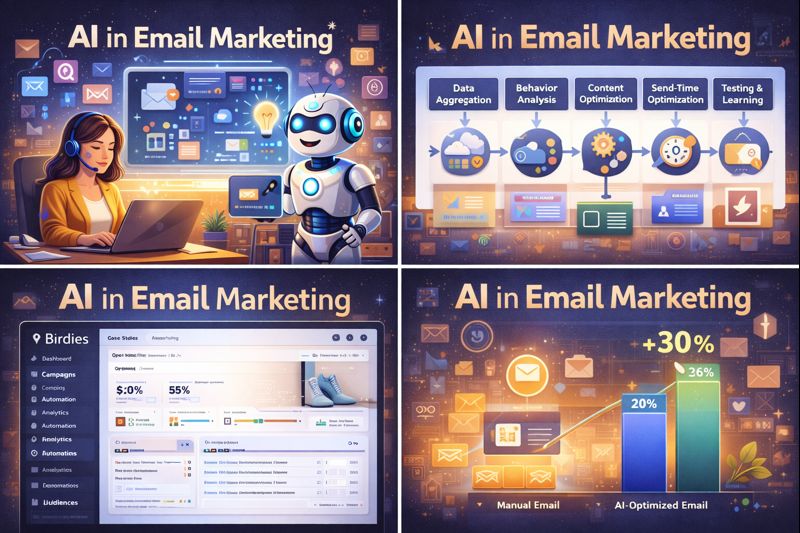
AI in Email Marketing

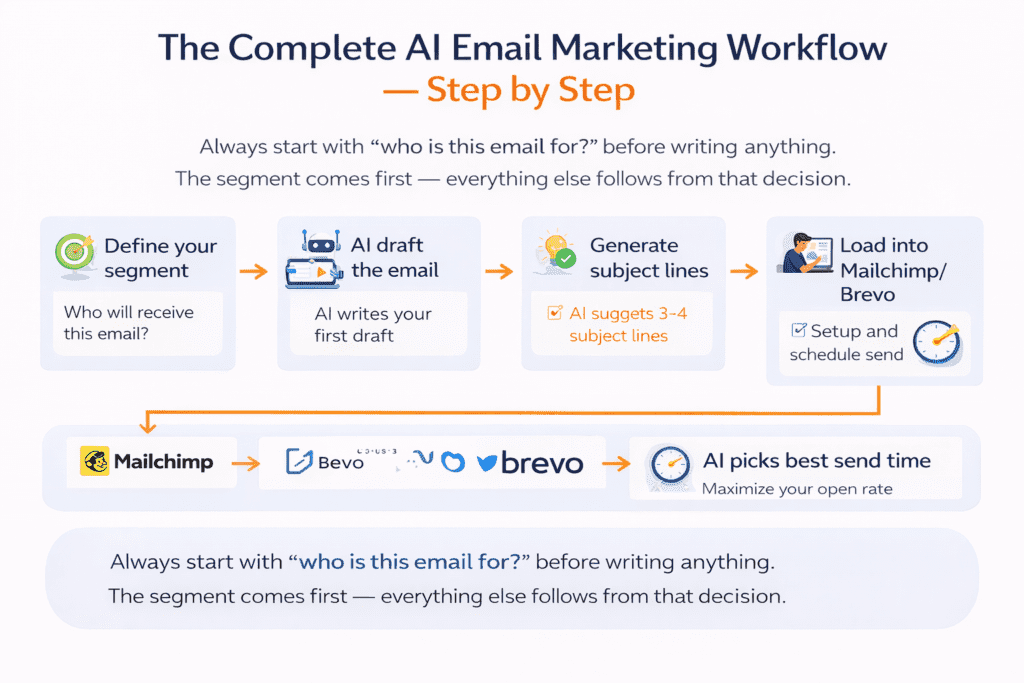
AI-driven email systems follow a continuous improvement cycle:

  1. Data Aggregation
    Collects data from email platforms, CRM systems, websites, and purchases (e.g., Salesforce, HubSpot).
  2. Behavior Analysis
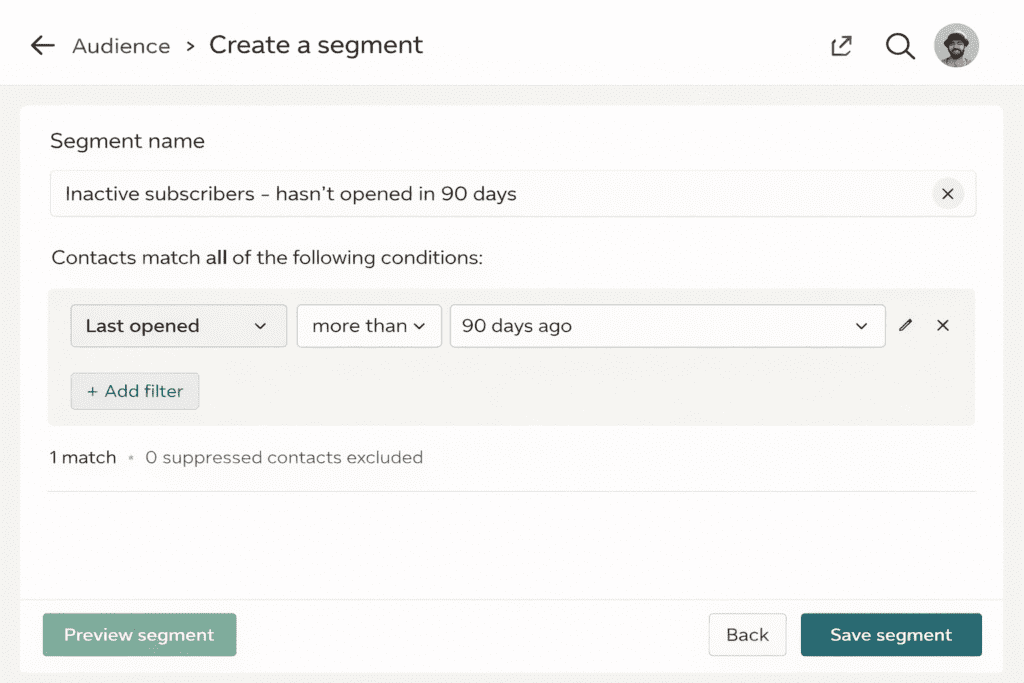
    Identifies patterns in opens, clicks, inactivity, and conversions.
  3. Content Optimization
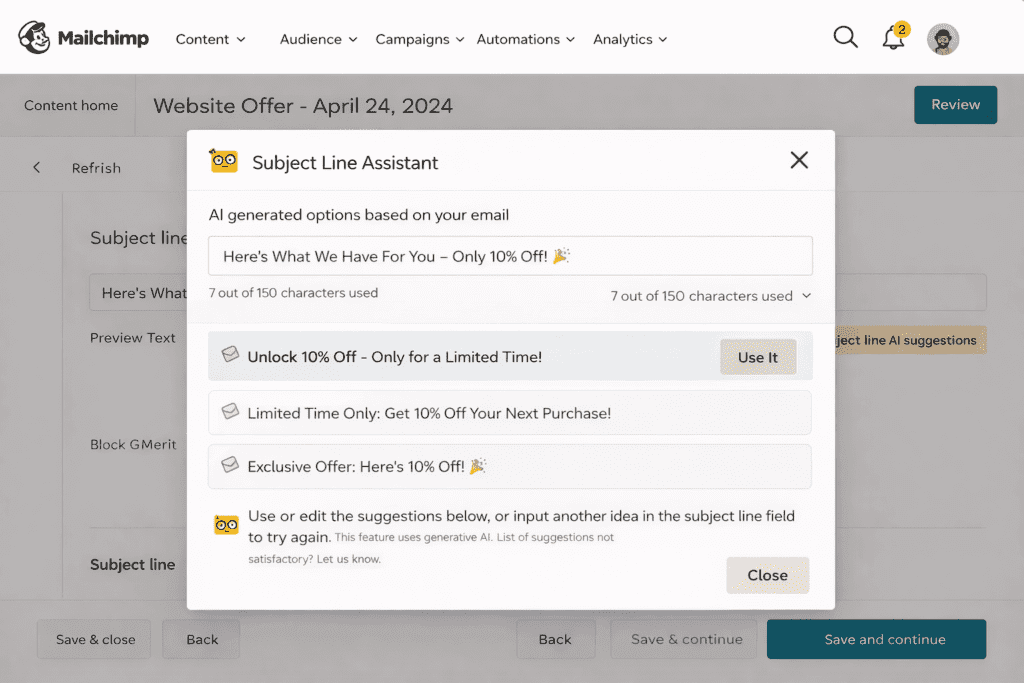
    Suggests subject lines, email layouts, product recommendations, and CTAs.
  4. Send-Time Optimization
    Predicts when each subscriber is most likely to open emails.
  5. Testing & Learning
    Runs A/B tests and refines future campaigns based on performance data.

This structured loop allows AI in email marketing to adapt continuously rather than relying on fixed rules.

Real-World Examples of AI in Email Marketing

Several brands already use AI responsibly with measurable outcomes:

  • Birdies used AI-based personalization to tailor messaging based on customer preferences, improving open rates and conversions.
  • Salesforce Einstein analyzes customer history to recommend email content, optimize A/B tests, and support sales outreach.
  • Omnisend helps e-commerce brands send personalized cart reminders and product recommendations.
  • Mailchimp uses predictive analytics to suggest optimal send times for different audience segments.

These examples show how AI in email marketing supports both marketing and sales teams without removing human oversight.

Key Benefits of AI in Email Marketing

When implemented correctly, AI delivers practical advantages:

  • Higher engagement through relevant subject lines and timing
  • Better segmentation based on real behavior, not assumptions
  • Time efficiency by automating repetitive tasks
  • Improved insights through real-time performance analysis
  • Consistent optimization across campaigns

These benefits make AI especially valuable for teams managing large or diverse email lists.

Challenges and Limitations to Be Aware Of

Despite its advantages, AI in email marketing has limitations:

  • Data quality issues can reduce accuracy
  • Privacy and compliance requirements (GDPR, consent) must be respected
  • Over-automation risks can dilute brand voice
  • Context gaps mean AI may miss emotional nuance

Human review and ethical standards are essential to avoid these risks and maintain trust.

Best Practices for Using AI in Email Marketing

To use AI effectively and safely:

  • Start with clear goals (opens, clicks, conversions)
  • Integrate AI with trusted platforms like Mailchimp or HubSpot
  • Use AI-generated content as drafts, not final copy
  • Maintain list hygiene and compliance checks
  • Monitor performance and adjust strategy regularly

A balanced human-AI approach delivers the best long-term results.

Best AI Tools For Business & Marketing

Frequently Asked Questions (FAQs)

1. What is AI in email marketing?

AI in email marketing means using Artificial Intelligence to create, personalize, and send emails more effectively. It helps businesses send the right message to the right person at the right time, improving engagement and results.

2. How does AI improve email marketing?

AI improves email marketing by analyzing user behavior, predicting preferences, and automating tasks. It helps write better subject lines, personalize content, and choose the best time to send emails.

3. Is AI email marketing suitable for small businesses?

Yes, AI email marketing is helpful for small businesses. It saves time, improves email performance, and helps businesses connect with customers more effectively without needing a large team.

4. Can AI write marketing emails automatically?

Yes, AI can generate email subject lines, email content, and responses. However, human review is important to ensure the message feels natural and aligns with the brand voice.

5. Does AI increase email open rates?

Yes, AI can increase open rates by optimizing subject lines, personalizing emails, and sending them at the best time when users are most likely to open them.

6. Is AI email marketing safe and ethical?

AI email marketing is safe when used responsibly. Businesses should respect privacy, avoid spam, and follow email marketing laws and ethical practices.

7. What are examples of AI in email marketing?

Examples include:
Personalized product recommendations
Automated email sequences
Smart subject line suggestions
Customer behavior analysis
These features improve user engagement.

8. Do I need technical skills to use AI in email marketing?

No, many AI email tools are easy to use and designed for beginners. They provide simple dashboards and automation features that do not require coding skills.

9. Can AI help reduce email marketing workload?

Yes, AI automates repetitive tasks like segmentation, scheduling, and content generation, saving time and effort.

10. Will AI replace human email marketers?

No, AI supports email marketers but does not replace them. Human creativity and strategy are still important for effective email marketing.

11. How does AI personalize emails?

AI analyzes customer data such as past purchases, browsing behavior, and preferences to send relevant and personalized emails.

Conclusion

AI in email marketing helps brands move from generic campaigns to meaningful communication. By combining automation with human oversight, businesses can improve engagement, efficiency, and trust. The most successful strategies treat AI as a decision-support tool—guided by ethics, data quality, and clear goals.

Start small, test carefully, and let AI enhance—not replace—your marketing expertise.

References