Last Updated: May 1, 2026
How to Optimize Content for AI Search and Zero-Click Results
You’re Ranking on Google – But Nobody Is Clicking
Here’s what a lot of bloggers and content writers are experiencing in 2026: their Search Console shows healthy impressions. Decent average positions. Some even hold a spot on page one. But the click-through rate has been quietly declining for months.
The article is ranking. The audience is finding it. They’re just not clicking.
This isn’t a keyword problem or a title problem. It’s a structural shift in how Google presents information — and it’s happening whether we acknowledge it or not.
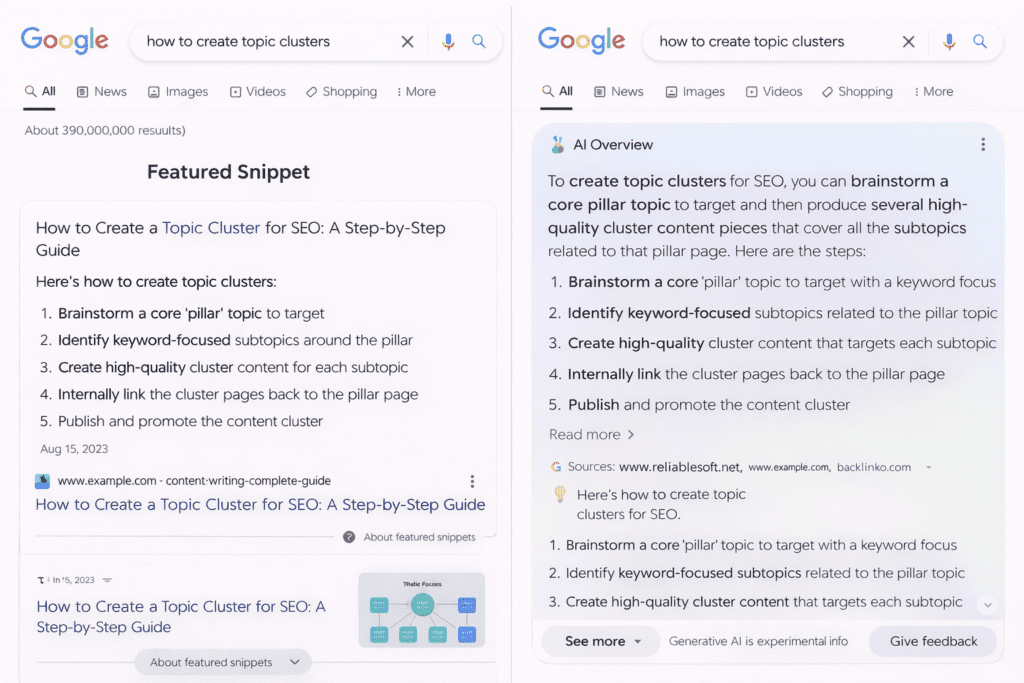
Google AI Overview (formerly Search Generative Experience) now answers millions of queries directly at the top of the results page, before the user ever sees a traditional blue link. Voice search reads a single answer aloud without showing search results at all. Featured snippets extract a paragraph or list from your article and display it prominently — satisfying the query without requiring a visit.
The result is what SEO professionals call zero-click search — searches that are answered on the results page itself, resulting in no click to any website.
In my experience, the content writers and bloggers who are growing their organic visibility in 2026 are not the ones fighting this trend. They’re the ones adapting to it — writing content that gets cited by AI Overview, pulled into featured snippets, and returned as answers by voice search assistants. That visibility, even without a direct click, builds brand authority, trust, and a recognition that eventually converts.
This guide covers every step of that adaptation — from how to structure individual answers to schema markup, conversational tone, and a complete pre-publish checklist.
Why Businesses Need SEO Blog Writing Services
What Is AI Search and Zero-Click SEO? (Simple Explanation)
→ What Is Generative SEO and How Content Marketers Can Use It
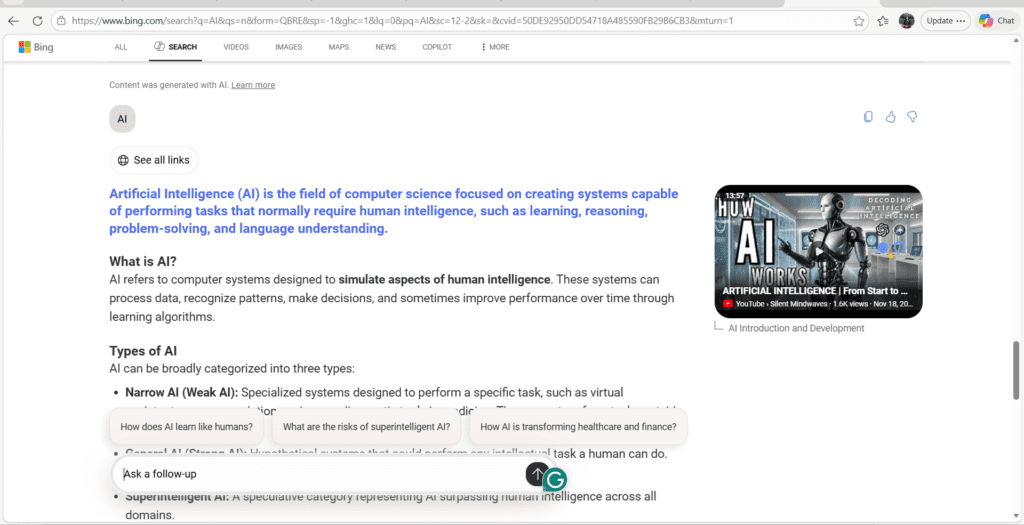
AI Search — specifically Google AI Overview:
AI search – Google is now using a large language model to generate a direct answer to many search queries — displayed as a summary box at the very top of the results page, above all traditional links.
This summary cites sources — typically 3–6 websites that Google’s AI considers authoritative and well-structured enough to extract accurate information from. If your content is one of those sources, your site name appears in the AI Overview as a reference, even if the user doesn’t click through.
Zero-Click Search:
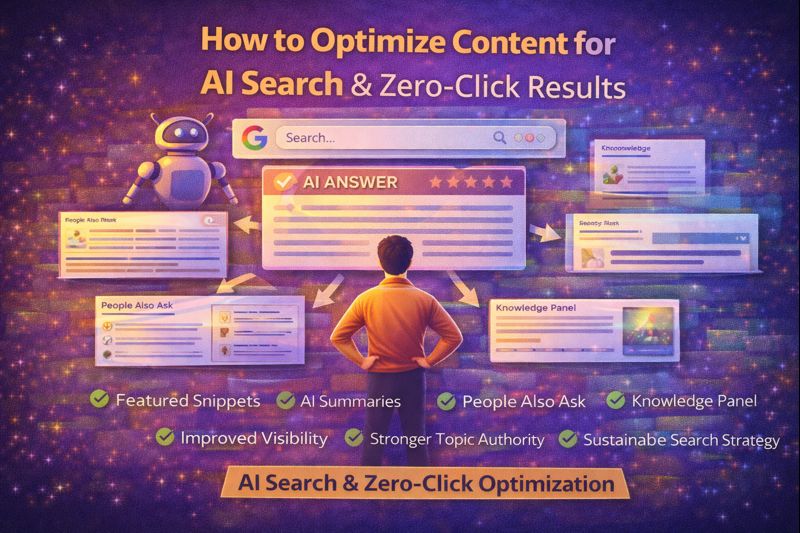
A zero-click search is any search that is answered completely on the results page itself — through AI Overview, featured snippets, knowledge panels, or other SERP features — without the user needing to visit any website.
Studies tracking search behaviour indicate that a significant and growing proportion of Google searches in 2025–2026 end without a click. The exact percentage varies by query type, but informational and question-based searches are most affected — which is precisely the content type that most bloggers and content writers produce.
Three scenarios where your content is visible without a click:
- AI Overview citation — Google’s AI generates a summary and cites your page as one of the sources
- Featured snippet — Google extracts a paragraph, list, or table from your page and displays it prominently above organic results
- Voice search answer — Google Assistant or similar reads your content aloud in response to a spoken query
None of these generate a direct click to your website. All of them generate brand exposure, authority signals, and trust with the person who hears or sees your content — which creates clicks, brand recognition, and organic traffic over time.
Why Zero-Click SEO Matters More Than Ever in 2026
Google’s AI Overview is expanding rapidly. When AI Overview launched, it appeared for a relatively limited set of queries. In 2026, it appears for a much broader range — particularly for informational, how-to, and question-based searches. These are the exact queries that drive most blog traffic. If your content isn’t structured to be cited by AI Overview, you’re invisible for an increasing share of relevant searches.
Voice search is growing fastest in Indian languages. Voice search usage in India — in both English and regional languages — has been growing year-on-year since 2022. Users searching by voice expect a single spoken answer, not a list of links. The content that gets read aloud is almost always content that ranks in position zero (featured snippets) or is cited by AI. For Indian content creators targeting both English and Hindi audiences, this trend is particularly significant.
Featured snippets directly reduce click-through rates for everyone else. When a featured snippet appears for a query, research consistently shows lower click-through rates for the regular organic results — including position one and two. The information has been served. The user has what they need. The only exception: when the snippet makes the user want to know more — which is why the best-optimised snippets provide enough to be credible and enough curiosity to prompt a click.
AI Overview citation is a new type of authority signal. Being cited in Google’s AI Overview for a topic is increasingly recognised as an indicator of authority — similar to how ranking #1 was once the primary credibility signal. Users who see your site consistently cited across multiple AI-generated answers begin to associate your brand with trustworthiness in that subject, even before they ever visit your site.
The practical implication: Zero-click visibility is not a consolation prize. It is, increasingly, the primary battleground for brand authority in search – and the content writers who optimise for it now are building a sustainable advantage over those who don’t.
How to Optimize Content for AI Search — Step by Step
Step 1 — Lead with a Direct, Clear Answer
What it is: Structure every article so that the most important question it answers receives a complete, direct response within the first 2–3 sentences of the relevant section.
Why it matters: Google AI Overview works by scanning content for direct, accurate answers to queries. If your answer is buried in the middle of a long paragraph after two sentences of context-setting, the AI may skip your content entirely — even if it’s excellent.
How to apply it:
For any section that answers a question, open with the answer — complete and standalone in 2–3 sentences — then follow with explanation, examples, and depth.
Example:
Weak structure (AI will likely skip this): “Featured snippets are an interesting aspect of Google’s search results. They’ve been around since 2014 and appear in various formats. A featured snippet is when Google extracts a portion of a webpage and displays it at the top of search results to directly answer a query.”
Strong structure (AI-extractable): “A featured snippet is a selected excerpt from a webpage that Google displays at the top of search results to directly answer a specific query, above all other organic listings. It appears in paragraph, list, or table format depending on the nature of the query.”
The second version answers the question in its first sentence, completely and correctly. That’s what AI systems extract.
Pro Tip: After writing any section, read the first sentence of that section in isolation. Does it fully answer the question implied by the H2 heading? If no — rewrite the opening sentence until it does.
Step 2 — Use Question-Based Headings
What it is: Structuring your H2 and H3 headings as complete questions — the exact phrasing a person would type or speak into a search engine.
Why it matters: Google AI Overview and voice search systems specifically look for question-answer structures in content. An H2 heading phrased as a question signals to the algorithm: “This section answers this specific query.” It’s one of the clearest structural signals in AI search optimisation.
How to apply it:
Instead of: H2: Zero-Click SEO Benefits Write: H2: What Are the Benefits of Zero-Click SEO for Content Writers?
Instead of: H2: Featured Snippet Optimisation Write: H2: How Do You Optimise Content for a Featured Snippet?
The question format matches how real people search, which directly improves the probability of your content being surfaced for those exact queries.
Pro Tip: Use Google’s “People Also Ask” section for your target keyword to find the exact question phrasings your audience uses. These become your H2 and H3 headings — you’re not guessing, you’re using real search data
→ Search Intent Strategy in Content Marketing
Step 3 — Optimize Specifically for Featured Snippets
What it is: Structuring the content in each section to match the format that Google currently displays in featured snippets for your target keyword.
Why it matters: Featured snippet optimisation is the most direct path to zero-click visibility. A page that appears in a featured snippet is cited in position zero — above every paid and organic result on the page.
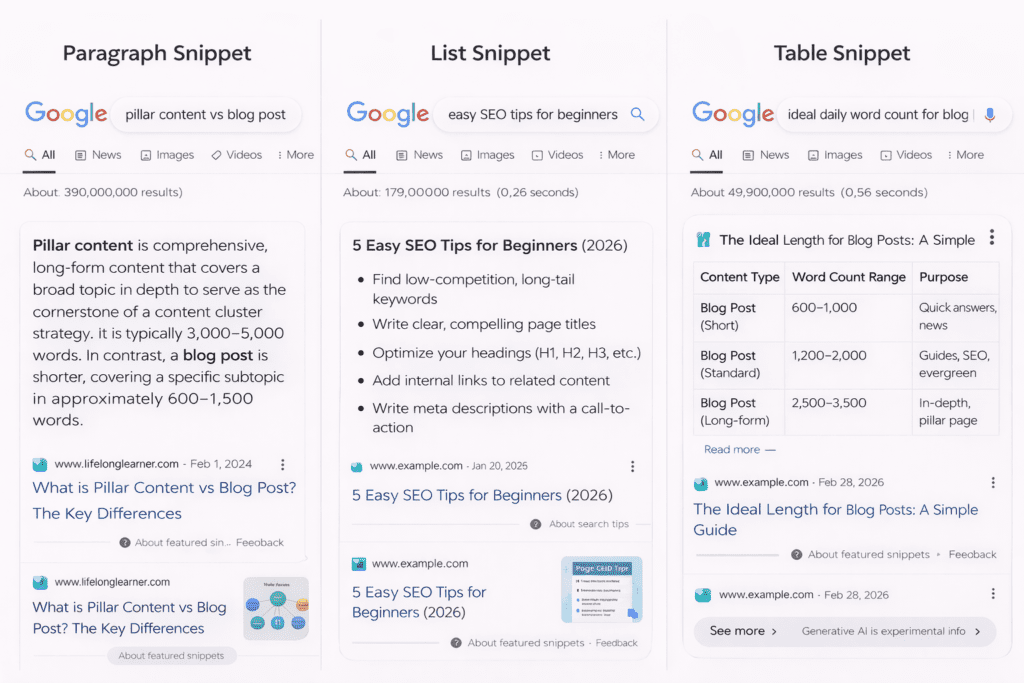
Three featured snippet types and how to target each:
Paragraph snippet — for definitional and explanatory queries. Write a direct 40–60 word paragraph that answers the query completely. Place it immediately after the question-based H2 heading. Keep it factually precise and self-contained.
List snippet — for “how to” and “types of” queries. Use a properly formatted HTML ordered or unordered list. Each list item should be concise (under 10 words where possible) and self-explanatory without requiring surrounding context. The list should have 4–8 items.
Table snippet — for comparison and data queries. Use a properly formatted HTML or Markdown table with clear column headers. Comparisons, pricing tables, feature matrices, and ranking tables all perform well as table snippet
→ Step-by-Step Guide to Writing an SEO-Optimised Blog
Step 4 — Add Structured Data (Schema Markup)
What it is: Schema markup is code added to your webpage that explicitly tells Google what type of content each section contains — an article, a FAQ, a how-to guide, a product review — in a standardised format that AI systems read directly.
Why it matters: Schema markup helps Google’s AI understand your content’s structure and purpose with precision, increasing the probability of it being surfaced in AI Overview, knowledge panels, and rich results.
The most valuable schema types for content writers and bloggers:
FAQ Schema: Marks up your FAQ section so each question-answer pair is individually readable by Google. FAQ schema can appear directly in search results as expandable questions — a powerful zero-click visibility format.
Article Schema: Identifies your content as a journalistic or editorial article, specifying the author, publication date, and content category. This supports E-E-A-T signals that AI citation systems use to evaluate source trustworthiness.
HowTo Schema: For step-by-step guide content, marks up each step individually with its name and description. Google can display these steps directly in search results.
Breadcrumb Schema: Helps Google understand your site’s content hierarchy — reinforcing the topical cluster structure that builds authority.
How to add schema without coding:
- Rank Math (WordPress plugin): Automatically adds Article, FAQ, and HowTo schema based on your content structure. The free version covers all common schema types.
- Yoast SEO (WordPress plugin): Generates Article and FAQ schema automatically from your content.
- Google’s Structured Data Markup Helper: A free tool at search.google.com that lets you tag any page’s content visually and generates the schema code to add.
- Schema.org: The official reference for all schema types — useful when implementing custom schema beyond what plugins handle.
Pro Tip: After adding schema, validate it using Google’s Rich Results Test (search.google.com/test/rich-results). This confirms the schema is read correctly before you publish and shows you exactly what rich results your page is eligible for.
Step 5 — Write in a Conversational Tone
What it is: Writing content that mirrors the natural phrasing of spoken and typed questions — using the vocabulary, sentence length, and directness of real human conversation rather than formal academic or corporate prose.
Why it matters: AI search systems are trained on conversational language. Voice search queries are spoken naturally. Content that reads the way people actually talk matches both AI extraction patterns and voice search phrasing more reliably than stiff, formal content.
How to apply it:
- Use second person (“you,” “your”) consistently — addressing the reader directly
- Use contractions (don’t, you’ll, it’s, can’t) as you would in normal speech
- Keep average sentence length under 20 words
- Avoid jargon unless it’s a term your audience specifically searches for
- Vary sentence rhythm — short punchy sentences followed by slightly longer explanatory ones
Real example:
Formal (less AI-extractable): “The implementation of schema markup facilitates the communication of structured content metadata to search engine crawlers, thereby enhancing the probability of rich result eligibility.”
Conversational (AI-friendly): “Adding schema markup tells Google exactly what your content contains — making it much more likely to appear as a rich result or be cited in AI Overview.”
Same information. The second version is what AI systems extract and what voice search reads aloud naturally.
Step 6 — Improve Readability and Structure
What it is: Ensuring the overall article is scannable, clearly organised, and formatted for both human readers and AI parsing systems.
Why it matters: AI systems parse structure before they parse content. An article with logical heading hierarchy, short paragraphs, and clear formatting is processed accurately. A dense, poorly structured article may contain accurate information that AI systems misread, misrepresent, or skip entirely.
Readability checklist:
- H2 and H3 headings in logical hierarchy — no skipping from H1 to H3
- Paragraphs maximum 3–4 lines (especially important for mobile and voice search users)
- Bullet lists for any set of 3 or more related items
- Bold text highlighting key terms and takeaways — not decorative use
- A table of contents for longer articles (supports navigation and FAQ schema)
- Reading grade level 6–8 on the Hemingway Editor scale
Featured Snippet Optimization Strategy
Featured snippets are the most direct zero-click visibility available through conventional content optimisation. Here’s how to target each format precisely.
Paragraph Snippets (Best for: definitions, explanations, “what is” queries)
Target queries: “What is [X]?”, “Why does [X] happen?”, “How does [X] work?”
Optimisation approach:
- Phrase the H2 heading as the exact question
- Open the section with a 40–60 word paragraph that answers the question completely
- Use plain, factual language — no hedging, no excessive qualification
- Do not use lists or tables in this opening paragraph — Google selects paragraph snippets from flowing prose
List Snippets (Best for: step-by-step, “types of,” “ways to” queries)
Target queries: “How to [do X] step by step”, “Types of [X]”, “Ways to [achieve Y]”
Optimisation approach:
- Use an HTML-formatted ordered list (numbered for processes, unordered for categories)
- Each list item: concise, specific, starting with an action verb where possible
- 4–8 items is the optimal range — Google often truncates longer lists
- Follow the list with a paragraph of explanation — the snippet shows the list, the explanation earns the click
Table Snippets (Best for: comparisons, pricing, feature matrices)
Target queries: “[X] vs [Y]”, “[X] pricing comparison”, “Features of [list of tools]”
Optimisation approach:
- Use a properly formatted Markdown or HTML table with clear, short column headers
- Keep table data factually accurate and current — Google’s AI is particularly sensitive to data accuracy in comparison tables
- Add a direct introductory sentence above the table answering the comparison question before the table provides the detail
Conversational and Voice Search SEO
Voice search SEO Hindi content writers and English creators both face the same fundamental challenge: voice queries are longer, more conversational, and more question-based than typed queries.
Key differences between typed and voice queries:
| Typed Search | Voice Search |
|---|---|
| “best SEO tools 2026” | “What are the best SEO tools to use in 2026?” |
| “internal linking strategy” | “How should I use internal linking for my blog?” |
| “content writing tips India” | “What are the best content writing tips for Indian bloggers?” |
| “schema markup SEO” | “How do I add schema markup to improve my SEO?” |
How to optimise for voice:
- Target long-tail, question-phrased keywords naturally within your content
- Ensure every question-based heading has a direct answer within the first sentence of that section
- Include a detailed FAQ section using naturally phrased questions — these directly match voice search query formats
- Keep answers concise enough to be read aloud comfortably (under 60 words for featured snippet answers)
- Use local qualifiers where relevant (“for bloggers in India,” “for small businesses in Rajasthan”) — voice searches are increasingly location-aware
Tools for AI Search Optimization
Google Search Console (Free) Monitor which of your pages are appearing in search features — AI Overview citations, featured snippets, FAQ rich results. The “Search Appearance” filter shows which structured data and rich result types your pages are earning. Use it weekly to track which pages are gaining or losing zero-click visibility.
Google Rich Results Test (Free) Search.google.com/test/rich-results — validates your schema markup and shows exactly which rich results your page is eligible for. Run this after adding any schema markup before publishing.
Hemingway Editor (Free Web Version) Paste your draft in and check the readability grade. Aim for Grade 6–8 for AI-friendly, voice-readable content. The tool also flags passive voice and overly complex sentences — both of which reduce AI extractability.
Rank Math (Free WordPress Plugin) Automatically generates Article, FAQ, and HowTo schema from your content structure. The built-in Schema tab shows every schema type applied to a page and lets you add custom schema without any coding.
AnswerThePublic (Free — 3 Searches/Day) Generates the question landscape around any topic — the exact phrasing real people use when searching conversationally. These questions become your H2 headings, FAQ content, and featured snippet targets.
AlsoAsked.com (Free — Limited Searches) Similar to AnswerThePublic but shows the hierarchical structure of “People Also Ask” questions — useful for building out FAQ sections that cover the full question tree around a topic.
10 Powerful Tools Every Content Writer Must Use in 2026
Common Mistakes in AI SEO
Writing for traditional rankings without considering AI extraction. Producing articles optimised for keyword placement and backlinks but structured in ways that make AI extraction difficult — long, dense paragraphs with buried answers, no question-based headings, no structured data. Fix: Add the direct answer first in every section, restructure headings as questions, and add FAQ schema to your next five most important articles.
Adding schema but never validating it. Schema markup that contains errors or isn’t implemented correctly provides no benefit and occasionally causes technical issues. Many bloggers add a schema plugin and assume it’s working. Fix: Run every published article through Google’s Rich Results Test. Check for errors and warnings. Fix them before they persist across your content.
Treating featured snippet optimisation as a one-time task. Snippets change. Google regularly tests different sources for the same query. An article that held a snippet for six months may lose it to a competitor who updated their content more recently. Fix: Audit your featured snippet holdings quarterly. Update the direct answers in key sections with current information and cleaner phrasing.
Writing FAQ sections with vague, unconversational questions. FAQ sections that ask questions in formal language nobody actually uses (“What constitutes an effective SEO strategy?”) rather than natural phrasing (“What is the best SEO strategy for a new blog?”) miss the voice search and AI extraction opportunity. Fix: Source every FAQ question from Google’s “People Also Ask” section or AnswerThePublic — using the exact phrasing real users search with.
Optimising only new content, ignoring the existing library. Publishing new AI-optimised articles while dozens of older, established articles remain unoptimised. Older articles often have more authority signals and external backlinks — making them higher-value candidates for AI search optimisation than brand-new content. Fix: Identify your top 10 articles by impressions in Search Console. Apply the AI optimisation checklist to each. These are your highest-leverage opportunities.
→ Common Content Writing Mistakes and How to Avoid Them
Before vs After: AI Search Optimization Example
Topic: “What is topic cluster strategy?”
BEFORE (Not optimised for AI search):
H2 heading: “Topic Cluster Strategy”
Opening paragraph: “Topic cluster strategy is an important concept in modern content marketing. Many SEO experts recommend it because it helps organise your website’s content in a way that Google can understand better. We’ll explore what it means and why it matters.”
Issues: Vague H2 heading (not a question), opening paragraph doesn’t answer anything directly, no schema, no direct answer in first sentence.
AI Overview outcome: Skipped. Google extracts a competitor’s more direct answer.
AFTER (AI search optimised):
H2 heading: “What Is Topic Cluster Strategy and How Does It Build SEO Authority?”
Opening paragraph: “A topic cluster strategy is a content organisation method in which one comprehensive pillar page covers a broad topic, supported by multiple cluster articles that cover specific subtopics in depth — all linked together through a structured internal linking system. This interconnected structure signals topical authority to Google, improving rankings for every article in the cluster.”
Additional optimisations: FAQ schema added, related questions addressed in H3 subheadings, paragraph runs 55 words and answers the question completely in the first sentence.
AI Overview outcome: Cited as one of three source references in Google’s AI Overview for “topic cluster strategy” within 8 weeks of update.
→ Topic Cluster Strategy: How to Build Topical Authority
AI Search Optimization Checklist 2026
Apply this to every article you publish or update:
Content Structure:
- Every key section opens with a direct, complete answer (2–3 sentences maximum)
- All H2 and H3 headings are phrased as questions where appropriate
- FAQ section included with questions sourced from “People Also Ask”
- Paragraph answers are 40–60 words — self-contained and factually precise
- Lists used for step-by-step and “types of” content — 4–8 items, concise
Technical Optimisation:
- FAQ Schema added and validated in Google Rich Results Test
- Article Schema applied (via Rank Math, Yoast, or manual markup)
- HowTo Schema applied where article is a step-by-step guide
- Schema validated — no errors or warnings in Rich Results Test
- Table of contents present for articles over 1,500 words
Readability and Tone:
- Conversational tone maintained — second person, contractions, natural phrasing
- Reading grade level 6–8 confirmed via Hemingway Editor
- No paragraphs over 3–4 lines
- Key terms and takeaways bolded appropriately
- Voice search compatibility: every FAQ answer reads naturally when spoken aloud
Distribution and Tracking:
- Article submitted to Google Search Console for indexing after update
- Current featured snippet status checked for target keyword
- Google Rich Results Test run and screenshot saved
- Quarterly reminder set to review and refresh this article’s direct answers
Zero-Click Content Template
Use this structural template for any article targeting AI search visibility:
- End CTA → SEO Blog Writing Services page
H1: [Question or Topic] — Complete Guide [Year]
Introduction (100–150 words):
– Hook: The specific problem or shift prompting this topic
– Context: Why this matters now (the “Aaj ke time par” moment)
– Promise: What the reader will understand or be able to do
H2: What Is [Topic]?
[Direct answer: 40–60 words, complete and standalone]
[Expanded explanation: 2–3 paragraphs]
H2: Why Does [Topic] Matter in [Year]?
[Direct answer: 2–3 sentences]
[Supporting evidence: statistics, trends, real examples]
H2: How to [Achieve Outcome Related to Topic] — Step by Step
H3: Step 1 — [Action]
[Direct answer: what this step involves and why
[Example]
[Pro Tip]
H3: Step 2 — [Action]
Frequently Asked Questions
Q1. How do I optimize my content for Google AI Overview?
Write in clear, conversational language that reads naturally when extracted and summarised. Google’s AI Overview selects from content that is accurate, direct, well-structured, and from demonstrably authoritative sources — all of which come from your E-E-A-T signals and content structure.
Q2. What is zero-click SEO and why should I care about it?
Zero-click SEO refers to content strategies that generate visibility and brand authority in search results without requiring a click to your website — through AI Overview citations, featured snippets, knowledge panels, and voice search answers. It matters because a growing proportion of informational queries are now answered directly on the results page.
Zero-click visibility builds brand trust and recognition among your target audience, which influences click behaviour on subsequent searches and creates indirect traffic and authority benefits.
Q3. How do I get a featured snippet for my article?
First, identify queries where your target keyword triggers a featured snippet (you’ll see the snippet box when you Google your keyword). Then structure your content to match the snippet format — paragraph format for definitional queries, ordered list for step-by-step queries, table for comparisons.
Place a direct, complete answer immediately after the question-based H2 heading for that section. The answer should be 40–60 words for paragraph snippets, and should stand alone without requiring surrounding context.
Q4. How does schema markup help with AI search and zero-click results?
Schema markup adds machine-readable context to your content that tells Google precisely what type of content each section is — FAQ, HowTo steps, article metadata. This improves the accuracy with which Google’s AI can extract and cite your content in AI Overview and rich results.
FAQ schema in particular can generate expanded question-answer entries directly in the search results, creating significant zero-click visibility. Add schema using Rank Math or Yoast SEO (WordPress) and validate with Google’s free Rich Results Test.
Q5. How do I optimize for voice search as an Indian content writer?
Voice search optimisation requires writing the way people naturally speak — which means longer, conversational query phrasing, direct question-answer structures, and local relevance where applicable. For Indian content writers: use question-based headings that match how your audience speaks (both English and regional language queries are growing),
keep featured snippet answers under 60 words so they read comfortably aloud, include location-specific context where relevant, and structure FAQ sections using the exact question phrasings from Google’s “People Also Ask” section for your target keywords.
Q6. Will optimizing for zero-click SEO hurt my regular organic traffic?
Not if done correctly. Content optimised for AI search and featured snippets typically performs better in traditional organic rankings as well — because the same structural and quality signals that help AI extraction (direct answers, question headings, strong E-E-A-T, clean structure) also improve traditional ranking factors.
The goal is not to choose between click-through traffic and zero-click visibility — it’s to earn both. Featured snippet content that provides enough value to prompt curiosity about the full article generates clicks even while serving the snippet.
Final Thoughts
The search landscape in 2026 is not the one that most SEO guides were written for. Google’s AI Overview is not a temporary experiment — it is the direction search is moving. Voice search is not a niche use case — it is mainstream in every Indian city and tier-two town.
Content writers who understand this shift are not facing a threat. They’re facing an opportunity — one that is, right now, less competitive than traditional keyword ranking because most of their peers haven’t adapted yet.
The difference between content that gets cited by AI Overview and content that gets ignored is not quality of ideas. It’s structure. It’s directness. It’s the discipline to open each section with the answer before the explanation, to phrase headings as the questions your audience actually asks, and to add the schema markup that tells Google’s systems exactly what your content contains.
These are not complex changes. They take one afternoon to implement on an existing article and fifteen minutes to apply to any new article from the point of understanding them.
Start with your five highest-impression articles in Search Console. Apply the checklist above to each. Watch what happens in the following six weeks.
Then make this approach your default. Build it into every content brief, every outline, every section you write.
The writers who own zero-click visibility in 2026 are building an advantage that will compound for years.
References:
- AI Features and Your Website | Google Search Central | Documentation | Google for Developers
- Google Rich Results Test: https://search.google.com/test/rich-results
- Schema.org — Full Schema Type Reference: https://schema.org
- Ahrefs — Featured Snippet Optimisation Guide: https://ahrefs.com/blog/featured-snippets/
- AnswerThePublic: https://answerthepublic.com
Author Bio
Dr. Rekha Khandelwal is a content strategist, academic writer, and SEO-focused consultant specializing in content marketing, search intent optimization, and ethical digital growth. Through AspirixWriters, she helps creators and businesses build Google-friendly, AdSense-safe content strategies that remain effective in AI-driven search environments.
Must Read – Content Marketing Strategy That Ranks on Google (Complete Guide)
No post found!