Last Updated: March 21, 2026
Cluster Post 2 | Module 8: Grant Writing and Research Funding
From Concept to Submission Series | 2026
Academic Writing Mastery: The Complete 2026 Guide To Research Papers, Thesis & Dissertation Writing
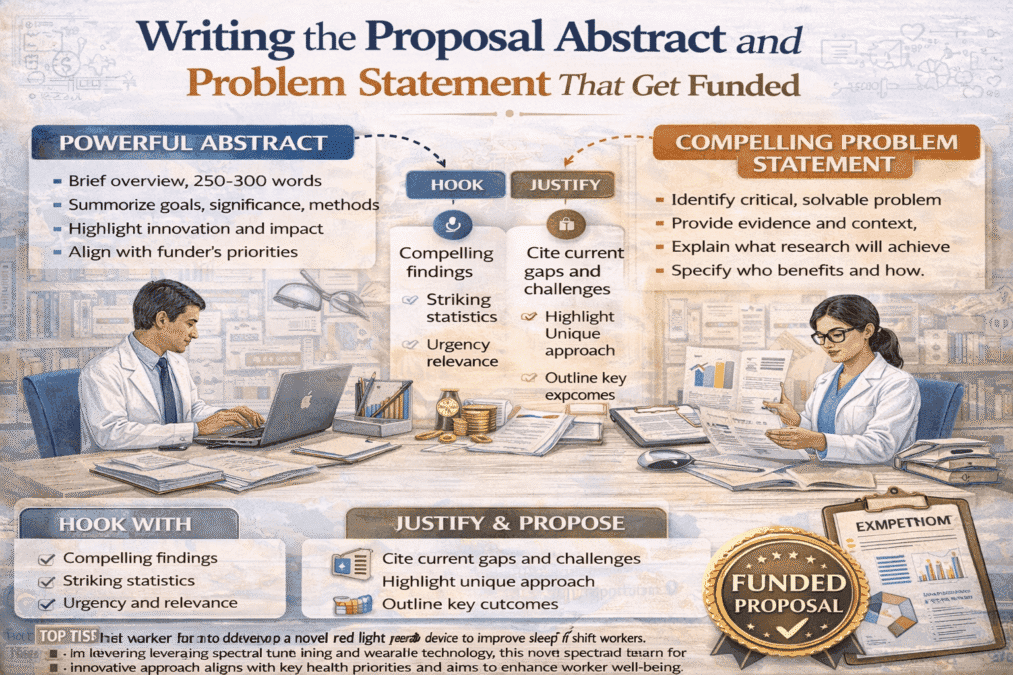
Writing the Proposal Abstract and Problem Statement
The module overview gives a worked abstract example and describes the problem statement structure. This post goes deeper: the precise difference between a funded and unfunded abstract, the three-tier significance hierarchy that separates competitive proposals, worked before-and-after examples for both sections, and how the abstract and problem statement must function together.
What Reviewers Do in the First Three Minutes
Grant reviewers receive many proposals in a review cycle. Before the formal assessment begins, reviewers form a preliminary impression — positive, negative, or neutral — based almost entirely on the abstract and the first two paragraphs of the problem statement. This impression is not determinative, but it is highly persistent: a reviewer who is positively engaged by the abstract reads the methods section charitably; a reviewer who is not engaged reads it looking for problems.
The abstract must do one thing above all: make the reviewer believe this research matters. Not that it is technically competent (the methods section will establish that), not that the researcher is qualified (the CV section will establish that), but that the question being asked is worth the funder’s money. Most abstracts describe what the research will do without making the case that the question matters. This is the most common reason good research receives poor abstract scores.
The Funded Abstract: Six Elements in Order
A competitive grant abstract reliably contains six elements, each in a specific position. The module gives this structure. This post shows what each element must accomplish and what it looks like when done well vs. poorly.
Element 1: The situation (one sentence)
One sentence establishing the contemporary context that makes the research urgent. This is not a general background sentence — it is a sentence that creates a sense of timeliness, stakes, or urgency.
Weak (general context, no urgency): ‘Education is important for India’s development and has been studied by many researchers over the years.’ Strong (specific, timely, stakes-driven): ‘India’s National Education Policy 2020 mandates foundational literacy for all students by Grade 3, yet current data from ASER 2024 show that 52% of Grade 3 students in rural India cannot read a Grade 1 text — a gap with direct implications for a generation of children now entering primary school.’
Element 2: The knowledge gap (one to two sentences)
The specific thing we do not currently know or understand — not the broad topic, but the precise gap this research will fill. The gap must be genuinely unfilled by existing research, not just underexplored.
Weak (general gap): ‘More research is needed on teacher training in India.’ Strong (specific gap): ‘Existing intervention studies have tested training models developed in resource-adequate contexts. No published study has evaluated whether a low-cost, locally designed training programme — delivered without specialist trainers or external technology — can produce measurable literacy gains in under-resourced rural schools with high teacher absenteeism and large multilingual classrooms.’
Element 3: The research aim (one sentence)
A single precise sentence stating what this project will do. This should be a research aim, not a research ambition. ‘This study will develop and evaluate X’ is an aim. ‘This study will transform literacy outcomes across India’ is an ambition — and reviewers recognise the difference.
Element 4: The method (two to three sentences)
Enough methodological detail for a reviewer to assess feasibility. Not a full methods section — that comes later — but enough to show the approach is sound and the scale is realistic.
Weak (vague): ‘The study will use mixed methods to collect data from schools in Rajasthan.’ Strong (specific and proportionate): ‘A quasi-experimental design will compare 40 intervention schools (receiving the locally-designed training programme) with 40 matched control schools over one academic year. Literacy will be assessed at baseline, midpoint, and endpoint using the ASER-India assessment tool, producing data from approximately 3,200 students in Grades 1–3. Teacher interviews and classroom observations will document implementation processes and contextual challenges.’
Element 5: The expected outputs (one to two sentences)
What the research will produce — not what it hopes to find, but what it will definitively produce. Papers, datasets, frameworks, policy reports, validated instruments. Outputs are certain; findings are uncertain. Strong abstracts commit to outputs.
Element 6: The significance (one to two sentences)
This is the element most commonly omitted or underdeveloped. The significance sentence must answer: so what? If this research succeeds, what changes? Who benefits? How much does it matter?
Weak significance: ‘This research will contribute to the literature on teacher training.’ Strong significance: ‘Findings will provide Indian education policymakers with evidence on whether a fully scalable, low-cost training model can close the foundational literacy gap — an issue affecting approximately 12 million rural primary students currently entering Grade 3 without baseline reading skills. The model, if effective, requires no specialist delivery infrastructure and could be replicated in similar contexts across South Asia.’
The full worked abstract
India’s National Education Policy 2020 mandates foundational literacy for all students by Grade 3, yet current ASER data show that 52% of rural Grade 3 students cannot read a Grade 1 text. While teacher training is widely recognised as central to literacy improvement, no published study has evaluated whether a low-cost, locally designed programme — delivered without specialist trainers or external technology — can produce measurable literacy gains in under-resourced rural schools with high teacher absenteeism and large multilingual classrooms. This study will develop and evaluate a low-cost teacher training programme adapted for under-resourced rural primary schools in Rajasthan. A quasi-experimental design will compare 40 intervention schools with 40 matched controls over one academic year, assessing 3,200 students at baseline, midpoint, and endpoint using the ASER-India tool. Teacher interviews and classroom observations will document implementation processes. The study will produce: validated evidence on the programme’s literacy impact, a replicable programme model with implementation guidelines, and a validated assessment protocol for under-resourced multilingual contexts. Findings will provide policymakers with evidence on whether a fully scalable training model can close the foundational literacy gap — an issue affecting approximately 12 million rural primary students currently entering Grade 3 without baseline reading skills. Word count: 195. All six elements present. Stakes established, gap specific, outputs committed, significance quantified.
The Problem Statement: Building the Case in Three Moves
The problem statement (or background section) is where you build the intellectual case for your research. Its job is to take a reviewer from general awareness of your topic to specific conviction that your research question is the right next question. It does this in three moves.
Move 1: Establish what is at stake
Open with the real-world significance of your topic. Not its academic significance — that comes later — but the human, social, or practical stakes. Why does this topic matter outside the university? The opening of the problem statement should make any informed reader understand that something important is at issue.
The opening sentence is the most important sentence in the problem statement and typically the weakest in draft proposals. It should not start with ‘Research has shown that…’ or ‘Scholars have long recognised…’ — these are academic openings that bury the stakes. Open with what matters: ‘Every year, approximately 12 million children enter Grade 3 in rural Indian schools without the reading skills they need to access the curriculum.’
Move 2: Establish what is known and what is not
This is the compressed literature review: what has been studied, what has been found, and — crucially — what has not. The gap must be specific and well-defined. Reviewers who know the literature will check whether the gap is real. A claimed gap that existing work already fills is a fatal flaw in a problem statement.
The structure: synthesise relevant findings in two to four sentences, then identify the specific dimension that has not been studied. The synthesis should be thematic, not author-by-author. The gap should follow logically from the synthesis — it should feel like the obvious next question given what is known.
Move 3: Connect the gap to your proposed research
The final move is the bridge: having established the gap, explain in one to two sentences how your proposed research addresses it. This should feel inevitable — as if the research design you are proposing is the natural next step from the gap you identified. If it requires explanation or defence, the problem statement has not built the case adequately.
Weak bridge (requires defence): ‘Given these gaps, this study will conduct interviews with teachers to understand their perspectives on training.’ Strong bridge (feels inevitable): ‘Given the absence of evidence on low-cost, locally designed training models, this study will develop and evaluate one — testing whether effective teacher training for under-resourced rural contexts requires the specialist infrastructure that existing models assume.’
The Significance Hierarchy
The module lists three types of significance: academic, practical, and methodological. In competitive grant applications, these are not equal. Reviewers weight them differently depending on the funder — and building the right hierarchy for the right funder is one of the most effective ways to strengthen a proposal.
- Government research councils (SERB, NSF, ESRC): Weight academic and methodological significance most heavily. The research must advance knowledge and the methods must be rigorous. Practical significance is valued but secondary.
- Government development agencies (ICSSR, DFID/FCDO): Weight practical and policy significance. Research must connect to development priorities. Academic rigour is necessary but not sufficient.
- Private foundations (Tata Trusts, Ford Foundation, Gates): Weight social impact significance above all. Research must address a mission-aligned social problem. Academic framing can be lighter.
- International fellowships (Fulbright, DAAD): Weight cross-cultural, bilateral, or capacity-building significance. Research that builds research capacity or cross-cultural understanding is valued alongside intellectual merit.
Write the significance section to match the funder’s hierarchy. The same research project can legitimately emphasise different dimensions of its significance for different funders — this is not misrepresentation, it is appropriate audience awareness.
Legal Research and Writing: Complete Guide for Law Students and Legal Researchers
FAQs
Q: How do you write a research proposal abstract?
A research proposal abstract (200–300 words) must cover: the research problem and why it matters; the specific research question or objective; the methodology in one sentence; the expected outputs; and the significance of the contribution. Unlike a paper abstract which reports completed work, a proposal abstract describes planned work. Write it in future tense. Every sentence should build the case for funding — reviewers read abstracts first and often make preliminary funding decisions based on them alone. Be specific: ‘will analyse 1,200 court orders’ is more persuasive than ‘will conduct empirical research.’
Q: How do you write a research problem statement for a grant proposal?
A grant proposal problem statement has three elements: the significance of the problem (who is affected and how seriously); the specific knowledge gap (what is not understood about the problem that prevents its solution); and why your research will address this gap (what your specific study will produce that does not currently exist). The problem must be specific enough that a solution is conceivable and general enough that funders can see broader relevance. Reviewers assess: does this problem genuinely need solving? Is this the right way to solve it? Does this researcher have the capacity to do it?
Q: What is the difference between a research problem and a research question in a grant proposal?
The research problem is the real-world or scholarly situation that motivates the research — the gap in knowledge or practice that your project addresses. The research question is the specific, answerable question your study will investigate. A research problem might be: ‘The factors predicting bail denial in Indian Sessions Courts are poorly understood, limiting evidence-based reform.’ The research question derived from this: ‘Which variables independently predict bail denial in Sessions Courts in three Indian states from 2020 to 2024?’ A grant proposal needs both — the problem justifies the funding; the question specifies what the money will produce.
Q: How long should a grant proposal be?
Grant proposal length is determined by the funding body’s guidelines — not by you. ICSSR Major Project proposals: typically 15–25 pages. SERB-CRG proposals: 15–20 pages in the prescribed format. UGC-STRIDE: follows a specific online application form with character or word limits per section. Never exceed the specified length — reviewers penalise proposals that do not follow guidelines. If a section has a word limit, treat it as a constraint that forces you to communicate efficiently, not as a ceiling to fill. Concise, precise proposals consistently outperform verbose ones at the same quality level.
Q: How do you write the significance section of a research proposal?
The significance section answers: why does this research matter, and who benefits from the knowledge it will produce? Be specific about beneficiaries (not ‘society’ but ‘district-level policymakers responsible for prison reform’; ‘judges applying bail jurisprudence’; ‘legal aid organisations designing training programmes’). Connect significance to existing policy frameworks (NEP 2020, DPDPA 2023, national health policies) to show funders that the research fits within recognised priorities. Quantify where possible: ‘The 5.5 lakh undertrial detainees currently in Indian prisons’ is more compelling than ‘a significant number of people.’
References
- Locke, L. F., Spirduso, W. W., & Silverman, S. J. (2022). Proposals That Work (8th ed.). Sage.
- Ries, J. B., & Leukefeld, C. G. (2019). Applying for Research Funding (2nd ed.). Sage.
- Browning, B. A. (2024). Grant Writing for Dummies (9th ed.). Wiley.
Next: Cluster Post 3 — Methods and Budget: The Two Sections That Lose Most Grants
No post found!