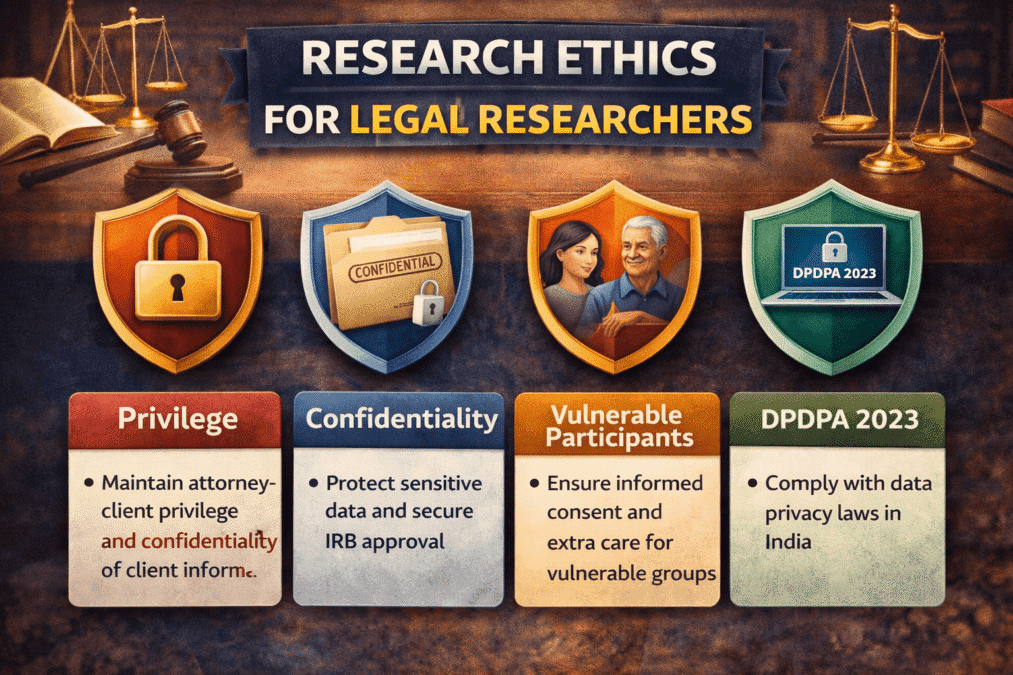
Research Ethics for Legal Researchers
Academic Writing Mastery: The Complete 2026 Guide To Research Papers, Thesis & Dissertation Writing
The five cluster posts in Module 10 cover ethics committee applications, informed consent, privacy and data security, research with vulnerable populations, and research integrity. All of that applies to legal researchers who conduct empirical research. This post covers the specific ethics challenges that arise in legal research contexts — challenges that general research ethics guidance either misses entirely or addresses inadequately.
Legal research ethics is complicated by a feature that does not apply in other disciplines: the research domain itself is law, which means that participants (lawyers, litigants, judges, legal aid workers) operate within professional and procedural frameworks that create specific ethical obligations and constraints. Lawyer-client privilege, sub judice proceedings, court record confidentiality, and the power dynamics of carceral environments all require ethical analysis that goes beyond the standard informed consent and data security framework.
Doctrinal legal research that analyses published primary sources does not require ethics review. This post focuses on empirical legal research — research involving human participants, court records, or data collection about legal actors and legal processes.
When Legal Research Requires Ethics Approval
The threshold question for any legal research project is whether ethics approval is required. The answer depends on what data you are collecting and from whom.
| Research type | Ethics approval required? | Applicable framework |
| Doctrinal analysis of published judgments, statutes, constitutional provisions | No | No ethics framework applies. Published primary legal sources are public documents. |
| Analysis of published law journal articles and scholarly commentary | No | No ethics framework applies. |
| Interviews with lawyers, advocates, judges, legal aid workers | Yes | ICSSR Ethical Guidelines for Social Science Research; NLU institutional ethics committee |
| Interviews with litigants, defendants, complainants, prisoners | Yes — urgent review required | ICMR Guidelines (if health-related); ICSSR; NLU ethics committee. Vulnerable population protocols required. |
| Analysis of court records (published orders and judgments) | Generally no — but check for personal data | If personal data extracted, DPDPA 2023 compliance required. Ethics committee consultation recommended. |
| Analysis of unpublished court files and case files | Yes | Court administration approval + institutional ethics approval. DPDPA compliance required for personal data. |
| Survey research on legal professionals or legal system users | Yes | ICSSR; NLU ethics committee. Anonymity and voluntary participation required. |
| Observation in courts, tribunals, legal aid centres | Yes | Institutional approval + venue permission + ethics approval. Participant observation protocols. |
Privilege and Confidentiality: The Ethics Issues Specific to Law
Lawyer-client privilege in research contexts
Lawyer-client privilege — the legal protection for confidential communications between a lawyer and client made for the purpose of obtaining legal advice — is one of the most important constraints on empirical legal research involving legal practitioners. Understanding its scope is essential for research design.
Privilege protects the communication, not the general knowledge of the lawyer. A lawyer cannot disclose what a specific client told them about their case. A lawyer can describe, in general terms, their professional practices, their experience of the legal system, and their observations about how courts operate. Research design must be built around this distinction.
- Design interviews to elicit general professional experience: Ask lawyers about their practice patterns, not specific clients. ‘How do you typically prepare for a bail hearing?’ is appropriate. ‘What did you do to prepare for [specific client]’s bail hearing?’ is not.
- State the research purpose explicitly in consent: Informed consent for lawyer interviews must make clear that the research purpose is to understand professional practices and legal system functioning, not to obtain information about specific cases or clients.
- Anonymous publication: Quotes from lawyer interviews should be anonymised in publications. Even where the lawyer has consented to being identified, the combination of identifying information and professional candour may inadvertently reveal client information.
Sub judice matters and ongoing proceedings
Research that involves participants with ongoing legal proceedings creates a specific ethical risk: participation in research may affect the participant’s legal position. A defendant who describes their case in a research interview may make statements that could be used against them. A claimant who discusses their litigation strategy may inadvertently disclose information relevant to the opposing party.
The ethical obligations are:
- Inform participants clearly before consent that the research is not confidential in the legal sense — researcher confidentiality is not the same as legal privilege. Unlike communications with a lawyer, communications with a researcher do not attract legal protection from disclosure.
- Advise participants who have ongoing proceedings to consult their lawyer before participating in research that involves discussing those proceedings.
- If a participant discloses information that suggests they are at legal risk from participating (for example, a defendant who makes potentially incriminating statements), pause the interview and remind them of the risk before continuing.
- Consider excluding participants with active proceedings from research designs that require discussion of those proceedings. Design around the constraint rather than creating risk for participants.
Court record confidentiality
Not all court records are public. Understanding which records are public, which are restricted, and which are confidential is essential for legal research ethics.
| Record type | Public access? | Research access requirements |
| Published Supreme Court and High Court judgments | Yes — fully public | No special access required. Available on SCC Online, Manupatra, JUDIS. |
| District court and Sessions court orders (published) | Varies by court and state | Check with court administration. Many district courts publish orders; access to registries varies. |
| Case files and original records (unpublished) | No — restricted | Written application to Registrar General required. Research purpose must be stated. Access may be conditional on anonymisation commitments. |
| Family court records | Confidential under Family Courts Act 1984 | Research access requires court order or specific judicial permission. High bar. |
| Proceedings involving minors (juvenile courts) | Confidential under Juvenile Justice Act 2015 | Research access extremely restricted. Separate ethics review required. Best avoided unless research focus requires it. |
| In camera proceedings | Confidential by court order | No research access without judicial permission. |
Research with Vulnerable Participants in Legal Contexts
Module 10 Cluster Post 4 covers research with vulnerable populations in detail. Legal research contexts produce specific vulnerability configurations that require additional analysis.
Research with prisoners and undertrial detainees
Prisoners and undertrial detainees are among the most ethically complex participant groups in legal research. Three distinct vulnerability factors operate simultaneously:
- Coercion risk: In carceral environments, the voluntariness of consent is structurally compromised. Prisoners may fear that non-participation has negative consequences (parole decisions, prison conditions). Researchers must design consent processes that explicitly address this risk and make clear that non-participation has no consequences.
- Power dynamics with researchers: Researchers who access prisons typically do so with institutional authorisation that confers apparent authority. Prisoners may perceive the researcher as someone connected to prison administration or the justice system. This must be explicitly addressed in the consent process: who you are, what your institutional relationship is, and what happens to the information you collect.
- Legal jeopardy: Undertrial detainees have active legal proceedings. Anything they say to a researcher could theoretically be used in their case. The sub judice obligations described above apply with particular force. In practice, this means: do not ask undertrial detainees about the facts of their case; design research questions around their experience of the legal system, not their legal situation.
Access to prisons for research requires: institutional ethics approval; a letter from your supervising institution; application to the Inspector General of Prisons (state-level) or Director General of Prisons; and in some states, approval from the Home Department. Build six months of access negotiation time into your research timeline.
On ethics approval for prison research: Some NLU ethics committees are not fully equipped to review prison research protocols because this is a relatively new form of legal research in India. If your committee lacks experience with carceral research, consult ICSSR’s ethical guidelines and consider seeking external review from a committee with relevant experience.
Research with litigants
Litigants — parties to civil or criminal proceedings — are vulnerable for the specific reason that their participation in legal proceedings has created a power imbalance with the state or opposing parties. Research design must account for:
- Trauma and re-traumatisation: Litigants in criminal, domestic violence, and family cases may have experienced significant trauma. Research interviews that require them to recount legal proceedings may re-traumatise. Use trauma-informed interviewing approaches and have referral resources available.
- Literacy and language: Many litigants — particularly in legal aid contexts — may have limited formal education and may not be comfortable in English. Consent forms and interview protocols must be available in the participant’s preferred language. Do not conduct research in a language the participant does not fully understand.
- Time and resource costs: Litigants are often under significant financial and time pressure from their legal proceedings. Compensate participants for their time at a reasonable rate. Do not design research that imposes significant burdens on people already burdened by legal proceedings.
Research with legal aid clients
Legal aid clients have a specific vulnerability: they are receiving a service that they depend on, and they may perceive that their participation in research is connected to the quality of service they receive. The ethical obligation is to ensure that participation in research has absolutely no effect — positive or negative — on the legal aid services provided to the participant. This must be stated explicitly in the consent form and explained verbally.
The DPDPA 2023 and Legal Research Ethics
The Digital Personal Data Protection Act, 2023 has created new compliance obligations for empirical legal researchers who collect, store, or process personal data. This section covers the specific DPDPA obligations that apply to legal research contexts.
What constitutes personal data in legal research
Under the DPDPA 2023, personal data means any data about an individual who is identifiable by or in relation to such data. In legal research contexts, the following are personal data:
- Names of parties in court cases (where you are working with case files, not published judgments)
- Interview recordings and transcripts that identify participants
- Survey responses linked to identifiable individuals
- Court file extracts that include party names, addresses, identification numbers, or financial information
- Prison records, legal aid records, or any administrative data about identifiable individuals
Published court judgments where party names appear are public documents. Extracting data from published judgments for research analysis does not create DPDPA obligations in the same way as collecting fresh personal data from individuals.
DPDPA compliance for legal research: key obligations
- Lawful basis for processing: Research involving personal data requires a lawful basis. For academic research, ‘legitimate uses’ under Section 7(b) of the DPDPA 2023 may apply, but this requires careful analysis. Your ethics application should address the lawful basis explicitly. Consent from research participants is the clearest lawful basis for interview-based research.
- Data minimisation: Collect only the personal data that is necessary for your research question. If your research question can be answered with anonymised data, do not collect identifiable data. If you are analysing court records, extract only the variables relevant to your analysis — do not copy entire case files.
- Purpose limitation: Personal data collected for one research project cannot be reused for a different research project without a new consent or lawful basis. Data collected for a study of bail outcomes cannot be used for a subsequent study of sentencing without separate consent.
- Security obligations: Personal data must be stored with appropriate security measures. Interview recordings should be encrypted. Transcripts should be stored on password-protected institutional systems. Physical case file notes should be stored securely. Specify your security measures in your ethics application.
- Retention and deletion: Specify in your data management plan how long you will retain personal data and when you will delete it. The standard for academic research is: retain for the duration of the project plus any required archiving period, then delete securely. Anonymised data may be retained longer.
DPDPA and Shodhganga: PhD theses submitted to Shodhganga are publicly accessible. If your thesis contains personal data from research participants — interview quotes, case file data with identifying information — ensure that all such data is fully anonymised before Shodhganga submission. Do not assume that consent to participate in research constitutes consent to public archiving of the data.
Research Integrity Specific to Legal Scholarship
Module 10 Cluster Post 5 covers research integrity comprehensively. The following issues are specific to legal scholarship.
Plagiarism in legal writing: quotation, paraphrase, and attribution
Legal writing has distinctive plagiarism risks because of its heavy reliance on primary source quotation. The anti-plagiarism principles that apply to all academic writing apply to legal scholarship, with the following additions:
- Statutory and constitutional text: Quoting statutory and constitutional provisions verbatim is necessary when the precise wording is legally significant. This is not plagiarism — it is proper legal citation. Ensure the provision is in quotation marks and cited to the official source.
- Case quotation: Reproducing holdings, obiter dicta, and judicial reasoning verbatim is standard in legal scholarship and is not plagiarism when properly cited. The rule is: any verbatim reproduction of judicial language must be in quotation marks with a pinpoint citation to the page or paragraph of the judgment.
- Secondary source paraphrase: Paraphrasing another scholar’s legal argument without attribution is plagiarism, as in all academic disciplines. The fact that you are reaching the same legal conclusion as another scholar does not mean you can present that reasoning as if it were yours. If you independently reached the same conclusion, acknowledge the prior scholarship that reaches similar conclusions.
Self-plagiarism and prior publication
Legal researchers who publish working papers on SSRN before journal submission must be aware that some journals treat SSRN posting as prior publication. Check each journal’s policy on prior publication before submitting a paper that has an SSRN working paper version. Most law journals distinguish between working paper versions (permitted) and published journal articles (not permitted for simultaneous submission).
Authorship in collaborative legal research
Co-authorship norms in legal scholarship differ from science. Law has traditionally been a single-author discipline, particularly for doctrinal work. Multi-author papers are more common in empirical legal research. The same authorship integrity principles that Module 10 Cluster Post 5 covers apply: every named author must have made a genuine intellectual contribution to the work. Honorary authorship and ghost authorship are integrity violations in legal scholarship as in all academic disciplines.
References
Indian Council of Social Science Research. (2021). Ethical Guidelines for Social Science Research in India. ICSSR.Ethical Guidelines – ICSSR
Indian Council of Medical Research. (2017). National Ethical Guidelines for Biomedical and Health Research Involving Human Participants. ICMR.
Ministry of Electronics and Information Technology. (2023). The Digital Personal Data Protection Act, 2023 (Act No. 22 of 2023). Government of India.
Ministry of Home Affairs. (1894, as amended 2000). The Prisons Act, 1894 and Prison Manuals (state-specific). Government of India.
Ministry of Women and Child Development. (2015). The Juvenile Justice (Care and Protection of Children) Act, 2015. Government of India.
Ministry of Law and Justice. (1984). The Family Courts Act, 1984. Government of India.
Israel, M., & Hay, I. (2006). Research Ethics for Social Scientists: Between Ethical Conduct and Regulatory Compliance. Sage.
Dickson-Swift, V., James, E. L., Kippen, S., & Liamputtong, P. (2007). Doing sensitive research: What challenges do qualitative researchers face? Qualitative Research, 7(3), 327–353.
Academic Writing Mastery: The Complete 2026 Guide To Research Papers, Thesis & Dissertation Writing
Classmate Pulse Spiral Notebook ✏️ Need a Spiral Notebook for Everyday Writing? A spiral notebook…

Latest Scholarships & Fellowships 2026–27: Open Opportunities for Upcoming call
Latest Scholarships & Research Fellowships 2026–27 Last Verified: 30 September 2026 Students, researchers, PhD scholars…
Writing & Research Resources: Useful Books, Tools & Essentials for Writers and Researchers
Whether you are an author, content writer, law student, academic researcher, PhD scholar, teacher, or…
International Treaties as a Source of International Law | LL.B. Notes
International Treaties as a Source of International Law Introduction International treaties are one of the…

The Ultimate Guide to Organizing LLB Notes for Exam Success
LLB Notes for Exam Success Studying law is not simply about reading hundreds of pages….
What Is the Best AI Tool for Legal Research in 2026? A Practical Guide for Lawyers, Law Students and Researchers
What Is the Best AI Tool for Legal Research in 2026? Last updated: September 2026…