Last Updated: March 21, 2026
Cluster Post 3 | Module 7: AI Tools in Academic Research — Opportunities, Ethics, and Best Practices
From Concept to Submission Series | 2026
Academic Writing Mastery: The Complete 2026 Guide To Research Papers, Thesis & Dissertation Writing
Prompt Engineering for Researchers
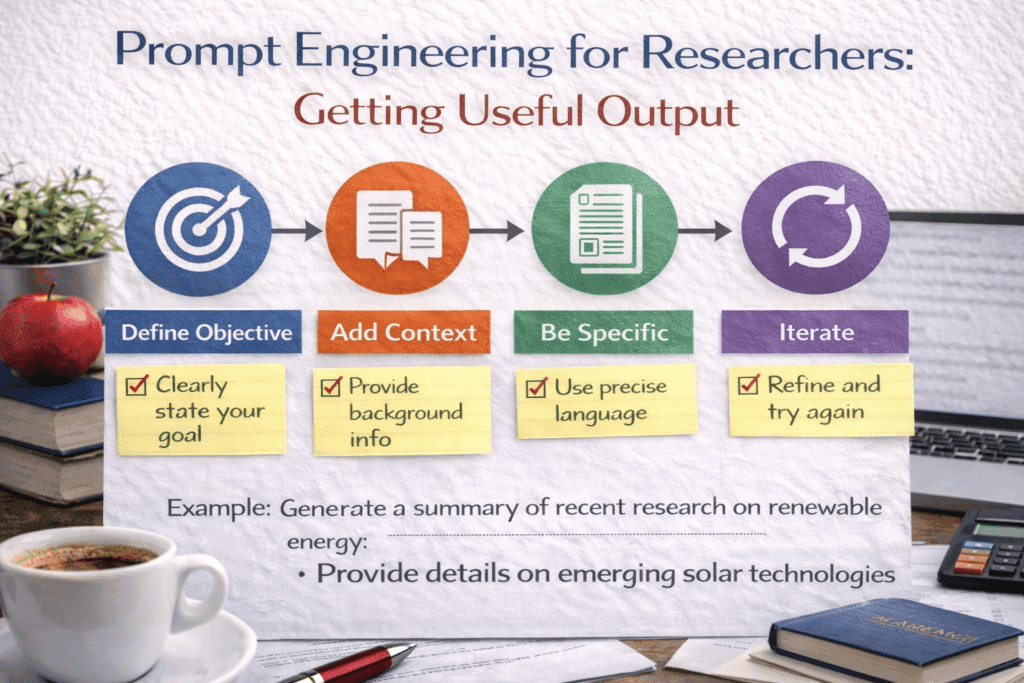
The module overview gives two prompt examples contrasting poor and good prompts. This post goes deeper: the anatomy of an effective research prompt, twenty-five worked examples across the research lifecycle, the follow-up prompt strategy for refining poor outputs, and what to do when AI gives you something confidently wrong.
Why Prompt Quality Determines Output Quality
The same AI model given two differently worded prompts for the same task can produce outputs that differ dramatically in usefulness. This is not random variation — it reflects the fact that LLMs generate text conditioned on everything in the prompt. A vague prompt gives the model wide latitude to produce generic output. A specific, contextualised prompt constrains the model toward the specific output you need.
The most common prompting error among researchers is under-specification: asking for something without saying who you are, what you already know, what constraints apply, and what specifically you want the output to do. Under-specified prompts produce generic, often useless responses that require significant rework — which takes more time than writing a good prompt would have.
The Anatomy of an Effective Research Prompt
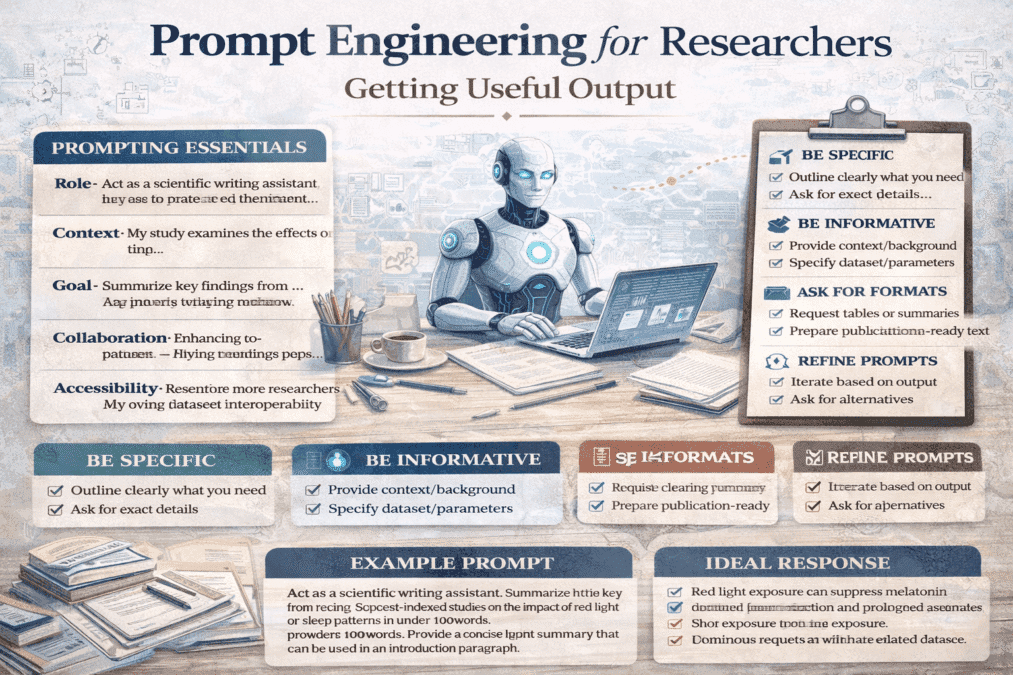
A well-constructed research prompt has five components. Not every prompt needs all five, but more complex tasks benefit from all of them.
- Role and context: Who you are and what you are working on. ‘I am a doctoral researcher in constitutional law at an Indian NLU, writing my PhD thesis on AI surveillance and Article 21.’
- What you have already done: The intellectual work you have completed before asking for help. ‘I have read fifteen papers on proportionality doctrine and identified three competing frameworks.’
- The specific task: What you want the AI to do, precisely. Not ‘help me with my literature review’ but ‘suggest how these three frameworks could be organised into a coherent thematic structure.’
- Constraints and requirements: Any parameters the output must meet. ‘The structure should fit within a 4,000-word chapter. It must connect to the Puttaswamy judgment specifically.’
- Output format: What form the response should take. ‘Give me three alternative structural options, each described in two to three sentences, with the rationale for each.’
Full prompt combining all five components: ‘I am a PhD researcher in education studies at a central university, studying teacher retention in rural schools in Rajasthan. I have conducted 26 semi-structured interviews and coded them manually, identifying 18 initial codes. I am now trying to group these codes into broader themes for my analysis chapter. My 18 codes are: [list]. I want you to suggest three alternative ways these codes could be grouped into themes — not to do my analysis for me, but to help me consider different organisational possibilities I may not have seen. For each grouping option, briefly explain what principle or logic organises it. Keep each option to under 100 words.’
This prompt is specific, honest about what has already been done (manual coding, 26 interviews), clear about the constraint (three options, under 100 words each), and explicit that the AI is suggesting rather than deciding.
Twenty-Five Worked Prompts Across the Research Lifecycle
Research question development
1. ‘I am starting a PhD in socio-legal studies. I am interested in the intersection of environmental law and indigenous land rights in India. I have read broadly in both areas and have identified these five potential research directions: [list]. Which of these has the clearest gap in the existing literature? Please give specific reasons, not just general observations about originality.’
2. ‘I have a research question: “How have Indian High Courts applied the precautionary principle in environmental cases since 2010?” I am concerned this may be too descriptive rather than analytical. What would a more analytically ambitious version of this question look like, and what kind of contribution would it allow me to make?’
Literature search
3. ‘I am researching AI-assisted judicial decision-making. My Google Scholar searches for “algorithmic decision-making courts” and “AI criminal justice” are returning many US-focused papers. What alternative search terms might surface more Indian, South Asian, or Global South scholarship on this topic?’
4. ‘I have a list of seminal papers on institutional theory: [list]. What related theoretical frameworks or adjacent conversations in the literature do these papers connect to that I might be missing in my literature review?’
Understanding methods and theory
5. ‘I need to use discourse analysis in my thesis but am reading conflicting accounts of what it involves. Can you explain the key differences between Foucauldian discourse analysis, critical discourse analysis (Fairclough), and thematic discourse analysis, and what each is appropriate for?’
6. ‘I plan to use a multiple case study design following Yin (2018). My supervisor is questioning whether a comparative case study would be more appropriate. Can you explain the difference between these two designs and what research questions each is best suited to answer?’
7. ‘I am running a logistic regression in R. My output shows a VIF of 8.3 for one predictor. I know this indicates multicollinearity. Can you explain what this means for my results and what my options are for addressing it?’
Brainstorming and argumentation
8. ‘I am arguing in my thesis that the proportionality standard from Puttaswamy (2017) is the appropriate framework for judicial review of AI surveillance under Article 21. What are the three strongest counterarguments to this position that I should anticipate and address in my discussion chapter?’
9. ‘I have found a pattern in my interview data: all participants who had mentors in their first year reported higher retention, but three participants with mentors left anyway. Rather than treating these as outliers, I want to theorise this variation. What conceptual frameworks might help me explain why mentoring works for some but not others?’
10. ‘I need to connect my empirical findings on teacher retention to a theoretical framework. My findings show that professional isolation is the primary driver of attrition. Which of these theories — communities of practice, social capital theory, or self-determination theory — best connects to this finding, and why?’
Writing improvement
11. ‘Here is a paragraph from my methodology section: [paragraph]. The writing is unclear and the passive voice makes it hard to follow. Please suggest a revised version that is more direct, uses active voice where appropriate, and maintains all the technical accuracy. Do not change any of the methodological claims.’
12. ‘I am a non-native English speaker. I wrote this sentence trying to explain my theoretical contribution: [sentence]. I am not sure if it sounds natural in academic English or if the meaning is precise. Please suggest two alternative phrasings and explain what each one emphasises differently.’
13. ‘This transition sentence between my literature review and my methodology chapter feels abrupt: [sentence]. It does not explain how the gap identified in the literature connects to the research design I chose. Please suggest three alternative transition sentences.’
Structuring and organisation
14. ‘I have written a 3,000-word results section that presents findings from three research questions. My supervisor says it reads like a list rather than an argument. I am not sure how to restructure it. Here is my current structure: [outline]. What structural changes would make it read more analytically?’
15. ‘I have five chapters planned for my thesis: [titles and brief descriptions]. My supervisor says Chapter 3 and Chapter 4 overlap significantly. Here are the main topics each covers: [list]. Can you help me see what the overlap is and suggest how to redistribute the content between the two chapters?’
Data analysis support
16. ‘I want to run a Kruskal-Wallis test in Python to compare three groups on a non-normally distributed outcome. Can you write the code using scipy.stats, including the appropriate post-hoc test with Bonferroni correction?’
17. ‘I have a dataset with 47 interview transcripts. I have coded each one manually using 22 codes. I want to create a table showing code frequency by participant type (three types). Can you help me write Python code to generate this from a CSV where rows are participants and columns are codes?’
Citation and reference
18. ‘I need to cite the Puttaswamy judgment in OSCOLA format. It is: Justice K.S. Puttaswamy (Retd.) v Union of India (2017) 10 SCC 1. How do I format this in OSCOLA, and where does the citation go in a footnote versus in a bibliography?’
19. ‘I have been using author-date citations throughout my thesis but my university requires footnote citations. Can you explain how to convert from author-date to footnote citation style in general, and give me an example of the same citation in both formats?’
Responding to reviewer comments
20. ‘A reviewer of my paper said: “The theoretical framework needs strengthening throughout.” This is very vague. I want to write a response letter entry that acknowledges the concern and describes what I changed without admitting that the original framework was inadequate. Can you help me draft this response?’
21. ‘Two reviewers have given contradictory feedback: Reviewer 1 says my methodology section is too detailed; Reviewer 2 says it needs more detail on sampling. How should I address both concerns in my response letter without appearing to dismiss either reviewer?’
Pre-submission review
22. ‘Here is the abstract of my thesis: [abstract]. Does this abstract follow the standard structure for a social science thesis abstract? What is missing or unclear?’
23. ‘I want to check whether my introduction makes a clear problem statement before I submit. Here is my introduction: [text]. What is the problem my thesis claims to address, based on reading this? Is it clear enough, or is the problem buried?’
Understanding institutional requirements
24. ‘I am a PhD candidate at a central university in India. I need to understand the post-viva corrections process under UGC regulations. Can you explain what minor and major corrections mean, how long I have to submit each, and who reviews the corrections?’
25. ‘I need to upload my thesis to Shodhganga. Can you explain what PDF/A format is, why Shodhganga requires it, and how to convert a standard PDF to PDF/A in Adobe Acrobat?’
The Follow-Up Prompt Strategy
When AI gives you a poor or generic output, the instinct is to ask the question again or give up. The more effective approach is a targeted follow-up that identifies specifically what was wrong with the first output.
First prompt produced generic output: ‘The response you gave is too general. I need you to engage specifically with the Indian constitutional law context, not international frameworks. The key cases are Puttaswamy (2017), Gobind v. State of Madhya Pradesh (1975), and the recent AI surveillance orders from the Delhi High Court. Can you revise your response to engage specifically with these rather than with US or European precedents?’
Follow-up when AI produced a wrong claim: ‘You said that the Puttaswamy judgment established a three-part test. I do not believe this is accurate. The judgment has multiple concurring opinions and the operative test varies by which opinion you follow. Can you revise your response to accurately reflect this complexity rather than stating a single unified test?’
Follow-up when output was too long: ‘This response is 800 words. I need it under 150 words for my methods section. Please condense it to the three most important points only, stated in single sentences.’
Follow-up prompts are more efficient than starting over because they preserve the context established in the conversation and direct the model to the specific problem, rather than generating a new generic response.
Legal Research and Writing: Complete Guide for Law Students and Legal Researchers
FAQs
Q: What is prompt engineering in academic research?
Prompt engineering is the practice of designing inputs to AI models to get more accurate, useful, and relevant outputs. For researchers, it means specifying: the task clearly (not ‘help me with my paper’ but ‘identify three logical gaps in this argument’); the context (paste the relevant text rather than describing it); the format of the desired output (bullet points, a structured outline, a table); the constraints (do not add citations, focus only on the text I have provided); and the audience (write for a social science academic audience). Better prompts produce more useful outputs — vague prompts produce generic responses.
Q: How do you write a good prompt for AI writing assistance?
A good AI writing prompt is specific about task, context, constraints, and format. Instead of ‘improve my writing,’ try: ‘Rewrite the following paragraph for clarity and concision. Keep all technical terms. Maintain the hedged academic tone. Do not add any new claims or citations. Target 80 words: [paste paragraph].’ Providing the actual text produces better results than describing it. Specifying what to exclude (no new citations, no new claims) is as important as specifying what to include. Review AI output critically — even well-prompted AI produces errors requiring correction.
Q: What prompts are most useful for researchers doing a literature review?
Useful literature review prompts: ‘Identify three key debates in the literature on [topic] and describe the main positions in each’ (for orientation, not citation); ‘Based on the following five paper abstracts I have pasted, suggest five search terms I have not yet used’; ‘Identify the logical structure of the following literature review section and note where the argument is unclear’; ‘What are the most common methodological limitations cited in empirical research on [topic]?’ Always verify AI-generated claims about the literature against primary sources — use AI to identify directions, not to generate content.
Q: How do you use AI to improve academic writing style?
Effective AI prompts for writing improvement: ‘Rewrite this sentence in active voice without changing the meaning’; ‘Identify all hedge words in this paragraph and suggest where hedging is too strong or too weak’; ‘Replace all nominalisations in this passage with verbs’; ‘Simplify this paragraph without losing precision’; ‘Identify the topic sentence of each paragraph and note which paragraphs lack one.’ These prompts ask AI to apply specific writing principles to your text — they assist your revision without replacing your judgment about what the writing should say.
Q: What AI prompts help with thesis writing?
Useful thesis writing prompts: ‘Does the following chapter introduction clearly state what the chapter will contribute to the overall thesis argument?’; ‘Identify where the following discussion section describes findings rather than interpreting them’; ‘Draft five alternative topic sentences for this paragraph, which currently begins with [X]’; ‘Is the following gap statement specific enough to justify this research question?’; ‘List the logical steps between these two paragraphs that seem to be missing.’ These prompts use AI as a critical reader, not as a writer — the intellectual work remains yours.
References
- Mollick, E. R., & Mollick, L. (2023). Using AI to Implement Effective Teaching Strategies. The Wharton School.
- OpenAI Prompt Engineering Guide. platform.openai.com/docs/guides/prompt-engineering
- Anthropic Prompting Documentation. docs.anthropic.com
Next: Cluster Post 4 — Disclosure Documentation and AI Integrity
- Module 1 Overview The Complete Guide to Research Paper and Thesis Structure
- Module 2 Overview The Academic Writing Process: Complete Guide from First Draft to Submission (2026)
- Module 3 Overview Research Methodologies: Complete Guide to Quantitative, Qualitative, Mixed Methods & Legal Research (2026)
- Module 4 Overview Data Analysis and Results Presentation: Complete Guide for Quantitative, Qualitative & Legal Research (2026)
- Module 5 Overview Organization and Academic Tone: Complete Guide to Professional Scholarly Writing (2026)
- Module 4 Overview Peer Review and Publication: Complete Guide from Submission to Acceptance (2026)
- Module 7 Overview AI Tools in Academic Research: Opportunities, Ethics, and Best Practices (2026)
Next in Series
- Module 8 Overview Grant Writing and Research Funding: Complete Guide to Finding Money for Your Research (2026)
- Module 9 Overview Academic Career Development: Complete Guide to Building Your Professional Life in Research (2026)
- Module 10 Overview Research Ethics and the IRB Process: Complete Guide to Doing Research Responsibly (2026)
No post found!