Last Updated: March 21, 2026
Cluster Post 3 | Module 8: Grant Writing and Research Funding
From Concept to Submission Series | 2026
Academic Writing Mastery: The Complete 2026 Guide To Research Papers, Thesis & Dissertation Writing
Methods and Budget
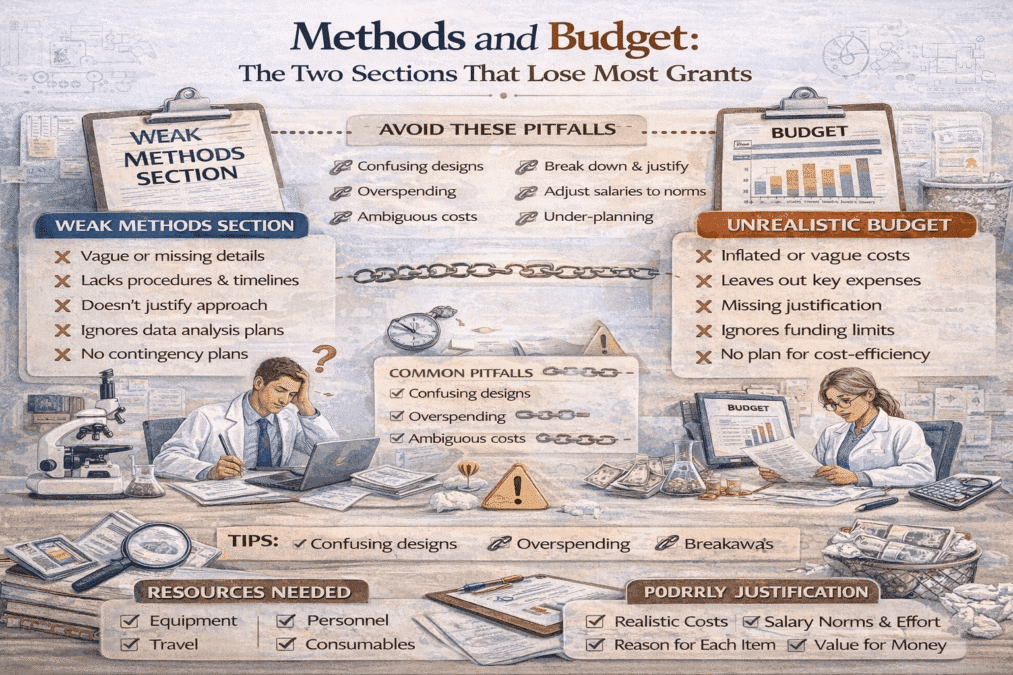
The module overview explains what methods and budget sections should contain. This post goes deeper: why methods sections fail even when the research design is sound, the specific reviewer questions that a strong methods section must answer, the budget justification logic reviewers apply, and the seven most common budget errors with corrections.
Why Methods Sections Fail
The methods section is where most grant rejections are actually decided. Abstract scores create the initial impression; methods scores determine the outcome. A proposal with a compelling problem statement but a vague or implausible methods section will be rejected. A proposal with a methodologically strong plan can often recover from a slightly weak problem statement.
The most common reason methods sections fail is not that the research design is wrong — it is that the section fails to communicate the design clearly enough for reviewers to assess it. Reviewers approach the methods section looking to answer five questions: is the design appropriate for the research question? Is the sample realistic and adequate? Are the instruments or procedures clearly described? Is the timeline feasible? What are the risks and how will they be managed? A methods section that does not explicitly answer these questions forces the reviewer to guess — and reviewers who have to guess tend to score conservatively.
The Five Questions a Methods Section Must Answer
Question 1: Is the design appropriate for the question?
State your research design explicitly and justify it by connecting it to your research question. ‘A quasi-experimental design was chosen because random assignment to the intervention is not feasible in school settings’ is a justification. ‘This study uses a quasi-experimental design’ is not.
Without justification: ‘This study employs a mixed-methods design. With justification: ‘This study employs a sequential explanatory mixed-methods design: quantitative data on literacy outcomes will be collected first, and qualitative data on implementation processes will be collected second to explain the quantitative findings. This sequence is appropriate because the quantitative findings will identify which schools showed unexpected patterns, allowing qualitative data collection to be targeted at explaining those patterns rather than addressing all schools equally.’
Question 2: Is the sample realistic and adequate?
Every sample decision must be justified on two dimensions: adequacy (is it large enough to answer the question?) and feasibility (can you actually recruit these participants?). Most proposals justify adequacy but not feasibility. Reviewers who know the research context will challenge implausible recruitment plans.
- For quantitative studies: report your power calculation. State the effect size you are powered to detect, the alpha level, and the resulting sample size. A sample not grounded in a power calculation appears arbitrary.
- For qualitative studies: explain your sampling strategy (purposive, theoretical, maximum variation) and your saturation rationale. ‘We will interview 30 participants’ needs to be followed by ‘this number is consistent with qualitative studies of comparable scope and is expected to achieve thematic saturation based on the homogeneity of the target population.’
- For doctrinal/archival studies: explain your selection criteria for sources and cases. ‘All Supreme Court privacy decisions from 2017 to 2025’ is a justified sample; ‘relevant cases’ is not.
Question 3: Are the instruments and procedures clearly described?
Reviewers need enough procedural detail to verify that the data collection is appropriate for the analysis you propose. For quantitative research: name the instruments, state whether they are validated, and specify the data collection procedure. For qualitative research: describe the interview guide structure, the observation protocol, or the document analysis framework.
Weak procedural description: ‘Data will be collected through interviews with teachers.’ Strong procedural description: ‘Semi-structured interviews will be conducted with 30 teachers (15 from intervention schools, 15 from control schools) using a 45-minute protocol covering three domains: (1) implementation processes and adaptations made, (2) perceived challenges and support needs, and (3) observed student responses to literacy activities. All interviews will be audio-recorded with participants’ consent, transcribed verbatim, and analysed using inductive thematic analysis following Braun and Clarke’s (2006) framework.’
Question 4: Is the timeline feasible?
The timeline is a feasibility test. A reviewer who sees that you have allocated three months to collect data from 80 schools across rural Rajasthan will question whether this is achievable — and if you have not addressed that question in the proposal, they will flag it as a risk.
Build the timeline from activities, not from the calendar. First determine what needs to happen and how long each stage realistically takes; then arrange these into a timeline. A timeline built from calendar backwards (‘I have 24 months, so I’ll divide it evenly’) produces unrealistic plans. A timeline built from activities forward shows you understand the research process.
Question 5: What are the risks and how will they be managed?
Every research proposal has risks. Not acknowledging them signals either naivety or overconfidence — both of which concern reviewers. Acknowledging risks and demonstrating that you have a contingency plan signals methodological maturity.
Standard risks and responses for field research in India: Risk: School non-participation or dropout over the academic year. Mitigation: 50 intervention and 50 control schools will be recruited to allow for up to 20% attrition while maintaining the 40/40 sample needed for adequate power. Risk: Teacher transfer, which is common in rural government schools. Mitigation: Intervention schools will train two teachers per school rather than one, ensuring programme continuity if one teacher transfers.
Budget Strategy: The Logic Reviewers Apply
Reviewers approach the budget by asking one question: is every rupee directly connected to a research activity that is necessary to answer the research question? A budget item that cannot be traced back to a specific research activity is padding. A research activity that has no budget line is a feasibility problem.
The budget and the methods section must be a perfect mirror. Every activity in the methods section should have a corresponding budget line. Every budget line should correspond to a specific methods activity. Reviewers check this correspondence — a budget that does not match the methods section signals poor planning.
Building the budget from activities, not from amounts
The most common budgeting error is to start with a funding ceiling — ‘this grant is for up to ₹15 lakh, so I will budget ₹14.5 lakh’ — and work backward. This produces padded budgets that reviewers recognise immediately.
The correct approach: list every activity, estimate the realistic cost of each from market rates or institutional experience, total the costs, and submit that total. If the total exceeds the funding ceiling, reduce the scope of the research until the budget fits — do not reduce costs by removing specific line items without reducing the corresponding activities.
The Seven Most Common Budget Errors
| Error | How to fix it |
| Vague personnel costs: ‘Research assistants: ₹2,40,000’ with no further detail | Specify: number of RAs, months employed, monthly rate, their specific tasks. Example: ‘2 RAs × ₹10,000/month × 12 months = ₹2,40,000. Tasks: classroom observations (RA1), data entry and transcription (RA2).’ |
| Travel costs without calculation: ‘Travel to field sites: ₹80,000’ | Show the calculation: number of visits × distance × per-km rate (or vehicle hire rate). Example: ’80 schools × 2 visits × ₹500/visit = ₹80,000. Average distance 50km from district headquarters; vehicle hire at ₹10/km.’ |
| Software listed without justification: ‘SPSS license: ₹40,000’ | Justify why this software specifically: ‘SPSS 28 for quantitative analysis: ₹40,000 for one-year institutional license. Required for multilevel modelling analysis of nested student/school data, for which free alternatives (R) are available but require specialist programming skills not available in the research team.’ |
| Equipment without necessity argument: ‘Laptop: ₹60,000’ | Explain why existing equipment is insufficient: ‘Portable recording devices ×3: ₹18,000. Required for simultaneous interviews across schools; PI’s existing equipment is insufficient for parallel data collection.’ |
| Missing contingency or indirect costs | Check whether the scheme requires institutional overhead. Most Indian government grants require 10-20% indirect cost allocation to the institution. If required, include it; if not required, note its absence. |
| Budget items not in the methods section: ‘Translation services: ₹30,000’ with no mention of translation in methods | Either add translation to the methods section with an explanation of why it is needed, or remove it from the budget. Every budget item needs a corresponding methods justification. |
| Participant compensation without ethical justification | If you are paying participants, include a note in both the budget justification and the ethics section explaining the amount is non-coercive, consistent with compensation norms in the context, and approved by or subject to ethics committee review. |
Legal Research and Writing: Complete Guide for Law Students and Legal Researchers
FAQs
Q: How do you write a methods section for a research grant proposal?
A grant proposal methods section must convince reviewers that your design will answer your research question and that you can execute it. Include: research design and paradigm (briefly justified); data sources and access strategy (how will you get the data?); sampling strategy and sample size justification; data collection instruments and procedures; analysis approach; ethics approval plan; and timeline with realistic milestones. Feasibility is reviewers’ primary concern — a methods section that does not explain how you will access participants or data signals an unfeasible project regardless of how sophisticated the design is.
Q: How do you write a research budget for a grant proposal?
A research budget must be itemised, realistic, and justified. Include: personnel costs (research associate salary at UGC norms, project coordinator if needed); travel (field visits itemised by location and estimated cost); equipment and materials (databases, printing); conference dissemination (registration and travel for presenting findings); and contingency (5–10%). Every budget line must be justified in a budget narrative: explain why each item is necessary for the research, not just what it costs. Reviewers reject budgets that are inflated (padding) or unrealistically low (suggests the researcher has not thought through the project).
Q: What is a research timeline in a grant proposal?
A research timeline is a month-by-month or quarter-by-quarter plan showing when each activity in the research project will occur. Present it as a Gantt chart or table: activities listed vertically, time periods horizontally. Include: ethics approval, instrument development, data collection, data analysis, writing, dissemination, and submission of final report. The timeline must be realistic — reviewers assess feasibility by checking whether the proposed activities can actually be completed within the project period. A 12-month project that proposes 6 months of data collection and 6 months of everything else is not feasible.
Q: What are the most common reasons grant proposals are rejected?
The most common rejection reasons are: vague or insufficiently specific research question; methodology that does not clearly address the research question; unrealistic timeline or budget; insufficient evidence of researcher capacity (no relevant publications or prior grants); inadequate access and feasibility plan (no clear path to data); weak significance statement that does not demonstrate why the funding body should care; and failure to follow the application format. Most grant rejections are for preventable reasons — careful attention to the call for proposals and the funded projects list of the target funder prevents most of them.
Q: How do you calculate the salary for a research associate in an Indian grant proposal?
Research associate (RA) salary in Indian grant proposals must follow UGC/ICSSR/DST norms rather than institutional or market rates. ICSSR norms (2024): Junior Research Fellow Rs 37,000/month; Senior Research Fellow Rs 42,000/month. SERB norms are updated annually — check the current SERB scheme guidelines for the applicable rate. Include HRA (House Rent Allowance) as per government norms if the RA is relocating. Do not underbudget RA costs to make the proposal look efficient — reviewers know the norms and underbudgeted salary lines signal that the researcher has not properly planned the project.
References
- Ries, J. B., & Leukefeld, C. G. (2019). Applying for Research Funding (2nd ed.). Sage.
- Locke, L. F., et al. (2022). Proposals That Work (8th ed.). Sage.
Next: Cluster Post 4 — The Proposal Review Process: How Grants Are Actually Decided
No post found!