Last Updated: March 21, 2026
Cluster Post 4 | Module 8: Grant Writing and Research Funding
From Concept to Submission Series | 2026
Academic Writing Mastery: The Complete 2026 Guide To Research Papers, Thesis & Dissertation Writing
The Proposal Review Process
The module overview describes the review process at a high level. This post goes deeper: what happens in a panel review session, how scores are translated into funding decisions, how to read rejection feedback strategically, and the specific resubmission decisions that separate researchers who eventually get funded from those who do not.
What Actually Happens in a Review Panel
The module explains that peer reviewers score proposals against criteria. What it does not describe is the dynamics of the panel meeting — where funding decisions are actually made.
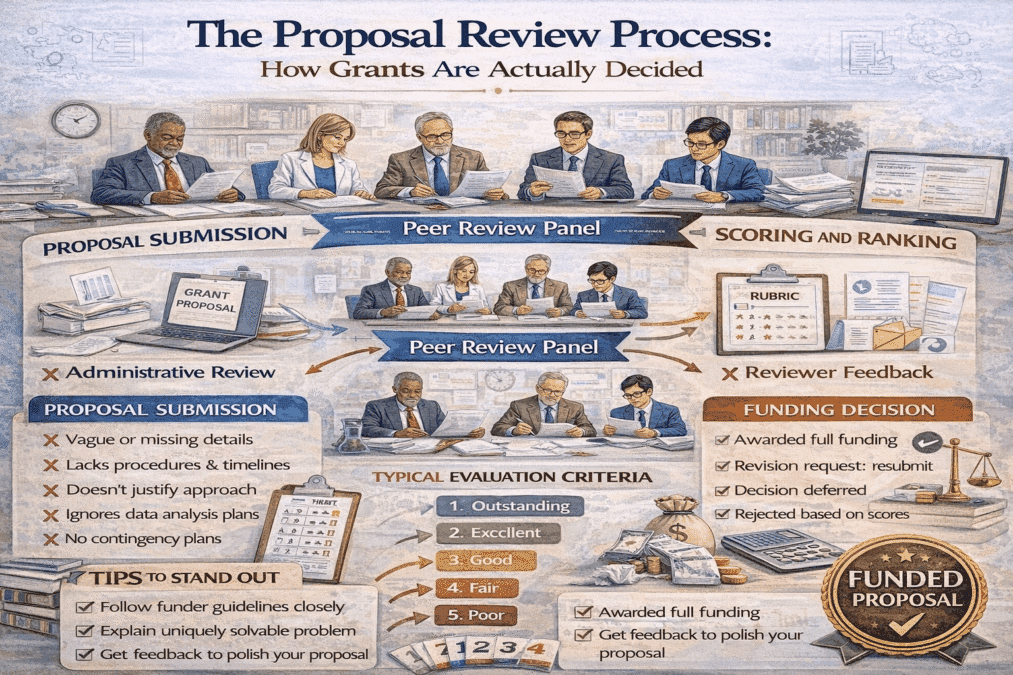
For most competitive government grants, proposals go through two stages: individual review (each reviewer scores the proposal independently and writes comments) followed by a panel discussion (reviewers compare scores, discuss disagreements, and produce a final ranking). The funded proposals are those that score well in both stages — it is possible to receive strong individual scores that get moderated downward in panel discussion, particularly if one reviewer has a significant concern that others did not notice.
Panel discussions are driven by the proposal’s weakest section. A proposal with an excellent problem statement and a strong methods section but a questionable budget will spend most of its panel time on the budget. A proposal that raises no concerns across any section moves through quickly with its scores intact. This is why addressing every section adequately — not just making the strongest sections brilliant — is more efficient than a proposal with uneven quality.
Programme officers matter. At most Indian government agencies (SERB, ICSSR, DST) and international funders, programme officers are not neutral administrators — they have views about research priorities and sometimes attend or chair review panels. A programme officer who is enthusiastic about your research area can be an advocate in panel discussion. Building a relationship with the relevant programme officer — attending their public information sessions, sending a brief query about fit before submission — is standard practice among successful grant writers and not considered inappropriate.
How Scores Translate into Funding Decisions
The module gives a numerical scoring rubric (1–10). What matters practically is understanding the distribution and the cut-off, not just the scale.
In most competitive grant rounds, the score distribution is not even. Proposals cluster at the good-to-very-good range (scores 3–6 on the module’s scale), with fewer at the excellent end and fewer at the poor end. Funding decisions are made at the margin — the difference between a funded and unfunded proposal at the cut-off is often very small. This means that proposals rejected with a score of 4 are often close in quality to proposals funded with a score of 3.
Practical implication: rejection at the margin is not a signal that the research is poor — it is a signal that the proposal needs refinement. Understanding your score in the context of the funding rate for that round is important. A rejection in a round with a 5% funding rate means you were in the top 20–30% of applications but not the top 5%. That is a meaningful signal about where the proposal stands and what a resubmission needs to do.
When scores are not provided
Many Indian government grant schemes — including some ICSSR and UGC programmes — do not provide numerical scores with rejection decisions, only category verdicts (funded/not funded) or brief written feedback. When no score is provided, you cannot assess your position in the distribution. The strategic response: contact the programme officer and ask whether the proposal was close to the funding threshold or significantly below it. Many programme officers will indicate this informally, which tells you whether a minor revision or a substantial rewrite is needed.
Reading Rejection Feedback Strategically
Grant rejection feedback is typically shorter and less specific than journal peer review feedback. A reviewer who writes three detailed paragraphs in a journal review may write two sentences for a grant review. Reading this sparse feedback strategically requires understanding what each type of comment signals.
| Rejection comment type | What it actually signals and how to respond |
| ‘The research question is not sufficiently original / the contribution is unclear’ | The gap in the literature was not established convincingly, or the gap exists but the proposal did not explain why this particular approach to filling it is the right one. Revise the problem statement to make the specific, unfilled gap explicit. Show that existing work has not done what this proposal does. |
| ‘The methodology is not adequately described / the methods are not appropriate for the question’ | Either the methods section was too vague (most common) or the design genuinely does not match the research question. Read the proposal as a reviewer: can you answer all five methods questions (Cluster Post 3) from the proposal text? If not, the description is the problem, not the design. |
| ‘The timeline is not realistic / the scope is too ambitious’ | The proposal committed to more than is achievable in the time and budget. Reduce scope — remove one strand of data collection, one research question, one field site. A funded smaller study is better than a rejected overambitious one. |
| ‘The budget is not adequately justified / the budget is excessive’ | Individual line items lack justification, or the totals are out of proportion with the research activities. Rebuild the budget from activities (Cluster Post 3 approach) and ensure every figure has a visible calculation. |
| ‘The significance is not clear / the impact is not demonstrated’ | The proposal described the research without convincing reviewers it matters. Revise the significance section using the hierarchy approach (Cluster Post 2) and quantify impact wherever possible. |
| ‘The PI lacks the necessary expertise / the team is insufficient’ | The qualifications section was too thin, or the research requires expertise the team does not have. For the former: add specificity to the PI section. For the latter: consider adding a collaborator or consultant with the missing expertise. |
The Resubmission Decision
Not every rejection warrants resubmission to the same funder. The resubmission decision requires answering three questions before investing the time in revision.
Question 1: Is the fit right?
Fit problems cannot be solved by revision. If the feedback indicates that the research is outside the funder’s current priorities, or that the funder is currently emphasising a methodology your research does not use, a better-written version of the same proposal will not succeed. Check the funder’s recently funded portfolio: if your research type is absent from the last two or three funding rounds, the fit problem is real.
Question 2: Are the problems fixable?
Some rejection reasons are fixable in revision — vague methods, thin justification, overambitious scope. Others are structural — the research question is genuinely less original than you believed, the sample is genuinely not feasible, the team genuinely lacks a required expertise. Structural problems require more than revision: they require reconceiving the research or building the team.
The honest diagnostic: read the reviewer’s concerns and ask: if I fix these specific problems, does a stronger version of this proposal exist? If yes — if the concerns are about execution and presentation rather than about the research itself — resubmit. If the concerns go to the heart of the research design, revise the research first and then resubmit.
Question 3: Is this the right funder?
Rejection from one funder often reveals that the research is better positioned for a different funder. A proposal rejected by SERB for insufficient quantitative rigour may be well-positioned for ICSSR, which values qualitative and policy-relevant research more. A proposal rejected by an Indian agency for insufficient national significance may be well-positioned for an international funder that values comparative work.
Read the rejection not only for what to improve but for what it reveals about how the research is perceived by this funder’s community. That perception may be correct — and may point you toward a better-fit funder.
Building the Resubmission
If you have decided to resubmit, the process mirrors the journal revision process from Module 6: build a response document that addresses each reviewer concern systematically, sequence substantive before textual changes, and run a coherence check on the revised proposal before submission.
One important difference from journal revision: grant proposals are usually not submitted with a response letter. The revised proposal must stand alone. This means every revision must be incorporated into the proposal text itself — you cannot note in a cover letter that you have addressed a concern; the revised proposal must show it.
Most grant funders allow resubmission after one review cycle. Some require one year between submissions; others have no such restriction. Check the scheme’s guidelines. For ICSSR and most UGC schemes, resubmission in the next cycle is standard practice for strong proposals that were near the funding threshold.
Managing Awarded Funds: What the Module Understates
The module gives sound advice on fund management. Two points worth adding for Indian researchers specifically:
Utilisation certificates are the hidden workload of grant management. Indian government grants require periodic utilisation certificates — documented proof that money was spent on approved items, submitted on a prescribed schedule. Failing to submit utilisation certificates on time can freeze the grant, require return of funds, or make you ineligible for future grants from the same agency. Build the UC submission schedule into your project timeline from day one.
Budget flexibility is more restricted in government grants than researchers expect. Moving more than 10–15% of the budget between approved categories typically requires a formal amendment request to the funding agency. This process can take weeks. Researchers who wait until they need a laptop to discover they budgeted only for consumables face delays. Read the grant terms carefully before committing any spending.
Legal Research and Writing: Complete Guide for Law Students and Legal Researchers
FAQs
Q: How are research grant proposals reviewed in India?
Indian grant proposals (ICSSR, UGC, SERB) are reviewed in two stages: desk review (eligibility check — does the applicant meet qualification requirements, is the proposal complete?); and expert committee review (2–3 subject experts evaluate scientific quality, feasibility, and significance). For ICSSR Major Projects, the review committee typically includes two disciplinary experts and one methodology expert. Shortlisted proposals may require a presentation before the committee. Final funding decisions are made by the funding body’s programme committee based on reviewer recommendations and available budget.
Q: What do grant reviewers look for in a research proposal?
Grant reviewers assess: significance (does the problem genuinely need solving?); innovation (does the proposed approach add something new?); approach (is the methodology appropriate, rigorous, and feasible?); researcher capacity (do the PI’s qualifications and track record suggest they can complete the project?); and impact (will the outputs be used by anyone?). The ICSSR and SERB review criteria are published in their guidelines — read them before writing your proposal and use them as a checklist. Every proposal section should visibly address at least one review criterion.
Q: How long does it take to hear back from a research grant application?
Indian grant application timelines: ICSSR Major Research Projects — typically 6–12 months from submission to funding decision. SERB-CRG — approximately 6–9 months. UGC-STRIDE — 4–8 months. These timelines are approximate and can vary significantly depending on the funding cycle, review committee availability, and administrative processes. Delays are common — plan your research around receiving funding 3–6 months after the expected decision date, not on the date itself. Submit well before you need the funds; grant funding cannot be expedited.
Q: Can you reapply for a grant after rejection?
Yes — most Indian funding bodies permit reapplication in the next funding cycle. Before reapplying: request reviewer feedback if available (ICSSR and some SERB schemes provide this); address every weakness identified; strengthen your publication record if that was flagged; and revise the proposal based on what funded projects in that cycle looked like. Reapplication with substantive revision is often successful. Simply resubmitting the same proposal unchanged, hoping for different reviewers, rarely works. Some schemes require a gap period between applications.
Q: What happens after your research grant is approved?
After grant approval: sign the grant agreement specifying deliverables, reporting requirements, and financial conditions; open a separate bank account for grant funds if required; complete any pre-commencement requirements (ethics approval, institutional clearances); hire research personnel through your institution’s prescribed process; begin the research according to the approved timeline; submit progress reports at specified intervals (typically six-monthly for ICSSR and annually for SERB); and submit a final report with outputs at project completion. Failure to submit progress reports can result in funding suspension. Retain all financial records for audit.
References
- Gerin, W., et al. (2023). Writing the NIH Grant Proposal (4th ed.). Sage.
- Ries, J. B., & Leukefeld, C. G. (2019). Applying for Research Funding (2nd ed.). Sage.
- ICSSR — Application and review process. icssr.org
- SERB — Review criteria and process. serb.gov.in
Next: Cluster Post 5 — International Funding for Indian Researchers: Fulbright, DAAD, Commonwealth, and Beyond
No post found!