Last Updated: June 15, 2026
Income Tax India 2026- Complete Guide to Tax Slabs, New vs Old Regime, Deductions & ITR Filing under Income Tax India 2026
Priya earns Rs 12 lakh per year. She has never done tax planning in her life. Her tax this year: zero. Rahul earns Rs 15 lakh. He has a home loan, NPS contribution, and LIC premium. His tax after deductions: also near zero. Two different incomes. Two different strategies. Same result — because both understand how India’s tax system works.
From April 1, 2026, that system changed more than it has in 65 years. The Income Tax Act 1961 has been replaced by the new Income Tax Act 2025 (Act 30 of 2025). Tax rates are unchanged. But the rules, forms, deadlines, and terminology have all shifted. This guide covers everything you need to know — tax slabs, regime comparison, deductions, ITR forms, and the key changes from Finance Bill 2026.
| Rs 12.75L Zero tax limit for salaried — new regime | 536 Sections New IT Act 2025 — down from 819 | April 1, 2026 IT Act 2025 effective — everything changes today | 7.28 Crore ITR filers AY 2024-25 |
What Changed with IT Act 2025
The Income Tax Act 1961 served India for 65 years. From April 1, 2026, it is replaced by the Income Tax Act 2025 (Act 30 of 2025). Tax rates are identical — this is a structural reform, not a rate change.
| What | Before April 1, 2026 | From April 1, 2026 |
| Act | Income Tax Act, 1961 | Income Tax Act, 2025 |
| Sections | 819 sections | 536 sections |
| Rules / Forms | 511 rules + 399 forms | 333 rules + 190 forms |
| Time period | Financial Year + Assessment Year | “Tax Year” — one unified term |
| Tax rates | Same | Unchanged — revenue neutral |
“Tax Year” is the biggest terminology change. Tax Year 2026-27 = April 1, 2026 to March 31, 2027. Your Form 16, mutual fund statements, and bank interest certificates will now show “Tax Year 2026-27” — replacing the old “FY 2025-26 / AY 2026-27” notation.
New vs Old Regime — Which is Right for You
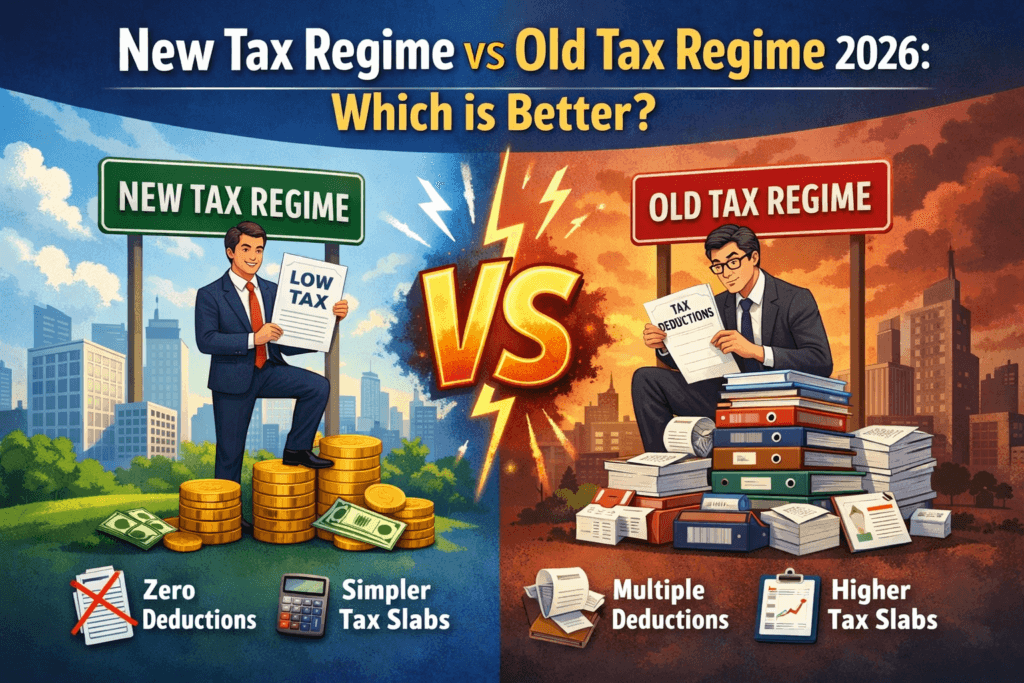
The new tax regime is the default in 2026. You are automatically in it unless you actively opt out. The new regime has lower rates but almost no deductions. The old regime allows all deductions but at higher base rates.
One important thing to note is that Section 156 rebate does NOT apply to LTCG (Section 112A) or STCG (Section 111A) on Equity Shares or Equity Oriented Mutual Funds. If you have salary income plus mutual fund/stock gains, the 156 rebate is available only from the salary tax — not the capital gains tax.
So, if your salary is Rs. 1020000/- and there is no other income, there will be full tax rebate u/s 156 and tax payable will be nil. But, at the same time if your salary is Rs. 1000000/- and STCG on Equity Shares is Rs. 20000/-, your tax will be 20% of Rs. 20000/- + 4% education cess, as rebate u/s 156 will not be allowed from tax on STCG u/s 111A.
Tax Slabs 2026 — Complete Rate Tables
New Tax Regime — FY 2026-27 (Tax Year 2026-27)
| Income Slab | Rate | Cumulative Tax |
| Up to Rs 4,00,000 | Nil | Zero |
| Rs 4,00,001 — Rs 8,00,000 | 5% | Rs 20,000 |
| Rs 8,00,001 — Rs 12,00,000 | 10% | Rs 60,000 |
| Rs 12,00,001 — Rs 16,00,000 | 15% | Rs 1,20,000 |
| Rs 16,00,001 — Rs 20,00,000 | 20% | Rs 2,00,000 |
| Rs 20,00,001 — Rs 24,00,000 | 25% | Rs 3,00,000 |
| Above Rs 24,00,000 | 30% | Rs 3,00,000 + 30% above Rs 24L |
Section 156 rebate: Rs 60,000 if total income up to Rs 12,00,000 (new regime).
Old Tax Regime — FY 2026-27 (Below 60 Years)
| Income Slab | Rate |
| Up to Rs 2,50,000 | Nil |
| Rs 2,50,001 — Rs 5,00,000 | 5% |
| Rs 5,00,001 — Rs 10,00,000 | 20% |
| Above Rs 10,00,000 | 30% |
For Senior Citizen (60-79 yrs), basic exemption limit is Rs 3,00,000 and for Super Senior citizen (80 yrs or more), this basic limit is Rs 5,00,000 and thereafter tax will be calculated as per above table.
Deductions — What is Allowed in Each Regime
| Deduction | Old Regime | New Regime |
| Standard Deduction (salaried) | Rs 50,000 | Rs 75,000 |
| Section 123 — ELSS, PPF, LIC, EPF etc. | Up to Rs 1,50,000 | Not allowed |
| Section 126 — Medical Insurance | Rs 25,000 / Rs 50,000 senior | Not allowed |
| HRA Exemption Sch. III(11) | Minimum of 3 conditions | Not allowed |
| Home Loan Interest Section 22(2) | Up to Rs 2,00,000 | Not allowed |
| NPS Employee Section 124 | Extra Rs 50,000 | Not allowed |
| NPS Employer Section 124 | Allowed | Allowed |
| LTCG Exemption Section 112A | Rs 1,25,000/year | Rs 1,25,000/year |
The only meaningful deduction in the new regime is employer NPS contribution under 124. If your employer contributes to NPS on your behalf, that is deductible even in the new regime
Finance Bill 2026 — 5 Changes That Affect You
Finance Bill 2026 (Bill No. 3 of 2026), introduced February 1, 2026. Most provisions effective April 1, 2026.
| Change | Clause | What It Means for You |
| ITR Due Date Extended | Clause 5 | ITR-3 and ITR-4 (non-audit business/professional) due August 31 — extended from July 31. Salaried ITR-1 and ITR-2 still July 31. |
| New Section 234-I: Revised Return Fee | Clause 12 | Revised ITR after 9 months: Rs 5,000 fee (income above Rs 5L) or Rs 1,000 (below Rs 5L). Within 9 months: free. Effective March 1, 2026. |
| Section 147A: Faceless Clarification | Clause 8 | Reassessment notices only from regular AO — not from National Faceless Assessment Centre. Retrospective from April 1, 2021. |
| TDS Default Decriminalised | Clause 20 | TDS default below Rs 10L: only fine, no imprisonment. Rs 10L-50L: simple imprisonment up to 6 months or fine. Above Rs 50L: up to 2 years or fine. |
| Foreign Assets Disclosure Scheme | Clauses 114-128 | One-time voluntary disclosure for undisclosed foreign assets. Tax + 100% penalty = prosecution immunity. Date to be notified. |
Which ITR Form Should You File?
| Form | Who Files | Key Condition | Due Date |
| ITR-1 (SAHAJ) | Salaried individuals | Income up to Rs 50L. No capital gains. | July 31 |
| ITR-2 | Individuals with capital gains | Any LTCG or STCG from MF or stocks — even one unit means ITR-2. | July 31 |
| ITR-3 | Business or professional income | Non-presumptive business income. Includes all ITR-2 sources. | Aug 31 / Oct 31 (if audited) |
| ITR-4 (SUGAM) | Presumptive income | 44AD business or 44ADA professional income. Income up to Rs 50L. | August 31 |
If you have redeemed even one unit of a mutual fund in Tax Year 2026-27, you cannot file ITR-1. You must file ITR-2. This is the most common filing mistake made by salaried investors.
Income Tax India 2026 Complete Guide
Must read
- Income Tax New Provisions 2026
- New Tax Regime vs Old Tax Regime 2026
- Income Tax Slabs FY 2025-26: New & Old Regime Rates 2026
- Section 123 Deductions 2026: Complete List of All Options
- How to Save Income Tax India 2026: 15 Legal Ways
- LTCG Tax on Mutual Funds 2026: 12.5% Rate & FIFO Rules
- PPF Interest Rate, Limit,Withdrawal & EEE Benefits 2026
- NPS Tax Benefit 2026
- HRA Exemption 2026: Formula, 8 Cities & Claim Guide
- Home Loan Tax Benefits 2026: Section 22(2), 123 Guide
- Advance Tax 2026: Due Dates, Calculation & 424/425 Guide
- The most important amendment in Income Tax in 2026
- Income Tax Calculator 2026: New vs Old Regime Guide
- Tax Exemption on Sale of Residential House
- Housing Loan Tax Benefits under New Regime
FAQs
Q1: Is Rs 12.75 lakh tax-free in 2026 for salaried employees?
Yes — in the new regime. Income up to Rs 12,00,000 attracts zero tax via Section 156 rebate of Rs 60,000. Salaried employees additionally get Rs 75,000 standard deduction — making effective zero-tax limit Rs 12,75,000. Important: 156 does not apply to STCG/LTCG from equity MF or stocks.
Q2: Which tax regime is better in 2026?
If your total deductions (123 + 126 + HRA + home loan + NPS) exceed approximately Rs 3.75 lakh at Rs 10L income or Rs 4.25 lakh at Rs 15L income — old regime saves more tax. Below those thresholds, new regime is better. Use our Income Tax Calculator 2026 to check your exact situation.
Q3: What is the ITR filing last date in 2026?
Salaried (ITR-1, ITR-2): July 31, 2026. Non-audit business and professional (ITR-3, ITR-4): August 31, 2026 — newly extended by Finance Bill 2026 Clause 5. Tax audit cases: October 31, 2026.
Q4: What is Section 156 rebate and does it apply to LTCG?
Section 156 rebate is Rs 60,000 in new regime (income up to Rs 12L) and Rs 12,500 in old regime (income up to Rs 5L). It reduces your tax to zero within those limits. It does NOT apply to LTCG under Section 112A or STCG under Section 111A.
Q5: What is “Tax Year” in the new Income Tax Act 2025?
“Tax Year” replaces “Financial Year” and “Assessment Year” under the new IT Act 2025. Tax Year 2026-27 = April 1, 2026 to March 31, 2027. Your Form 16 and investment statements will now show Tax Year 2026-27 instead of the old two-year notation. This is a terminology change only — no impact on tax calculation.
Q6: Can I switch between new and old regime every year?
Salaried employees (no business income) can switch every year. Declare your choice to your employer at year start for TDS, then formally opt when filing ITR. If you have business income, you can switch only once from new to old regime — then you are locked in as you can come in new, but now can’t go back to old. New regime is always the default.
Q7: Is 123 deduction available in the new tax regime?
No. Section 123 (ELSS, PPF, LIC, EPF, NSC, tuition fees, home loan principal) is NOT available in the new regime. Only the standard deduction of Rs 75,000 and employer NPS (Sec. 124) are allowed. To claim 123, you must opt for the old regime.
Q8: Which ITR form if I have mutual fund capital gains?
Any capital gains from mutual fund redemption — even one unit of LTCG or STCG — means you cannot file ITR-1. You must file ITR-2. This is one of the most common filing errors for salaried investors who also invest in mutual
Disclaimer : This article is for educational and informational purposes only. It is not personal tax advice. Every taxpayer’s situation is unique — income sources, deductions, residential status, and applicable sections all vary. All data is sourced from official government sources as cited. Also, there may be some changes while passing of Finance Bill, 2026. For your specific tax calculation and ITR filing, please consult a qualified Chartered Accountant or use the official e-filing portal https://www.incometax.gov.in/iec/foportal/
Author –
CA Ajay Khandelwal is a Chartered Accountant and financial expert with over 21 years of experience in taxation, compliance, and business advisory. As a key expert at AspirixWriters, he provides practical insights on income tax, financial planning, and regulatory matters, helping readers make informed financial decisions.
Author Profile CA. Ajay Khandelwal
References
Finance Bill 2026, Bill No. 3 of 2026, as introduced in Lok Sabha February 1, 2026 | Clause 2 (rates), Clause 5 (due dates), Clause 8 (147A), Clause 12 (234-I), Clause 20 (276B), Clauses 114-128 (Foreign Assets Scheme) | indiabudget.gov.in — https://indiabudget.gov.in
Income Tax Act 2025 (Act 30 of 2025), notified in Official Gazette August 21, 2025 | Replaces IT Act 1961 from April 1, 2026 | 536 sections, 333 rules, 190 forms | egazette.gov.in — https://egazette.gov.in
Finance Act 2025 | Section 202 — new tax regime | Standard deduction Rs 75,000 | 124 employer NPS in new regime | incometaxindia.gov.in — https://incometaxindia.gov.in
Must read Mutual Funds India 2026: Complete Beginner’s Guide
Advance Tax 2026: Due Dates, Calculation & 424/425 Guide
Advance Tax 2026 Who Pays, How to Calculate, 4 Due Dates and Section 424/425 Interest…
Complete Guide to Income Tax in India for 2026

Home Loan Tax Benefits 2026: Section 22(2), 123 Guide
Home Loan Tax Benefits 2026 Section 22(2) Interest Rs 2L, 123 Principal Rs 1.5L —…

Home Loan Tax Deduction under New Tax Regime 2026
Last Updated: May 2026 Introduction Buying a home is one of the biggest financial decisions…
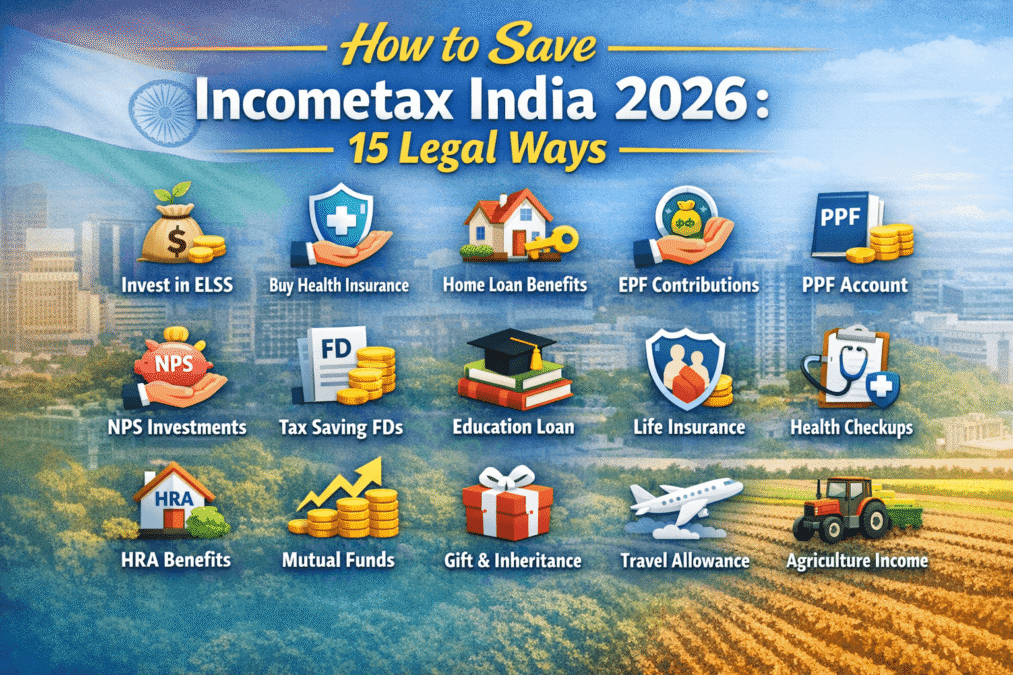
How to Save Income Tax India 2026: 15 Legal Ways
How to Save Income Tax India 2026 15 Legal Ways with Section Numbers, Limits and…
HRA Exemption 2026: Formula, 8 Cities & Claim Guide
HRA Exemption 2026 Calculation Formula, 8 Cities at 50% and Complete Claim Guide (IT Rules…