Last Updated: May 11, 2026
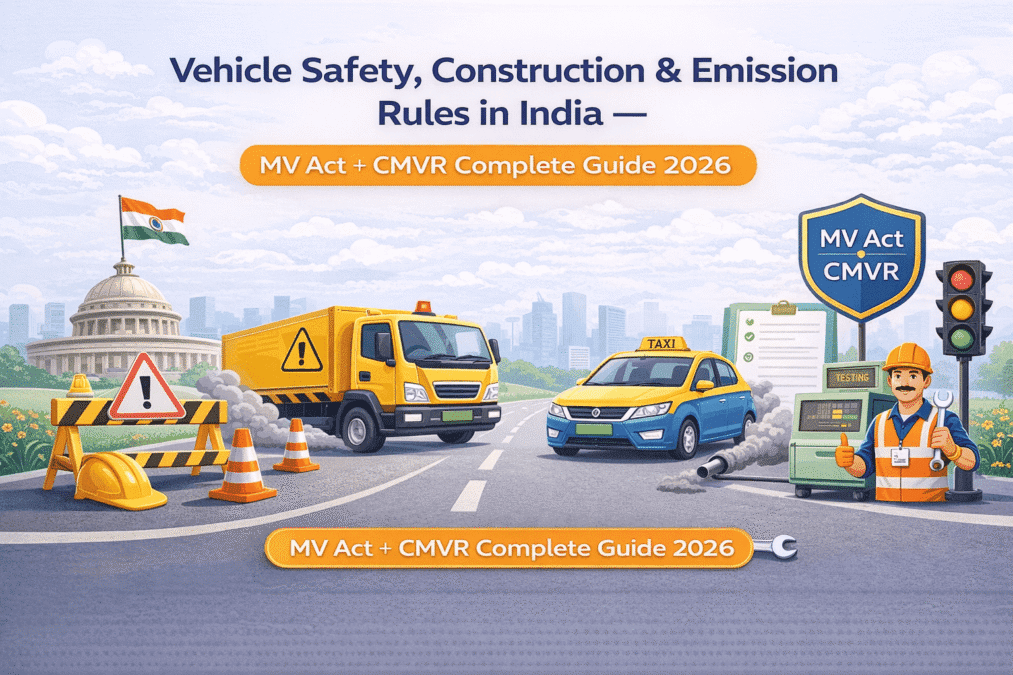
Vehicle Safety & Emission Rules India MVA-06 part of MVA Complete Guide
← Previous: MV Act 1988 Permit Rules in India (MVA-05)
→ Next: Traffic Rules and Penalties in India 2026 (MVA-07)
Why Vehicle Safety and Emission Rules Matter in 2026
Delhi’s air quality is regularly ranked among the worst in the world. Mumbai faces severe congestion from poorly maintained vehicles. Every year, thousands of people die in accidents caused by faulty brakes, bald tyres, and overloaded trucks with no working headlights.
These are not just environmental or safety statistics. They are the reason India enacted Chapter VII of the Motor Vehicles Act, 1988 and why the Central Motor Vehicles Rules, 1989 prescribe detailed construction and equipment standards for every vehicle on Indian roads.
If you own a vehicle, drive one, work in the automotive industry, or are preparing for law exams — understanding these rules is not optional. Traffic police now use AI-powered cameras and Vahan database cross-checks to instantly identify vehicles with expired PUC certificates, failed fitness tests, and non-compliant modifications. The penalties are real, and the enforcement is growing sharper every year.
This guide covers everything: Chapter VII of the MV Act, CMVR construction standards, BS6 emission norms, PUC certificate rules, vehicle fitness requirements, the scrappage policy, and the latest 2026 updates — all sourced from official government documents.
What Are Vehicle Safety Rules Under the Motor Vehicles Act, 1988?
Vehicle safety rules in India are set by Chapter VII of the Motor Vehicles Act, 1988 (Sections 109-111) and the Central Motor Vehicles Rules, 1989 (CMVR). These rules prescribe standards for the construction, equipment, and maintenance of all motor vehicles — including brakes, lights, tyres, load limits, seat belts, airbags, mirrors, and exhaust emissions. Any vehicle that does not meet these standards cannot legally be used on Indian roads.
Chapter VII is the safety backbone of the entire Motor Vehicles Act. While earlier chapters deal with who can drive and which vehicles are allowed — Chapter VII deals with what those vehicles must be made of and how they must be maintained. It gives MoRTH the authority to prescribe technical standards and empowers the Central Government to issue rules through the CMVR.
| Section | Subject | What It Controls |
| Sec 109 | General provision regarding construction and maintenance of vehicles | Ensures all vehicles on road are safe, properly maintained, and under driver control |
| Sec 110 | Power of Central Government to make rules | National standards for vehicle safety, emissions, and construction |
| Sec 111 | Power of State Government to make rules | State-level regulations for vehicle construction/equipment that are NOT covered by Central Government rules |
Vehicle Construction and Equipment Standards Under CMVR 1989
The Central Motor Vehicles Rules, 1989 (CMVR) is subordinate legislation made under Section 110 (Central Government) and Section 111 (State Government) of the Motor Vehicles Act, 1988. It translates the Act’s broad mandate into specific, measurable technical standards.
The CMVR is regularly updated by MoRTH — with the 21st Amendment (Nov 2022), 22nd Amendment (Dec 2022), and subsequent updates adding new standards for armoured vehicles, hydrogen fuel cell vehicles, and EV safety.
Mandatory Safety Equipment Under CMVR
- Brakes: Every vehicle must have at least two separate braking systems. Heavy vehicles must have additional parking brakes and, for new models, ABS (Anti-lock Braking System) is mandated by AIS standards.
- Lights and Signals: Headlights, tail lights, brake lights, turn indicators, hazard lights, and reverse lights are all mandatory under CMVR Rule 100–103 (lights) and Rule 101 (signalling devices). Daytime Running Lights (DRL) are mandatory for new vehicles from 2021.
- Tyres: Minimum tread depth standards are prescribed under CMVR Rule 104. Bald or worn tyres are a violation under Section 190 and CMVR Rule 104.
- Seat Belts: Mandatory for all front seat occupants in cars under Section 194B. CMVR standards prescribe technical specifications for seat belts in new vehicles.
- Rear-view Mirrors: Mandatory on both driver’s and passenger’s side for cars; on the right side for two-wheelers.
- Airbags: Mandatory for front seats in new passenger vehicles from 1 April 2021 (minimum 2 airbags per vehicle — driver and front passenger). Six airbags mandatory for new M1 category vehicles (passenger cars) from 1 October 2023.
- Speed Governor: Mandatory for all new commercial vehicles (buses, trucks) — must be set to prescribed maximum speed and cannot be tampered with (CMVR Rule 125).
- High Security Registration Plates (HSRP): Mandatory for all new vehicles sold in India from 2005 onwards. Tamper-proof, IND-embossed chromium hologram plates as per CMVR specifications.
Download the free MACT Claim Filing Checklist PDF 2026 and stay prepared with the right legal information when it matters most.
Free MACT Claim Filing Checklist PDF 2026
Prohibition on Structural Modifications (Section 128)
Section 128(6) of the Motor Vehicles Act prohibits any alteration to the structure, dimensions, or engine of a registered vehicle without prior approval from the registering authority. Common illegal modifications include:
- Increasing engine capacity
- Altering body to increase seating beyond registered capacity
- Changing fuel type without CMVR approval
- Modifying exhaust system to increase noise or emissions
Illegal modifications make a vehicle non-compliant with its registration certificate — and can void the vehicle’s insurance.
2019 Addition — Vehicle Recall (Section 110A): If a defect in any vehicle model poses a danger to the environment, the driver, or other road users, the Central Government can order a mandatory recall of all affected vehicles. The manufacturer must either reimburse the full purchase price or replace the vehicle with one of equivalent or better specification. This provision — inserted by the 2019 Amendment — is modelled on global automotive recall frameworks.
What is BS6 emission norm in India and when did it come into effect?
BS6 (Bharat Stage VI) is India’s most stringent vehicle exhaust emission standard, equivalent to Euro 6 norms. It was introduced by MoRTH and became mandatory for all new petrol, diesel, and CNG vehicles sold in India from 1 April 2020 — two years ahead of the original 2022 schedule.
India skipped BS-V entirely, moving directly from BS-IV to BS-VI to accelerate environmental protection.
BS6 norms prescribe maximum permissible levels of:
- Particulate Matter (PM): 4.5mg/km (down from 25mg/km in BS4)
- Nitrogen Oxides (NOx): 80mg/km for diesel (down from 250mg/km in BS4)
- Carbon Monoxide (CO)
- Hydrocarbons (HC)
Key Reductions from BS4:
- Diesel NOx reduced by 70%
- Diesel PM reduced by 80%
- Petrol NOx reduced by 25%
- Fuel sulphur content: 10 ppm (BS6) vs 50 ppm (BS4) — five times lower
BS6-Compliant Technologies Required:
- Diesel Particulate Filters (DPF)
- Selective Catalytic Reduction (SCR)
- On-Board Diagnostics (OBD)
- Real Driving Emissions (RDE) testing (BS6 Phase-II from 2023)
All new vehicles must comply before they can be registered.
BS6 Phase-II (2023 Update):
Real Driving Emissions (RDE) testing became mandatory from April 2023, ensuring vehicles comply under actual on-road conditions (not just lab testing).
Bharat Stage Emission Standards — Evolution
| Standard | Equivalent (Euro) | Introduced | Key Pollutant Reductions |
|---|---|---|---|
| BS I (Bharat Stage I) | Euro 1 | 2000 | Basic HC and CO limits |
| BS II (Bharat Stage II) | Euro 2 | 2001 (metro) | Tighter HC, CO; stricter PM |
| BS III (Bharat Stage III) | Euro 3 | 2005 (metro) | NOx limits introduced; catalytic converter needed |
| BS IV (Bharat Stage IV) | Euro 4 | 2010 (metro); 2017 (nationwide) | Significant PM reduction |
| BS V (Bharat Stage V) | Euro 5 | Skipped | India moved directly to BS6 |
| BS VI (Bharat Stage VI) | Euro 6 | 1 April 2020 (nationwide) | NOx cut by 70% (diesel); PM cut by 80%; RDE testing added (Phase-II, 2023) |
Note: BS VII is proposed for 2026–27
Why India Skipped BS5?
India leapfrogged directly from BS4 to BS6 — skipping BS5 entirely. This was a deliberate policy decision announced in 2016 by MoRTH, driven by severe air quality concerns in Indian cities and supported by Supreme Court directions on vehicular pollution. The two-year early implementation (2020 instead of 2022) was also a direct response to Delhi’s pollution crisis. Source: MoRTH official notification; PIB.
BS6 Phase 2 (OBD-II) — Effective 2023
BS6 Phase 2, which requires On-Board Diagnostics (OBD-II) systems in all new vehicles, became mandatory from 1 April 2023. OBD-II monitors a vehicle’s emission control systems in real time and alerts the driver (via a dashboard warning light) if any emission-related component is malfunctioning. This means emission failures can now be detected without a roadside test — and a vehicle with a malfunctioning emission system is technically non-compliant with BS6 standards even if it passes a roadside PUC test. Source: MoRTH; CMVR Amendment Gazette.
What Is a PUC Certificate and Why Is It Mandatory?
What is a PUC certificate and how long is it valid in India?
A Pollution Under Control (PUC) certificate is a mandatory document that verifies a vehicle’s exhaust emissions are within the limits prescribed under the Central Motor Vehicles Rules, 1989. All motor vehicles on Indian roads — including two-wheelers, cars, and commercial vehicles — must carry a valid PUC certificate at all times. For BS6 vehicles: first test within 3 months of purchase, PUC is valid for 1 year from the first test (within 3 months of purchase) and every year thereafter. For BS4 and older vehicles: valid for 6 months. Issued by authorised PUC testing centres. Source: CMVR Rule 115; Section 190, MV Act.
Download the free MACT Claim Filing Checklist PDF 2026 and stay prepared with the right legal information when it matters most.
Free MACT Claim Filing Checklist PDF 2026
PUC Certificate — Key Rules at a Glance
| Rule | Details | Authority |
| Who needs it | Every motor vehicle on any public road in India — no exceptions | CMVR Rule 115 |
| When to get first PUC | Within 3 months of purchase for all vehicles | CMVR Rule 115 |
| Validity — BS6 vehicles (new) | 1 year (annually renewable) | CMVR (post-2020) |
| Validity — BS4 and older | 6 months | CMVR Rule 115 |
| Where to get it | Any MoRTH-authorised PUC testing centre; linked to Vahan database | CMVR; Vahan portal |
| Cost | Approx. Rs. 60–100 per test (varies by state) | State transport dept. |
| Digital PUC | PUC details updated on Vahan database in real time after each test | Vahan portal |
| Penalty for expired PUC | Rs. 1,000 fine + up to 3 months imprisonment under Section 190(2) as discretionary not automatic | Sec 190(2), MVA 1988 |
Example: Sameer drives his 5-year-old petrol car. His PUC expired 2 months ago. At a toll booth, an ANPR camera cross-references his number plate with the Vahan database and detects no valid PUC on record. An e-Challan of Rs. 1,000 is automatically generated and sent to his registered mobile number. He must pay at echallan.parivahan.gov.in within 60 days. He also cannot renew his vehicle’s insurance or fitness certificate without a valid PUC. The lesson: set a reminder 2 weeks before your PUC expiry.
Vehicle Fitness Certificate Rules — Section 56 and CMVR
A Certificate of Fitness (CF) is the official document certifying that a transport vehicle meets the construction, equipment, and safety standards prescribed under the Motor Vehicles Act and CMVR. Section 56 makes it mandatory for every transport vehicle. Private vehicles do not require a CF — but they must still comply with the construction standards and valid PUC.
| Vehicle Category | Initial CF Validity | Renewal Frequency | Who Issues |
| New transport vehicle (goods/passenger) | 2 years from registration | Annual thereafter | Motor Vehicle Inspector / authorised ATS |
| Old transport vehicle (after 2 years) | 1 year per renewal | Annual | Motor Vehicle Inspector / authorised ATS |
| Three-wheelers (commercial) | 1 year from registration | Annual | Motor Vehicle Inspector |
| Private vehicle (car, two-wheeler) | Not required | Not required | N/A — but PUC mandatory |
| Vehicle over 15 years (private) | Fitness test mandatory for RC renewal | every 5 years after 15 years (not before) | Authorised Testing Station (ATS) |
Since 2021–22, automated testing stations (ATS) have been introduced across India, providing computerised, corruption-resistant fitness testing. The RVSF (Registered Vehicle Scrapping Facility) framework feeds into this — vehicles that repeatedly fail fitness tests are redirected to the scrappage process.
Vehicle Scrappage Policy India 2021–2026 — Complete Rules
What is the vehicle scrappage policy in India and what are the age limits?
India’s Vehicle Scrappage Policy, notified by MoRTH in 2021, mandates that private vehicles older than 20 years and commercial vehicles older than 15 years must undergo a mandatory automated fitness test at an Authorised Testing Station (ATS). Vehicles that fail the test are declared End of Life Vehicles (ELVs) and must be scrapped at a Registered Vehicle Scrapping Facility (RVSF). The policy is tracked digitally through the Vahan portal.
Scrappage Policy — Key Rules at a Glance
| Rule | Private Vehicle | Commercial Vehicle | Government Vehicle |
| Age trigger | 20 years | 15 years | 15 years |
| Action required | Mandatory automated fitness test at ATS | Mandatory fitness test at ATS | Mandatory scrappage — no renewal allowed |
| If test passed | RC renewed for 5 years | CF renewed for 1 year | N/A — must scrap |
| If test failed | Declared ELV — must scrap at RVSF | Declared ELV — must scrap | Must scrap |
| Incentive for scrapping | Up to 5–8% discount on new vehicle + road tax waiver in some states | Proportional incentive | N/A |
| Digital tracking | Vahan database tracks fitness history | Vahan database | Vahan database |
EPR Mandates — FY 2026-27
Under Extended Producer Responsibility (EPR) rules notified by the Ministry of Environment, Forest and Climate Change (MoEFCC), automobile manufacturers and importers are required to take back End of Life Vehicles from FY 2026–27. Producers must register on the digital EPR portal, report annual ELV collection targets, and ensure all scrapping is done at AIS-129 certified RVSFs. Non-compliance attracts penalties under the Environment Protection Act, 1986 read with the Motor Vehicles Act scrappage framework. Source: MoEFCC notification; psrcompliance.com.
Download the free MACT Claim Filing Checklist PDF 2026 and stay prepared with the right legal information when it matters most.
Free MACT Claim Filing Checklist PDF 2026
Latest Updates 2026 — Vehicle Safety and Emission Rules
Latest Update 2026:
- CMVR 22nd Amendment (December 2022, G.S.R. 2022): Armoured vehicle construction norms (AIS-194) added — ballistic protection standards for specialised vehicles.
- CMVR 5th Amendment (September 2023): Hydrogen fuel cell vehicle safety and emission norms notified.
- CMVR November 19, 2025 Amendment (PIB PRID 2216507) : Primary focus: User fee compliance at toll plazas on National Highways and updated safety device specifications. Six airbags mandatory for new M1 category passenger cars from 1 October 2023.
- BS6 Phase 2 (OBD-II): Mandatory from 1 April 2023 for all new vehicles.
- EPR mandates for vehicle manufacturers: EPR rules notified January 6, 2025, operative from April 1, 2025 (FY 2025-26), with full enforcement ramping up to FY 2026-27.
- AI-powered e-Challan cameras now detect expired PUC automatically at toll booths via Vahan database cross-reference nationwide.
Penalties for Vehicle Safety and Emission Violations
| Violation | Section | Fine (2019 Amendment) | Extra Punishment |
| Driving vehicle in unsafe/defective condition | Sec 190(1) | Rs. 1,000 (1st offence); Rs. 2,000 (repeat) | Vehicle impounded until repaired |
| Expired or no PUC certificate | Sec 190(2) | Rs. 1,000 | Up to 3 months imprisonment possible |
| Illegal structural modification (Sec 110) | Sec 191 | Rs. 1,000 + Rs. 2,000 for subsequent | Modification must be reversed; RC may be cancelled |
| No seat belt — driver or front passenger | Sec 194B | Rs. 1,000 | Community service possible |
| Driving without functioning headlights at night | Sec 177 | Rs. 500 First–Rs. 1,500 (repeat) | Compoundable offence |
| Overloading (per extra tonne of goods) | Sec 194 | Rs. 2,000 first; Rs. 20,000 per extra tonne for repeat | Rs. 2,000 per extra passenger for overloaded passenger vehicle |
| Driving vehicle without valid fitness certificate | Sec 56+192 | Rs. 5,000 first; Rs. 10,000 subsequent | Vehicle impounded |
| Tampering with speed governor | Sec 111 | Rs. 1,000 and above | Prosecution possible |
5 Common Mistakes Vehicle Owners Make About Safety and Emission Rules
- Mistake 1 — ‘My new BS6 car does not need a PUC for the first year.’ Wrong. New BS6 vehicles must get their first PUC test within 3 months of purchase (under factory warranty), then annually thereafter.” — many owners miss this deadline and unknowingly drive with an expired PUC. Set a reminder at 11 months from purchase date.
- Mistake 2 — ‘Tinted film on windows is just a style choice — it is not illegal.’ Under CMVR standards, windshield and front side window glass must allow at least 70% visible light transmission (VLT). Excessive tinting (darker than 70% VLT) violates CMVR Rule 100 and is a Section 190 offence. Police can order removal on the spot.
- Mistake 3 — ‘My car is more than 15 years old but I got the RC renewed — so I am fine.’ An old private vehicle’s RC renewal (after 15 years) does not automatically clear it of fitness requirements. The vehicle must pass a fitness test at an ATS. Simply renewing the RC without a fitness test is incomplete and does not legalise an unsafe vehicle.
- Mistake 4 — ‘Modifying my motorcycle exhaust for a sportier sound is just cosmetic.’ Replacing the original exhaust with a louder aftermarket system is a structural modification under Section 110. It also likely results in the vehicle exceeding the CMVR noise limits and the BS6 emission standards. This is an illegal modification that can result in RC cancellation and insurance voiding.
- Mistake 5 — ‘If I scrap my old car, I lose money.’ Under the Vehicle Scrappage Policy 2021, scrapping your old vehicle at a RVSF provides a Scrappage Certificate that entitles you to road tax concessions (up to 25% for private cars) and incentive discounts from manufacturers on new vehicle purchases. Check the MoRTH-notified RVSF near you through the Vahan portal.
Summary — Vehicle Safety and Emission Rules
| Quick Revision: 1. Chapter VII (Sections 109–111), Motor Vehicles Act 1988 + CMVR 1989: Together govern all vehicle safety and construction standards in India. 2. BS6 (Bharat Stage VI): India’s current emission standard — mandatory for all new vehicles from 1 April 2020. BS6 Phase 2 (OBD-II) mandatory from April 2023. 3. PUC Certificate: Mandatory for every vehicle at all times. BS6 vehicles: 1-year validity. Older vehicles: 6-month validity. Penalty for expired PUC: Rs. 1,000 + possible jail. 4. Section 110: No structural modification without approval. Illegal modifications void insurance and cancel RC. Should be Section 128(6) for structural modifications 5. Section 110A (2019): Central Govt can order manufacturer vehicle recall for safety defects. 6. Certificate of Fitness (Section 56): Mandatory for all transport vehicles. Annual renewal with MV Inspector. 7. Scrappage Policy: Private vehicles over 20 years and commercial over 15 years must pass automated fitness test. Fail = ELV; must scrap at RVSF. 8. EPR mandates FY 2026–27:Started April 2025; full enforcement FY 2026–27 . Source: MoEFCC. |
FAQ — Vehicle Safety and Emission Rules India
Q1. What is BS6 emission norm in India?
BS6 (Bharat Stage VI) is India’s current emission standard, similar to Euro 6. It became mandatory from 1 April 2020 for all new petrol, diesel, and CNG vehicles under CMVR, 1989. BS6 reduced pollution significantly (PM by 82% and NOx by 68%). India skipped BS5. BS6 Phase 2 with OBD-II started from 1 April 2023.
Q2. How long is a PUC certificate valid in India?
For BS6 vehicles, the PUC certificate is valid for 1 year, with the first test required within 3 months of purchase (then yearly renewal). For BS4 and older vehicles, it is valid for 6 months and must be renewed twice a year. PUC is issued by authorised centres and updated on the Vahan database.
Q3. What is the vehicle scrappage policy in India 2026?
India’s Vehicle Scrappage Policy (2021) says private vehicles over 20 years and commercial vehicles over 15 years must pass fitness tests. Government vehicles are scrapped after 15 years. Failed vehicles are declared ELVs and scrapped at authorised centres. Owners get benefits like tax discounts. From 2026–27, manufacturers must recycle old vehicles under EPR rules.
Q4. What happens if a PUC certificate expires in India?
If your PUC expires, it is illegal under the Motor Vehicles Act. You may face a ₹1,000 fine and up to 3 months in jail. AI e-challan cameras can detect and fine you automatically. An expired PUC can also block insurance, RC renewal, and fitness renewal. So, renew your PUC quickly at an authorised centre.
Q5. Is window tinting legal in India under CMVR?
Window tinting is allowed only within limits under CMVR Rule 100. The front windshield and front side windows must allow at least 70% visible light transmission (VLT). Rear windows may use Sun Control Film (SCF/SLC). Darker tint on front windows is illegal and can lead to fines. Police can remove illegal tint on the spot. Supreme Court guidelines (2012) prohibit tinting front windshield and front side windows beyond 70% VLT.
Q6. What is Section 110A of the Motor Vehicles Act?
Section 110A (added in 2019) allows the government to recall vehicles if they have defects that can harm people or the environment. The manufacturer must either refund the full price or replace the vehicle. This rule makes India’s vehicle recall system similar to global standards like the USA and EU.
Q7. Are six airbags mandatory in Indian cars?
From 1 October 2023, all new M1 category passenger cars (standard vehicles up to 8 seats including driver) in India must have 6 airbags (driver, front passenger, side, and curtain) as per CMVR rules. Earlier, only 2 airbags were required from April 2021. Older vehicles don’t need upgrades, but all new M1 models must follow this rule.
References :
- Motor Vehicles Act, 1988 (Chapter VII, Sections 106–120)
- The Central Motor Vehicles Rules, 1989
- MoRTH/PIB notifications.
- indiacode.nic.in.
- CMVR latest amendment: GSR 394(E) 2021 and subsequent gazettes.
Continue Reading — Motor Vehicles Act Series on AspirixWriters.com
MV Act 1988 Permit Rules in India (MVA-05)
Motor Vehicles Act 1988 India: Complete Guide
Traffic Rules and Penalties in India 2026 (Challan, Fines & Sections) (MVA-07)
Vehicle Registration Rules in India (MVA-04)
Motor Insurance & Third Party Law in India : MVA-08)
Disclaimer: This article is written for educational and informational purposes only using official sources (Motor Vehicles Act 1988, CMVR 1989, MoRTH, PIB, indiacode.nic.in). It does not constitute legal or technical advice. Emission standards, penalty amounts, and scrappage rules are subject to change by MoRTH notifications. Verify current specifications at morth.nic.in and indiacode.nic.in. Last Updated: April 2026.
About Author
Dr. Rekha Khandelwal is a Ph.D. in Law, legal researcher, and founder of AspirixWriters.com. She specializes in simplifying Indian laws and academic concepts into clear, practical knowledge for students, aspirants, and the general public.
Dr. Rekha Khandelwal | Academic Writer, Legal Technical Writer, AI Expert & Author | AspirixWriters

Free MACT Claim Filing Checklist PDF 2026
MACT Claim Filing Checklist Part of Motor Vehicles Act 1988 India: Complete Guide Road accidents…
Motor Vehicles (Amendment) Act, 2019 Explained — Key Changes, Penalties & Latest Updates 2026
Motor Vehicles Amendment Act 2019 — Complete Guide (MVA-11) Part of Motor Vehicles Act 1988…

Good Samaritan Law in India — Section 134A MV Act Explained Simply (2026)
Good Samaritan Law India — Section 134A (MVA-10) Part of Motor Vehicles Act 1988 India:…

MACT Claims in India: Step-by-Step Process, Compensation & Rules (2026 Guide)
MACT Claim in India 2026 – MVA-09 Part of Motor Vehicles Act 1988 India: Complete…

Motor Insurance & Third Party Law in India : MV Act 1988 Complete Guide 2026
Motor Insurance & Third Party Law India -MVA-08 ← Previous: Traffic Rules & Fines (MVA-07)…
Traffic Rules and Penalties in India 2026 — Complete Guide (Challan, Fines & Sections)
Traffic Rules and Penalties in India 2026 MVA-07: Part of MVA Complete Guide ← Previous:…