
Call for Papers in Law 2026: Verified Law Journals, Conferences & Research Opportunities
Last Updated: 13 August 2026
Finding a suitable Call for Papers (CFP) can be difficult for law students, research scholars, academicians and legal professionals. Deadlines change, conferences may close their submissions, and information published on third-party websites may become outdated.
At AspirixWriters, we prioritise accuracy over quantity. Each opportunity listed as Verified is checked against an official journal, university, conference or institutional source wherever possible.
Latest Verified Call for Papers in Law 2026
The following opportunities have been checked for their current status as of 13 August 2026.
| Opportunity | Institution / Organiser | Type | Area | Deadline | Status |
|---|---|---|---|---|---|
| NLIU Law Review – Volume XVI Issue I | National Law Institute University, Bhopal | Law Journal | All areas of law | 16 Aug 2026 | 🟢 Open |
| Amity Law Review – Volume 22 | Amity Law School, Amity University | Law Journal | All areas of law | 31 Aug 2026 | 🟢 Open |
| GLC-SPIL International Law Journal – Volume VII Issue I | Government Law College, Mumbai / SPIL | Law Journal | International Law | 16 Sep 2026 | 🟢 Open |
| International Conference on Leaving No One Behind | Presidency School of Law, Presidency University, Bengaluru | Conference | Law, Justice & Inclusive Governance | 7 Sep 2026 – Abstract | 🟢 Open |
| ICLS 2026 – 5th International Conference on Law and Social Transformation | Alliance University, Bengaluru | Conference | ADR, AI, Justice & Sustainable Development | 15 Sep 2026 – Full Manuscript* | 🟡 Stage-specific |
1. NLIU Law Review – Volume XVI Issue I
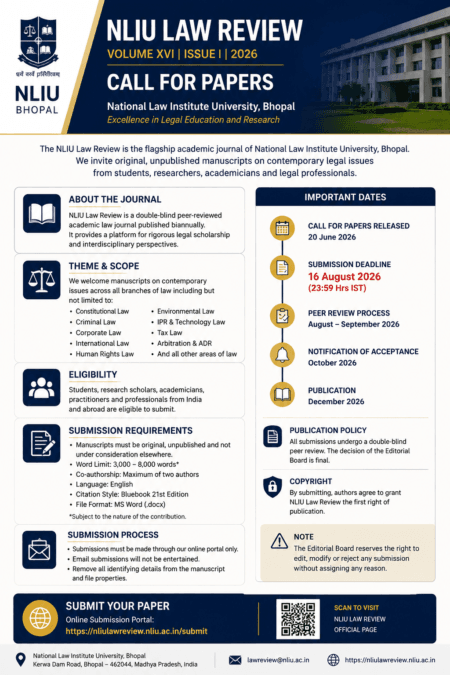
Institution: National Law Institute University, Bhopal
Type: Academic Law Journal
Scope: All branches of law
Deadline: 16 August 2026, 23:59 hours
The NLIU Law Review is the flagship journal of the National Law Institute University, Bhopal. The journal describes itself as a double-blind peer-reviewed academic law journal published biannually by the University.
The current call welcomes manuscripts on contemporary legal issues across all branches of law, provided the work is relevant, current and original.
Important points
- Submissions are accepted through the prescribed online submission link.
- Manuscripts must be submitted in .docx format.
- The manuscript should not contain identifying information.
- Email submissions are not considered.
- Deadline: 16 August 2026.
- The journal accepts submissions across branches of law.
Best suited for: LL.B. students, LL.M. students, research scholars, academics and legal researchers.
Official source: NLIU Law Review – Official Call for Papers
2. Amity Law Review – Volume 22, 2026
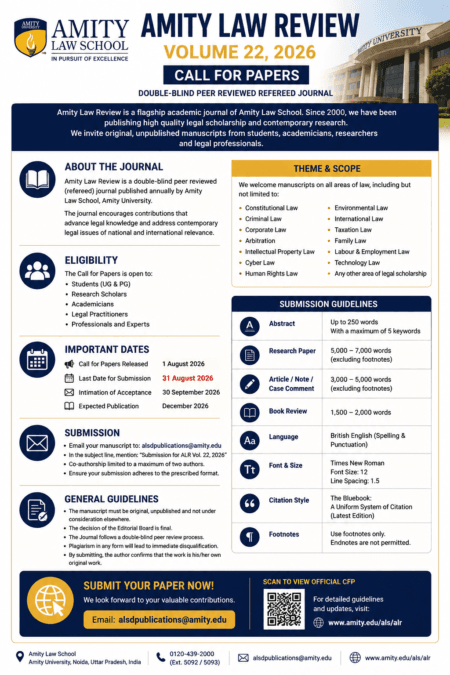
Institution: Amity Law School, Amity University
Type: Peer-reviewed Law Journal
Scope: All areas of law
Deadline: 31 August 2026
Amity Law Review is a double-blind peer-reviewed/refereed journal published by Amity Law School. Its official CFP states that the journal has been in circulation since 2000 and accepts contributions including research papers, research articles, case comments and book reviews.
Areas covered
The journal covers areas including:
- Constitutional Law
- Criminal Law
- Corporate Law
- Arbitration
- Cyber Law
- Intellectual Property Law
- and other areas of legal scholarship.
Submission requirements
The official CFP specifies:
- Maximum two co-authors
- Abstract up to 250 words
- Maximum five keywords
- Research papers generally 5,000–7,000 words
- Notes and case comments: 3,000–5,000 words
- Book reviews: 1,500–2,000 words
- British spelling and punctuation
- Times New Roman
- Footnotes rather than endnotes
Deadline: 31 August 2026.
Official submission email: alsdpublications@amity.edu
Official source: Amity Law Review – Official Call for Papers
3. GLC-SPIL International Law Journal – Volume VII Issue I
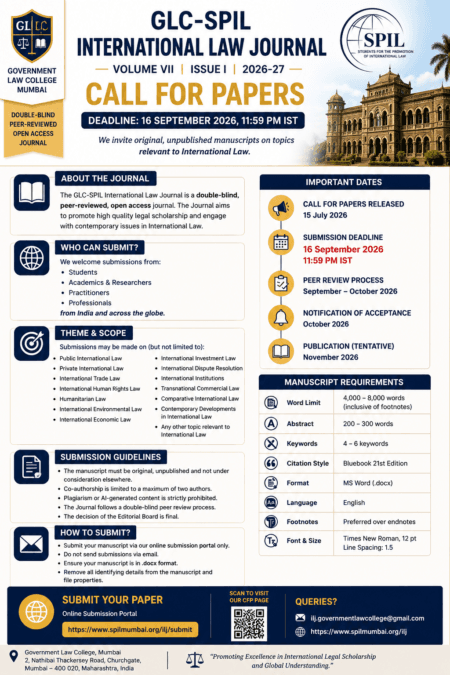
Institution: Government Law College, Mumbai / Students for the Promotion of International Law
Type: Double-blind peer-reviewed open-access journal
Area: International Law
Deadline: 16 September 2026, 11:59 PM IST
The GLC-SPIL International Law Journal is inviting submissions for Volume VII Issue I on topics relevant to International Law. The official journal page states that submissions are welcomed from students, academics, practitioners and researchers across the globe.
The journal covers areas including:
- Public International Law
- Private International Law
- International Trade Law
- Human Rights
- Environmental Law
- Humanitarian Law
- Investment Law
- Dispute Resolution
- International Institutions
- Transnational Commercial Law
The journal describes itself as double-blind, peer-reviewed and open access.
Submission policy
The journal’s official submission policy requires original and unpublished work and does not permit simultaneous submissions while a manuscript is under consideration.
Deadline: 16 September 2026
Time: 11:59 PM IST
Official source: GLC-SPIL International Law Journal – Official CFP
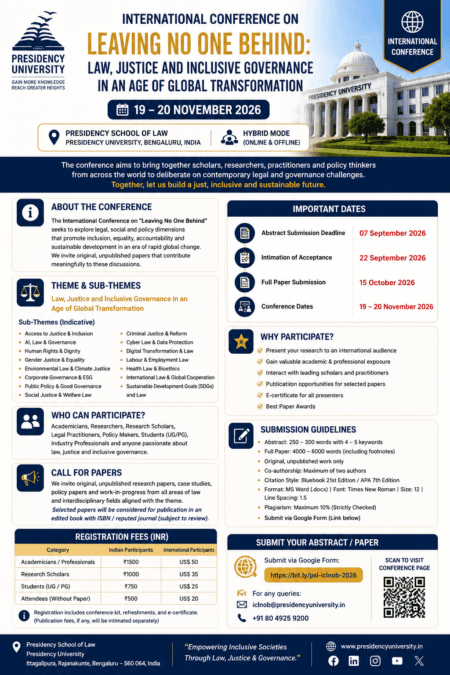
Organiser: Presidency School of Law, Presidency University, Bengaluru
Type: International Conference
Mode: Hybrid
Conference dates: 19–20 November 2026
Theme
Law, Justice and Inclusive Governance in an Age of Global Transformation
The conference covers contemporary legal and policy issues including, among other areas:
- AI and intellectual property
- Generative AI
- WIPO developments
- Cybercrime and human rights
- Victimology
- Restorative Justice
- Prison Reform
- Criminal Justice
- Digital Evidence
- Fair Trial Rights
Important dates
- Abstract submission: 7 September 2026
- Acceptance notification: 22 September 2026
- Full paper: 15 October 2026
- Conference: 19–20 November 2026
The official page lists registration fees separately for academicians/professionals and research scholars, with different rates for Indian and international delegates.
Official source: Presidency University – Official Conference Page
5. ICLS 2026 – 5th International Conference on Law and Social Transformation
Organiser: Alliance School of Law, Alliance University
Location: Bengaluru, India
Mode: Hybrid
Conference: 26–28 October 2026
The conference focuses on contemporary developments in Alternative Dispute Resolution (ADR) and explores areas such as:
- Arbitration
- Mediation
- Conciliation
- Negotiation
- Online Dispute Resolution
- Artificial Intelligence
- Investment Arbitration
- ESG Governance
- Technology-enabled justice
- Cross-border dispute resolution
The official conference website states that the conference uses a double-blind peer-review process for submitted manuscripts.
Important dates
| Stage | Date |
|---|---|
| Abstract deadline | 31 July 2026 |
| Abstract acceptance | 10 August 2026 |
| Full manuscript | 15 September 2026 |
| Peer review completion | 18 October 2026 |
| Conference | 26–28 October 2026 |
Important: Because the abstract deadline has already passed, the 15 September full-manuscript date should not be presented as an open CFP for new abstracts. It applies to the subsequent manuscript stage for accepted abstracts.
The official site lists registration fees and states that the conference is hybrid.
Official source: ICLS 2026 – Official Alliance University Conference Page
Opportunities for Law Students
If you are an LL.B. or LL.M. student, publication opportunities can help you develop:
- Legal research skills
- Academic writing
- Citation skills
- Case-law analysis
- Research methodology
- Academic profiles
- Conference presentation experience
Currently relevant opportunities
NLIU Law Review
Open to contemporary legal scholarship across branches of law.
GLC-SPIL International Law Journal
Explicitly welcomes submissions from students as well as academics, practitioners and researchers.
Amity Law Review
Useful for research papers, articles, case comments and book reviews, subject to its eligibility and submission requirements.
AI, Law & Technology Research Opportunities
AI and technology law are rapidly developing areas of legal scholarship.
Researchers may consider topics such as:
- Artificial Intelligence Regulation
- AI Governance
- Generative AI and Law
- AI Liability
- Data Protection
- Algorithmic Accountability
- AI and Intellectual Property
- AI and Human Rights
- Cybersecurity
- Digital Evidence
- AI in Courts
- Automated Decision-Making
- Platform Regulation
Jindal Global Law Review – AI & Law Special Issue
A special issue of the Jindal Global Law Review on Artificial Intelligence and Law was announced by the Cyril Shroff Centre for AI, Law and Regulation at Jindal Global Law School.
The call sought extended abstracts by 30 June 2026, followed by full manuscripts from accepted abstracts by 15 October 2026. Therefore, as of 13 August 2026, this should not be listed as an open opportunity for new abstract submissions.
This is a good example of why CFP pages need to distinguish between “current submission opportunity” and “later manuscript stage.”
How to Choose the Right Law Journal
Do not select a journal merely because its name contains words such as:
- International
- Scopus
- UGC
- Peer Reviewed
- Indexed
- Reputed
Instead, check the actual journal information.
Before submitting, verify:
1. Editorial board
Is the editorial board identifiable?
2. Peer-review process
Does the journal explain its review process?
3. Official website
Is the CFP available on the journal/university website?
4. Submission guidelines
Are the word limit, citation style and formatting requirements clear?
5. Publication fee
Is a publication fee or APC clearly disclosed?
6. Indexing
If the journal claims indexing, verify the claim independently.
7. Publication history
Look at previous volumes and issues.
8. Copyright policy
Understand what rights you give the publisher.
9. AI policy
Check whether the journal has a policy concerning AI-assisted writing or AI-generated content.
10. Deadline
Always check the current official deadline immediately before submission.
How to Verify a Call for Papers
A CFP found on Google, LinkedIn or another website should not automatically be treated as current.
Use this simple process:
Step 1 — Find the official organisation
Identify the university, journal, publisher or conference organiser.
Step 2 — Locate the official CFP
Look for the announcement on the organisation’s own website.
Step 3 — Check the deadline
Make sure you are looking at the current edition rather than an old CFP.
Step 4 — Check eligibility
Confirm whether students, research scholars, academics or practitioners are eligible.
Step 5 — Check fees
Distinguish between:
- Submission fee
- Publication fee/APC
- Conference registration fee
- Optional charges
Never assume that an opportunity is free merely because a fee is not mentioned.
Step 6 — Check submission instructions
Use the official submission form or email specified by the organiser.
Step 7 — Recheck before submission
CFPs can change after they are initially announced.
Understanding “Peer-Reviewed” and “Indexed”
These terms should be treated carefully.
Peer-reviewed
A journal should not be described as peer-reviewed merely because another website says so. Look for an official peer-review policy.
For example, the GLC-SPIL journal officially describes itself as double-blind peer-reviewed.
Similarly, NLIU Law Review officially describes itself as double-blind peer-reviewed.
Indexed
“Indexed” is not the same as “high quality.”
A journal may appear in a database without necessarily having the academic standing a researcher expects.
Therefore, verify:
- Which database?
- Is the journal currently listed?
- Is the specific journal title/ISSN correctly matched?
- Is the indexing current?
Avoid relying solely on a journal’s own marketing statement.
What Does “No Publication Fee” Mean?
A no-publication-fee statement should only be used when the official source clearly confirms it.
Also remember:
No publication fee ≠ no conference registration fee.
A conference may allow paper submission without a publication fee but require registration after acceptance.
Similarly, an edited book may have different financial arrangements from a journal.
Always check the exact terms before submitting.
Recently Closed Calls for Papers
We keep expired opportunities separate so that readers do not mistake them for active CFPs.
Examples from the August 2026 research review include previously announced calls involving:
- Indian Journal of Constitutional Law
- Journal of Intellectual Property Studies
- UPES Law Review
- Journal of National Law University Delhi
- Indian Journal of Law and Technology
- NLIU Journal of Law & Technology
- Earlier AI and legal governance conferences
- Earlier constitutional law conferences
For example, the Indian Journal of Constitutional Law’s official submission guidelines state that its 2026 submissions were expected by 31 May 2026.
The journal itself remains active and peer-reviewed, but an expired CFP should not be presented as an open opportunity.
Our Verification System
To make this page more useful, AspirixWriters uses three simple categories:
🟢 Verified
The opportunity and important details have been checked against an official source.
🟡 Stage-Specific / Requires Rechecking
The opportunity exists, but a particular deadline or submission stage requires careful checking—for example, a full-paper deadline that follows an earlier abstract-selection stage.
🔴 Closed / Expired
The submission deadline has passed.
We do not recommend submitting an expired CFP merely because it still appears online.
CFP Submission Checklist for Researchers
Before clicking Submit, make sure you have checked:
- Correct journal/conference
- Current CFP
- Submission deadline
- Eligibility
- Word limit
- Abstract requirement
- Citation style
- Formatting requirements
- Author-limit requirements
- Plagiarism/originality requirement
- AI-use policy
- Publication fee
- Conference registration fee
- Copyright terms
- Submission email/form
- Official website
Frequently Asked Questions
What is a Call for Papers?
A Call for Papers (CFP) is an invitation issued by a journal, conference, edited-book publisher or academic institution asking researchers to submit scholarly work for consideration.
Can LL.B. students submit research papers?
Yes, where the particular journal or conference permits student submissions. Eligibility must always be checked in the individual CFP.
For example, GLC-SPIL explicitly welcomes students among its contributors.
Should I submit the same paper to multiple journals?
Not when the journal prohibits simultaneous submissions. Always read the journal’s submission policy.
For example, the GLC-SPIL submission policy expressly states that simultaneous submissions are not permitted.
How can I know whether a journal is genuinely peer-reviewed?
Look for an official peer-review policy on the journal’s website. Do not rely solely on third-party descriptions.
Is a Scopus-indexed journal automatically the best journal?
No. Indexing is only one factor. Researchers should also consider the journal’s scope, editorial quality, review process, publication history and relevance to their research.
Should I pay a publication fee?
Do not pay simply because a website requests payment. First verify the fee, publisher, journal and publication process through authoritative sources.
Can I submit an AI-assisted research paper?
This depends on the specific journal or conference’s policy. Always check its current AI policy and ensure that the research, citations, analysis and final manuscript comply with the organiser’s rules.
Final Advice for Researchers
A good CFP is not necessarily the one with the shortest deadline or the most attractive claims.
Choose an opportunity based on:
Academic fit + credibility + eligibility + review process + publication terms + deadline
Most importantly, verify the official source immediately before submission.
AspirixWriters aims to make CFP discovery easier, but the final responsibility for checking submission requirements rests with the author and the official organiser.
About AspirixWriters
AspirixWriters is a knowledge and research platform covering law, AI, academic research, career opportunities and modern professional knowledge.
The platform publishes research-oriented resources designed to help students, researchers, professionals and lifelong learners find practical and reliable information
Last reviewed: 13 August 2026
Explore
- Latest Legal Opportunities
- Internships →
- Judiciary →
- Scholarships
- Fellowships →
- Call for Papers →
- Resume & Interview Preparation →
- Freelancing →
- Law Study Material →
- AI Hub →

Best AI Tools in 2026: I Tested, Researched & Compared the AI Tools Worth Using
Last Updated: August 2026 Best AI Tools in 2026 There are thousands of AI tools…
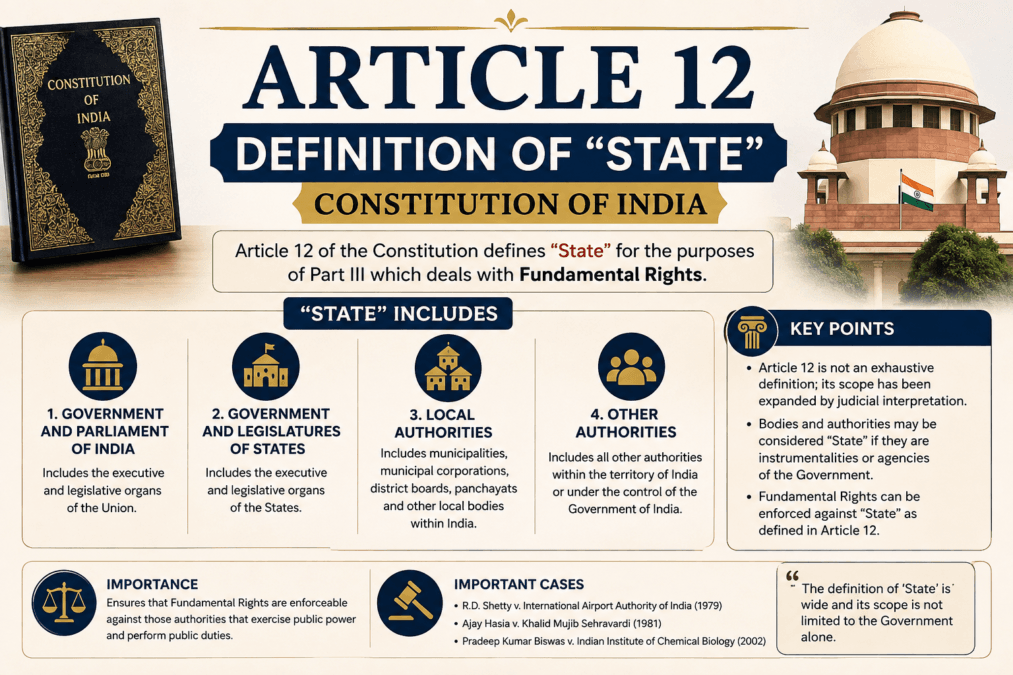
Article 12 — Definition of “State” Constitution of India
Article 12 of the Indian Constitution Subject: Constitutional Law | Module: Fundamental Rights — 1….
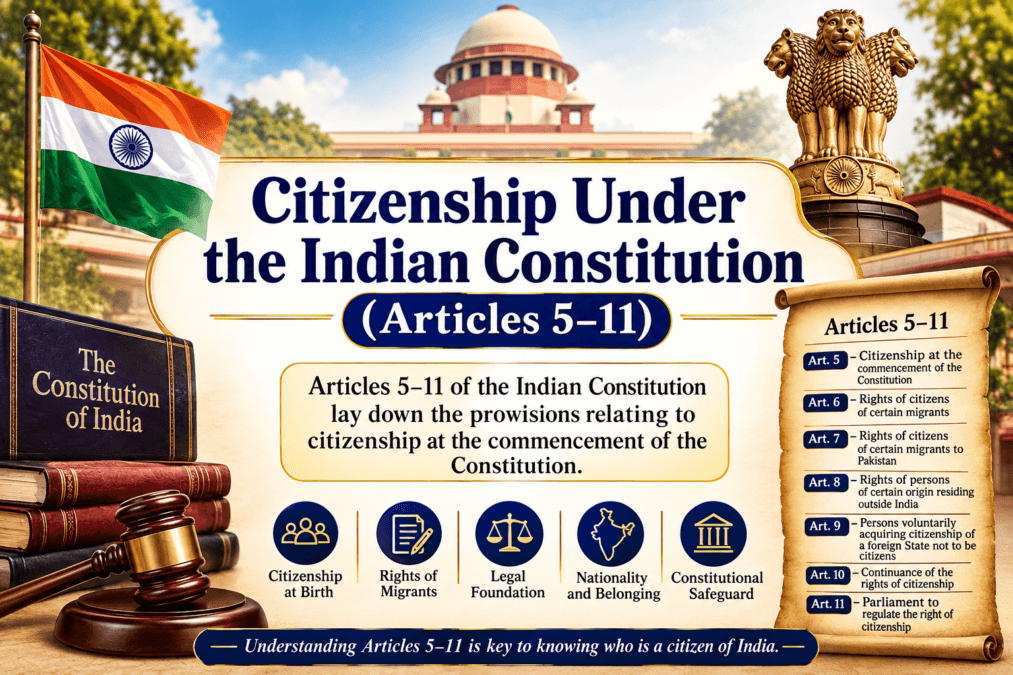
Citizenship Under the Indian Constitution (Articles 5–11)
Subject: Constitutional Law | Module: Citizenship | 1. Introduction Before anyone can claim a Fundamental…