
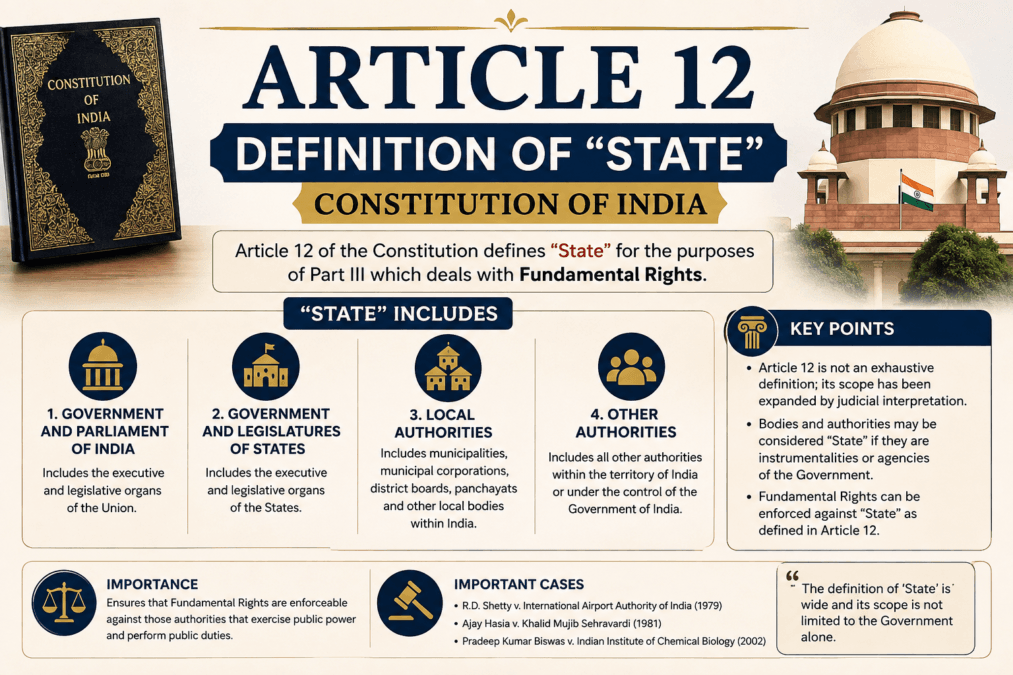
Article 12 of the Indian Constitution
Subject: Constitutional Law | Module: Fundamental Rights —
1. Introduction – Article 12 — Definition of “State”
Fundamental Rights in Part III are, for the most part, guarantees enforceable against the State — so before a citizen can claim a violation of, say, Article 14 or Article 19, one preliminary question has to be answered: is the body being sued actually “the State”? Article 12 answers exactly this. It doesn’t create any right by itself — it’s a definition clause, but one of the most litigated definition clauses in the entire Constitution, because governments increasingly act through corporations, societies, and autonomous bodies rather than government departments directly, and because courts have separately had to work out whether the judiciary itself counts as “State” when it acts.
2. Constitutional Text
Article 12: “In this Part, unless the context otherwise requires, ‘the State’ includes the Government and Parliament of India and the Government and the Legislature of each of the States and all local or other authorities within the territory of India or under the control of the Government of India.”
This is a definition for Part III (Fundamental Rights) — it tells you who can be sued for violating a Fundamental Right that is available only against the State.
3. Meaning — Breaking Down the Definition
Article 12 lists four categories:
- Government and Parliament of India — the Union executive and legislature.
- Government and Legislature of each State — the State executive and legislature.
- Local authorities — municipalities, panchayats, and similar bodies with governmental functions over a local area.
- Other authorities — within the territory of India or under the control of the Government of India.
The first three categories are relatively straightforward. The real litigation battlegrounds have always been the fourth (“other authorities”) and a separate question the text doesn’t address at all: whether the judiciary itself is “State.” Both are best understood as continuous, chronological stories built up case by case.
4. Stage 1 — The Early, Narrow Approach
1954 — University of Madras v. Shanta Bai, AIR 1954 Mad 67 → An early High Court decision that applied the principle of ejusdem generis — reading “other authorities” narrowly, as limited to bodies of the same kind as “Government,” “Parliament,” and “local authorities” (i.e., bodies exercising governmental/sovereign power). On this reasoning, a university was held not to be “other authority.” This narrow approach is historical only — it does not reflect the current, much broader test (see Stage 2 onward), but it’s worth knowing as the starting point courts eventually moved away from.
1962 — Ujjam Bai v. State of Uttar Pradesh, AIR 1962 SC 1621 → While primarily concerned with other constitutional questions (the scope of Article 32 relief against quasi-judicial orders), this case also touched on the meaning of “authority” under Article 12, contributing early groundwork to the discussion — its Article 12 relevance is modest compared to the landmark cases that followed, and it is mentioned here mainly for completeness rather than as an independently decisive authority.
5. Stage 2 — The Instrumentality or Agency Doctrine: Chronological Development
This is the heart of Article 12 case law — the doctrine was built up case by case, each decision expanding, refining, or limiting the one before it.
1967 — Rajasthan State Electricity Board v. Mohan Lal, AIR 1967 SC 1857; (1967) 3 SCR 377 — Landmark → The Supreme Court rejected the narrow ejusdem generis reading from Shanta Bai and held “other authorities” wide enough to include any authority created by statute, functioning within India or under the control of the Government of India — regardless of whether it performs sovereign/governmental functions, and regardless of whether some of its activities are commercial in nature. A statutory corporation (the Electricity Board) was accordingly held to be “State.” This was the first major expansion beyond a narrow literal reading, and remains a foundational authority relied on in later cases.
1975 — Sukhdev Singh v. Bhagatram Sardar Singh Raghuvanshi, AIR 1975 SC 1331; (1975) 1 SCC 421 — Landmark → Held that major statutory corporations — ONGC, LIC, and IFC — were “State” under Article 12, extending the Rajasthan Electricity Board approach to bodies discharging important public/statutory duties. This case began developing what would soon crystallise into the “instrumentality or agency” framework — looking at the degree of statutory power and government backing behind a body, not merely whether it was “created by statute.”
1979 — R.D. Shetty v. International Airport Authority of India, AIR 1979 SC 1628; (1979) 3 SCC 489 — Landmark → Justice P.N. Bhagwati laid down a set of indicative factors — government shareholding, financial assistance, monopoly status, deep governmental control, and public importance of functions — for identifying when a corporation is really a government “instrumentality or agency” in substance, even though it is technically a separate legal entity. The Court stressed that the legal/corporate form of a body is not decisive — what matters is the reality of government control behind that form. This was the direct precursor to the six-factor test below.
1981 — Som Prakash Rekhi v. Union of India, AIR 1981 SC 212; (1981) 1 SCC 449 — Important → Held that Bharat Petroleum Corporation Limited, a government company, was “State” — the Court found that its corporate form did not conceal the reality of extensive government ownership and control. This case reinforced the R.D. Shetty approach shortly before it was formally consolidated in Ajay Hasia — its contribution is best understood as an application and confirmation of the emerging doctrine, rather than an independent doctrinal shift.
1981 — Ajay Hasia v. Khalid Mujib Sehravardi, AIR 1981 SC 487; (1981) 1 SCC 722 — Landmark, Must Know → Consolidated the R.D. Shetty factors into the now-standard six-factor “instrumentality or agency” test:
- Whether the entire share capital is held by the government.
- Whether government’s financial assistance meets almost the entire expenditure of the body.
- Whether the body enjoys a monopoly status conferred or protected by the State.
- Whether there is “deep and pervasive” State control over its management and affairs.
- Whether the body’s functions are of public importance and closely related to governmental functions.
- Whether a department of Government has been transferred to the body.
The Court expressly held these factors to be illustrative, not a rigid mandatory checklist — no single factor is decisive, and it is not necessary that every factor be satisfied; courts weigh the cumulative effect of all relevant facts. This became the standard reference point for Article 12 questions for the next two decades.
6. Stage 3 — Consolidation: The “Deep and Pervasive Control” Standard
2002 — Pradeep Kumar Biswas v. Indian Institute of Chemical Biology, (2002) 5 SCC 111; AIR 2002 SC 1334 — Landmark, Most Important → A 7-judge bench overruled the narrower position in Sabhajit Tewary v. Union of India, (1975) 1 SCC 485 (which had earlier held the CSIR was not “State”), and refined the Ajay Hasia approach for the modern era. The Court held that CSIR is “State,” and clarified that the six Ajay Hasia factors are not six independent mandatory conditions to be checked off one by one — the real, unifying question is whether the body is cumulatively, financially, functionally and administratively dominated by, or under the control of, the Government, to a degree that is “deep and pervasive.” Mere regulatory control — the kind of oversight the government exercises over many private bodies through licensing or statutory compliance requirements — is not enough. → Sabhajit Tewary is worth remembering mainly because it was overruled — a good example of how a case can remain important in exam answers precisely for having been superseded.
7. Stage 4 — The Limits of Article 12: Private Bodies and Public Functions
2005 — Zee Telefilms Ltd. v. Union of India, (2005) 4 SCC 649; AIR 2005 SC 2677 — Landmark, Must Know → A 5-judge bench, by a 3:2 majority, applied and clarified the limits of the Pradeep Kumar Biswas test. The Board of Control for Cricket in India (BCCI) was held not to be “State” under Article 12 — despite its factual monopoly and immense public importance in Indian cricket — because it was not created by statute, and the government did not dominate its finances, functioning, or administration. Consequently, a writ petition against BCCI under Article 32 was not maintainable. → Crucially, the Court clarified that this does not mean BCCI is beyond all judicial review: because it performs certain public functions, it could still face writ jurisdiction under Article 226 before a High Court. This distinction — “not State under Article 12” is not the same as “immune from all judicial review” — is one of the most important takeaways from this stage of the doctrine.
2003 — Federal Bank Ltd. v. Sagar Thomas, (2003) 10 SCC 733 — Important → Distinguished a private bank (not “State” under Article 12, and not exercising a “public duty” of the kind that would attract writ jurisdiction) from bodies that are genuinely amenable to Article 226 because of the public character of their functions. Useful for showing that even the broader Article 226 “public function” test has its own limits — not every private commercial entity qualifies.
2005 — Binny Ltd. v. V. Sadasivan, (2005) 6 SCC 657 — Important → Clarified the distinction the Zee Telefilms footnote depends on: being “State” under Article 12 is a separate question from being amenable to writ jurisdiction under Article 226 because of public duties/functions. A body can fail the first test but still satisfy the second, if it performs functions of a public character.
2015 — K.K. Saksena v. International Commission on Irrigation and Drainage, (2015) 4 SCC 670 — Supporting → Further illustrates the Article 12/Article 226 distinction in the context of an autonomous, internationally-linked body — useful mainly as an additional, more recent example of courts applying the Zee Telefilms/Binny Ltd. distinction rather than as an independent doctrinal development.
8. Stage 5 — Is the Judiciary “State” Under Article 12?
This is a distinct and commonly misunderstood sub-question. The correct position is not a blanket “yes” or “no” — it depends on which function of a court is being exercised.
1963 — Prem Chand Garg v. Excise Commissioner, U.P., AIR 1963 SC 996 — Background → An early case supporting the proposition that even the Supreme Court’s own rule-making power (e.g., framing procedural rules) must be exercised consistently with Fundamental Rights. Its significance here is limited and specific: it helps frame the relationship between the non-adjudicatory powers of courts and Part III, rather than settling the broader question of whether judicial orders themselves are “State action.”
1966 — Naresh Shridhar Mirajkar v. State of Maharashtra, AIR 1967 SC 1; (1966) 3 SCR 744 — Landmark, Must Know → A 9-judge bench held that a judicial order of a superior court, made while deciding a case between parties (here, an oral order restricting publication of a witness’s testimony during a trial), is not amenable to challenge under Article 32 merely on the ground that it violates a Fundamental Right. The Court reasoned that a judicial decision, properly so called, only settles the dispute between the parties before it and does not constitute the kind of “State action” Article 32 is designed to check in the way legislative or executive action is. This is the foundational case distinguishing judicial adjudication from ordinary State action for Article 12/32 purposes, and later cases continue to rely on it.
1988 — A.R. Antulay v. R.S. Nayak, (1988) 2 SCC 602; AIR 1988 SC 1531 — Important → Applying the principle recognised in Mirajkar, the Court held that judicial proceedings of the Supreme Court itself are not subject to writ jurisdiction under Article 32 — since no Bench of the Supreme Court is “subordinate” to a larger Bench, a writ of certiorari cannot issue to correct the Court’s own judicial orders. Important accuracy note: Antulay did not overrule Mirajkar — it applied and extended the same underlying principle to the Supreme Court’s own proceedings; describing it as an “overruling” would misstate the relationship between the two cases.
2002 — Rupa Ashok Hurra v. Ashok Hurra, (2002) 4 SCC 388; AIR 2002 SC 1771 — Landmark, Must Know → A Constitution Bench, relying on Mirajkar and Antulay, confirmed that a final judgment/order of the Supreme Court cannot be challenged under Article 32 by an aggrieved person even after a review petition has been dismissed — reaffirming the finality of Supreme Court judgments against direct Article 32 attack. At the same time, recognising the need for a safety valve in cases of genuine miscarriage of justice, the Court created the “curative petition” — a narrow, carefully circumscribed remedy allowing the Supreme Court, in exercise of its inherent power, to reconsider its own final judgments in exceptional circumstances. This case remains the leading authority for both propositions.
2015 — Radhey Shyam v. Chhabi Nath, (2015) 5 SCC 423 — Important (Article 226/227 context) → A 3-judge bench, relying on the Mirajkar principle, held that judicial orders of civil courts are not amenable to writ jurisdiction under Article 226 in the same way administrative or quasi-judicial orders are — the correct remedy against such orders lies (where available) under the supervisory jurisdiction of Article 227, not through a writ of certiorari under Article 226. In reaching this conclusion, the Court overruled its earlier decision in Surya Dev Rai v. Ram Chander Rai, (2003) 6 SCC 675, to the extent that case had permitted Article 226 writs against civil court orders.
Putting Stage 5 together: Courts have consistently distinguished a judge’s adjudicatory function (deciding a dispute between parties) — which is not treated as ordinary “State action” reachable by a fresh Article 32/226 writ — from a court’s administrative, rule-making, or other non-judicial functions, which remain subject to constitutional scrutiny like any other exercise of public power. The correct exam-safe formulation is: “Judicial orders, in the exercise of adjudicatory power, are not independently challengeable as violating Fundamental Rights through Article 32; but courts remain bound by the Constitution in their non-adjudicatory functions, and errors in judicial orders are corrected through the ordinary appellate/review/curative hierarchy, not through a parallel writ challenge.”
9. Exceptions and Limitations
- Mere regulatory or supervisory control by the government (as opposed to control over a body’s very existence, finances and administration) is not sufficient to make it “State” under Article 12.
- A body found not to be “State” under Article 12 is not necessarily beyond judicial review altogether — it may still be amenable to writ jurisdiction under Article 226 if it performs public functions (Zee Telefilms, Binny Ltd.), even though Article 32 would not be available against it.
- A judicial order, made in the exercise of adjudicatory power, is not independently open to challenge as a Fundamental Rights violation through Article 32 (or, per Radhey Shyam, through Article 226 for civil court orders) — the correct route is appeal, review, or (exceptionally) a curative petition.
- The definition under Article 12 applies “for this Part” (Part III) — i.e., specifically for determining who can be sued under Fundamental Rights.
10. Important Distinctions
| Concept | Distinction |
|---|---|
| Article 12 “State” vs. General Meaning of “State” | Article 12’s definition applies specifically to Part III (Fundamental Rights); the ordinary/general meaning of “State” is different and used elsewhere in the Constitution |
| Article 32 vs. Article 226 (in this context) | Article 32 requires the respondent to be “State” under Article 12; Article 226 is broader and can reach certain private bodies performing public functions even if they are not “State” under Article 12 |
| Deep and Pervasive Control vs. Mere Regulation | Only the former makes a body “State”; ordinary regulatory oversight does not |
| Judicial (Adjudicatory) Function vs. Administrative/Rule-Making Function of Courts | The former is not independently challengeable as a Fundamental Rights violation via a fresh writ; the latter remains subject to ordinary constitutional scrutiny |
11. Practical Examples
- A government company where the State holds 100% of the share capital, funds nearly all its expenses, and closely supervises its board decisions would likely be “State” under Article 12 (per Ajay Hasia/Pradeep Kumar Biswas).
- A private sports federation that receives some government recognition but is not created by statute, not financially dependent on government funding, and manages its own affairs independently — like BCCI in Zee Telefilms — would likely not be “State” under Article 12, though it may still face writ scrutiny under Article 226 for its public functions.
- If a High Court, while deciding a civil suit, passes an order a litigant believes violates their Fundamental Rights, the correct remedy is appeal or revision — not a fresh writ petition under Article 32 treating the order itself as unconstitutional “State action” (Mirajkar; Radhey Shyam).
12. Current Legal Position
Settled:
- “Other authorities” under Article 12 covers bodies under deep and pervasive governmental control (Pradeep Kumar Biswas, 2002), assessed using the Ajay Hasia factors as illustrative indicators rather than a rigid checklist.
- Mere public importance of a body’s functions, without the requisite degree of State control, is insufficient (Zee Telefilms, 2005) — though such a body may still face Article 226 scrutiny.
- Judicial adjudicatory orders are not independently challengeable as Fundamental Rights violations via Article 32 (or, for civil courts, Article 226) — settled since Mirajkar (1966) and consistently applied through Antulay (1988), Rupa Ashok Hurra (2002), and Radhey Shyam (2015).
13. Ten-Point Quick Revision
- Article 12 defines “State” for the purposes of Part III (Fundamental Rights) only.
- Four categories: Union Government/Parliament, State Government/Legislature, local authorities, “other authorities.”
- Early approach (Shanta Bai, 1954): narrow, ejusdem generis reading — now only of historical interest.
- Rajasthan Electricity Board (1967): first broad reading — any statutory authority qualifies.
- R.D. Shetty (1979) → Ajay Hasia (1981): six-factor “instrumentality or agency” test, illustrative not exhaustive.
- Pradeep Kumar Biswas (2002): 7-judge bench; overruled Sabhajit Tewary; “deep and pervasive control” is the touchstone.
- Zee Telefilms (2005): BCCI held not “State” (3:2 majority) — but still open to Article 226 scrutiny (see also Binny Ltd., Federal Bank).
- Mere regulatory oversight ≠ deep and pervasive control.
- Judiciary is not automatically “State” for every purpose — adjudicatory orders are shielded from direct Article 32/226 challenge (Mirajkar, Antulay, Radhey Shyam), but courts remain bound by the Constitution in their non-adjudicatory functions.
- Rupa Ashok Hurra (2002): created the narrow “curative petition” safety valve against final Supreme Court judgments.
14. Practice Questions
- Explain the “instrumentality or agency” test and trace its development from R.D. Shetty to Pradeep Kumar Biswas.
- Why was BCCI held not to be “State” under Article 12 in Zee Telefilms v. Union of India? Does this mean BCCI is completely beyond judicial review?
- “The judiciary is State under Article 12.” Critically examine this statement with reference to Naresh Shridhar Mirajkar and Radhey Shyam v. Chhabi Nath.
- Introduction to the Constitution of India
- Preamble to the Constitution
- Salient Features of the Constitution
Free conceptual/revision note — full previous-year question bank read AspirixWriters Law Success Series.
FAQs
Are statutory corporations considered State under Article 12?
A statutory corporation may be considered “State” if it satisfies the relevant constitutional tests developed by the Supreme Court. The mere fact that an organisation is called a corporation is not, by itself, decisive.
Is a government company considered State under Article 12?
A government company may fall within Article 12 depending on factors such as government ownership, financial control, administrative control, public functions and the overall relationship with the Government. The determination depends on the facts of each case.
Is the judiciary included in “State” under Article 12?
The judiciary requires an important distinction. Judicial decisions made while adjudicating disputes are generally not treated as ordinary “State action” that can be directly challenged under Article 32 merely by alleging violation of a Fundamental Right. However, courts remain subject to constitutional requirements when performing administrative or other non-judicial functions.
Is the Supreme Court considered State under Article 12?
The Supreme Court’s judicial orders are not ordinarily treated as “State action” for a fresh Article 32 challenge. However, this should not be understood to mean that the judiciary is completely outside constitutional scrutiny; its non-judicial functions remain subject to constitutional limitations.
What is the “instrumentality or agency of the State” test?
The Supreme Court has developed tests to determine whether a body is effectively an instrumentality or agency of the Government. Factors may include government ownership, financial assistance, deep and pervasive government control, public functions and other circumstances showing substantial governmental involvement.
Which case expanded the meaning of “State” under Article 12?
Rajasthan State Electricity Board v. Mohan Lal (1967) is an important early decision that gave a broad interpretation to the expression “other authorities” under Article 12.
What is the importance of R.D. Shetty v. International Airport Authority of India?
R.D. Shetty v. International Airport Authority of India is an important case concerning whether a body can be regarded as an instrumentality or agency of the State under Article 12. The Court identified several relevant factors for determining governmental character.
Is LIC a State under Article 12?
Yes. The Supreme Court has treated LIC as “State” under Article 12. The case of Sukhdev Singh v. Bhagatram Sardar Singh Raghuvanshi is an important authority in this area.
Is ONGC a State under Article 12?
Yes. ONGC has been recognised as “State” under Article 12 in Supreme Court jurisprudence concerning statutory corporations and government instrumentalities.
Can a private company be considered State under Article 12?
A private company is not automatically “State” merely because it performs some public or important function. Whether a body falls within Article 12 depends on the applicable constitutional tests and the nature and extent of governmental involvement.
What is the difference between Article 12 and Article 226?
Article 12 defines “State” for Part III, while Article 226 gives High Courts power to issue writs for enforcement of Fundamental Rights and for other purposes. Therefore, the scope of Article 226 is wider than the Article 32 remedy in important respects.
Can Fundamental Rights be enforced against private individuals?
Some Fundamental Rights operate directly against private persons in specific circumstances, depending on the constitutional provision. Therefore, it is not correct to say that all Fundamental Rights can be enforced only against the “State.”
What is the difference between Article 12 and Article 13?
Article 12 defines “State”, while Article 13 deals with laws inconsistent with or in derogation of Fundamental Rights. Together, they form an important part of the constitutional framework for protecting Fundamental Rights.