
Nature of Jurisprudence
Introduction
Jurisprudence Complete Notes
Meaning and Definition of Jurisprudence
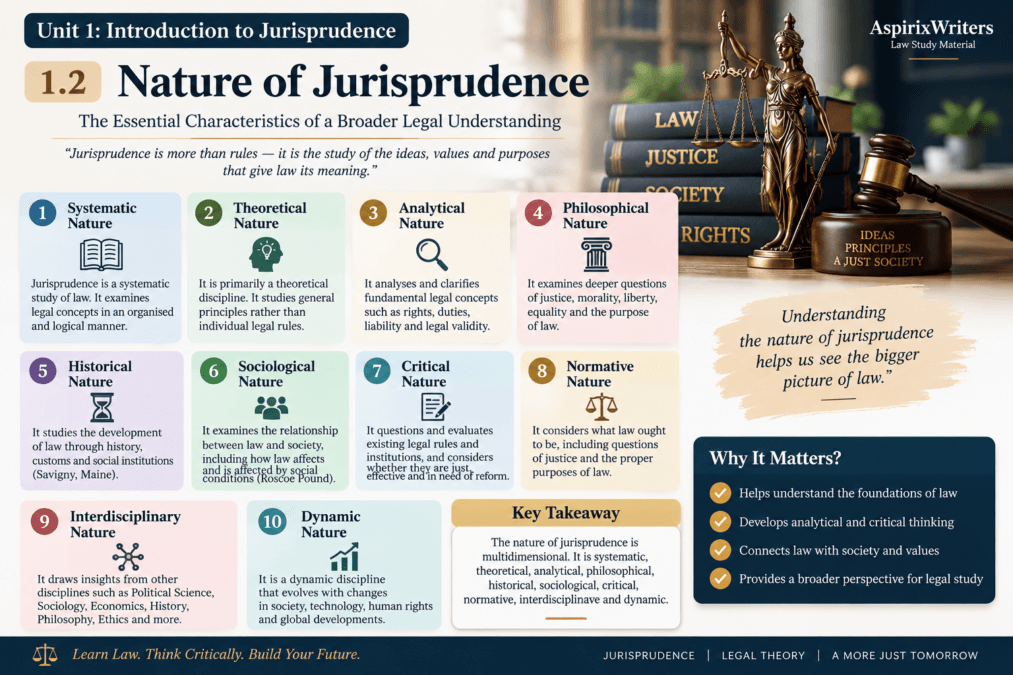
The nature of jurisprudence refers to the essential characteristics of jurisprudence and the manner in which it studies law. Jurisprudence is not simply the study of legal rules. It examines the fundamental concepts, principles, foundations and purposes of law.
Its nature is broad because different schools of jurisprudence approach law from different perspectives.
1. Systematic Nature
Jurisprudence is a systematic study of law. It examines legal concepts in an organised and logical manner.
It studies concepts such as:
- Rights
- Duties
- Liability
- Ownership
- Possession
- Justice
- Legal obligation
2. Theoretical Nature
Jurisprudence is primarily a theoretical discipline. It studies general principles rather than concentrating only on individual legal rules.
For example, instead of studying only a particular rule relating to ownership, jurisprudence asks:
What is ownership?
3. Analytical Nature
Jurisprudence analyses and clarifies fundamental legal concepts.
The Analytical School, particularly thinkers such as John Austin and later H. L. A. Hart, examines the structure and nature of law.
Questions may include:
- What is law?
- What is a legal right?
- What is a legal duty?
- What makes a rule legally valid?
4. Philosophical Nature
Jurisprudence has an important philosophical dimension. It considers questions relating to:
- Justice
- Morality
- Liberty
- Equality
- Rights
- Authority
- Legal obligation
For example:
Is an unjust law still law?
Such questions demonstrate the philosophical nature of jurisprudence.
5. Historical Nature
The Historical School of Jurisprudence examines the development of law through history, customs and social institutions.
Thinkers such as Savigny and Henry Maine contributed significantly to historical approaches to jurisprudence.
This approach helps explain how legal institutions and concepts have developed over time.
6. Sociological Nature
Jurisprudence also studies the relationship between law and society.
The Sociological School examines:
- How law affects society
- How society influences law
- The social purposes of law
- The effectiveness of legal rules
Roscoe Pound is closely associated with the concept of social engineering, under which law seeks to balance competing social interests.
7. Critical Nature
Jurisprudence does not merely accept existing law. It can critically examine whether laws are:
- Logical
- Just
- Effective
- Socially desirable
- In need of reform
This encourages students to think beyond the literal wording of legal rules.
8. Normative Nature
Some approaches to jurisprudence consider what law ought to be, rather than merely describing what existing law is.
Normative questions include:
- What is a just law?
- What should the law protect?
- When is punishment justified?
- What limits should exist on State power?
However, jurisprudence is not exclusively normative; different schools adopt different approaches.
9. Interdisciplinary Nature
Modern jurisprudence is connected with several other disciplines, including:
- Political Science
- Sociology
- Economics
- History
- Philosophy
- Ethics
- Psychology
- Criminology
- Technology
For example, questions concerning Artificial Intelligence and law may involve legal, technological, ethical and social considerations.
10. Dynamic Nature
Jurisprudence is a dynamic discipline because law and society continuously change.
Modern developments in:
- Artificial Intelligence
- Data protection
- Human rights
- Environmental law
- Digital technology
- Globalisation
create new jurisprudential questions.
Thus, jurisprudence continues to evolve with changing social and legal conditions.
Quick Revision Table
| Nature | Main Idea |
| Systematic | Organised study of legal concepts |
| Theoretical | Studies general principles |
| Analytical | Analyses legal concepts |
| Philosophical | Examines justice and morality |
| Historical | Studies development of law |
| Sociological | Studies law and society |
| Critical | Evaluates existing law |
| Normative | Considers what law ought to be |
| Interdisciplinary | Connects law with other disciplines |
| Dynamic | Evolves with society and law |
Easy Way to Remember
Jurisprudence is:
Systematic + Theoretical + Analytical + Philosophical + Historical + Sociological + Critical + Normative + Interdisciplinary + Dynamic
One-Line Revision
Jurisprudence is a broad, systematic and evolving discipline that studies law, its concepts, principles, foundations and relationship with society.
Examination Questions
Long Answer
- Explain the nature and characteristics of jurisprudence.
- Discuss the analytical, philosophical, historical and sociological nature of jurisprudence.
- Why is jurisprudence considered an interdisciplinary and dynamic discipline?
- Is jurisprudence a science or a philosophy? Discuss.
Short Answer
- What is the nature of jurisprudence?
- Why is jurisprudence called a theoretical discipline?
- What is the sociological nature of jurisprudence?
- What is meant by the normative nature of jurisprudence?
- Why is jurisprudence considered dynamic?
Conclusion
The nature of jurisprudence is multidimensional. It is systematic, theoretical and analytical, while also having philosophical, historical, sociological, critical, normative and interdisciplinary dimensions.
Therefore, jurisprudence provides law students with a broader understanding of what law is, how it works, why it exists and how it relates to society.
Explore
Don’t Miss New Law Opportunities!
Join our WhatsApp community for verified updates on Law Jobs, Internships, Competitions, Scholarships, LLB Notes & more.
About the Author: Dr. Rekha Khandelwal is a Ph.D. in Law and experienced legal educator, researcher, and academic writer specializing in law, legal research, and AI governance. [Read Full Author Profile →]
Explore more –
✔ Professional Writing Services
Classmate Pulse Spiral Notebook ✏️ Need a Spiral Notebook for Everyday Writing? A spiral notebook…

Latest Scholarships & Fellowships 2026–27: Open Opportunities for Upcoming call
Latest Scholarships & Research Fellowships 2026–27 Last Verified: 30 September 2026 Students, researchers, PhD scholars…
Writing & Research Resources: Useful Books, Tools & Essentials for Writers and Researchers
Whether you are an author, content writer, law student, academic researcher, PhD scholar, teacher, or…